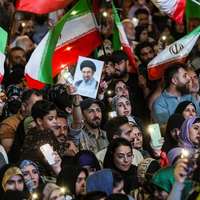
An Iranian flag is raised during a state-organized ceremony at Tehran's Azadi Square commemorating the country's slain Supreme Leader, July 24, 2026
President Donald Trump’s increasingly explicit threats of a wider Iran war have fueled anxiety and speculation inside the country, as analysts and social media users debate whether the conflict is approaching a more destructive and unpredictable phase.
On Friday, Trump met his top advisors to discuss the possible escalation but later told reporters he had not yet decided whether to launch major new strikes. He at the same time warned that the US military is “locked and loaded” to escalate the campaign.
His comments came one day after he told Axios he was considering launching a military strike on Iran "larger than all previous attacks" and that he was close to making a decision.
Inside Iran, however, the focus quickly shifted from Trump's words to what they might signal.
International affairs analyst Amir-Ali Abolfath drew parallels with the opening hours of the war.
"I have the same feeling I had on the night of February 28th before the major attack," he wrote. "It may not happen tomorrow, but if the current trajectory continues, another day like that—or an even bigger one—could lie ahead."
Another widely shared post by X user Tohid Javadi reflected similar anxiety.
"All the signs point to extensive bombing of Iran in the coming hours and days. Unless Iran fully surrenders, this situation will continue."
Military exchanges widen
The speculation was reinforced by another night of military exchanges.
US Central Command carried out strikes mainly across southern Iran targeting military installations, logistics facilities and air defense systems.
Iran, meanwhile, continued attacks on US positions in Kuwait, Bahrain, Jordan and Iraq's Kurdistan Region.
The Islamic Revolutionary Guard Corps (IRGC) claimed it had struck a US base in Kuwait as well as an Amazon data centre in Bahrain, alleging the facility had provided intelligence support to the US military.
Iran's army also claimed attacks on Isa Air Base in Bahrain and Al-Azraq Air Base in Jordan.
In a separate statement, the IRGC urged civilians in those countries to remain at least 500 metres away from potential Iranian targets.
Social media activist Hatef Salehi argued that the scale of the American military buildup suggested Washington was preparing for more than coercive diplomacy.
"This enormous military buildup and deployment of advanced US equipment to the region is highly unlikely to be merely psychological or diplomatic pressure on Iran."
War or pressure campaign?
Not everyone believes the latest escalation points to an imminent regional war.
Political analyst Amin Shayegan argued that the confrontation remains "more a contest of endurance than a purely military competition."
According to Shayegan, Washington is attempting to gradually erode Iran's military and economic capabilities, while Tehran is seeking to tie the costs of the conflict to global energy markets and international trade in an effort to alter US calculations.
Diplomatic activity has added another layer of uncertainty.
Britain announced the withdrawal of all its diplomats from Tehran, while reports circulated that US military aircraft had departed British air bases for operations related to Iran.
Iranian media also reported that French and German diplomats had left Tehran. France's embassy denied those reports, while the German embassy told Iran International that it remained open but was currently providing limited consular services.
Attention also focused on the arrival of an Omani delegation in Tehran.
Officially, IRNA said the visit concerned coordination of shipping management in the Strait of Hormuz. But Oman has long served as the principal intermediary between Tehran and Washington, prompting widespread speculation online that Muscat could also be carrying messages related to the rapidly escalating conflict.
Some users interpreted the visit as a final warning before a larger US military operation, while hardline commentators instead portrayed it as another attempt to revive negotiations—an outcome they argued Tehran should reject.
File ohoto shows a police officer standing inside a café in Tehran during an inspection.
Several cafés in central Tehran have been shut down after authorities renewed pressure over compulsory hijab, days after senior clerics called for stricter enforcement and weeks after the government briefly tolerated looser dress code during wartime pro-establishment gatherings.
Café owners describe a renewed campaign against businesses associated with a different urban lifestyle.
Among the cafés forced to close in recent days were some located along Tehran's central streets. Some had previously been shuttered over allegations they failed to enforce Iran's compulsory hijab rules.
The latest wave followed public appeals by Friday prayer leaders for tougher action.
“The situation regarding hijab in society is not acceptable,” Mohammad Reza Naseri, the Friday prayer imam of Yazd, said on July 17, urging officials and cultural institutions to confront what he described as “corruption and indecency.”
In the northern city of Rasht, Friday prayer imam Rasoul Falahati praised pro-government nighttime gatherings and argued that confronting what he called “organized unveiling” should also involve public participation. Falahati urged the government and parliament to fully implement Iran's hijab law.
Days later, café owners in central Tehran found their businesses sealed.
'They saw us as the odd ones out'
The owner of a café on Sanaii Street in Tehran, which was closed on July 20, told Iran International that unusual pressure had built over recent weeks, saying organizers of nighttime gatherings appeared to view cafés such as his as incompatible with the atmosphere they wanted to create.
According to the owner, plainclothes men carrying radios and firearms visited the café twice in the days before the funeral of Ali Khamenei, the slain leader of the Islamic Republic, describing the business, its staff and customers as “a stain of shame” and “the enemy's foot soldiers.”
“One of them said our city was preparing for the funeral of the leader, yet you are here engaged in pleasure, music and corruption,” the owner recalled.
He said he warned employees that closure appeared imminent.
A young woman who managed the dining area at another shuttered café on the same street said rumors of inspections had circulated the previous day, but the conduct of officials still came as a shock.
“The way they stormed in and behaved was so aggressive and disrespectful that everyone was stunned,” she said. “Some colleagues did not even have time to collect their personal belongings before the café was closed.”
Wartime images told a different story
The closures stand in sharp contrast with scenes seen only weeks earlier.
During the 40-day war and its aftermath, women without compulsory hijab appeared openly at pro-establishment nighttime gatherings and at Ali Khamenei's funeral. State media interviewed some of them, and their images appeared in official coverage.
Women gather at a café in Tehran. Cafés have become important social spaces for young Iranians, but several venues in the capital were recently closed. (File photo)
Religious singers also adopted a noticeably different tone.
“A woman with loose hijab who has come to the square is the light of our eyes and the daughter of our country,” one speaker said during a gathering.
The imagery contrasted with years of rhetoric from parts of Iran's political and religious establishment portraying women who reject compulsory hijab as posing an ideological challenge to the Islamic Republic.
The difference appeared less a change in official thinking on compulsory hijab than a reflection of changing political priorities. At a moment when authorities sought to project national unity and broad public participation, women with different styles of dress became part of the official narrative. As that period faded, so did the visible tolerance.
The pattern extended beyond dress.
State media also featured rappers performing songs supporting the system and Iran's armed forces, despite rap music facing years of official restrictions and criticism.
The contrast illustrated a broader pattern. Different forms of dress, music or cultural expression appeared acceptable when reinforcing an official political message but faced restrictions once they existed outside that framework.
Pressure spreads beyond Tehran
The closures in central Tehran form part of a broader campaign affecting businesses across Iran.
On May 19, the historic Ameri House hotel complex in the central city of Kashan was closed over what authorities described as failure to observe mandatory hijab rules.
On June 15, the judiciary's Mizan news agency reported that prosecutors ordered a Tehran café closed and opened a criminal case against its managers after images circulated online from an event authorities said violated legal and religious standards.
The campaign expanded elsewhere.
On July 2, the public prosecutor of Kohgiluyeh County announced the closure of 10 cafés and teahouses in Dehdasht for allegedly failing to observe religious standards.
Less than three weeks later, the Mohseni Mansion, a restored historic Qajar-era property operating as a hotel and restaurant in the southern city of Behbahan, was shut over what officials described as optional hijab among some customers and the playing of music.
A customer smokes a cigarette inside a café in central Tehran. (File photo)
Authorities in Lorestan, Ardebil and Aran va Bidgol have also announced closures of businesses over accusations including unveiling, failure to observe Islamic standards, moral violations.
Competing accounts
Officials and business owners offer different explanations for the closures.
Tasnim News Agency, which is affiliated with the Islamic Revolutionary Guards Corps, rejected suggestions that the cafés had been targeted over morality enforcement. The businesses, it said, were closed solely because of licensing and trade violations and that the action had “no connection” to moral security.
They describe earlier warnings, visits by plainclothes personnel, scrutiny of customers' clothing and growing pressure surrounding the atmosphere inside their businesses. Their accounts differ sharply from the official explanation and leave unanswered questions about the principal reason behind the closures.
For many owners, the consequences extend beyond politics. Many cafés had already struggled amid economic stagnation, falling purchasing power, internet disruptions and a sharp decline in customers. Sudden closure leaves employees without wages, rent unpaid and businesses facing taxes and debts despite being unable to operate.
Iranian lawmakers raise fists and wave red “revenge” flags during a parliamentary session in Tehran, beneath a portrait of slain Supreme Leader Ali Khamenei, July 14, 2026
The surge in oil prices appears to be hardening Tehran's resolve against renewed negotiations with Washington, giving ammunition to those who argue that a prolonged conflict puts more pressure on the United States than on Iran.
The shift comes as Brent crude climbed above $100 a barrel for the first time in two months after Iran-aligned Houthi attacks expanded maritime tensions from the Strait of Hormuz to the Bab al-Mandab Strait, raising fears of broader disruption to Middle Eastern energy exports.
US President Donald Trump this week warned that the United States would destroy Iranian bridges or power plants in response to attacks on shipping in the Strait of Hormuz.
He later blamed Tehran for Houthi attacks on commercial vessels in the Red Sea, saying any further assaults would trigger an "extremely severe" US response against both the Houthis and Iran.
Amid the escalating threats, Brent crude surged 6% on Thursday, climbing back above $100 a barrel for the first time in two months.
Tehran sees leverage
Iranian officials increasingly portrayed the price rally as evidence that insecurity around the Strait of Hormuz and the Bab al-Mandab had strengthened Tehran's negotiating position.
"The equation of this war is clear: either everyone or no one," Parliament Speaker and Iran's chief negotiator Mohammad-Bagher Ghalibaf wrote on X. "In a region where we cannot sell oil, no one will sell oil. If our security is not guaranteed, no infrastructure will remain safe."
He later added: "They wanted to punish Iran. Punished themselves with triple-digit oil instead."
Mohammad Mokhber, an adviser to Supreme Leader Mojtaba Khamenei, argued that the latest rally reflected disruptions to transportation rather than production, implying prices could climb much higher if energy infrastructure itself came under attack.
"Oil at $100 is, so far, merely the result of disruptions in transportation, not production. The fire the United States is igniting in the region's oil and gas fields will eventually engulf the entire world."
Ali Akbar Velayati, another senior adviser to Mojtaba Khamenei, likewise warned that "the illusion of striking Iran at low cost" could have consequences extending well beyond the battlefield to global energy markets.
Talks lose momentum
The more confident tone in Tehran coincided with signs that diplomacy was stalling.
According to Axios, citing two regional sources familiar with mediation efforts, Iran's leadership rejected the latest proposal presented through intermediaries.
"We're trying, but the Iranians are not cooperating," one source told the outlet.
Trump also acknowledged that negotiations had made little progress, saying Tehran wanted to negotiate but had not "suffered enough yet."
Conservative Iranian media and hardline commentators argued that soaring oil prices had renewed Washington's interest in diplomacy and urged Tehran to resist returning to the negotiating table while economic pressure on the United States and its partners continued to build.
Following its announcement of attacks on US facilities in Kuwait, the Islamic Revolutionary Guard Corps (IRGC) declared that Washington "must pay the price for breaking its commitments" and vowed not to allow the United States to use "deceptive ceasefires" to replenish military supplies and strategic reserves before resuming hostilities.
The statement accused Washington of seeking negotiations only after being "defeated on the battlefield."
Hardline commentator Hamid Moghaddam similarly argued that renewed American interest in diplomacy reflected the surge in oil prices and urged Iranian negotiators to hold their position.
Another hardline commentator wrote that unless households in the West began to feel the economic consequences of the conflict, the United States and Israel "would have no hesitation in turning Iran into another Libya or Gaza."
Former Israeli intelligence officer Danny Citrinowicz questioned whether Trump's increasingly forceful warnings would alter Tehran's calculations.
"The Houthis are not going to stop attacking, just as Iran is not going to stop supporting them," he said.
"These threats are unlikely to change behavior in either Sana'a or Tehran. If anything, repeated ultimatums that are not enforced risk highlighting the limits of American deterrence."
An Iranian cleric visiting the Islamic Revolutionary Guard Corps Aerospace Force Museum in Tehran, November 2025
President Donald Trump’s threat to strike Iran’s Pickaxe Mountain nuclear-linked facility has intensified hardline calls for Tehran to withdraw from the Nuclear Non-Proliferation Treaty and develop a nuclear weapon.
The debate gained fresh momentum after Trump warned Tuesday that the United States would target the deeply buried facility, known in Persian as Mount Kolang Gaz La, if Iran sought to restore its nuclear program there.
Advocates of this view argue that the recent wars demonstrated that conventional military capabilities alone no longer provide sufficient deterrence, making a nuclear option increasingly necessary. Others stop short of openly advocating nuclear weapons but argue that Iran should at least leave the NPT in response to growing US threats.
The arguments echo comments made by Fereydoun Abbasi, the former head of the Atomic Energy Organization of Iran and a politician closely associated with Saeed Jalili’s hardline camp, months before he was killed in Israeli strikes during the 12-day war in June 2025.
In January 2025, Abbasi argued that under the new security environment, “the dangers of not building a bomb and lacking strong deterrence are far greater than the costs of acquiring it,” warning that weak deterrence would only encourage direct aggression.
Abbasi also maintained that Iran had long ago crossed the scientific and technical threshold required to build a nuclear weapon, arguing that the remaining obstacle was no longer technical but rather “a strategic decision.”
In his view, when threats from Israel and its allies become existential, missile deterrence and reliance on regional allies are no longer sufficient, leaving the country increasingly vulnerable without a nuclear deterrent.
Social media campaign targets negotiating officials
Many hardline social media users now argue that Iran should build a nuclear bomb as quickly as possible. They have also criticized officials they describe as “eager for negotiations”—including President Masoud Pezeshkian, Parliament Speaker Mohammad-Bagher Ghalibaf and Foreign Minister Abbas Araghchi—for failing to put withdrawal from the NPT on the government’s agenda.
One X user writing under the name Ayyar reacted to Foreign Ministry spokesman Esmaeil Baghaei’s statement that Iran remained committed to the NPT.
“Just hours after Baghaei declared that Iran is still a member of the NPT, Trump threatened to bomb the Pickaxe Mountain nuclear facility,” the user wrote. “They killed the country’s leader along with thousands of Iranians and repeatedly struck our nuclear facilities. What exactly must the enemy do before we leave the NPT? Are you asleep?”
Another user, writing under the name Sam, argued: “Why are we afraid of leaving the NPT? Afraid of a global consensus against Iran? Staying in the treaty hasn’t prevented that. We have no choice but to build nuclear weapons for comprehensive deterrence. Nuclear weapons could be the final answer.”
Another account, Seyed Mehrdad, wrote: “The answer to a nuclear threat is not threatening regional infrastructure. Deterrence lies in leaving the NPT and conducting a live nuclear test.”
Other users argued that Iran should not remain without nuclear weapons if countries such as Turkey or Saudi Arabia eventually acquire them, insisting that “missile power alone cannot guarantee deterrence.”
Another post claimed that nuclear-capable bombers would not threaten Iran if the country already possessed nuclear weapons, reflecting a broader argument among hardliners that only an atomic arsenal could prevent further US or Israeli attacks.
Debate spreads beyond social media
The discussion has also spread into conservative media. On June 28, the IRGC-affiliated Fars News Agency published an opinion piece titled “There Is No Alternative but to Build an Atomic Bomb,” arguing that Iran required nuclear deterrence to secure the “peace of mind” necessary to resolve other disputes through negotiations.
Fars later clarified that the article had appeared in its interactive opinion section and did not represent the agency’s official editorial position.
Other conservative outlets, including Kayhan, and hardline members of parliament have generally avoided explicitly endorsing nuclear weapons. They have, however, increasingly referred to concepts such as “redefining deterrence,” “reviewing nuclear commitments” and “revising the country’s defense doctrine.”
Calls for NPT withdrawal intensify
Trump’s latest warning against Pickaxe Mountain has also prompted some conservative figures to publicly raise the possibility of leaving the NPT.
Political analyst Mohammad Hossein Khoshvaght, who has close ties to the late supreme leader’s family, questioned whether conventional responses to US attacks would simply encourage further aggression, asking whether such a cycle could continue “until Iran is brought down.”
Former senior Revolutionary Guards commander Ghorbanali Salavatian urged Iranian authorities to formally notify international organizations that Iran would withdraw from the NPT if the United States attacked Pickaxe Mountain.
He added that such a withdrawal should occur “without delay” if an attack took place.
Khamenei’s fatwa returns to focus
The debate has also reopened questions surrounding the religious prohibition on nuclear weapons issued by the late Supreme Leader Ali Khamenei.
Following Khamenei’s death, some social media users argued that Mojtaba Khamenei, as the new supreme leader, should revoke or revise his father’s fatwa declaring nuclear weapons religiously forbidden in light of the changed security environment.
One user wrote in March that because Ali Khamenei was no longer a living source of emulation, his fatwa was no longer binding. The user described the pursuit of nuclear deterrence as “a national demand and the right of the Iranian people.”
The issue had already surfaced in September 2025, when 70 members of parliament argued that Khamenei’s previous ruling should be changed or reinterpreted and demanded authorization for the development and possession of an atomic bomb to establish “nuclear deterrence.”
The lawmakers argued that while the use of nuclear weapons could remain religiously forbidden, producing and possessing them solely for deterrence should be treated differently.
Official position remains unchanged
Before Ali Khamenei’s death, Iranian officials and nuclear negotiators consistently maintained that his fatwa was a permanent religious ruling rather than a temporary political decision.
According to their interpretation, not only the production and use of nuclear weapons but even their possession solely for deterrence is forbidden under Islamic law. They argued that Iran’s deterrence should instead rest on missile capabilities, technological advances and human capital.
Under Shiite jurisprudence, however, a new marja, or source of emulation, may issue rulings that differ from those of his predecessors.
Araghchi acknowledged this possibility in an interview with Al Jazeera in April, saying any change to the nuclear fatwa would depend on the position adopted by Iran’s new supreme leader.
For now, the government’s formal position remains unchanged. Baghaei said Monday that Iran remained a member of the NPT and recognized its obligations under the treaty, although he added that Tehran continually reviewed its foreign policy and national security options.
Baghaei also said Wednesday that no nuclear activity was taking place at Pickaxe Mountain, accusing Washington of using the site as a “fabricated pretext” for further attacks and sabotage.
People talk and work at Nook Cafe in Tehran, Iran in this file photo from September 2024
The latest round of café closures in Tehran is a reminder to ordinary Iranians that wartime or otherwise, those in power still decide how much space they are allowed to occupy.
On Sunday morning, authorities sealed several well-known cafés on Sanaei Street in central Tehran, with reports of similar closures in nearby Iranshahr. Among them were Dobar, 1401, Sam Café, Jo Café and Café Man.
The website Emtedad reported that each café was given a different explanation. Some were told it was because of hijab. Others because they served sandwiches. Others because they had chairs on the pavement.
The variety of reasons almost felt more revealing than any single one.
Hamed, who manages one of the affected cafés, says staff had already been warned that officials would come to seal the premises before inspectors even arrived.
"They told us they were coming," he says. "Now I'm trying to work out how we're supposed to pay wages, rent and everything else. First there was the war. Now this. Every few weeks there's another blow for small businesses and ordinary people."
The official explanations seemed almost secondary. The decision, many felt, had already been made.
Sanaei has become a familiar place in these dispatches because it represents something increasingly scarce in Tehran: a refuge. Its cafés are not cheap, often more expensive than many young people can comfortably afford. Yet they remain full. Students spend hours over a single coffee. Couples linger. Friends argue about politics, music and migration.
After weeks of war, blackouts and an internet that barely functioned, the street had slowly begun to feel alive again. For a few weeks, Sanaei almost felt like itself again. That, many people now believe, was precisely the problem.
Shiva, 33, who regularly meets friends there, says cafés are more than businesses. They are among the last places where the city still feels like a city.
"The war could have brought people together," she says. "Instead, it feels as though they're using its aftermath to settle scores with people they don't see as loyal."
Whether that is the authorities' intention is impossible to know. What is striking is how many people independently reached almost the same conclusion.
Many believe the authorities fear respite almost as much as dissent. When a city begins to relax, people gather, talk, laugh and slowly reclaim public life. Moments like Sunday's, they believe, are periodic reminders that no part of that life exists beyond the state's reach.
Ladan, a 28-year-old nurse who rarely visits Sanaei anymore because cafés have become too expensive, nevertheless took the closures personally.
"It almost feels as though someone decided the war hadn't put enough pressure on people," she says. "So they went after the places where people still gathered. It's difficult not to feel that ordinary life itself has become the target."
That helps explain why the closures provoked such bitterness. It was not the inconvenience, but the contempt. Many people felt that after months of war, inflation, blackouts and uncertainty, the authorities' instinct was still not to ask what society needed, but to remind society who remained in charge.
The Islamic Republic has already lost many of the social battles it once fought so fiercely, at least in Tehran. Compulsory hijab is openly challenged. Young men and women mix freely. Cafés remain among the few places where a generation battered by protests, repression and war can still carve out something resembling an ordinary life.
But losing the social argument is not the same as losing the power to enforce it. That may be the real message behind Sunday's closures: not that chairs on the pavement or sandwiches suddenly became intolerable, but that almost any pretext can be enough to take away a business, a meeting place or simply somewhere people had begun to feel at ease.
Hamed shrugs when asked whether the cafés will eventually reopen.
"They probably will," he says. "But that's not really the point anymore."
Perhaps he is right. After everything people have lived through, the instinct of those in power still seems to be not to give society a little more room to breathe, but to remind it that even breathing remains a privilege, not a right.
A view the panel at Iran International town hall in Washington, DC (July 2026)
The US may be peeling away layers of Iran's leadership, but without a plan for what comes next, bombing the coast and seizing islands cannot reach the problem in Tehran, and risk delivering an IRGC takeover rather than real change, experts said at an Iran International town hall.
The panel, held at Iran International's Washington headquarters and moderated by Fardad Farahzad, brought together Michael Rubin of the American Enterprise Institute, Ilan Berman of the American Foreign Policy Council, and Iranian-American analyst Fereshteh Pezeshk.
The discussion came amid renewed US strikes, with attacks tearing through bridges and infrastructure across Iran's south.
Is Washington heading for a ground operation?
The question hanging over the room was whether the air campaign is a prelude to something larger. Rubin framed the choice in stark terms.
"When you have a hornet's nest, you have two good options. One is to leave it alone. The other one is to get rid of it," he said. "The last thing you want to do is sit underneath it lightly tapping it with a stick, and we're getting to the point where that stick tapping is over."
The open question, he added, is "are we heading to boots on the ground? And if we're heading to boots on the ground, are we simply talking about the islands in the Persian Gulf, or are we talking about some of the ports?"
Pezeshk talked about the risks. A move onto Iranian soil, she argued, would be "disastrous," and not only in military terms. "A very good population of Iranians, unlike the rest of the Middle East, are pro-American," she said, describing "a chasm between the people and the Islamic Republic" after the killing on Iran's streets.
Michael Rubin of the American Enterprise Institute at Iran International town hall in Washington
An occupation, she warned, could close that chasm rather than widen it. "The solution is in Tehran, not on the coasts. You've got to resolve that problem."
Berman placed the same question inside American politics, noting that gasoline prices and looming midterm elections are shaping every decision the administration makes.
The task now, he said, is to establish what military planners call escalation dominance, "to show the Iranian regime that they have more firepower and they have politically more will to stay and to fight."
Regime change or transformation?
The most contested idea of the evening came from Berman, who argued that a quieter transformation has already taken place inside the Islamic Republic.
The current rulers, he said, "have a different DNA. They behave differently, they negotiate differently," a shift he traced in part to a war that opened at the very top of the escalation ladder with the killing of the supreme leader.
However, he pointed out that the change has not produced true regime change. “The Trump administration hasn’t dug deep enough... “You haven’t had regime change as most of us have historically thought about it – a transition from the Islamic Republic to a fundamentally different governing system.”
Rubin pushed the logic toward the machinery of power, describing an effort to peel away the leadership layer by layer. With the Revolutionary Guards numbering well over 100,000, he argued, "somewhere along those ranks there is someone who wants to enrich himself" and would deal with Washington.
But he cautioned that the administration may not know who actually runs the country, comparing its approach to "negotiating with the doorman in a skyscraper rather than negotiating with the owner."
Both men returned to a warning that any transition badly managed could produce something worse.
Iranian-American analyst Fereshteh Pezeshk at Iran International town hall
Pezeshk offered the strongest caution against treating decapitation strikes as a complete regime-change strategy. “You have to resolve the political issue in Tehran, not the manifestation.”
She pressed the point harder: removing the leadership without a plan for the day after risks chaos. "How do you ensure it's not going to be a Taliban-like power that comes in? Are you working with the opposition? Are you inclusive enough?" She saw little sign of that groundwork.
"The guy sitting in Tehran is going to be there forever until they die. The US president, two and a half years from now, is gone."
The next uprising, and a fumbled chance
If there was a shared conviction, it was that Iran's streets, not its negotiators, will decide the outcome, and that Washington keeps missing its moments there.
Berman described unrest in Iran as a cyclical force, erupting roughly every two and a half years and accelerating. The lesson of the past six months, he said, is that the US was caught flat-footed when it mattered.
When the internet went dark in January, he recounted, the administration assumed it could "just pierce that veil" with Starlink units and VPNs. Instead it found the jamming, aided by Russia and China, far more robust than expected, and its own tools not prepositioned.
"One of the most important lessons that this last half year has brought is we should be thinking now about the next round of protests, because the next protest is going to start."
Pezeshk argued it already had. She credited the January protests, set off in part by an opposition call to the streets, as "one of the biggest protests ever in Iranian history," met with a killing she put at around 40,000. Her frustration was that such a force draws so little attention in Washington.
The Kurds, the islands, and a mafia state
Asked whether the US might arm Kurdish or other groups to open a ground front, the panel was wary. Rubin noted Washington's long reluctance to back separatist movements in the region, and Pezeshk attributed the on-again, off-again talk to "the chaos of the Trump administration."
Berman said officials he had spoken to were "very nervous about the steadfastness and the resolve of these elements."
Ilan Berman of the American Foreign Policy Council
Rubin, speaking "as an analyst rather than advocate," sketched where a limited campaign might fall: not the ports, but strategic islands, from Abu Musa and the Tunbs to Kish and Qeshm, "the gateway to Bandar Abbas."
He warned that seizing Iranian territory could backfire by rallying a fiercely nationalist public. The Islamic Republic, he argued, would not be moved by the loss of land the way a normal state would.
"They act like a mafia. They don't care if part of the country is gone as long as they're still in power."
Pezeshk’s argument was that territorial occupation – whether by US forces, Kurdish groups or another regional actor – could unite Iranians around national sovereignty.
Can an ideological system make a lasting deal?
Rubin argued that the Islamic Republic’s political identity limits its ability to reach the kind of pragmatic agreement sought by the Trump administration. Rubin argued that the Islamic Republic’s political identity limits its ability to reach the kind of pragmatic agreement sought by the Trump administration.
Pezeshk was skeptical any lasting deal is possible with a system she sees as ideological to its core.
Persian Gulf states, she said, want development, not confrontation, "they do not want to go back to the 18th century," while the Islamic Republic "has a tolerance for absorbing a lot of pain just because they don't care about their people."
Whether the war ends at the table or on the coast, the panel's consensus held that its true resolution lies elsewhere.
As Rubin put it, the nuclear file, the missiles and the proxies are all "the manifestation of the root cause, which is the Islamic Republic."