Rival visions of Iran take to the streets during Ashura
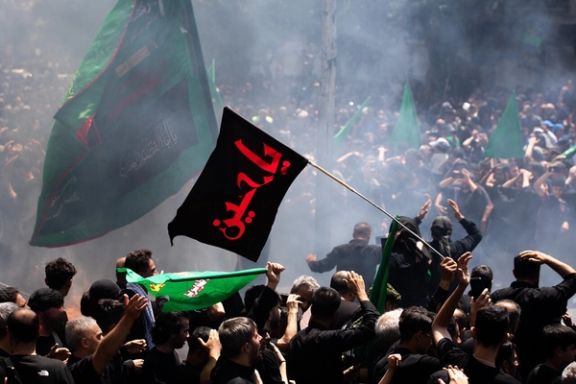
Iran's Ashura commemorations have again become a stage for competing political narratives, with government supporters and opponents alike using Shi'ite mourning rituals to advance sharply different messages.
Every year during the Islamic month of Muharram, millions of Shi'ite Muslims across Iran commemorate the martyrdom of Imam Hussein, the grandson of the Prophet Muhammad who was killed in 680 AD.
Hardliners often invoke his example to argue Iran should continue confronting the United States, while government critics use the same symbolism to condemn injustice at home.
Political messaging also comes through speeches by eulogists (maddahs), who preside over ceremonies recounting Hussein's sacrifice and heroism.
Read the full article here.





Iran's Ashura commemorations have again become a stage for competing political narratives, with government supporters and opponents alike using Shi'ite mourning rituals to advance sharply different messages.
Every year during the Islamic month of Muharram, millions of Shi'ite Muslims across Iran commemorate the martyrdom of Imam Hussein, the grandson of the Prophet Muhammad who was killed in 680 AD.
Hardliners often invoke his example to argue Iran should continue confronting the United States, while government critics use the same symbolism to condemn injustice at home.
Political messaging also comes through speeches by eulogists (maddahs), who preside over ceremonies recounting Hussein's sacrifice and heroism.
At one ceremony, well-known maddah Reza Narimani criticized President Masoud Pezeshkian for disclosing in a recent speech that funds equivalent to the value of 20 million barrels of oil had been allocated to the Revolutionary Guards' Aerospace Force during the war.
Narimani also claimed Supreme Leader Mojtaba Khamenei opposed negotiations and an agreement with Washington and had merely observed the government's recent diplomatic efforts.
Another eulogist, Mohammad Reza Bazri, criticized officials he accused of ignoring "the ten conditions of the Imam"—a reference to slain leader Ali Khamenei—while pursuing an agreement with Washington and failing to respond to what he described as US violations of the ceasefire.
"The Iranian people would never consent to an agreement with the United States," he claimed.
Opposition mourning
Government critics have likewise used Ashura ceremonies to express dissent, often through traditional mourning chants or carefully worded speeches condemning injustice without directly naming officials.
Religious gatherings in Yazd and Bushehr have become known for incorporating such politically charged poetry.
One widely performed lament, heard again this year, calls on people to rise up and "bring down the idols and palaces of tyrannical rulers."
Another popular mourning chant, which has gained prominence among religious opponents of the government in recent years, criticizes what it portrays as state-sponsored religion.
"In your religion, there is God's name, but God is absent," the lyrics say.
The poem's author, Shahabeddin Mousavi, was detained for a period after it became widely known.
Remembering those killed
While many ceremonies are organized or supported by the state, independent local communities also hold mourning processions that sometimes become venues for political expression.
According to social media posts, some Ashura gatherings this year included performances of the patriotic song Az Khoon-e Javanan-e Vatan ("From the Blood of the Nation's Youth") in memory of thousands of young people killed during the January unrest.
Originally composed during Iran's Constitutional Revolution more than a century ago, the song likens the blood of fallen youth to red tulips blooming from the earth.
At some ceremonies, eulogists reportedly read aloud the names of those killed.
In the central city of Arak, the mother of Mohammad Radmannia, a 29-year-old who was fatally shot in the back of the head with live ammunition in Tehran, urged mourners to continue her son's path.
In a village in the northern province of Gilan, mourners attached a photograph of Mani Safarpour, an 18-year-old from Lahijan who was also killed in Tehran, to a ceremonial drum and cymbals before gathering at his grave to perform chest-beating rituals.
Some opposition activists criticized fellow government opponents for attending Ashura ceremonies, arguing that the events are widely viewed because of state promotion as expressions of support for the Islamic Republic.
"The massacre of protesters in January was carried out on the direct orders of the leader of Shi'ites (Ali Khamenei), while other senior clerics remained silent," one user wrote on X. "A couple of Yazdi or Bushehri mourning chants cannot erase that crime from our society's memory."
Another user wrote: "The blood that was unjustly spilled will never be washed away. No lament or elegy can diminish the scale of this tragedy in our collective memory."
Others defended participation in the ceremonies.
"These mourning chants serve to remind people of those tragedies," one user argued.
Another wrote that participating in Ashura ceremonies was "part of the struggle to reclaim religious symbols" from the government.
A further comment added: "When will people understand that many ordinary religious Iranians have nothing to do with the government or its hardline supporters?"
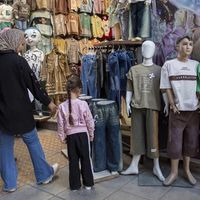
Many Iranians fear that a diplomatic opening with the United States could come at the cost of renewed social restrictions at home, as reports of stricter hijab enforcement begin circulating following the recent war.
Over recent days, social media users have voiced concern that a period of relative tolerance toward personal freedoms may be coming to an end.
With the immediate external crisis easing and further negotiations with Washington expected, many fear authorities could once again shift their focus to domestic social controls.
There has been no official announcement confirming the return of the morality police. But reports circulating online suggest increased scrutiny of hijab compliance in several cities, particularly the religious centers of Qom and Mashhad, although many of the incidents remain difficult to independently verify.
Many Iranians fear that a diplomatic opening with the United States could come at the cost of renewed social restrictions at home, as reports of stricter hijab enforcement begin circulating following the recent war.
Over recent days, social media users have voiced concern that a period of relative tolerance toward personal freedoms may be coming to an end.
With the immediate external crisis easing and further negotiations with Washington expected, many fear authorities could once again shift their focus to domestic social controls.
There has been no official announcement confirming the return of the morality police. But reports circulating online suggest increased scrutiny of hijab compliance in several cities, particularly the religious centers of Qom and Mashhad, although many of the incidents remain difficult to independently verify.
One widely shared video, which users say was filmed in the holy city of Qom, appears to show male and female officers attempting to persuade a young woman to enter a white van resembling those previously used by the so-called morality police.
In a separate video reportedly filmed in Mashhad, a police officer is seen confronting a young woman riding as a passenger on a motorcycle, telling her to buy a headscarf from a nearby shop before continuing her journey.
Another video from Tehran shows an argument between a young woman and several men. One tells her she has no right to appear without a head covering because it is against the law, while others threaten to call the police.
Optional, or is it?
Social media users have also reported visits by the Public Venues Supervision Office, the police body responsible for monitoring businesses, to inspect compliance with hijab regulations in companies, cafés and restaurants.
"They say hijab has become optional," one user wrote. "It's true that the way we dress has completely changed, both in the street and at work. But during these days of negotiations officials came to inspect our workplace over hijab.
"Imagine the anxiety in a company where most employees are women without hijab, fearing the business could be sealed because of them."
The legal rights group Dadban said reports from different parts of Iran suggested security, law enforcement and judicial institutions had once again increased their focus on domestic social control.
"Measures taken in recent weeks, from intensified street enforcement to growing pressure on citizens, point to the return of this approach," the group said.
"It appears that, following the reduction of external tensions, the responsible institutions have once again prioritized internal control and restricting individual and social freedoms."
Wartime tolerance, post-war uncertainty
During the war, state media and some officials openly welcomed the participation of unveiled women in pro-government gatherings. Images of women without head coverings were broadcast on state television, breaking with longstanding editorial practice.
At one gathering, organizers even projected a performance by a Lebanese female singer onto a large screen, challenging the state's longstanding ban on solo female singing.
Those departures from established norms unsettled many hardline supporters of the Islamic Republic. Now, with a memorandum signed with the United States and the prospect of further negotiations ahead, some Iranians fear authorities could seek to reassure conservative constituencies by tightening social controls once again.
Others worry that radical groups could feel emboldened to intervene directly under the principle of "enjoining good and forbidding wrong," a religious doctrine frequently invoked to justify policing perceived moral violations.
"After an agreement, what can their street forces do?" one social media user wrote. "Will they once again be unleashed on the public over hijab and other issues? A confrontation between society and the state lies ahead."
Another predicted authorities would intensify hijab enforcement and close cafés to appease conservatives opposed to rapprochement with Washington.
Political scientist Morteza Nemati urged caution over reports of the morality police's return but highlighted what he saw as an irony.
"I don't know how accurate the reports about relaunching the morality police are," he wrote on X. "But if you do bring them back, please be careful not to accidentally arrest the same unveiled women whose images you were showing at the nighttime rallies."
Resistance to Mohammad Bagher Ghalibaf's leadership, both as parliament speaker and chief negotiator, appears to be growing, though it remains confined to a small but vocal group of ultraconservative lawmakers.
Over recent days, at least four MPs—Hamid Rasai, Amir Hossein Sabeti, Abolfazl Aboutorabi and Kamran Ghazanfari—have publicly challenged Ghalibaf, accusing him of violating Supreme Leader Mojtaba Khamenei's red lines and keeping parliament closed to shield the government and negotiators from criticism.
Despite the attacks, Ghalibaf's position appears secure. A recent internal vote showed his supporters retain a comfortable majority, with fewer than 30 of the Majles' 290 members opposing his speakership.
All four leading critics belong to the ultraconservative Paydari (Steadfastness) Party, which has consistently opposed negotiations with the United States.
Even so, Ghazanfari has threatened that if parliament does not reopen before June 28, he and like-minded MPs will stage a sit-in outside the Majles. He argues the closure was never authorized by the Supreme National Security Council (SNSC), as Ghalibaf has maintained, and claims one man has effectively been making decisions on behalf of all 290 lawmakers.
Parliament was originally closed after the outbreak of the 40-day war with Israel and the United States because of security concerns.
Ghazanfari's assertion that "all MPs" want parliament reopened is not borne out by events. Over the past four months, only Rasai has publicly demanded its reopening. Ghazanfari nevertheless accuses Ghalibaf of unlawfully keeping the Majles shut because he fears lawmakers would oppose negotiations with Washington.
Ghalibaf has rejected the allegation, saying parliament remains operational and that sessions are being held online because of continuing security risks. He has also called on the Judiciary to investigate the claims against him.
According to ILNA, Ghazanfari has further accused Ghalibaf of violating the constitution and falsely claiming the SNSC ordered parliament's closure.
He also alleges Ghalibaf refused to show MPs the purported SNSC authorization and ignored what he described as a request from Mojtaba Khamenei to reopen parliament.
Hardline MP Abolfazl Aboutorabi told the Didban Iran website that Ghalibaf was preventing parliament from legislating on Iran's sovereignty over the Strait of Hormuz. He accused the speaker of "playing with words" by presenting the accord with the United States as an MoU rather than a binding agreement.
Aboutorabi said several MPs were preparing a legal complaint against Ghalibaf, arguing that any memorandum or agreement should require parliamentary approval.
Asked whether MPs planned to impeach President Masoud Pezeshkian over the MoU, he replied that impeachment was not currently under consideration, adding: "Maybe God helps and makes him a martyr."
The remark is among the most serious death-tinged comments directed at the president since a prominent eulogist earlier suggested Pezeshkian could be beheaded before later insisting the remark had been intended as an "internal discussion."
Aboutorabi also accused Ghalibaf of violating Khamenei's red lines on the Strait of Hormuz and nuclear negotiations.
Similar allegations have been made by other Paydari figures, including Mahmoud Nabavian and Amir Hossein Sabeti, who argue the agreement with Washington is being pursued against the Supreme Leader's wishes.
For now, however, there is little indication the campaign is gaining traction beyond a small faction. Ghalibaf's support within parliament remains strong, while his longstanding ties to the Revolutionary Guards and Khamenei's inner circle leave him well placed to withstand attacks from rivals with far less institutional backing.
President Masoud Pezeshkian's unusually blunt remarks about Iran's economic crisis have intensified infighting over Supreme Leader Mojtaba Khamenei's position on the US-Iran agreement.
The dispute centers on a written message attributed to Khamenei outlining his position on the Memorandum of Understanding.
In the message, Khamenei wrote: "In principle, I had a different view, but because of the commitment that the President, as head of the Supreme National Security Council, gave on behalf of himself and the council members regarding safeguarding the rights of the Iranian nation and the Resistance Front, and because they explicitly accepted responsibility for it, I authorized it."
Hardliners, including parliamentarian Hamid Rasaei and former MP Kamran Ghazanfari, accused Pezeshkian, parliament speaker Mohammad Bagher Ghalibaf and their allies of effectively staging a "coup" against the Supreme Leader.
'A devastated economy'
The dispute spilled into public view when attendees at an official event shouted that Pezeshkian's government should adhere to the "principles" referenced by Khamenei.
"The principle is justice. The principle is serving the people. The principle is honesty," Pezeshkian responded.
"For 40 to 50 days, we could not export a single barrel of oil from the Persian Gulf," he said. "They have devastated our economy, and many young people have become unemployed. Our young people have no hope for the future. We have to pay benefits to the unemployed and we cannot collect taxes. You tell me, where is the money supposed to come from?"
Pezeshkian also revealed that the government had diverted $20 million in oil-export revenues that would normally have gone into the state budget to the IRGC Aerospace Force to procure military equipment.
"If we had not supported the IRGC, our armed forces would not have been able to fight."
He added that he was withholding further details in the interest of national unity, saying he had much more to say but preferred not to disclose it.
Institutional backing
Pezeshkian's remarks also suggested growing confidence that key power centers continue to back the agreement despite mounting criticism from hardliners.
According to the president, the memorandum was approved by the Supreme National Security Council (SNSC) with the backing of the country's most senior commanders from both the regular army and the Revolutionary Guards.
Further evidence emerged on Tuesday when Sobh-e Sadegh, the weekly publication of the IRGC's political office, reported that Saeed Jalili—an SNSC member and a longstanding opponent of talks with Washington—had sought to clarify the leader's position.
According to the report, Jalili said Khamenei's statement was not opposition to negotiations but to Tehran's negotiating approach and certain provisions of the memorandum. He reportedly also said those who voted for the agreement in the council could not be accused of acting against the leadership.
His remarks echoed those of IRGC political chief Yadollah Javani, who said on Monday that the negotiations had been conducted with Khamenei's permission and according to the conditions he had set.
"The interpretation by some that the phrase 'in principle' signifies opposition to negotiations with the United States is incorrect," Javani said.
Competing readings
Iranian newspapers have offered sharply different interpretations of the controversy.
The government newspaper Iran argued that the Supreme Leader's message emphasized "responsibility, commitment, effort, and concern" on the part of government officials.
"The Leader's message was about the government's responsibility," it wrote, "but in part of the political sphere it became a tool for intensifying attacks on the government."
The conservative Khorasan newspaper argued that the message sought to balance three principles: maintaining the Islamic Republic's stance toward US hostility, conditionally accepting the outcome of the official decision-making process and demanding accountability from those implementing the memorandum.
It added that, in political and jurisprudential reasoning, the phrase "in principle" refers to a general rule that can admit exceptions under special circumstances.
Not all conservative voices defended the government. In an editorial titled Mr. President, the Enemy Can Hear You Too, the conservative website Alef criticized Pezeshkian for repeatedly discussing Iran's economic difficulties in public.
One reader commented: "Saying that not even a single barrel of oil was exported because of the US blockade, or that all military officials supported the memorandum, does not send a good message to the enemy."
Debate spills onto social media
Social media reflected the same divide. Supporters praised Pezeshkian's candor, while critics renewed accusations that he was attempting to pressure the Supreme Leader into accepting the agreement.
One supporter wrote: "Pezeshkian is completely right. You cannot run a country without money. We have to face reality."
A critic responded on X: "Standing against the Leader and then blaming everything on the Leader and the system is not called courage."
The dispute increasingly appears to be less about the memorandum itself than about who gets to define Khamenei's position. As negotiations with Washington move forward, competing factions are seeking to claim the leader's authority either to legitimize the agreement or to constrain those implementing it.