• العربية
  • فارسی
Brand
  • Iran Insight
  • Politics
  • Economy
  • Analysis
  • Special Report
  • Opinion
  • Podcast
  • Iran Insight
  • Politics
  • Economy
  • Analysis
  • Special Report
  • Opinion
  • Podcast
  • Theme
  • Language
    • العربية
    • فارسی
  • Iran Insight
  • Politics
  • Economy
  • Analysis
  • Special Report
  • Opinion
  • Podcast
All rights reserved for Volant Media UK Limited
volant media logo
INSIGHT

President's economic reality check fuels Iran's US deal debate

Maryam Sinaiee
Maryam Sinaiee

Iran International

Jun 25, 2026, 00:47 GMT+1
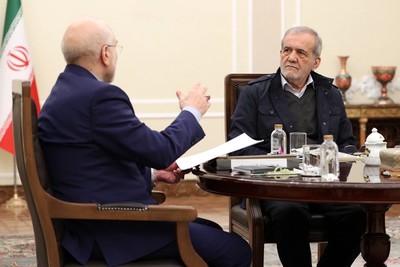
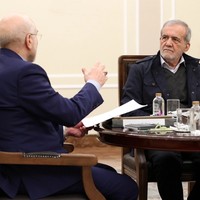
President Masoud Pezeshkian showing his copy of the MoU signed remotely with President Donald Trump. June 17, 2026

President Masoud Pezeshkian's unusually blunt remarks about Iran's economic crisis have intensified infighting over Supreme Leader Mojtaba Khamenei's position on the US-Iran agreement.

The dispute centers on a written message attributed to Khamenei outlining his position on the Memorandum of Understanding.

In the message, Khamenei wrote: "In principle, I had a different view, but because of the commitment that the President, as head of the Supreme National Security Council, gave on behalf of himself and the council members regarding safeguarding the rights of the Iranian nation and the Resistance Front, and because they explicitly accepted responsibility for it, I authorized it."

Hardliners, including parliamentarian Hamid Rasaei and former MP Kamran Ghazanfari, accused Pezeshkian, parliament speaker Mohammad Bagher Ghalibaf and their allies of effectively staging a "coup" against the Supreme Leader.

'A devastated economy'

The dispute spilled into public view when attendees at an official event shouted that Pezeshkian's government should adhere to the "principles" referenced by Khamenei.

"The principle is justice. The principle is serving the people. The principle is honesty," Pezeshkian responded.

"For 40 to 50 days, we could not export a single barrel of oil from the Persian Gulf," he said. "They have devastated our economy, and many young people have become unemployed. Our young people have no hope for the future. We have to pay benefits to the unemployed and we cannot collect taxes. You tell me, where is the money supposed to come from?"

Pezeshkian also revealed that the government had diverted $20 million in oil-export revenues that would normally have gone into the state budget to the IRGC Aerospace Force to procure military equipment.

"If we had not supported the IRGC, our armed forces would not have been able to fight."

He added that he was withholding further details in the interest of national unity, saying he had much more to say but preferred not to disclose it.

Institutional backing

Pezeshkian's remarks also suggested growing confidence that key power centers continue to back the agreement despite mounting criticism from hardliners.

According to the president, the memorandum was approved by the Supreme National Security Council (SNSC) with the backing of the country's most senior commanders from both the regular army and the Revolutionary Guards.

Further evidence emerged on Tuesday when Sobh-e Sadegh, the weekly publication of the IRGC's political office, reported that Saeed Jalili—an SNSC member and a longstanding opponent of talks with Washington—had sought to clarify the leader's position.

According to the report, Jalili said Khamenei's statement was not opposition to negotiations but to Tehran's negotiating approach and certain provisions of the memorandum. He reportedly also said those who voted for the agreement in the council could not be accused of acting against the leadership.

His remarks echoed those of IRGC political chief Yadollah Javani, who said on Monday that the negotiations had been conducted with Khamenei's permission and according to the conditions he had set.

"The interpretation by some that the phrase 'in principle' signifies opposition to negotiations with the United States is incorrect," Javani said.

Competing readings

Iranian newspapers have offered sharply different interpretations of the controversy.

The government newspaper Iran argued that the Supreme Leader's message emphasized "responsibility, commitment, effort, and concern" on the part of government officials.

"The Leader's message was about the government's responsibility," it wrote, "but in part of the political sphere it became a tool for intensifying attacks on the government."

The conservative Khorasan newspaper argued that the message sought to balance three principles: maintaining the Islamic Republic's stance toward US hostility, conditionally accepting the outcome of the official decision-making process and demanding accountability from those implementing the memorandum.

It added that, in political and jurisprudential reasoning, the phrase "in principle" refers to a general rule that can admit exceptions under special circumstances.

Not all conservative voices defended the government. In an editorial titled Mr. President, the Enemy Can Hear You Too, the conservative website Alef criticized Pezeshkian for repeatedly discussing Iran's economic difficulties in public.

One reader commented: "Saying that not even a single barrel of oil was exported because of the US blockade, or that all military officials supported the memorandum, does not send a good message to the enemy."

Debate spills onto social media

Social media reflected the same divide. Supporters praised Pezeshkian's candor, while critics renewed accusations that he was attempting to pressure the Supreme Leader into accepting the agreement.

One supporter wrote: "Pezeshkian is completely right. You cannot run a country without money. We have to face reality."

A critic responded on X: "Standing against the Leader and then blaming everything on the Leader and the system is not called courage."

The dispute increasingly appears to be less about the memorandum itself than about who gets to define Khamenei's position. As negotiations with Washington move forward, competing factions are seeking to claim the leader's authority either to legitimize the agreement or to constrain those implementing it.

Most Viewed

Ships face conflicting Iran, US instructions in Strait of Hormuz - FT
1

Ships face conflicting Iran, US instructions in Strait of Hormuz - FT

2

Banking disruption hits services at eight Iranian banks

3

Israel smuggled tens of thousands of Starlink systems into Iran, former PM says

4
VOICES FROM IRAN

Don’t feed us, free us: Iranians hit back at Vance over 'hunger' remarks

5

Tehran bread prices jump up to 100% in latest increase

Banner
Banner
Banner

Spotlight

  • President's economic reality check fuels Iran's US deal debate
    INSIGHT

    President's economic reality check fuels Iran's US deal debate

  • IRGC personnel sheltered in Shiraz lodging complex were target of deadly strike
    EXCLUSIVE

    IRGC personnel sheltered in Shiraz lodging complex were target of deadly strike

  • Don’t feed us, free us: Iranians hit back at Vance over 'hunger' remarks
    VOICES FROM IRAN

    Don’t feed us, free us: Iranians hit back at Vance over 'hunger' remarks

  • Opium for survival: Inside a shift in Iran’s Zagros villages
    EXCLUSIVE

    Opium for survival: Inside a shift in Iran’s Zagros villages

  • Tehran bread prices jump up to 100% in latest increase

    Tehran bread prices jump up to 100% in latest increase

•
•
•

More Stories

Don’t feed us, free us: Iranians hit back at Vance over 'hunger' remarks

Jun 24, 2026, 02:57 GMT+1
•
Saba Heidarkhani
Don’t feed us, free us: Iranians hit back at Vance over 'hunger' remarks
100%
Protesters scatter rice into the air in Abdanan during the January 2026 uprising, a scene that later became a symbol of dignity and defiance for many Iranians.

After Donald Trump said Iran has “a hunger problem” and JD Vance said unfrozen Iranian assets could help “feed the Iranian people,” Iranians pushed back, saying the country’s real crisis is repression, corruption and the fight for freedom, not hunger.

Speaking in Switzerland on Monday, Vance said Washington could agree to release frozen Iranian funds for purchases of US agricultural products such as wheat, corn and soybeans.

"If Iranian assets are ever unfrozen, they're going to go to make American farmers richer and to feed the Iranian people," Vance said.

He said the United States and Qatar would oversee the process, though Iranian officials have disputed that characterization.

Trump made similar remarks on Tuesday, saying money taken out of Iran would go to American farmers to provide “corn, soybeans, wheat to Iran.”

“They have a hunger problem, they have a food problem, they have a medicine problem, they got a lot of problems,” Trump said, adding that inflation in Iran had “hit 300%.”

  • Will the Islamic Republic trade with the 'Great Satan'?

    Will the Islamic Republic trade with the 'Great Satan'?

The remarks sparked widespread reactions from Iran International's viewers, many of whom said the country's struggle cannot be reduced to hunger.

"American officials talk about hunger in Iran as if our problem is a lack of food. Everything exists here. Government policies have made food unaffordable. Sending grain won't solve our problems," one viewer told Iran International.

While many respondents acknowledged the country's worsening economic crisis, they argued that inflation, corruption and decades of mismanagement—not a shortage of food—have made life increasingly difficult.

Others said they have little faith that any economic relief provided to the Islamic Republic would ultimately benefit ordinary citizens.

"Right now the Islamic Republic is probably figuring out how to send that wheat to Lebanon and Iraq," one viewer wrote.

The comment was a reference to the Islamic Republic's long-standing support for regional militant allies and proxy groups. Many respondents argued that Tehran has repeatedly prioritized its regional strategy over the welfare of its own citizens.

Several viewers also objected to what they saw as a portrayal of Iranians as a population waiting to be fed.

"The people of Iran are not hungry. They sacrificed their lives and shed blood for freedom," one respondent said.

Many pointed to the nationwide protests of January 2026, arguing that the movement was driven by demands for freedom and political change rather than economic assistance.

Some referenced the symbolic scene in Abdanan, where protesters threw rice into the air during demonstrations. Videos from the western city showed protesters throwing rice into the air, a gesture many interpreted as a rejection of the idea that their uprising was driven by hunger.

"Mr. Vance, you were not there during those January nights in Abdanan when grains of rice fell from the sky like snow," one citizen wrote.

For many respondents, the image symbolized dignity and defiance. They argued that while many Iranians are struggling economically, the country's crisis is ultimately one of governance and freedom.

They did not deny the depth of economic hardship, but said reducing Iran’s crisis to hunger ignored the political nature of their struggle.

Others stressed that Iran is not a poor country lacking resources.

"Our problem with the Islamic Republic is not only economic. It is a government that opposes human dignity, personal freedoms and Iran's ancient national culture. It is governed by ideology and follows a path separate from the Iranian people," one viewer wrote.

Another respondent was blunter.

"Mr. Vance, Iran is a rich country. If you don't believe me, ask Hezbollah, Hamas, the Popular Mobilization Forces and the Houthis."

The reactions reveal deep skepticism among Iranians who wrote to Iran International toward any agreement that could provide financial relief to the Islamic Republic. For them, the issue is not hunger alone, but freedom, dignity and who ultimately benefits when money flows back into the hands of Tehran.

Banking disruption hits services at eight Iranian banks

Jun 23, 2026, 14:20 GMT+1
Banking disruption hits services at eight Iranian banks
100%
File photo of people queue at an ATM in an Iranian city as customers seek access to banking services.

At least eight Iranian banks suffered widespread service disruptions on Tuesday, leaving customers unable to access many electronic and card-based services days after a separate outage affected four major banks.

Customers told Iran International that services at Pasargad, Melli, Mellat, Sepah, Tejarat, Saderat, Tose’e Ta’avon and Resalat banks were severely disrupted on Tuesday with reports indicating that almost all services had become unavailable.

Some domestic media outlets also confirmed the disruptions. ILNA news agency reported that parts of Iran's banking systems had experienced outages and slowdowns since Tuesday morning.

The Informatics Services Corporation later pointed to cyberattacks as the cause of the latest problems.

“The Informatics Services Corporation has temporarily taken card-based services offline to prevent any unauthorized access and safeguard customers’ data and assets,” the company said in a statement.

Customers wait at a bank branch in Iran as staff process transactions at service counters. (undated)
100%
Customers wait at a bank branch in Iran as staff process transactions at service counters.

Outages follow earlier attack

The disruption comes after electronic services at Melli, Tejarat, Saderat and Tose’e Saderat banks were hit by major outages on June 13.

Those problems affected mobile banking, internet banking, automated teller machines, point-of-sale terminals and other card services.

A day later, the Coordination Council of Banks said the outage resulted from a “limited cyberattack” targeting communications infrastructure shared by the four lenders. The council said no unauthorized access to customer data had occurred and no information had been deleted.

Meysam Zohourian, a member of parliament’s Economic Committee, later warned that a full restoration of services could take up to two weeks.

“Despite investigations by various bodies, the origin and cause of the main attack have not yet been identified, and even replacing hardware has not solved the problem,” Zohourian wrote on X.

A customer speaks with a bank teller at a branch in Iran. (undated)
100%
A customer speaks with a bank teller at a branch in Iran.

Infrastructure under scrutiny

Zohourian also criticized the role of the Informatics Services Corporation, which provides key banking and payment infrastructure and is partly owned by the Central Bank and several commercial lenders.

Iran’s banking sector has faced repeated service outages in recent years, many of them linked to cyberattacks. Such disruptions have become more common during periods of conflict and heightened security concerns, raising questions about the resilience of the country’s financial infrastructure.

Iran and US trade rival readings of MoU before 60-day talks mature

Jun 23, 2026, 13:48 GMT+1
•
Arash Sohrabi
Iran and US trade rival readings of MoU before 60-day talks mature
100%

The US-Iran memorandum is being implemented before Washington and Tehran have agreed what it means, turning the fragile deal into a battle over interpretation across the Strait of Hormuz, frozen funds, nuclear inspections, oil sanctions and Lebanon.

Less than a week after the two sides signed the MoU to end more than three months of war, its contradictions are already shaping the next phase of diplomacy: Hormuz is open, but ships may still need Iranian permission; funds are “available,” but Washington says they may be channeled toward wheat, corn and other approved purchases; inspectors are “back,” according to US officials, but Iran says there is no plan for UN inspectors to visit bombed nuclear sites; oil sales have been authorized, but Vice President JD Vance says Tehran will not benefit unless it changes behavior; Lebanon is written into the deal, but Israel is not a party to it.

For Iran, ambiguity has become leverage. Officials in Tehran are insisting that implementation of the MoU’s early provisions is a precondition for talks on more sensitive issues, while rejecting US descriptions of what the next stage should include.

Nuclear sites and missiles

Iranian Foreign Ministry spokesman Esmaeil Baghaei said on Tuesday that Tehran had not met International Atomic Energy Agency chief Rafael Grossi in Switzerland and had no plan for UN nuclear inspectors to visit facilities damaged in US and Israeli strikes.

“We have not had a meeting with the director general of the International Atomic Energy Agency, nor do we have any plans for an agency inspection of Iran’s nuclear facilities that were damaged as a result of the military attack by the United States and the Zionist regime,” Baghaei said. “Basically, there is no procedure at all in this regard.”

  • Iran says no plan for UN nuclear inspections at bombed sites

    Iran says no plan for UN nuclear inspections at bombed sites

That directly undercut Vance’s statement that talks on inspectors’ return could begin this week and President Donald Trump’s claim that Iran would agree to “major weapons inspections.”

Baghaei also ruled out talks on Iran’s missile program.

“Iran’s defensive and missile capabilities have never been part of our talks, nor will they ever be subject to negotiation with any party,” he said.

Money, oil and the first rewards

The dispute over money is just as sharp. Baghaei rejected the idea that Iran had agreed to spend released assets on US agricultural goods, after Vance said Washington wanted a mechanism to steer funds toward purchases such as soy, corn and wheat.

Baghaei said Iran would use its assets based on national needs, including price and quality.

“What is important for us is access to assets that have been unjustly blocked,” he said.

At the same time, the US Treasury has issued a 60-day license allowing Iran to produce, sell and deliver crude oil, petroleum products and petrochemicals, with related banking, insurance and transport services.

That gives both sides a political line. Washington says deeper benefits remain conditional. Tehran can point to immediate oil authorization and access to blocked assets as proof that pressure has begun to give way.

The same ambiguity surrounds the proposed $300 billion reconstruction framework. It exists in the text, but US officials have denied direct US or Qatari payments, leaving unclear whether it means grants, investment, credit facilities or future regional funding.

Hormuz is open, but under whose rules?

The Strait of Hormuz is the clearest practical test.

Ali Bahreini, Iran’s ambassador to the UN office in Geneva, said Tuesday that Hormuz was “completely open” to commercial vessels and that no charges would be collected during the 60-day period.

“Yes, the Strait of Hormuz is completely open, of course, for commercial vessels, according to the memorandum of understanding,” Bahreini said. “And it is without receiving any charges. After 60 days, it depends on the negotiations.”

  • Ships face conflicting Iran, US instructions in Strait of Hormuz - FT

    Ships face conflicting Iran, US instructions in Strait of Hormuz - FT

But the Financial Times reported that shipowners are in “deep confusion” over conflicting guidance. Iran has told vessels to seek permission from Tehran and use a route near the Iranian coast, while the US and some Western insurers advise ships to use a route on the Omani side under US air cover.

That leaves shipowners weighing the risk of Iranian interference against possible sanctions, insurance or compliance concerns.

The contradiction captures the MoU’s central problem: the US says Hormuz has reopened; Iran says reopening proves ships must deal with Tehran’s authority.

Lebanon still as the next flashpoint

Lebanon may be the deal’s most dangerous test.

Bahreini said Iran told the Switzerland talks that Lebanon is an “unquestionable part” of the MoU and that ending military operations must include respect for Lebanon’s territorial integrity, a halt to attacks and Israeli withdrawal.

“Iran’s red line is any attack against Lebanon, any more attack against Lebanon,” he said.

He warned that Iran would respond to any violation, including attacks on Lebanon or Hezbollah.

“If they are going to violate the MOU in any format, including by attacking Lebanon and Hezbollah in Lebanon, then Iran will respond,” he said.

Earlier on Tuesday, Reuters reported that Israeli gunfire killed two people in southern Lebanon, the first reported fatalities from Israeli fire there in three days. The Israeli military said it struck armed militants who posed an immediate threat.

A joint statement after US-Iran talks mediated by Pakistan and Qatar said the parties had agreed to create a deconfliction cell to monitor the termination of hostilities in Lebanon. But Israel is not a party to the US-Iran MoU, and Prime Minister Benjamin Netanyahu said this week that Israeli troops retain freedom of action against Hezbollah threats and will remain in Lebanon as long as necessary.

That leaves Washington responsible for restraining an ally outside the deal, while Tehran treats Lebanon as a condition for keeping talks alive.

A deal already under strain

Baghaei said talks on sanctions and nuclear issues depend on implementation of specific MoU provisions.

“The start of negotiations on these two issues is contingent on the implementation of specific provisions of the memorandum of understanding,” he said. “Part of it has been achieved, and part of it is being implemented.”

That is the emerging shape of the deal: each side is implementing the clauses it can sell, disputing the clauses it dislikes, and using unresolved language as leverage before the final agreement.

For now, the MoU has stopped a wider war and reopened commercial movement through Hormuz. But it has also created a new diplomatic battlefield in which every clause is being tested, stretched and weaponized before the 60-day clock has even fully begun.

Tehran bread prices jump up to 100% in latest increase

Jun 23, 2026, 13:13 GMT+1
•
Hooman Abedi
Tehran bread prices jump up to 100% in latest increase
100%
A baker prepares traditional flatbread Barbari at a bakery in Iran.

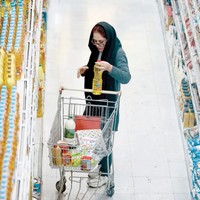
Bread prices across Tehran province have risen by as much as 100%, pushing the cost of one of the most important staple foods sharply higher and raising fresh concerns over government plans to overhaul the country's subsidy system.

Residents arriving at bakeries on Tuesday found new official prices in effect following an order issued by Tehran provincial authorities and announced by the Iran Chamber of Guilds' flour and bread working group. Under the new rates, lavash flatbread now costs 27,000 rials (2 cents), yeast-leavened barbari 100,000 rials (6 cents) and sangak 155,000 rials (10 cents).

The average monthly wage in Iran is estimated at around $150. A family relying solely on bread for its food consumption would spend roughly $8-$17 per month, depending on the type of bread purchased.

  • Bread shortages, soaring prices strain households in Iran, residents say

    Bread shortages, soaring prices strain households in Iran, residents say

The increase came only two days after Agriculture Minister Gholamreza Nouri Ghezeljeh said bread price rises were not under consideration and that the government was pursuing plans to transfer subsidies from bakeries to households through an expanded electronic voucher system.

The latest hike continues a trend that began during the presidency of the late Ebrahim Raisi and has accelerated under President Masoud Pezeshkian. Compared with less than a year ago, official price schedules show sangak prices have risen by 104%, barbari by 85% and lavash by 93%.

Freshly baked Sangak bread is displayed at a bakery in Iran (undated)
100%
Freshly baked Sangak bread is displayed at a bakery in Iran

Before September 2024, when the US dollar traded at around 600,000 rials on the free market, Lavash cost 5,000 rials ($0.008), while Barbari sold for 18,000 rials (3 cents) and Sangak for 30,000 rials (5 cents).

The increase follows similar price rises elsewhere in the country. Bread prices in West Azarbaijan province rose by 70% to 100% last month, while prices in Mashhad increased by an average of 49% in mid-June. Reports from other provinces have also pointed to either higher bread prices or reductions in dough weights, a practice some consumers and analysts describe as hidden inflation.

Card-based bread system

The latest increase comes as authorities continue to rely on the Nanino digital monitoring platform, introduced in 2022 to distribute subsidized flour based on bakery sales.

  • Rampant inflation may ignite bread riots in Iran, economist warns

    Rampant inflation may ignite bread riots in Iran, economist warns

Many bakers say technical problems and disputed calculations have reduced their flour allocations. Although authorities insist there are no limits on bread purchases, consumers in many areas report restrictions as bakeries attempt to stretch subsidized flour supplies.

Subsidy cuts spark concern

The Pezeshkian administration has steadily reduced support for wheat and flour subsidies since taking office and is examining plans to integrate bread subsidies into the electronic voucher program, a move that could effectively end the current subsidy structure.

The proposal has generated concern even among media outlets generally supportive of state policies. News website Khabar Online warned that public tolerance for rising prices was wearing thin and that additional pressure linked to a staple as widely consumed as bread could provoke a strong public reaction.

"Public tolerance for price increases has reached its limit, and society may face severe tension and shock from any new pressure, particularly over a product such as bread that is consumed extensively across cities, villages and lower-income households," the outlet wrote.

Freshly baked lavash bread is displayed at a bakery in Iran. (undated)
100%
Freshly baked lavash bread is displayed at a bakery in Iran.

Bakery owners say they face growing costs for labor, utilities and raw materials while operating under regulated prices and delayed subsidy payments. Economists and labor activists warn that repeated increases in bread prices disproportionately affect low-income families because bread remains a key component of household consumption.

The price rise comes as inflation remains elevated. According to Iran's Statistical Center, consumer prices in May were 83.9% higher than a year earlier, while annual inflation reached 57.7%.

As the government moves ahead with subsidy reforms, the price of bread is increasingly becoming a measure of the economic strain facing millions of families across the country.

Rising gym fees push fitness beyond reach for many Iranians

Jun 23, 2026, 10:38 GMT+1
•
Saba Heidarkhani
Rising gym fees push fitness beyond reach for many Iranians
100%
A man adjusts a treadmill at a gym in Iran.

Soaring gym fees and shrinking household budgets are forcing many Iranians to abandon sports and fitness activities, turning what was once a routine part of daily life into an unaffordable luxury, according to messages sent to Iran International.

Monthly gym memberships that were once within reach for many families now cost at least 20 million rials ($12.5) in smaller cities. In some gyms in Tehran and other major urban centers, 12 training sessions can cost as much as 200 million rials ($125). The average wage in Iran is $150.

Gym owners say inflation, rising rents, higher energy bills and the growing cost of imported equipment have left them little choice but to raise fees. For many households, however, food, housing and transportation now take priority over exercise.

Teen athletes forced to quit

Many of the messages received by Iran International on the issue came from teenagers who said financial pressures were disrupting their athletic ambitions.

A 15-year-old taekwondo athlete said she had spent months trying to save enough money to buy a punching bag. A 13-year-old basketball player said he had been forced to stop training indoors because of rising fees.

A university student in Mashhad said gym membership remained out of reach despite a strong interest in fitness.

“Registering at a gym and working out is something I still want to do, but my salary is so low that I cannot afford it,” the student said.

100%

The decline in participation is also hitting gym owners and coaches.

A gym manager in eastern Tehran said the number of clients at his facility had fallen to roughly one-third of previous levels, despite keeping membership fees unchanged.

Coaches in several cities said they had lost most of their students in recent months and lacked both fixed salaries and insurance coverage. Many warned that smaller sports businesses could face closure if the trend continues.

Rising costs beyond membership fees

The financial pressure extends beyond gym subscriptions. Coaches and athletes say the price of protein-rich foods and sports supplements has climbed sharply, making it harder to maintain training programs.

Citizens reported that whey protein now costs around 200 million rials ($125), while a 300-gram container of creatine sells for about 40 million rials ($25).

Football players also pointed to soaring equipment costs, saying cleats priced below 50 million rials ($31) have become difficult to find. One player said football field rental fees can also reach 50 million rials ($31).

Health experts have long warned that lower levels of physical activity can contribute to higher healthcare costs over time. For many Iranians, however, regular exercise is increasingly becoming a financial burden rather than a basic part of a healthy lifestyle.