Iran’s negotiators have opened a renewable 60-day clock. Its factories may not have that long. The Chamber of Commerce’s own PMI survey shows warehouses emptying, orders drying up and production lines at risk of stoppage within months.
Every serious economy watcher knows the ritual. At the start of each month, the purchasing managers’ indexes land, and markets move.
A PMI is the closest thing economics has to a pulse reading. Surveyors ask the people who run companies a simple set of questions about the month just ended: did production rise or fall, did new orders come in, are you hiring?
The answers are compressed into a number from 0 to 100. The 50 line separates growth from contraction. A few points below 50 signals trouble.
Readings under 40 usually belong to crises. When the index for US manufacturing fell to 41.5 in April 2020, with the country in lockdown, it made headlines for weeks.
A pulse reading below crisis level
Iran has a PMI too. Few outside the country have heard of it.
Since 2018, the research center of Iran’s Chamber of Commerce has surveyed managers of Iranian firms every month, following standard PMI methodology, and published the result under the Persian acronym Shamekh. The acronym is formed from Shakhes-e Modiran-e Kharid, literally “the index of purchasing managers.”
It is the instrument Iran’s own business establishment built to take the economy’s pulse. Official inflation statistics can be delayed, reweighted and narrated. A factory’s order book is harder to argue with.
That is what makes the latest readings so remarkable.
In March, the month war hit business conditions, Iran’s manufacturing Shamekh registered 26.2.
Some calibration is necessary, because the scale matters.
In April 2020, the cruelest month of the pandemic for many economies, Spain’s manufacturing PMI fell to 30.8. Britain’s fell to 32.6, its worst reading in roughly three decades. India, which confined 1.4 billion people to their homes, recorded 27.4, the lowest in that survey’s history.
Iran’s manufacturing sector in March came in below every one of them.
And the comparison flatters the situation, because those pandemic readings measured economies in a medically induced coma. Governments had deliberately and temporarily shut commerce down. Within months, every one of those indexes was back above 50.
No one switched Iran’s economy off to save lives.
Epic Fury may have concluded, but the economic fury continues. Judging by the latest figures, it is working. Iran’s industry is being suffocated by war, sanctions and the lingering effects of a naval blockade whose dismantling has now been promised but not yet proved in economic life.
The difference is the difference between a pause and a stroke.
Empty warehouses, falling orders
The 26.2 reading was never announced in a standalone report.
The chamber skipped its March publication. The figure surfaced quietly in a chart accompanying the April edition.
April itself brought no relief worth the name. Manufacturing stood at 37.4, while the whole-economy index was 38.5. Apart from March, these were the lowest readings in the survey’s history.
Iranian industry has now spent five consecutive months below the 50 line, meaning five straight months of contraction.
The Iranian New Year holidays, known as Nowruz, always slow business activity around late March and early April. Factories close, workers travel and early-spring readings often weaken. But the survey has eight Nowruz seasons on record, and none came anywhere near these levels.
Ten of the survey’s eleven components are below 50.
New orders, at 37.4, show demand drying up at home and in export markets alike. Delivery times, at 39.6, carry some of the report’s most telling explanations: internet shutdowns, broken payment channels and import restrictions.
Raw-material inventories stand at 32.6. That is not just a weak number; it is a warning about the physical ability to keep producing.
Here the chamber’s own language turns blunt. If conditions persist, it warns, production lines face partial or complete stoppage in the months ahead.
Employment, at 36.8, is the lowest in the survey’s history, even lower than during the war month itself. The layoffs did not end with the ceasefire. They are deepening.
One component points the other way, and it completes the picture.
The price of raw materials stands at 77.4, deep in inflationary territory. Iranian firms are producing less, selling less and paying more for what they buy.
Demonstrating stagflation usually requires setting two datasets side by side. Here, both halves sit on a single page of a single report, published by a single institution.
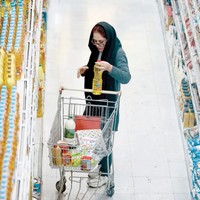
The costs are already passing through to households. Consumer prices rose nearly 9 percent in May. Not at an annual rate. In one month.
That is roughly what American consumers endured across the whole of 2022.
A 60-day clock factories may not have
What turns a bad snapshot into a worse forecast is the composition underneath.
For years, two sectors helped hold the index up: steel and petrochemicals. They are among Iran’s principal earners of hard currency, and they reliably scored above 50, pulling the average with them.
By the chamber’s own account, both were directly struck in the war.
Their weakness closes a loop. Fewer exports mean less foreign exchange. Less foreign exchange means scarcer and costlier imported inputs. Scarcer inputs mean still less production.
Set that loop beside the emptying warehouses, and beside a blockade that, by available estimates, has cost the economy on the order of $430 million a day. Even if the new memorandum begins to unwind it, the damage already done will not disappear on the day diplomats announce progress.
The component worth watching now is the quietest one: expectations of production for the month ahead.
It stands at 32.2, among the lowest readings the survey has ever produced. That question is about the future, answered by the people with the most direct knowledge of it and the least incentive for theater.
A memorandum now promises to change that future. A promise of the same kind preceded last year’s 12-day war in June 2025. Whether this one holds, or goes the way of that one, is the open question.
The agreement commits Washington to begin dismantling the blockade at once. But a signed page is not a furnace relit.
The talks in a Swiss resort started last week, and the 60 days the memorandum allots to reach a deal are, in the American president’s own telling, extendable by mutual consent.
Tehran has run this clock before. It is reportedly running it now over Lebanon.
At current inventories, the chamber’s surveyors warn, production lines face stoppage in the months ahead.
A government that spends its factories’ last quarter on a war beyond its borders has ranked its priorities. The managers who answered at 26 sit far down the list.
An illustration showing an ancient Iranian soldier and a Revolutionary Guard member holding a weapon together, displayed during a November 7 ceremony in Tehran where a statue of pre-Islamic Persian King Shapur I was unveiled.
Tehran’s unveiling of a towering statue depicting the Roman Emperor Valerian kneeling before pre-Islamic Persian King Shapur I has renewed criticism of the Islamic Republic’s appeal to nationalist sentiment following the June war with Israel.
For over forty years, the theocracy purged ancient Persian history from schoolbooks, replacing it with post-Islamic narratives. But after the 12-day conflict with Israel, officials have turned to the distant pre-Islamic past to rally a divided society.
From murals of ancient kings and soldiers to patriotic songs added to Shi’ite mourning ceremonies performed before Supreme Leader Ali Khamenei, Tehran now embraces imagery once deemed heretical by its own revolutionary ethos.
The statue unveiled in Tehran's Revolution Square
'Kneel before Iran' campaign
Tehran’s Revolution (Enghelab) Square was the scene of an unusual spectacle on Friday as officials unveiled a massive bronze statue depicting Roman Emperor Valerian kneeling in submission before Sassanid King Shapur I, commemorating Iran’s victory at the Battle of Edessa (260 AD).
The event was held under the slogan “Kneel before Iran,” part of what authorities describe as a campaign to project “national unity and historical pride” following the June war with Israel.
Tehran Mayor Alireza Zakani, a staunch ultraconservative, said on X: “Enmity with Great Iran can only end in kneeling before this historic nation.”
Municipal official Davood Goodarzi said the installation would be accompanied by visual displays depicting “other victories of Iranians over foreign aggressors,” including the defeat of British forces by local commander Rais-Ali Delvari, Mirza Kuchak Khan’s resistance against Russian troops, and Surena’s triumph over Rome at the Battle of Carrhae in 53 BCE.
The goal, Goodarzi said, is “strengthening concepts such as national dignity, social unity, and Iranian identity.”
The statue, he said, would remain temporarily at Revolution Square before being moved to a city gateway “where it will stand as the first emblem of Iran before diplomats and foreign visitors.”
Unveiled women were allowed to attend the unveiling ceremony—an uncommon scene at events organized by Tehran’s ultra-hardline municipality.
The turn to the pre-Islamic past
The sharp reversal also recalls remarks once made by Khamenei. In a 2011 speech, he asserted that “all the great military victories of this nation came after Islam,” dismissing pre-Islamic accounts as “things that are not documented.”
In 1987, he had said that prophets triumphed over kings such as Cyrus and that “nothing remains of these monarchs in history but names remembered with derision.”
Nevertheless, pro-government social media accounts have now gone so far as to circulate posters equating Khamenei himself with Shapur, showing him standing with a staff as Benjamin Netanyahu and Donald Trump kneel before him. The caption reads: “You will kneel before Iran.”
Image circulating by hardliners on social media
'Hypocrisy'
Pro-government figures have hailed the move as a patriotic success. Conservative political reporter Hossein Saremi posted: “Today’s grand Iranian gathering showed that people and the state share one essence: Iran itself. Nothing can take our homeland away.”
Others, however, called the spectacle “hypocrisy.” Journalist Gholamhossein Pashaei wrote on X: “Every year you close Pasargadae to stop people from celebrating Cyrus Day, yet you unveil Shapur’s statue in Enghelab Square with drums and fireworks during Fatimiyya (mourning period)!”
Dissident commentator Hamid Asafi called the ceremony “a perfect snapshot of the Islamic Republic’s contradictions.”
On Telegram he wrote: “A week ago they closed Cyrus’s tomb out of fear of the crowds, and now they glorify Shapur in the same breath. The Islamic Republic fears living history but poses for selfies with its corpse.”
He added: “They know people no longer respond to rosaries and sermons. That’s why they’ve brought history back to the stage—in a controlled costume. If they can’t erase the past, they’ll try to own it.”
The irony deepened as UNESCO formally recognized Cyrus’s Charter as one of the earliest human-rights documents.
President Masoud Pezeshkian wrote on X: “Iran, the cradle of dialogue, justice, and coexistence, can still inspire peace today.”
Users swiftly replied, questioning how such pride could coexist with a government that blocks access to Cyrus’s tomb each year to those wishing to visit it on his birthday.