Senior IRGC special unit commander killed in strikes - state media


Iranian media reported that a commander of a special unit of the Islamic Revolutionary Guard Corps was killed in strikes on Wednesday.
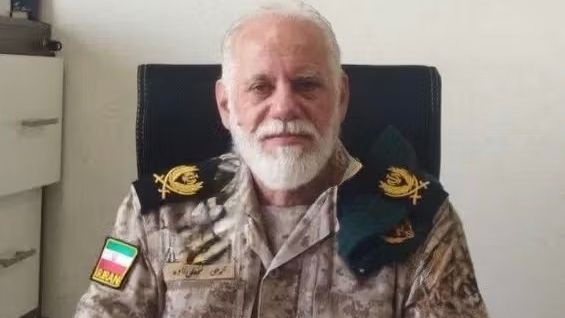
They said Mohammad Ali Fathalizadeh, commander of the Fatehin special unit, was among those killed.
No further details were immediately available.
The Fatehin unit is part of the IRGC and its members receive advanced military training and have previously been deployed in conflicts such as Syria.


An Iranian lawmaker said on Thursday that parliament had received an expedited bill focused on Iran’s authority over the Strait of Hormuz.
Somayeh Rafiei said the proposal addresses security, legal, political and economic aspects and would be reviewed by relevant committees.
Earlier this week, a key parliamentary committee approved a plan to impose transit fees on ships passing through the strait, according to state media.
Mobarakeh Steel Company said on Thursday that damage to production units had forced a complete halt to its lines.
The company said operations could not continue and asked staff to avoid coming to the complex until further notice.
State media reported last week that US and Israeli strikes hit two of the country’s largest steel producers, including Mobarakeh Steel in Isfahan and Khuzestan Steel Company in Ahvaz.
Khuzestan Steel said earlier on Thursday that repairs to its facilities could take between six months and one year after the strikes.
US and Israeli strikes hit several points near Azimiyeh in Karaj, west of Tehran, including what was described as the B1 bridge, state media reported.
Several people were wounded in the attacks, according to IRGC-affiliated Fars News Agency.
Power outages were reported in parts of Karaj, including Azimiyeh, Fardis and Jahan Shahr, following the explosions, Didban Iran reported.
Emergency teams were dispatched to the scene, and further details were expected.
The Paris offices of Goldman Sachs were placed under police surveillance after a bomb threat believed to be linked to an Iranian group, Le Parisien reported.
Prosecutors in Paris said on Thursday no suspicious items had been found.
Goldman told staff they could work remotely on Thursday, a source familiar with the matter said, while employees at Citigroup in Paris and Frankfurt also worked from home as a precaution. Citigroup said the move was a precautionary measure.
The heightened alert followed a foiled bomb attack near the Paris offices of Bank of America last week.
French anti-terrorism prosecutors said a man and three teenagers aged 16 and 17 had been placed under formal investigation and held in pre-trial detention on suspicion of manufacturing, transporting and handling an explosive device and attempting to destroy property as part of a terrorist organization.
They said the device, made from a five-litre petrol can attached to a large pyrotechnic charge containing a 650-gram active-material cylinder, was the most powerful of its kind identified in France and could have generated a fireball several meters wide.
Investigators said the adult suspect recruited the teenagers, paying them between 500 and 1,000 euros to plant and film the device. All four denied terrorist intent.
Authorities said the plot may be linked to a pro-Iranian group known as HAYI, which had posted a video naming Bank of America’s Paris headquarters, though prosecutors said the link had not been formally established.
A senior Iranian commander pushed back at US remarks about bombing Iran “back to the Stone Age,” saying American soldiers would be buried.
An account attributed to Majid Mousavi of the Islamic Revolutionary Guard Corps responded to comments by US Defense Secretary Pete Hegseth following President Donald Trump’s speech.
“It is you who will take your soldiers under gravestones, not Iran that you can return to the Stone Age,” the account said, adding that the United States was threatening “a civilization thousands of years old.”