Trump on Mojtaba Khamenei's leadership: 'We'll see what happens'
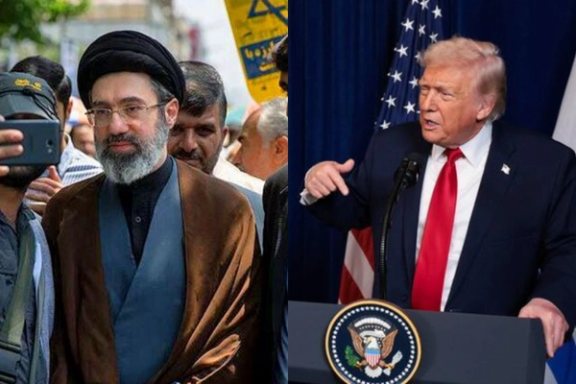

US President Donald Trump declined to comment on Iran's announcement of Mojtaba Khamenei as the new supreme leader, sufficing by telling The Times of Israel, “We’ll see what happens.”
He also said a decision on when to end the war with Iran will be a “mutual” one that he’ll make together with Israeli Prime Minister Benjamin Netanyahu.


A member of Iran's Assembly of Experts says some clerics were not informed about the in-person meeting at which Mojtaba Khamenei was named the new supreme leader and therefore could not attend despite being in the city of Qom.
Ayatollah Mohsen Heidari told state television that more than two-thirds of the body’s 88 members attended the session held in Qom on Sunday, meeting the quorum required for the vote.
“Some of the members were not informed about the meeting and could not make it to the session even though they were in the city of Qom,” Heidari said.
Heidari added that Mojtaba Khamenei received almost 85% of the votes cast by those present.
The Assembly of Experts, an 88-member clerical body elected for eight-year terms, is constitutionally responsible for appointing and overseeing Iran’s supreme leader. A minimum of two-thirds of its members must be present for such a decision to be valid.
If accurate, the figures would mean that at least about 59 members attended the meeting and that roughly 50 or more voted in favor of Khamenei.
Sources familiar with the discussions had earlier told Iran International that several members of the Assembly expressed objections to Mojtaba Khamenei’s selection earlier this week, warning that appointing the son of the late leader risks reinforcing perceptions of hereditary rule in the Islamic Republic.
Iran’s President Masoud Pezeshkian congratulated Mojtaba Khamenei on his selection as the new Supreme Leader, saying the appointment marked the beginning of a new era of strength and dignity for the country.
In a message released after the Assembly of Experts announced Mojtaba Khamenei as the third leader of the Islamic Republic, Pezeshkian said the decision reflected the “wise and decisive” choice of the clerical body following the death of his slain father.
Pezeshkian said the selection would reinforce national unity and help Iran confront what he described as hostile plots by its enemies. He added that the legacy of Mojtaba Khamenei’s father had laid a strong foundation for the country’s future and said Iran could achieve lasting independence, scientific and technological progress, and broad development under the new leadership.
Iran's Revolutionary Guard announced the launch of a new barrage of liquid- and solid-fuel missiles, including Khorramshahr, Fattah and Kheibar, along with drones, following the announcement of Mojtaba Khamenei’s leadership in an operation codenamed “Aliyyan waliyy Allah".
The phrase references the Shia belief that Prophet Muhammad appointed his son-in-law Ali as his rightful successor at the event of Ghadir.
Iranian state media published an image of a missile bearing the phrase “Labbayk, Seyyed Mojtaba” (At your service Seyyed Mojtaba), in what appeared to be a display of the military’s pledge of allegiance to the new supreme leader.

Mojtaba Khamenei, long known as the discreet and powerful son of slain Ayatollah Ali Khamenei, was announced early Monday as Iran’s new Supreme Leader at a time when the country is at war and Israel has openly vowed to target any successor to his father.
For decades Mojtaba operated largely out of public view while building deep ties across the Islamic Republic’s political and security apparatus. His rise marks the formal emergence of a figure who had already been widely regarded as one of the most influential actors behind the scenes of Iran’s ruling establishment.
Mojtaba, the second son of Ali Khamenei, has long been considered the only member of his family with clear political ambitions. His younger brother, Masoud, worked only in administrative roles within their father’s office, while his other two brothers and two sisters are not known to have held political or bureaucratic positions.

Iran’s Armed Forces General Staff and the central command of Khatam al-Anbiya headquarters issued a statement confirming their allegiance to Mojtaba Hosseini Khamenei after his selection as the new Supreme Leader.
The statement congratulated the nation on the appointment and said the armed forces and their commanders had pledged loyalty to Mojtaba Khamenei, vowing to carry out his orders and mobilize all capabilities to defend the Islamic Republic.
It added that the military would act “more powerfully and resolutely than before” to safeguard the achievements of the Islamic Revolution and warned enemies—particularly the United States—that Iran’s forces would resist any aggression and defend the country’s security and interests under the new leader’s command.