• العربية
  • فارسی
Brand
  • Iran Insight
  • Politics
  • Economy
  • Analysis
  • Special Report
  • Opinion
  • Podcast
  • Iran Insight
  • Politics
  • Economy
  • Analysis
  • Special Report
  • Opinion
  • Podcast
  • Theme
  • Language
    • العربية
    • فارسی
  • Iran Insight
  • Politics
  • Economy
  • Analysis
  • Special Report
  • Opinion
  • Podcast
All rights reserved for Volant Media UK Limited
volant media logo

Hidden camera video outlines alleged Iran-linked plot to kill Trump
Feb 27, 2026, 16:55 GMT+0
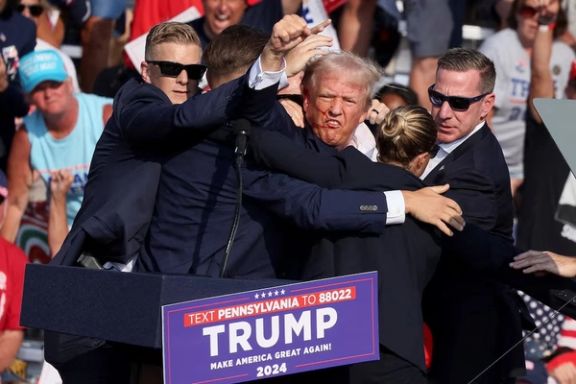
Republican presidential candidate and former US President Donald Trump gestures with a bloodied face while he is assisted by US Secret Service personnel after he was shot in the right ear during a campaign rally at the Butler Farm Show in Butler, Pennsylvania, US, July 13, 2024.

A newly released undercover video shown in a Brooklyn courtroom captures an alleged Iran-linked operative describing a 2024 plot to assassinate Donald Trump.

The operative who prosecutors say tried to hire two men to kill Trump for $5,000 upfront demonstrated the plan by placing a vape pen on a napkin to signify his “target,” the hidden camera video released by the New York Post shows.

“This is the target. How will it die?” Asif Merchant said in the meeting.

Merchant, 47, a Pakistani national who entered the United States in April 2024, is accused of attempting to recruit individuals he believed were hired killers.

Prosecutors said he offered cash payments and discussed staging a protest near a campaign rally to create confusion and allow the attackers to escape.

Although Trump was not explicitly named in the recorded exchanges, court documents show that he – then a leading candidate – was the intended target, the Post reported.

Prosecutors allege Merchant believed Trump’s policies had harmed Muslim-majority countries and acted with backing from individuals allegedly connected to Iran.

The scheme began to unravel when a Pakistani-American acquaintance, a former US Army linguist, alerted authorities after growing suspicious of Merchant’s plans. The FBI then arranged undercover meetings that were secretly recorded.

Merchant was arrested in July 2024 at an airport while attempting to leave the United States, authorities said.

He has pleaded not guilty to charges including murder for hire and attempting to commit an act of terrorism transcending national boundaries. If convicted, he faces a potential life sentence.

In November 2024, the US Department of Justice unsealed criminal charges regarding a thwarted plot by Iran's Islamic Revolutionary Guard Corps (IRGC) to assassinate Donald Trump prior to the 2024 presidential election.

Trump has been a target for assassination threats since he ordered the 2020 killing of Qassem Soleimani, the commander of the Islamic Revolutionary Guards Corps (IRGC) Quds Force in Iraq.


Most Viewed

Iran negotiators ordered to return after internal rift over Islamabad talks
1
EXCLUSIVE

Iran negotiators ordered to return after internal rift over Islamabad talks

2
EXCLUSIVE

Iran’s central bank warns economy may take 12 years to rebuild after war

3
INSIGHT

Iran's digital economy battered by prolonged blackout

4
ANALYSIS

US blockade enters murky phase as tankers spoof signals and buyers hesitate

5
ANALYSIS

Why the $100 billion Hormuz toll revenue is a myth

Banner
Banner

Spotlight

  • Hardliners push Hormuz ‘red line’ as US blockade tests Iran’s leverage
    INSIGHT

    Hardliners push Hormuz ‘red line’ as US blockade tests Iran’s leverage

  • Ideology may be fading in Iran, but not in Kashmir's ‘Mini Iran'
    INSIGHT

    Ideology may be fading in Iran, but not in Kashmir's ‘Mini Iran'

  • War damage amounts to $3,000 per Iranian, with blockade set to add to losses
    INSIGHT

    War damage amounts to $3,000 per Iranian, with blockade set to add to losses

  • Why the $100 billion Hormuz toll revenue is a myth
    ANALYSIS

    Why the $100 billion Hormuz toll revenue is a myth

  • US blockade targets Iran oil boom amid regional disruption
    ANALYSIS

    US blockade targets Iran oil boom amid regional disruption

  • Iran's digital economy battered by prolonged blackout
    INSIGHT

    Iran's digital economy battered by prolonged blackout

  • Iranian clerical call to kill Trump spreads, attracts alleged fundraising

    Iranian clerical call to kill Trump spreads, attracts alleged fundraising

  • Iranian official says Trump could face drone attack at Mar-a-Lago

    Iranian official says Trump could face drone attack at Mar-a-Lago

•
•
•

More Stories

IAEA says cannot assure Iran’s nuclear program is exclusively peaceful

Feb 27, 2026, 14:30 GMT+0

The UN nuclear watchdog warned it will not be in a position to provide assurance that Iran’s nuclear program is exclusively peaceful unless Tehran restores access to key facilities, according to confidential reports seen by Bloomberg and the Associated Press.

International Atomic Energy Agency Director General Rafael Grossi said the agency has been unable to verify the status and location of Iran’s stockpile of highly enriched uranium since military strikes by the United States and Israel hit several nuclear sites in June.

The IAEA said it has not been granted access to Iran’s four declared enrichment facilities and has therefore lost “continuity of knowledge” over previously declared nuclear material at affected sites. As a result, it cannot verify whether Iran has suspended all enrichment-related activities or confirm the current size, composition or whereabouts of its enriched uranium stockpile.

Grossi said his agency “will not be in a position to provide assurance that Iran’s nuclear program is exclusively peaceful” until Iran improves its cooperation.

Inspectors have observed regular vehicular activity at bombed sites, including the underground complex at Isfahan and the enrichment facilities at Natanz and Fordow, through satellite imagery. However, Grossi said that without on-site inspections the agency cannot determine the nature or purpose of those activities.

According to the IAEA, Iran holds 440.9 kg (972 pounds) of uranium enriched up to 60% purity, a short technical step from weapons-grade levels of 90%. Grossi has previously said that while such material does not mean Iran has a nuclear weapon, it could, in theory, be sufficient for multiple bombs if further enriched.

The warning comes as Iran and the United States continue indirect talks over Tehran’s nuclear activities. Iran maintains that its nuclear program is exclusively peaceful.

Iranian clerics escalate war rhetoric as US orders regional departures

Feb 27, 2026, 12:34 GMT+0

Senior Iranian clerics on Friday framed nuclear negotiations with Washington as conditional and cautioning that war remains an option if talks fail, as the United States and Britain began drawing down personnel in the region.

Lotfollah Dezhkam, Supreme Leader Ali Khamenei’s representative in Fars province, said indirect negotiations do not guarantee results and warned that “if negotiations do not succeed, the next option, which is war, is on our table,” according to state media. Iran speaks “from a position of power,” he added, arguing that talks only make sense if the other side understands the consequences of conflict.

Dezhkam’s remarks were echoed by other senior religious figures, suggesting a coordinated hardening of tone from the clerical establishment.

Rasoul Falahati, Khamenei’s representative in Gilan province, said the United States fears Iran’s cyber, drone and missile capabilities and warned that any action would draw a tougher response. “If the enemy makes a mistake, we will give them a lesson harsher than the 12-day war,” he said, adding that Israel understands it would face “difficult conditions” in any confrontation.

In northern Iran, Kazem Nourmofidi, Friday prayer leader of Gorgan, dismissed US military threats as political maneuvering. “These threats are more a show of power and a political bluff than reality,” he said. “They have no choice but to negotiate with Iran.” Nourmofidi pointed to Iran’s military strength and its strategic position over the Strait of Hormuz, warning that closing the waterway could send oil prices soaring and trigger global economic disruption.

Tehran’s Friday prayer leader Ahmad Khatami reinforced the red lines on the nuclear file itself, ruling out any suspension of uranium enrichment. “The Islamic Republic has never accepted suspension of enrichment and will not accept it,” he said, rejecting what remains a central US demand.

Military echoes clerical warnings

The religious rhetoric was mirrored by the armed forces. Iran’s military spokesperson Abolfazl Shekarchi warned that in the event of conflict, “American soldiers and their equipment will be destroyed,” cautioning that any “foolish action” could ignite wider regional escalation.

Even as the tone sharpened, Foreign Minister Abbas Araghchi said progress in talks requires the United States to avoid “miscalculation and excessive demands,” state media reported after a call with Egyptian Foreign Minister Badr Abdelatty. Araghchi briefed him on the latest round of indirect negotiations in Geneva.

US and region brace for fallout

The clerical warnings coincided with precautionary moves by Washington. The US State Department authorized the departure of non-emergency personnel and their families from Israel, citing security concerns. US Ambassador to Israel Mike Huckabee urged embassy staff who wished to leave to do so immediately.

Hospitals across Israel began preparing contingency measures in case of war, while China advised its citizens to leave Iran while commercial routes remain open.

The simultaneous escalation in rhetoric and precautionary actions abroad showed the volatility of the moment: negotiations might continue, but Iran’s religious leadership is publicly signaling that compromise has limits – and that confrontation remains firmly within view.

Fake CEO and cat photos help uncover billion-dollar IRGC crypto network

Feb 27, 2026, 10:56 GMT+0

Two UK-registered cryptocurrency exchanges allegedly processed billions of dollars for Iran’s Revolutionary Guards using a fabricated chief executive built from stock footage, according to an investigation by the Organized Crime and Corruption Reporting Project (OCCRP).

The report said the companies, Zedcex and Zedxion, listed a supposed director and person with significant control named “Elizabeth Newman,” but investigators found no passport records, migration history or other evidence that such a person exists.

Promotional materials for the exchanges used stock video footage labeled “Pretty black woman talking to camera” from Shutterstock to portray the fictitious executive, while other “team members” also appeared to be generic stock clips.

The companies were able to register in Britain because, until recently, Companies House required no identity verification for corporate filings.

OCCRP’s investigation also linked the exchanges to Iranian tycoon Babak Morteza Zanjani, who was sentenced to death in 2016 for embezzling oil revenues but whose sentence was commuted in 2024.

Zanjani briefly appeared as a director of Zedxion, the report said, and his name remains embedded in the metadata of the exchange’s white paper. A YouTube video also shows him promoting Zedcex.

Despite filing as dormant companies in Britain, the two exchanges processed roughly $94 billion in transactions, OCCRP reported.

Investigators traced more than $1 billion in cryptocurrency flows connected to entities linked to Iran’s Revolutionary Guard, according to the report and blockchain analysis firm TRM Labs.

That included more than $10 million sent to a Yemeni financier accused of supporting Houthi attacks on shipping in the Red Sea, the report said.

A key link between the network and Zanjani emerged through social media posts by his partner, Solmaz Bani—also known as Niyoosha or Sara Bani—a former model whom investigators say registered newsletter domains connected to the exchanges and appeared in login data tied to their operations.

According to the investigation, images shared by Zedxion’s Telegram channel in May 2024 showed a white cat with grey-brown markings and a distinctive purple bell collar.

A nearly identical cat, wearing the same collar, appeared in photographs posted on Bani’s now-deleted Facebook account in February 2025.

Investigators also said distinctive furniture seen in Zanjani’s social media posts matched items appearing in photographs linked to the exchange network.

The report said the scheme may have helped finance activities linked to the Revolutionary Guard, including repression during protests in Iran in January 2026 triggered by inflation and currency collapse.

The US Treasury sanctioned Zanjani on January 30, 2026. Britain has also sanctioned him, though the exchanges themselves have not been targeted.

New identity-verification requirements for Companies House filings are due to take effect in May 2026.

Zanjani dismissed the US accusations on social media platform X, calling them “merely a pretext for seizing 660 million Tether and extortion.”

The exchanges and Bani did not respond to requests for comment, according to the investigation.

Trump rhetoric signals shift toward conflict, experts say

Feb 27, 2026, 10:38 GMT+0
•
Negar Mojtahedi

President Donald Trump’s recent remarks on Iran, including his State of the Union address and frustration with ongoing nuclear talks, signal a shift beyond diplomacy to national security and human rights concerns, analysts told Eye for Iran.

A panel of security and policy analysts said the tone and structure of the administration’s messaging suggest Washington is increasingly reframing the Iran challenge around multiple justifications simultaneously, including ballistic missile threats, regional destabilization and mass killings inside Iran.

Janatan Sayeh, a research analyst focusing on Iranian affairs at the Foundation for Defense of Democracies (FDD), said the speech reflected three distinct pillars that historically have shaped US decisions to escalate foreign policy crises.

“If you look at all these three pillars,” he said, referring to nuclear ambitions, ballistic missiles and human rights violations, “they have been historically used to explain why the United States would get involved in a foreign conflict.”

According to Sayeh, the evolving rhetoric reflects growing pessimism in Washington about the prospects for diplomacy.

From nuclear file to broader threats

For years, US policy discussions surrounding Iran largely centered on the nuclear program. But Trump’s recent remarks placed greater emphasis on Tehran’s missile capabilities, warning they could eventually threaten the US homeland as well as American bases overseas.

“They’ve already developed missiles that can threaten Europe and our bases overseas, and they’re working to build missiles that will soon reach the United States of America," said Trump during his State of Union address this week.

Shayan Samii, a former US government appointee, said the messaging appeared designed to build a political and public framework for possible escalation.

“President Trump tried to create basically a framework for what a military intervention would be and why there is a need for a military intervention,” Samii told Eye for Iran.

He added that referencing the reported killing of tens of thousands of protesters carried particular significance.

“When he validates the number 32,000, that basically is telling the world that a massacre has occurred and we need to have a collective response for it,” Sami said.

The framing, he argued, was aimed not only at Trump’s political base but also at building broader bipartisan support in Washington.

Tehran’s defiant posture

Despite increasingly forceful rhetoric from Washington, analysts said Tehran appears to be continuing escalation while dismissing the significance of US warnings.

Middle East historian and political analyst Shahram Kholdi said Islamic Republic leaders are behaving as though the shift in tone does not signal imminent action.

“They are reacting as if they have not heard anything that President Trump has said,” Kholdi said.

He described Iran’s posture as a pattern of “passive-aggressive… escalatory behavior,” arguing that the regime is rebuilding military capabilities damaged in earlier confrontations during the 12-day war in June.

“They are rebuilding everything… the ballistic missile program, air defense systems,” he said, adding that Tehran appears to view Washington as “all rhetoric and no action.”

Diplomacy meets deterrence

The day after the latest round of talks concluded Thursday, Trump signaled growing frustration with negotiations.

“I’m not happy with the fact that they’re not willing to give us what we have to have… We’ll see what happens,” Trump told reporters Friday. “No, I’m not happy with the way they’re going.”

The remarks come amid a substantial US military deployment already positioned in and around the Middle East, including carrier strike groups, advanced fighter aircraft and additional naval assets — a buildup analysts say increases pressure while diplomacy continues.

Sayeh argued that extended negotiations may serve a strategic purpose by demonstrating that diplomatic avenues have been exhausted.

“As the talks drag out… it signals to the world that the West has exhausted all diplomatic options,” he said.

The combination of military buildup, shifting rhetoric and bipartisan concern marks a notable turning point in how Iran is being discussed in Washington.

Historian and political analyst Shahram Kholdi described the US military buildup as “a world war scale force,” comparing it to the kind of power Washington brought to bear during World War II’s Operation Torch.

As negotiations continue alongside escalating military signaling, the central question remains unresolved: whether the current posture is intended to force concessions from Tehran or to prepare the ground for a more decisive action.

Two arrested over shooting at Iranian lawmaker’s car, prosecutor says

Feb 27, 2026, 08:24 GMT+0

Two people have been arrested in connection with a shooting at the car of Iranian lawmaker Abbas Bigdeli, a provincial prosecutor said on Friday.

Ali Asghar Asgari, prosecutor of Qazvin, said the two suspects were detained over the use of a hunting weapon against Bigdeli’s vehicle. A judicial case has been opened against them, he added.

Asgari said the incident did not have a “terrorist” nature.

On Thursday evening, Salar Abnoush, head of the Qazvin provincial assembly of lawmakers, said the personal vehicle of Bigdeli, who represents Takestan in parliament, was hit by pellet gun fire. He said the lawmaker was unharmed.