IAEA chief says force could follow if US-Iran talks fail

Rafael Grossi, head of the International Atomic Energy Agency, said failure to reach an agreement between the United States and Iran could lead to the use of force.
“The message is that it is not impossible to reach an agreement that avoids more disruption, more deaths, more instability in the region,” Grossi said in an interview with RTVC Noticias. He added that the goal is to ensure “there are no nuclear weapons in Iran by any other path than violence.”
Grossi said the crisis must be resolved through a deal but warned that uncertainty over Iran’s enriched uranium stockpile increases risks. He said the IAEA has not been able to resume inspections of Iran’s enriched uranium since last year’s 12-day war, adding that while this does not mean nuclear weapons exist, the lack of monitoring “can generate dramatic decisions,” he told RTVC Noticias director William Parra after a visit to Colombia and ahead of talks in Geneva.





Political commentator Sadegh Zibakalam on Wednesday expressed shock at pro-Pahlavi stance voiced by Iran’s university students, saying he never imagined such slogans would be heard on campus.
“As a professor who taught the history of modern Iran’s political developments at university for 30 years, I could not have imagined even in my dreams that a university which, since Dec. 7, 1953, had always chanted against the Pahlavis would, after 82 years, out of anger and hatred, return to the Pahlavis,” wrote the professor and reformist figure on X.
Students at Iran’s major universities have been staging anti-government protests on campuses, calling for regime change and voicing support for exiled Prince Reza Pahlavi.
Iran accused the United States and Israel of running a coordinated disinformation campaign against Tehran, dismissing allegations about its nuclear program, ballistic missiles and the death toll from January protests.
Foreign Ministry spokesperson Esmail Baghaei cited “law of propaganda coined by Nazi Joseph Goebbels,” in a post on X on Wednesday and said, “This is now systematically used by the US administration and the war profiteers encircling it, particularly the genocidal Israeli regime, to serve their sinister disinformation & misinformation campaign against the Nation of Iran.”
“Whatever they're alleging in regards to Iran's nuclear program, Iran's ballistic missiles, and the number of casualties during January's unrest is simply the repetition of 'big lies',” he added.
The new academic term in Iran has begun under heavy tension, with students at several major universities staging anti-government protests and forcing authorities to confront a familiar dilemma: suppress dissent or risk wider unrest.
In early January, shortly after protests that began over economic grievances spread nationwide, authorities moved classes online in what officials described as a seasonal measure but which students widely viewed as an effort to preempt campus mobilization.
Now, with in-person classes resumed, memorial gatherings for those killed in January’s violent crackdown have evolved into open defiance on campuses in Tehran, Mashhad and Isfahan. Some have escalated into stand-offs between protesting students and pro-establishment groups.
In a notable shift, recent rallies have included chants naming Reza Pahlavi, the exiled son of Iran’s last monarch, as “the leader of Iran’s revolution,” and calling for the restoration of monarchy nearly five decades after the 1979 revolution.
On Monday, students at the University of Tehran organized a ceremony for Mohammad Reza Mohammadi Ali, a master’s student in theology. A group known as United Students reported that the Basij student organization sought to appropriate the event, claiming the deceased had supported the government.
Opposing students responded with chants including “This flower has fallen, a gift to the homeland,” “Woman, Life, Freedom,” and “By the blood of our comrades, we stand to the end.”
At Sharif University of Technology, a silent candlelight vigil turned confrontational after university cultural officials broadcast Quran recitations and music over loudspeakers. Students holding photos of the dead protested what they described as an attempt to drown out the gathering.
Videos circulating online show rival groups facing off. Pro-government students chanted support for Supreme Leader Ali Khamenei and slogans such as “Allahu Akbar” and “Death to America,” while calling for the expulsion of those they labeled “rioters.”
Opposition chants targeted the Islamic Republic, Khamenei, and institutions such as the Basij and the Islamic Revolutionary Guard Corps.
Symbols have become vivid markers of division. Pro-government students carried the flag of the Islamic Republic and burned U.S. and Israeli flags during demonstrations. Opposition students, by contrast, covertly brought in the pre-revolutionary lion-and-sun flag — replaced after 1979 — and raised it during gatherings this week. On Monday, students at three Tehran universities also set fire to the Islamic Republic flag.
Students at two Tehran universities and one in Isfahan have also called for the restoration of their pre-1979 names, which referenced members of the Pahlavi royal family before being changed after the revolution.
University security offices — and, according to student accounts, plainclothes forces believed to be operating from outside campuses — have been present during several confrontations, at times appearing to side with pro-establishment students.
Students report identification cards being photographed and participants filmed, actions widely interpreted as intimidation. Some universities have allegedly sent text messages barring certain students from campus and warning of possible disciplinary proceedings.
The renewed campus unrest places Iran’s leadership in a delicate position. A forceful intervention risks inflaming tensions and pushing protests beyond university gates. Yet allowing sustained mobilization at institutions long regarded as incubators of political activism could embolden broader opposition.
That dilemma is complicated by a longstanding legal safeguard.
A 2000 law prohibits military, police and security forces from entering university campuses to conduct operations, make arrests or use weapons without formal authorization. The measure was enacted after the July 1999 unrest, when vigilantes and plainclothes security forces stormed dormitories at the University of Tehran, triggering nearly a week of nationwide turmoil.
Despite the law, human rights groups and media outlets have documented repeated instances over the years in which security forces entered campuses without authorization, including during recent protests.
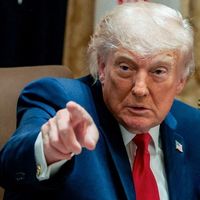
President Donald Trump warned in his State of the Union address on Tuesday night that Tehran is working on the development of advanced missiles that could eventually reach the United States.
“They've already developed missiles that can threaten Europe and our bases overseas, and they're working to build missiles that will soon reach the United States of America," the President said during his address.
The remarks come ahead of upcoming negotiations between Tehran and Washington in Geneva over Iran’s disputed nuclear program and concerns over the country’s expanding missile arsenal.
“They were warned to make no future attempts to rebuild their weapons program, in particular nuclear weapons,” he said, adding, “Yet they continue starting it all over, and are this moment again, pursuing their sinister ambitions.”
Reaffirming Washington’s longstanding position, Trump pledged that the Islamic Republic would not be allowed to obtain a nuclear weapon — a moment that drew visible bipartisan reaction in the chamber, with lawmakers from both parties rising as he reiterated the policy.
The president stressed that negotiations with Tehran were ongoing but warned the United States remained prepared to act if necessary.
For weeks, Trump has pointed to a large US naval buildup near Iran, including two aircraft carriers and multiple warships positioned in the region. Analysts say the scale of the deployment is comparable to past major US military operations, with advanced warplanes and strike capabilities in place.
“We are in negotiations with them. They want to make a deal, but we haven't heard those secret words ‘we will never have a nuclear weapon,” he said.
‘32,000 killed’
During the address, Trump also acknowledged the massacre that followed recent nationwide protests calling for an end to the Islamic Republic.
“And just over the last couple of months, with the protests, they've killed at least it looks like 32,000 protesters in their own country,” he said, adding that authorities had “shot them and hung them.”
“For decades since they seized control of that proud nation, 47 years ago, the regime and its murderous proxies have spread nothing but terrorism, death and hate,” Trump said.
Trump also referenced the US killing of Iranian commander Qassem Soleimani in 2020 during his first term.
“We took out Soleimani. I did that during my first term. Had a huge impact. He was the father of the roadside bomb.”
President Donald Trump said in his State of the Union address that Iran is pursuing missile and nuclear weapons programs despite past US efforts to stop them.
Trump said the country had already developed missiles capable of threatening Europe and US bases overseas, and was working on missiles that could reach the United States.
“They were warned to make no future attempts to rebuild their weapons program, in particular nuclear weapons. Yet they continue, starting it all over,” he said.
Trump added that the US is negotiating with Tehran, but he has not heard “the secret words: ‘We will never have a nuclear weapon.’ That is my preference.”
Trump highlighted a US military operation last June, which he called a “breakthrough” that obliterated Iran’s nuclear weapons program on Iranian soil, known as Operation Midnight Hammer. “For decades, it had been the policy of the United States never to allow Iran to obtain a nuclear weapon,” he said.
Trump also criticized the Iranian government and its proxies for spreading “terrorism, death and hate” since taking power 47 years ago. He accused them of killing and maiming thousands of American service members and hundreds of thousands — even millions — of civilians with roadside bombs, calling them “the kings of the roadside bomb.”
Trump said US actions during his first term, including taking out a key figure known as the father of the roadside bomb Ghassem Soleimani, had a “huge impact.”
Trump said the US is still negotiating with Tehran but said he has not heard “the secret words: ‘We will never have a nuclear weapon.’ That is my preference.” He added, “As president, I will make peace wherever I can, but I will never hesitate to confront threats to America wherever we must.”