Pressure by Iranian authorities on women footballers has intensified following resignations from the national team in protest at the quashing of nationwide protests with deadly force, people familiar with the matter told Iran International.
Security forces have used threats against players’ families and relatives, contract deductions and exclusion from team training to silence top-league players, sources said.
Authorities have also sought to pressure athletes by offering inducements to some individuals to monitor their teammates, while female players have been threatened with judicial action and long prison sentences if they express support for the protests, the sources added.
Football federation officials have meanwhile warned players that reacting publicly to the killings could result in multi-year bans from professional football activity, according to the sources.
The measures are aimed at preventing women footballers from expressing solidarity with the protests or participating in related commemorations, the sources said.
The pressure campaign follows the resignations of two players from Iran’s women’s national football team — Zahra Alizadeh and Kosar Kamali — in protest at the crackdown on nationwide protests in early January which left at least 36,500 dead.
Alizadeh, a national team player who competes for top-flight club Gol Gohar Sirjan, was the first athlete to step down from the squad. Kamali, a player for Ista, later announced her withdrawal from the national team in a social media post.
Niloufar Mirkarimi, a futsal referee operating under Iran’s football federation, also resigned from officiating, widening the protest beyond players to officials within the sport.
Posts announcing the resignations of Alizadeh and Kamali were removed from their Instagram pages hours after publication, according to people familiar with the matter.
Any protest-related posts or social media stories published by players have faced immediate security repercussions, the sources added.


Iran is entering a phase of persistent unrest, driven by decentralized “minor triggers” and deepening economic and legitimacy pressures that repression alone may no longer contain, senior analysts said at Iran International's townhall in Washington DC.
Iran experienced in January its most widespread and sustained unrest since the founding of the Islamic Republic, as protests spread across cities and provinces and authorities responded with an escalating crackdown that analysts say reflects a deepening crisis of legitimacy at the core of the state.
Speaking during a special Iran International Insight town hall on Wednesday, experts said the scale, persistence and decentralization of the unrest signal a structural rupture between state and society - one repression alone may no longer be able to contain.
In what participants described as one of the harshest security responses in recent years, tens of thousands have been killed, detained or interrogated. Rather than restoring order, panelists argued, the severity of the crackdown underscores mounting anxiety within the leadership about the durability of its authority.
A widening legitimacy gap
Political scientist Mohammad Ghaedi said each protest cycle deepens what he described as a structural legitimacy deficit.
“In democracies, when we ask why leaders should rule, the answer is because they are elected by the nation,” he said. “But if you ask that question of Iranians, there is no clear answer — because 47 years ago, Ayatollah Khomeini deceived the nation.”
According to Ghaedi, the leadership is fully aware of this vulnerability.
“They have to respond in a way that makes the nation unwilling to protest again. That explains the brutality of the repression,” he said.
From mega-triggers to permanent volatility
Bozorgmehr Sharafedin, a senior Iran analyst and Head of Digital at Iran International, said the protest landscape has fundamentally shifted.
“Iranian society has wisely moved from demonstrations triggered by mega-triggers to minor triggers,” he told the panel moderated by Gelareh Hon. “Minor triggers are very difficult for the government to contain because they're not centralized, they're unpredictable and they're emotionally charged.”
Instead of singular catalytic events driving nationwide mobilization, grievances now simmer across economic, social and political spheres — producing recurring, localized flare-ups that strain security forces and steadily erode the state’s ability to project control.
Sharafedin framed the crisis around three central actors: Ali Khamenei, Donald Trump and the Iranian public.
“The social contract between Khamenei and the people has expired,” he said. “Either the Supreme Leader reaches a deal with Trump at the expense of the people, or Trump sides with the people against the Islamic Republic. In both scenarios, Khamenei loses,”
Economic hardship and ideological erosion
Mohammad Machine-Chian, a senior journalist at Iran International and a former researcher at the University of Pittsburgh, argued that the unrest reflects both deep economic distress and mounting ideological rejection.
“Demanding a normal material life is in and of itself a rejection of Khomeinism — the whole ideology of the Islamic Republic, which prescribes abandonment of material life and demands sacrifice for the state” he said.
He cited soaring prices as a daily pressure reshaping public sentiment.
“Inflation is nearly 60%. Food inflation is about 72%. If we go deeper, it gets uglier — cooking oil around 200%, and red meat over 100%. This is the reality people are dealing with.”
Beyond inflation, he said, the regime’s traditional pillars are weakening. The Islamic Republic was historically sustained by an alliance between the bazaar and the mosques — institutions that once anchored its social legitimacy.
“The bazaar is finally breaking completely with the Islamic Republic,” he said. “Mosques now have detention centers. They no longer serve a social or civil purpose in Iranian society.”
Panelists also highlighted what they described as a significant psychological shift within society: foreign assistance, once politically taboo, is now openly debated.
Audience questions addressed policy trade-offs in the United States, concerns in Turkey over possible regional escalation, and the apparent weakening of Tehran’s regional proxy network.
The town hall concluded that the Islamic Republic faces converging pressures — eroded legitimacy, weakened institutions, economic deterioration and a society increasingly detached from the ideological foundations of the state. While repression may buy the leadership time, panelists said it no longer restores authority or rebuilds public consent.
Iranian courts sentenced Christians to more than 280 years in prison in 2025, according to a joint report by four rights groups, in what advocates describe as a widening use of national security laws to suppress religious dissent.
The findings reveal a sharp escalation in repression as authorities increasingly label those who leave Islam as "security threats" and "Mossad mercenaries" following regional conflicts.
The report, titled "Scapegoats" and released on Thursday, documents 254 arrests in 2025, nearly double the number recorded the previous year. Rights advocates say the surge reflects a strategic shift by the Islamic Republic to use national security frameworks to crush religious dissent.
"The Islamic Republic is a religious apartheid state where non-recognized minorities like Christian converts are not considered citizens but just 'ghosts' in the eyes of the regime," said Fred Petrossian, an Iranian-Armenian researcher and journalist specializing in religious minorities, based in Brussels, who collaborates with Article 18.
The study was a collaborative effort by Article 18, Open Doors, Middle East Concern (MEC), and Christian Solidarity Worldwide (CSW).

Regional tensions fuel domestic raids
The report describes the 12-day war with Israel in June 2025 as a "pivotal moment" for domestic targeting. In the single month following the June 24 ceasefire, at least 54 Christians were detained across 19 cities.
Petrossian told Iran International that the state has moved to "choke the freedoms" of converts by framing their faith as an extension of foreign hostility.
"A religious holiday becomes criminalized when it represents both faith and collective identity outside state-approved boundaries," Petrossian said.
He pointed specifically to Christmas, which in recent years has gained wide popularity among ordinary Iranians despite official disapproval from clerics.
Shops in major cities openly sell Christmas trees and decorations, cafés display festive themes, and large crowds, many of them Muslims, gather outside churches such as those in Tehran and Isfahan.
Authorities, however, often respond to private Christmas gatherings of converts with raids, arrests, and intimidation.
Petrossian added that the struggle for Christian freedom in Iran is inseparable from the broader fight for human rights and civil liberties for all citizens.
He said that at least 19 Christians have lost their lives in the recent violence and unrest, reflecting how deeply intertwined religious persecution is with the wider crackdown affecting the Iranian society.
Authorities have increasingly weaponized Article 500 bis of the penal code, which criminalizes "propaganda contrary to the holy religion of Islam". The report found that nearly 90% of all charges against Christians in 2025 were brought under this amended article, which carries sentences of up to 10 years.
Systematic mistreatment in detention
The report paints a horrifying picture of the conditions faced by converts in the Iranian prison system, including psychological torture and the deliberate denial of healthcare.


The 'two-tier' propaganda machine
Petrossian pointed to a "two-tier" system where the state uses recognized ethnic Christians, such as those of Armenian or Assyrian descent, to project an image of tolerance while criminalizing the larger community of converts.
While ethnic Christians may worship in their own languages, they are strictly prohibited from preaching in Persian or welcoming converts.
"Recognition does not mean they have all rights," Petrossian said. "The moment members of these communities do not follow the state’s red line, they face repression similar to that experienced by converts."
The Islamic Revolutionary Guard Corps (IRGC) has taken an increasing role in these crackdowns, often acting with more brutality than traditional intelligence agencies.
In February, 20 plainclothes IRGC agents raided a gathering in Gatab – a town in Mazandaran province where they reportedly tore cross necklaces off several people and blocked emergency medical personnel from assisting the injured.
"IRGC agents go to homes without a legal warrant and arrest people. They say obscene and offensive things and insult and humiliate them," one convert testified in the report.
Petrossian added that the state’s efforts to control even personal life create a "dystopian system" where religious holidays like Christmas are criminalized because they represent a "collective identity outside state-approved boundaries".
The report concludes by calling on the international community to hold Iran accountable under Article 18 of the ICCPR, which guarantees the freedom to adopt and practice a faith of one's choosing.
Student walkouts at schools across Iran this week underscored the continuing political presence of a younger generation that has remained deeply engaged despite months of arrests and repression.
The action, observed in numerous high schools and junior-high schools, followed a call earlier in the week by the country’s teachers’ union—one of the few remaining independent professional bodies whose members and leaders repeatedly face summons, detention and imprisonment.
The union had urged students and educators to honor those killed during the January protests, many of whom were themselves teenagers or in their early twenties.
Human rights organizations and media reports indicate that young people made up a significant share of those killed, wounded or detained during the crackdown, reinforcing the central role of Generation Z in Iran’s protest movement.
Videos circulating online on Wednesday appeared to show students—many of them girls—refusing to attend classes and instead gathering in schoolyards to sing patriotic songs in apparent solidarity with the victims.
Justice Minister Amir Hossein Rahimi acknowledged this week that a number of minors remain in detention in connection with the protests, adding that authorities were working to secure the release of some underage detainees.
At the center of unrest
Iran’s Generation Z has played a visible role in successive waves of unrest, including the nationwide protests of recent years.
Lists compiled by human rights organizations indicate that a large share of those killed or arrested were under 30, including university students and minors.
The involvement of younger Iranians reflects both demographic realities and deeper social changes.
Iran’s Generation Z has grown up during a period defined by economic instability, international isolation and increasing social restrictions. These conditions have shaped their expectations and political outlook in ways that differ from earlier generations.
A distinct identity
In a recent commentary published in the reformist newspaper Etemad, political analyst Abbas Abdi argued that Iran’s younger generation faces “multiple layers of pressure,” reflecting economic hardship, social constraints and limited political representation.
He identified several sources of tension, including declining economic opportunities, widening gaps between official norms and social realities, and what he described as the political marginalization of younger citizens.
These pressures, he wrote, have contributed to a growing sense of disconnection between younger Iranians and the country’s political establishment.
Abdi also emphasized that Generation Z is the first generation in Iran to grow up fully connected to digital networks, with access to global information and alternative sources of identity formation.
This shift has altered traditional patterns of socialization and authority. Younger Iranians are often less receptive to hierarchical forms of political messaging and more inclined toward decentralized and informal forms of expression and mobilization.
The outlook
While the state retains significant coercive capacity, the persistence of youth participation in protests suggests that underlying social and generational tensions remain unresolved.
Abdi warned that failure to address these generational pressures could deepen long-term instability, arguing that sustainable political order ultimately depends on the ability of governing institutions to adapt to social change.
The student walkouts this week, though limited in scope, reflected the enduring political consciousness of a cohort that has come of age during one of the most turbulent periods in Iran’s recent history—and whose role is likely to remain central in shaping the country’s political trajectory.
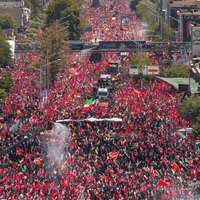
Forty days after more than 36,500 protesters were killed in a two-day crackdown in January, Iranians are marking the traditional chehelom not only in cemeteries but also in the streets and hospitals where the dead fell – a scale of loss that is reshaping how the country mourns.
In Iranian culture, the fortieth day after a death is a solemn threshold. Families and friends traditionally gather at the grave, laying flowers, reciting prayers and receiving visitors – a ritual of grief that is both private and communal, and that often carries religious undertones.
This week, cemeteries were only part of the picture as mourners map memory onto the sites of violence. With so many deaths concentrated in urban centers and around hospitals, intersections and residential streets, memorials have spread outward from cemeteries into the everyday fabric of cities.
Videos sent to Iran International and others circulating on social media show flowers placed not only on graves but on asphalt, sidewalks and hospital entrances – at the very spots where protesters were shot.
In Shiraz, relatives and close friends of Hamidreza Hosseinipour covered the boulevard where he was killed in petals. In Tehran’s Sadeghieh Square, citizens gathered at the traffic circle where demonstrators had been shot, laying flowers in what is normally a site of rush-hour congestion.
In Tehranpars district of the capital, mourners placed flowers and candles outside a hospital where wounded protesters were taken and where some died.
In Mazandaran province, black balloons were released into the sky.
Schools, too, became sites of commemoration. Videos show groups of schoolgirls lighting candles and singing patriotic songs, marking the chehelom inside classrooms rather than in mosques.
The sites of commemoration have widened beyond the places where many Iranians once expected mourning to unfold. Where people believe their loved ones fell, they now leave photographs, flowers or pieces of clothing.
Pavements become shrines. Traffic circles are transformed into temporary altars. Hospital gates turn into gathering points. The geography of grief has changed.
There are simply too many dead, and too many sites tied to their final moments, for remembrance to remain confined to cemetery gates.
Even when ceremonies do take place at graves, the atmosphere captured in recent videos differs sharply from older conventions of public mourning, where religious elegies used to set the tone. Today, music and movement have emerged as ways of carrying grief.


At Behesht Zahra cemetery in Tehran, footage shows families gathering and playing traditional musical instruments. In Najafabad, Isfahan province, mourners applauded and played music.
In Zanjan, kites were sent into the sky above the cemetery as names were read out.
In Shahreza, a video shows a traditional Qashqai dance performed during the fortieth-day memorial for 20-year-old Pouria Jahangiri, killed on January 8.
In Qarchak, near Tehran, mourners clapped in time to songs played for Hamid Nik, a resident who died after being hit during the crackdown. In another video from Najafabad, fireworks illuminate the night as people gather and chant.
In Mashhad, the memorial for Hamid Mahdavi – a firefighter whose act of carrying an injured protester on his back had spread widely online – took place not in silence but amid chants in the street: “For every one person killed, a thousand will rise behind them.”
These moments do not erase grief, they translate it.
The scenes appearing in recent weeks suggest a shift: not away from mourning itself, but away from a single, familiar language of mourning. Music, clapping, balloons released into the sky, kites and dance have become part of the ritual vocabulary.
After decades in which public mourning was steeped in official religious symbolism, the scenes in recent weeks suggest some are shaping something different: a mourning that is national in tone, public in form, and edged with defiance.
The fortieth day has long been a marker of closure in Iranian tradition – a moment when visitors thin out and life, at least outwardly, resumes.
But with flowers now laid on asphalt and candles lit at hospital doors, the boundary between mourning and daily life has blurred. The city itself has become the setting of remembrance – and, for many, the proof of how profoundly the culture of grief is changing.
A man who says he was deployed during Tehran’s January crackdown describes watching protesters shot and helping load bodies into refrigerated trucks, including a little girl whose earrings had been taken before her body was thrown inside.
Kazem, a 40-year-old Tehran resident, says he was present as part of the state’s repression apparatus during two nights of mass violence, January 8 and 9.
He says he had previously spent a relatively long time in detention by the IRGC Intelligence Organization and was released after promising cooperation. He maintains that he did not kill anyone and that he fired only into the air.
His account, given in an extended interview, offers a detailed insider description of how forces were assembled, armed and deployed.
Certain personal and operational details are not being published for security reasons.
The call-up
Kazem says that on the afternoon of January 7, while returning home from work, he received a call from a security contact instructing him to report to the IRGC’s Vali-e Asr garrison at 10 a.m. the next morning.
The compound houses intelligence operations for Tehran province and coordinates deployments of security and plainclothes forces across the capital.
“I assumed it was related to Pahlavi’s call for January 8 and 9,” he said.
He says dozens of men were present when he arrived, some of whom he had seen during previous security mobilizations.
“There were two types of people,” he said. “Some looked like office employees or shopkeepers – probably like me, under their knife – and others looked like thugs and hooligans. Those were especially violent.”
Roughly 50 to 60 men were taken into a hall, he says, where an intelligence official outlined the “possibility of unrest” and said they would assist in “controlling riots.”
Those without firearms experience received brief weapons instruction. Pre-prepared authorizations were distributed for Kalashnikov rifles, handguns and ammunition.
“The document I received was a temporary mission order,” he said, “on the letterhead of the Mohammad Rasoulallah Corps” – the IRGC’s main Tehran command, responsible for coordinating IRGC Ground Forces and Basij operations in the capital – signed by a senior operations official at the Imam Ali headquarters, a Basij-affiliated security structure created to respond to street protests and internal unrest.
“I received a weapon from the armory and was told to report at 5 p.m. to the Qods Basij Resistance Base in Jannat Abad, northwestern Tehran”
From there, he says, groups were assigned geographic zones. Some moved two by two on motorcycles; others in Toyota Hilux or Peugeot vehicles. He says he was deployed to western Tehran before 8 p.m.
Hunting leaders and death ambushes
Kazem describes Sadeghieh, a bustling northwestern neighborhood of the capital, as one of the primary confrontation zones.
He says he observed what he calls two distinct operational patterns.
The first he describes as “hunting leaders.”
According to Kazem, experienced intelligence operatives infiltrated protest crowds while appearing to join demonstrators. Their task, he says, was to identify individuals perceived as organizers or focal points – often those who appeared physically fit or athletic.
“After identifying targets, at an opportune moment – such as in dark streets where lights had been cut – they would shoot them from behind at close range with handguns,” he said. “Or they would communicate with snipers stationed on nearby rooftops, giving descriptions of clothing so the target could be shot.”
He says rooftop snipers were positioned on multiple buildings in the area.
The second pattern, he says, involved steering crowds into enclosed spaces.
“They would drive and direct frightened people into dead-end alleys or places already under control,” he said. “This pattern was repeated many times Friday night in the part of Tehran where I was. The goal was to kill as many as possible. No one was meant to be arrested there. Many fell into ambushes and were killed.”
Multiple videos sent to Iran International, along with documented reports published by outlets including Reuters and verified by Amnesty International, indicate that snipers were positioned on rooftops – including on top of a police station – and fired at protesters’ heads and upper bodies.
One eyewitness told Iran International that on Sunday morning, January 11, even after municipal water trucks had washed the streets, blood traces were still visible along Ashrafi Esfahani Street in Sadeghieh.
According to information shared with Iran International, during an emergency meeting with Tehran medical officials on the morning of January 9, a senior health official said that aggregated figures from the city’s treatment centers up to that point showed at least 1,800 people had been killed in the crackdown on the evening of January 8.
Finishing shots
Kazem describes encountering injured protesters in southern Tehran in the early hours.
In one instance, he says, he approached a man who had lost a significant amount of blood.
“He pleaded, ‘I have a small child, don’t shoot,’” Kazem recalled.
“I told him to pretend to be dead so they wouldn’t give him a coup de grâce,” he said.
Minutes later, he says, a motorcycle stopped beside the wounded man.
“The officer kicked him to confirm he was alive, then shot him in the head at close range.”
Killing children and refrigerated trucks
Kazem says children were among those killed. Based on what he says he personally observed in Sadeghieh and in one southern Tehran district, he estimates that at least 200 children died over the two nights.
He says bodies were collected using refrigerated trucks belonging to the Mihan ice cream company, similar to methods he says were used during earlier protests.
“Like in the 2022 protests, refrigerated Mihan ice cream trucks were used,” he said. “I personally helped load corpses.”
According to Kazem, the trucks were used to remove bodies from streets and transport them to undisclosed locations.
He describes a scene that remains vivid to him.
“We were loading bodies into a Mihan truck when I saw the man next to me tear the necklace and earrings off a 9- or 10-year-old dead girl before throwing her into the truck. I looked at him in fear.”
Kazem says he did not intervene and continued loading bodies.
Reports suggest the removal operation was systematic.
Iran Human Rights said in a report published on February 3 that, citing an eyewitness in Lorestan province, security forces transported the bodies of those killed in refrigerated Mihan ice cream trucks to the courtyard of a hospital in the province.
Iran International contacted Mihan to ask whether the company’s trucks were used to move bodies during the January 8-9 protests and whether the company confirmed the account. No response had been received by the time of publication.
France 24 and Amnesty International’s Switzerland office have also reported the use of food transport vehicles and containers to move the bodies of those killed.
Burning property and foreign forces
Kazem says he personally witnessed security personnel setting fire to banks and mosques after first clearing valuables.
“They would first evacuate valuables before burning the site,” he said. “I personally witnessed instructions to remove valuable items from a mosque before it was set on fire.”
He also says he saw a small number of fighters affiliated with Iraq’s Popular Mobilization Forces in Sadeghieh on the first night.
“The absolute majority were IRGC, plainclothes, Basij and security forces,” he said. “But I did see a small number of Hashd al-Shaabi.”
In the areas where he was present, he says regular police and special units appeared less directly engaged in lethal force.
“I think they weren’t prepared for killing on that scale,” he said.
Media reports have confirmed a limited presence of Hashd al-Shaabi forces in some areas during the crackdown. Videos from inside Iran also suggest that damage to public property was carried out by security forces footage – that several outlets, including Le Monde, have verified.
Payment for the dead
Kazem says he returned his weapon to the Vali-e Asr garrison on Saturday morning and was no longer required.
He says that afterward he heard from contacts that families seeking the bodies of loved ones were sometimes required to pay money, calculated according to neighborhood and reported property damage.
“They couldn’t charge everyone for bullets,” he said. “But when they did, it was based on how much damage the neighborhood had suffered.”
Iran International has documented in multiple reports that authorities extorted money from bereaved families in exchange for returning the bodies of their loved ones.
Kazem’s narrative adds another piece to the picture: January 8 and 9 were not reactive policing, but a coordinated, military-style campaign designed to crush protests with deadly force.