Sam Afshari, 17, was shot during protests in Karaj and later killed in hospital, according to his father, who says security forces fired the fatal shot.
The breathing tube was already in his mouth when, according to his father, the final shot was fired. It is one of many accounts emerging from Iran’s January protest crackdown.
Seventeen-year-old Sam Afshari had been taken to Madani Hospital in Karaj, near Tehran, after being shot on January 8 during protests near Mehran Square in the city’s Azimieh district. Witnesses later told his family that doctors were attempting to save him and that he was still conscious when asked his name.
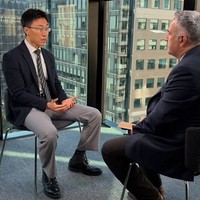
“He had the breathing tube in his mouth. They came and shot him. A final bullet,” his father, Parviz Afshari, told Iran International’s English podcast Eye for Iran.
That day, protests spread across Iran as demonstrators took to the streets demanding an end to the Islamic Republic. Sam was among them.
“They went for a free Iran,” Parviz said. “They went out to protest with bare hands. But they returned to their families with bullets in the back of the head and bullets in the back.”
Sam was his only child—an unimaginable loss, his father said, that many Iranian families are now struggling to understand and explain.
Sam Afshari as a toddler in Iran.
Sam was born in 2008 in Karaj and had turned 17 just weeks before his death. He was studying computer networks and hoped to continue his education abroad.
“This year he was supposed to come here so we could sort out his papers,” his father said, speaking from Germany. “He wanted to continue his studies, go to university and study computer engineering.”
His father described him as cheerful and ambitious.
“He joked a lot. We laughed so much,” Afshari said. “We were always in video contact, talking about the future.”
“I don’t think he went out because of poverty,” he added. “He went out because of his beliefs. He wanted democracy and the right to speak his mind.”
According to accounts later gathered by the family, Sam was shot from behind near a security police post at Mehran Square. Residents in a nearby apartment building attempted to pull the wounded teenager into their parking area to protect him.
Security forces arrived shortly afterward and took him away, his father said.
“They took my child with them.”
A hospital employee later informed the family that Sam had been transported to Madani Hospital along with other injured protesters. Witnesses told relatives that when medical staff asked his name, he answered “Sam,” indicating he was still conscious.
Hours later, he was dead.
"At the hospital they finished him off with a shot to the back of the head. The bullet came out through his cheek," Parviz said.
Because internet access had been cut during the unrest, Afshari said he did not learn what had happened until days later, when communication was briefly restored. Family members searched hospitals and morgues before his brother located the name “Sam Afshari” on a list of the dead at Beheshte Sakineh morgue in Karaj.
When Sam’s mother was brought to identify the body, she initially could not recognize him because of severe injuries.
“One side of my child’s face was destroyed,” Afshari said. “The back of his head too.”
She confirmed his identity only after asking officials to uncover a tattoo on his chest bearing the word “Mother” written in Latin script.
“When they saw the tattoo, they realized, yes, tragically — it was Sam.”
According to the family, authorities initially ordered that Sam be buried quietly at night in a remote area. After negotiations and payments, relatives secured permission to bury him closer to Karaj, but cemetery space was scarce.
“There were so many graves,” his father said. “They said there was simply no space.”
At Kalak-e Bala cemetery in Karaj, Sam was buried above another young protester because burial plots were already filled.
“Under his grave there is another martyr, Amir Bayati, and above is my son, Sam Afshari,” Afshari said.
Relatives described morgue halls crowded with bodies and refrigerated trucks waiting outside — scenes they said reflected the scale of deaths families were confronting in the days after the crackdown.
'He wanted a free Iran'
As the interview continued, Afshari’s grief gave way to anger and appeals for accountability.
“This is no longer the time for my tears. Now I feel rage,” he said. “If nothing happens, the blood of our children will be trampled. Our people—90 million human beings—are now hostages. Hostages of the Islamic Republic.”
He urged the international community not to remain silent. “The terrorist Islamic Republic must be brought to an end,” he said.
Throughout the interview, he returned repeatedly to the future his son never had.
“He had so many dreams, and I had so many dreams for him,” he said. “We buried this child with thousands of dreams.”
For Afshari, the story ends where it began—with a teenager who left home hoping for a different future. “He went for a free Iran,” his father said. “And we buried him instead.”