Protesters back in Tehran streets despite crackdown, eyewitness says
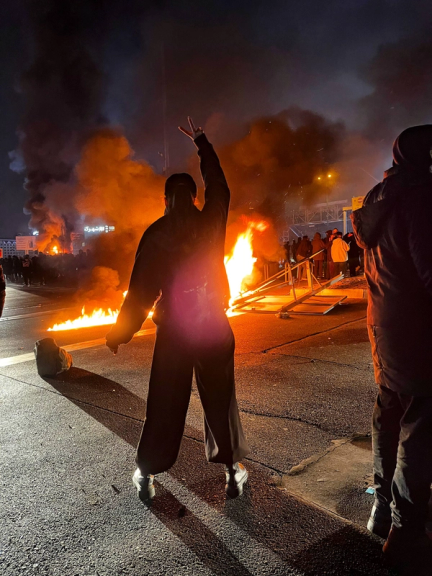
An eyewitness report from Tehran shows widespread protests continued on Friday night, marked by chants of “Death to the dictator,” the torching of police and IRGC vehicles, gunfire by IRGC forces, blocked streets, and nonstop car horn honking.
"The internet has been completely shut down, card payment terminals are not working, phone calls are impossible, and only Rightel users are able to send text messages," the eyewitness told Iran International.






Dozens of people have been killed in protests across Iran in recent days, according to human rights groups and witness accounts, with the full scale of casualties from Thursday night still unknown after authorities imposed a nationwide internet blackout.
Before communications were cut, Iran Human Rights, a Norway-based monitoring group, said at least 45 protesters had been killed between December 28 and January 8, and that more than 2,000 people had been arrested.
Those figures are likely to rise following Thursday’s nationwide protests and reports of further unrest on Friday night, but verification has become increasingly difficult as images and firsthand accounts from inside Iran have largely disappeared.
One video that circulated online on Thursday appears to show at least seven bodies lying on the ground in what looks like an underground parking area.
The footage, which has not been independently verified, is said by the narrator to have been recorded in Fardis, near the city of Karaj, west of Tehran. The narrator claims the victims were killed by live fire.
Warnings from the top
Supreme Leader Ali Khamenei, who has appeared rarely in public since last month’s 12-day war, addressed the nation on Friday, a day after the mass protests. He referred to demonstrators as “saboteurs” and said he would not retreat in the face of unrest.
Soon afterward, the Secretariat of Iran’s Supreme National Security Council issued a statement warning that security forces and the judiciary would show “no leniency toward saboteurs.”
Similar statements later issued by the national police force and the Revolutionary Guards’ intelligence arm described the protests as a “joint design” by Israel and the United States to undermine Iran’s security and vowed retaliation.
The remarks heightened concerns among activists and rights groups that the authorities were preparing for further violent crackdowns.
Recasting the dead
Alongside the use of force, Iranian authorities have in several cases sought to portray slain protesters as government supporters or as victims of protesters’ violence—a pattern seen in previous waves of unrest.
One such case involved Amir-Hessam Khodayari, 22, who was wounded by security forces on December 31 in the western city of Kouhdasht, in Lorestan province, and later died after being transferred to a hospital in the provincial capital, Khorramabad.
Little is publicly known about his education or occupation, but his family is described as working-class Kurds who follow the Yarsan faith, a religious minority.
The Revolutionary Guards issued a statement describing Khodayari as a member of the Basij, a pro-government militia, and as one of the “forces defending security.” State media echoed the claim, and local officials visited his family.
That account was contradicted after his family rejected efforts to identify him as a Basij member.
In a widely shared video, his father is seen telling mourners that his son had been a protester. Other videos showed crowds forcing security forces to retreat from his funeral, despite attempts by authorities to control the ceremony.
Family members and activists said they faced pressure, including threats to withhold his body and offers of financial compensation, to accept the official version of events.
A similar pattern was documented during the 2022 Woman, Life, Freedom protests, including in the case of Hamid-Reza Rouhi, another protester initially portrayed by authorities as a Basij member after his death.
Many more to come?
Another recent case involved Shayan Asadollahi, 28, who was killed in the city of Azna, also in Lorestan province. Authorities withheld his body for five days, pressuring his family to say he had been a Basij member or that he had died in a traffic accident.
He was eventually buried quietly in the remote village of Deh Haji.
Asadollahi worked as a hairdresser and was the sole breadwinner for his mother and sister after his father died in an accident last year. Friends described him as an avid supporter of the Persepolis football club.
Like many young Iranians, he was active on Instagram, where he shared photos of his work, daily life and football fandom—an online presence that fell silent after his death.
The stories that have emerged so far may represent only a fraction of what occurred, with many more accounts expected to surface if and when full internet access is restored.
Millions of Iranians filled streets across the country on Thursday, the 12th day of nationwide protests.
In videos sent to Iran International, dramatic scenes were shown, including the burning of signs and statues of late Quds Force commander Qassem Soleimani, as well as vehicles and buildings.
"I am deeply disturbed by reports of violence during nationwide protests in Iran over the past 13 days, including reported deaths and destruction of property," UN Human Rights chief Volker Türk said in a statement on Friday.
"The right to peaceful protest, as enshrined in international law, must be protected. All deaths should be promptly, independently, and transparently investigated. Those responsible for any violations must be held to account in line with international norms and standards."
Türk said he is concerned by reports of nationwide internet and communications shutdowns.
"Such actions undermine freedom of expression and access to information, as well as impacting on the work of those documenting human rights violations, and access to essential and emergency services."
A disturbing video circulating on social media shows several people lying motionless on the ground following massive protests held on Thursday night in Fardis, 25 miles west of Tehran.
The footage was reviewed by the Iranian fact-checking platform Factnameh, which said the videos are authentic, newly recorded, and had not previously appeared online.
At least seven people can be seen in the footage lying on the ground. The condition of some of them appears critical, though there has been no official confirmation of casualties during the crackdown on protests on Thursday.
Factnameh also said at least one additional video from protests in the streets of Fardis shows demonstrators coming under live fire.
Iranian exiled Prince Reza Pahlavi on Friday issued an urgent appeal for US President Donald Trump’s support, warning that a total internet shutdown in Iran could pave the way for a deadly crackdown on protesters.
"Mr. President, this is an urgent and immediate call for your attention, support, and action," Prince Pahlavi said in a post on X on Friday.
"Last night you saw the millions of brave Iranians in the streets facing down live bullets. Today, they are facing not just bullets but a total communications blackout. No Internet. No landlines."
"Ali Khamenei, fearing the end of his criminal regime at the hands of the people and with the help of your powerful promise to support the protesters, has threatened the people on the streets with a brutal crack down. And he wants to use this blackout to murder these young heroes," the prince warned.
He said Trump's threat to intervene if the Islamic Republic kills protesters "has also kept the regime’s thugs at bay. But time is of the essence."
"The people will be on the streets again in an hour. I am asking you to help. You have proven and I know you are a man of peace and a man of your word. Please be prepared to intervene to help the people of Iran."