• العربية
  • فارسی
Brand
  • Iran Insight
  • Politics
  • Economy
  • Analysis
  • Special Report
  • Opinion
  • Podcast
  • Iran Insight
  • Politics
  • Economy
  • Analysis
  • Special Report
  • Opinion
  • Podcast
  • Theme
  • Language
    • العربية
    • فارسی
  • Iran Insight
  • Politics
  • Economy
  • Analysis
  • Special Report
  • Opinion
  • Podcast
All rights reserved for Volant Media UK Limited
volant media logo

Iran hits back at G7 over call for US talks, Ukraine accusations

Nov 13, 2025, 19:45 GMT+0Updated: 23:56 GMT+0
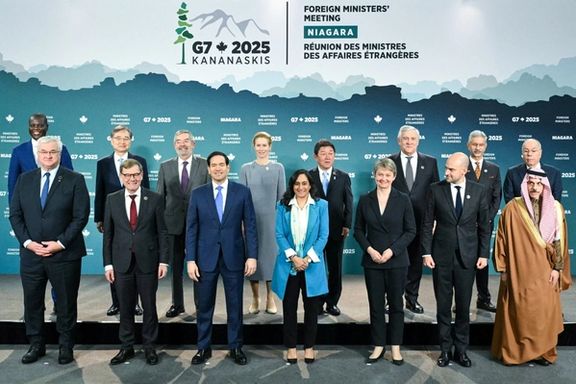
Delegates pose for a photo at the G7 foreign ministers meeting, in Niagara-on-the-Lake, Ontario, Canada, November 12, 2025.

Iran on Thursday rejected the Group of Seven foreign ministers’ final statement, accusing the bloc of lying about Iranian nuclear activities and alleged support for Russia's war in Ukraine.

In a joint statement on Wednesday, the G7 grouping of wealthy democracies (Canada, France, Germany, Italy, Japan, the United Kingdom and the United States) urged Tehran to resume full cooperation with the UN nuclear watchdog and to engage in direct talks with the United States.

Foreign Ministry spokesman Esmail Baqaei called the request "duplicitous and interventionist", saying the G7 had ignored what he described as years of unlawful pressure and military actions by the United States and Israel.

“The United States, because of its unlawful and unilateral withdrawal from the Joint Comprehensive Plan of Action (JCPOA) in 2018 and its military attack on Iran’s peaceful nuclear facilities, is the main party responsible for the current situation,” he said, referring to Tehran's 2015 nuclear deal with world powers.

He added that the three European parties “followed Washington's suit, failed in implementing their commitments and dismissed all of Iran’s diplomatic initiatives with clear bad faith.”

Tehran and the United States engaged in five rounds of negotiations before Israel launched a surprise military campaign on Iran in June. The attacks were capped off by US strikes on Iranian nuclear sites.

The negotiations have not resumed despite US entreaties.

Baqaei also criticized the G7's backing of the European move to trigger the snapback mechanism under the UN Security Council Resolution 2231 which led to the restoration of UN sanctions on Iran in late September.

“The repetition of the irresponsible position of G7 member states in endorsing the unlawful and unjustified action amounts to endorsing an internationally delinquent act,” he said.

The G7 communiqué called on UN member states to adhere to their obligations following what the ministers referred to as the legal activation of the mechanism.

Ukraine war

The Iranian spokesman rejected the G7’s allegation that Iran is supplying military assistance to Russia.

“The Islamic Republic of Iran has no involvement in the Ukraine conflict,” he said. “Those who accuse others should correct their own mistaken policies on global peace and security instead of insisting on a sense of superiority.”

The G7 ministers condemned what they called the provision of military assistance to Russia by North Korea and Iran, reaffirming support for Ukraine’s territorial integrity.

Iranian-designed drones have been key to Russia's war effort against Ukraine. However, Tehran has long denied it provides any military support for the Russian war efforts, insisting that the drones had been supplied before the Ukraine war started.

Most Viewed

Iran diplomacy wobbles as factions compete to avoid looking soft on US
1
INSIGHT

Iran diplomacy wobbles as factions compete to avoid looking soft on US

2
ANALYSIS

The politics of pink: how Iran uses cuteness to rebrand violence

3

Scam messages seek crypto for ships’ safe passage through Hormuz, firm warns

4
EXCLUSIVE

Family told missing teen was alive, then received his body 60 days later

5
TEHRAN INSIDER

The future has been switched off here

Banner
Banner

Spotlight

  • Diplomacy tolls at Hormuz as conflict returns to its doorstep
    OPINION

    Diplomacy tolls at Hormuz as conflict returns to its doorstep

  • Opposition to US talks grows in Tehran as ceasefire deadline nears
    INSIGHT

    Opposition to US talks grows in Tehran as ceasefire deadline nears

  • Tehran moderates see ‘no deal–no war’ limbo as worst outcome
    INSIGHT

    Tehran moderates see ‘no deal–no war’ limbo as worst outcome

  • The future has been switched off here
    TEHRAN INSIDER

    The future has been switched off here

  • Lights out, then gunfire: Witnesses recount Mashhad protest crackdown
    VOICES FROM IRAN

    Lights out, then gunfire: Witnesses recount Mashhad protest crackdown

  • Is Iran entering its Gorbachev moment?
    INSIGHT

    Is Iran entering its Gorbachev moment?

•
•
•

More Stories

Guards-linked outlet slams Iran official pictured with Israeli representative

Nov 12, 2025, 12:19 GMT+0

A Guards-linked outlet has criticized an Iranian standards official for sitting at the same roundtable as an Israeli representative at last month’s ISO meeting in Rwanda, warning that such contact could carry legal penalties.

Fars News Agency said the photos showed Farahnaz Ghollasi, deputy head of Iran’s National Standards Organization, seated at the same table as Gilad Golub, chief executive of Israel’s Standards Institution, during the Kigali conference held from October 6 to 10. It said the images, later removed from the ISO website, were verified through its own checks.

The outlet called the encounter “unprecedented” under Iranian policy, noting that law prohibits any contact or cooperation with Israeli institutions and can lead to imprisonment or permanent dismissal from public service. It also recalled that Iranian athletes have long refused to compete against Israelis in international events.

Fars added that the episode came shortly after the June war between Iran and Israel and noted that the sister of Farzaneh Ansari, who led Iran’s delegation to the ISO meeting, was among those killed in Israeli strikes during the conflict.

The agency also repeated earlier conservative criticism of Ghollasi’s appearance at international gatherings, saying she had previously been reprimanded for dress code violations.

Golub’s office told Iran International that he had sat at a shared conference table as part of a multilateral discussion and that “no direct meeting took place.”

It added, “We did not know the woman sitting opposite was Iranian, head covering does not necessarily indicate nationality."

Iran and Israel have no diplomatic ties, and Iranian delegates are typically instructed to avoid any engagement with Israeli representatives. The ISO annual meeting in Kigali brought together officials from more than 160 member states to discuss emerging global standards.

Iran hits back at US call to cut Hezbollah funding

Nov 11, 2025, 19:55 GMT+0

The Islamic Republic’s embassy in Lebanon on Tuesday fired back at remarks made by a top US sanctions official who urged Beirut to cut Tehran's funding to its Lebanese ally Hezbollah.

“There’s a moment in Lebanon now. If we could get Hezbollah to disarm, the Lebanese people could get their country back,” said John Hurley, the US Treasury’s undersecretary for terrorism and financial intelligence, in an interview with Reuters.

"The key to that is to drive out the Iranian influence," Hurley said, "and control that starts with all the money that they are pumping into Hezbollah."

Iran, according to Hurley, has delivered about 1 billion dollars to Hezbollah so far this year despite heavy Western sanctions.

His comments came during a regional tour through Turkey, Lebanon and the United Arab Emirates aimed at raising pressure on Tehran.

The Iranian embassy in Beirut dismissed the statements as “baseless and misleading” in a post on X Tuesday. “In recent days, American nonsense about Iran and its presence in Lebanon and the region has increased."

“It would have been better if American officials, instead of wasting time and being preoccupied with empty words, fulfilled the promises they made years ago to the people of Lebanon," it added, "even if only by helping to find a solution to the electricity crisis.”

“Rather than demonizing Iran and making unfounded accusations, the United States should have curbed the evil of the Israeli regime and its savage, ongoing aggression against Lebanon and its oppressed people,” the statement added.

Hurley’s comments mark Washington’s latest bid to choke off Tehran’s regional influence by targeting Hezbollah’s finances.

The strategy has intensified since Israel’s clash with the group escalated late last year with assassinations of senior and mid-ranking officials and an air and ground campaign which killed over 4,000 people.

Citing people familiar with Israeli and Arab intelligence, the Wall Street Journal reported last month that Hezbollah was rebuilding its weapons and ranks in defiance of a a ceasefire deal.

Israel meanwhile continues to maintain a military presence in outposts on Lebanese territory and has repeatedly carried out deadly airstrikes it says target militants.

Iraq votes under watchful gaze of US and Iran

Nov 11, 2025, 19:05 GMT+0
•
Behrouz Turani

Iraq’s parliamentary election on Tuesday unfolded under the shadow of foreign influence from the United States and Iran which have for two decades vied over the future of the war-battered Arab nation.

Less than half of eligible voters reportedly registered, raising doubts that turnout will reach even 50%. Public disillusionment has depressed participation since 2005, with only two exceptions: the first post-Saddam vote that year and the 2015 election, when turnout neared 80%.

Iranian media outlets, especially those aligned with Tehran’s political factions, have been following the buildup intensely.

Conservative papers and those close to state institutions cast the vote as a measure of Iran’s remaining leverage in Baghdad.

But reform-leaning Rouydad24 cautioned that while Tehran and Washington view the election through a geopolitical lens, Iraqi voters are focused on preserving “fragile stability and economic growth,” a subtle critique of both countries’ roles.

‘Weary people’

Truska Sadeghi, a journalist monitoring the election from Paris, described the November 11 vote as “a fateful test for a country caught between crises ranging from the legitimacy of its governments to the influence of foreign powers.”

Iraqis, she said, have grown weary of “repetitive and ineffective political maneuvers,” while shifting coalitions and Iran’s declining sway in the wider “axis of resistance” have made Baghdad Tehran’s most critical arena.

The United States has repeatedly warned Iran in recent months against meddling in Iraq’s political process, urging Baghdad to distance itself from Tehran.

Iran’s foreign ministry on Monday spoke against what it deemed to be "unacceptable” foreign interference. Iraq’s foreign ministry called the statement “provocative” and urged Tehran not to get involved in the country’s internal affairs.

Despite its diminishing regional clout, Iran remains a central player in the Iraq.

Tehran-aligned groups such as Hashd al-Sha’bi and various Kata’ib factions have rebranded themselves as civilian organizations, even as their armed presence in Baghdad remains visible.

‘Stability’

Analysts including Sadeghi and Frankfurt-based Ali Sadrzadeh argue that Iran-linked networks still wield significant political and economic leverage.

Islamic Revolutionary Guard Corps-Quds Force Commander Esmail Qaani and other senior officers continue to shuttle between Iranian and Iraqi cities, meeting aligned factions to ensure “Iraq’s stability.”

A key test for the next government will be whether it can assert authority over pro-Iranian groups like Hashd al-Sha’bi, which has long sought to position itself as a parallel defense institution.

“It’s a battle over whether Iraq achieves genuine political independence or remains tethered to foreign powers,” Sadeghi said.

Whatever the result, she added, Iraq’s next government will face the same core tasks: bringing armed groups under state control, restoring public trust through credible reforms, and recalibrating relations with Iran, the United States and regional partners.
US seeks new bases near key Iranian port, Khamenei adviser says

Nov 11, 2025, 08:12 GMT+0

The US is trying to set up military bases near Iran’s southern port on the Gulf of Oman to tighten control over regional energy and trade routes, a senior adviser to Supreme Leader Ali Khamenei said on Tuesday.

Ali Akbar Velayati, the adviser on international affairs, said Washington’s plan to expand its presence close to Pakistan’s Gwadar port and along Iran’s southern coast is part of a wider effort to counter China’s growing influence and to secure maritime routes linking South Asia to the Middle East. “The US wants new bases near this vital area to maintain its dominance over regional trade and to contain China’s rise,” he told the official news agency IRNA.

Velayati said the US is facing growing resistance to its presence across several regions, including the Middle East and Asia. He added that Iran, as an independent and influential state, will continue to work with Asian and Islamic nations that oppose what he called Western interference and domination.

  • US sees chance to strip Hezbollah of arms by choking Iran’s cash flow

    US sees chance to strip Hezbollah of arms by choking Iran’s cash flow

  • Iran says it will resist Western pressure even if it means war

    Iran says it will resist Western pressure even if it means war

Tehran steps up backing for allies

Iran’s foreign minister told parliament on Monday that the country has directed much of its diplomatic and political capacity toward supporting what it calls the “axis of resistance,” a network of regional allies opposing US and Israeli influence.

Abbas Araghchi said the ministry had prioritized “security diplomacy” and coordination with allied movements as part of a broader regional strategy. He said recent months have seen intensified confrontation with the United States and Israel, marked by assassinations and airstrikes across the region. “Under these circumstances, a significant portion of the Foreign Ministry’s efforts has been devoted to supporting the axis of resistance, effectively functioning as the foreign ministry of the axis,” he said.

Western governments have urged Iran to limit its backing for armed groups in Lebanon, Iraq and Yemen, saying such support fuels instability. Araghchi said Tehran’s diplomacy also aims to promote a multipolar order and deepen cooperation with blocs such as BRICS and the Shanghai Cooperation Organization.

US sending mixed messages on nuclear talks, Iran deputy FM says

Nov 11, 2025, 07:22 GMT+0

Iran accused the United States of sending mixed signals on reviving nuclear talks, saying the June strikes on its nuclear facilities war undermined ongoing diplomacy and efforts toward a peaceful agreement.

Deputy Foreign Minister Saeed Khatibzadeh told the Abu Dhabi Strategic Debate on Tuesday that Iran was engaged in indirect diplomacy when the attacks took place, calling Washington’s approach a “betrayal of diplomacy.”

He said Tehran still seeks a negotiated resolution to the decades-long nuclear dispute but will not compromise on national security.

Supreme Leader Ali Khamenei, who has final authority on foreign and nuclear policy, has said negotiations with Washington cannot continue under pressure.

Talks between Tehran and Washington, conducted indirectly through intermediaries earlier this year, have stalled since the June conflict, which Iranian officials say shattered trust. Major differences persist over uranium enrichment levels and the lifting of sanctions.

"Tehran is not seeking nuclear bombs and ... is prepared to assure the world about it. We are very proud of our home-grown nuclear program, and is against anyone who tries to sabotage and manipulate it" the diplomat added.

International monitors, including the International Atomic Energy Agency (IAEA), have reported no evidence that Iran is building a nuclear weapon, Khatibzadeh pointed out, adding that US intelligence assessments before the June conflict also indicated that Tehran was not actively pursuing bomb development.

Iran maintains that its nuclear program is entirely peaceful and subject to international oversight, arguing that Western claims of weaponization are politically motivated. US officials, however, have continued to call for stricter limits on Iran’s enrichment and missile programs.

  • US sees chance to strip Hezbollah of arms by choking Iran’s cash flow

    US sees chance to strip Hezbollah of arms by choking Iran’s cash flow

  • Iran helped Hezbollah rebuild command structure in Lebanon - Le Figaro

    Iran helped Hezbollah rebuild command structure in Lebanon - Le Figaro

  • Iran foreign minister doubles down on strengthening ‘axis of resistance’

    Iran foreign minister doubles down on strengthening ‘axis of resistance’

Support for regional groups

Khatibzadeh said Iran remained in contact with regional groups it considers part of its security framework, insisting their attacks on Israel were responses to the situation in Gaza and not launched on Iran’s orders.

“I would like to challenge the concept of proxies and militias... reducing them to being Iran’s militias or proxies is oversimplifying the situation,” he said, adding that for example Hezbollah was created after the Israeli attacks to Lebanon in 1980s. “With or without Iran supporting them, the resistance would stay there."

The Iranian deputy foreign minister added, “Has anybody noticed that Hezbollah has fired any bullets on behalf of Iran in the past few months? Everything Hezbollah has done has been for the cause of Palestine.”

On Monday, Foreign Minister Abbas Araghchi told parliament that Tehran had devoted much of its diplomatic capacity to supporting the so-called “axis of resistance,” a term it uses for allied movements in Lebanon, Syria, Iraq, Yemen and among Palestinian factions.