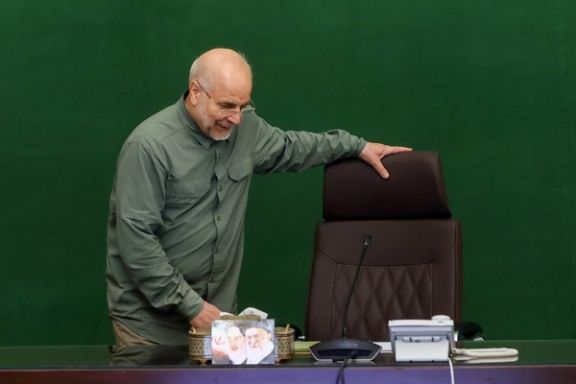
Parliament speaker Mohammad Bagher Ghalibaf takes a seat in a meeting of senior lawmakers in Tehran, Iran, November 3, 2025
The latest chatter in Tehran’s political circles is that Supreme Leader Ali Khamenei may be eyeing a bigger role for former Revolutionary Guards general and current parliament speaker Mohammad Bagher Ghalibaf.
Signs from within Ghalibaf’s own camp — the self-described “neocons” — indicate he is also positioning himself for a major elevation.
The clearest indication came on October 22, when Tourism Minister Reza Salhi Amiri asserted that Ghalibaf was tasked by Khamenei to lead the war effort after Israel killed several top commanders on day one of the 12-day war in June.
The account has not been rejected by Khamenei’s office and was echoed by outlets linked to the Intelligence Ministry, including Mashregh News and Tabnak, run by former Islamic Revolutionary Guard Corps (IRGC) commander Mohsen Rezaei.
Ghalibaf later confirmed in a YouTube interview that he coordinated military operations during the conflict, keeping a low profile to avoid Israeli targeting while meeting key figures in person.
That would suggest he was one of the few individuals with direct access to Khamenei throughout the war.
Supporters network
Since then, Iranian media have increasingly referred to Khorassan newspaper—funded and run under Khamenei’s office—as Ghalibaf’s outlet, with the paper heavily promoting his role in state affairs despite its earlier acknowledgment of parliament’s declining relevance.
Meanwhile, a coordinated social-media network calling itself “The Official Network of Ghalibaf’s Supporters” has swung into action.
The accounts promote his every appearance and cast him as a national leader rather than a parliamentary figure, crediting him for reviving the long-stalled Coupon Project for distributing essential goods or for pushing the idea of converting an old Tehran prison into a museum.
Supporter accounts have simultaneously attacked former President Hassan Rouhani for allegedly trying to tarnish Ghalibaf’s image, reviving debate-stage accusations that his campaigns took money from drug traffickers.
Other posts highlight Ghalibaf’s foreign travels, including his trip to Pakistan and meeting with prime minister Shahbaz Sharif on Friday November 7th.
Critics often ridicule Ghalibaf’s missteps, but they rarely note his credentials: he holds a legitimate university degree in political geography, is licensed to fly passenger aircraft, and has served as Tehran’s Police Chief and Commander of the IRGC Air Force.
In recent months, he has aligned himself rhetorically with hardline conservatives on issues such as censorship and hijab enforcement, while distancing himself from such initiatives once they become unpopular—a maneuver typical of politicians seeking higher office.
Zohran Mamdani’s stomping win in New York’s mayoral race drew starkly different reactions in Iran, with views on the first Muslim to run America’s largest city reflecting a bitterly divided political landscape.
For hardline supporters of the Shi'ite theocracy, his faith was a welcome slap to a US establishment seen as implacably hostile. To their critics, Mamdani's win highlights everything the Iranian system resists: youth, pluralism and the power of the vote.
The conservative daily Hamshahri, published by Tehran’s municipality, splashed "America Against America" on its front page, interpreting Mamdani's victory as a proof of the US enemy's internal divides.
Tehran lawmaker Abolghasem Jarareh declared in parliament: “Zohran Mamdani’s victory shows the strength of the slogan ‘Death to Israel!’”
Without elaborating, he then joined fellow lawmakers in chanting the slogan on the floor of parliament, a regular practice among arch-conservatives.
Abdolmotahhar Mohammadi, spokesperson for Tehran’s mayor, wrote on X: “The clear message of Zohran Mamdani’s election … is that the people of New York reject the influence of a genocidal regime in US governance,” adding that Iran “welcomes any strengthening of anti-racist and pro-Palestine discourse anywhere in the world.”
Gaza and Israel
Mamdani's platform emphasized affordable housing, police reform and Palestinian solidarity, earning him strong backing from progressives and Muslim organizations.
Early in his campaign he faced criticism for using the phrase "globalize the intifada" and has since distanced himself from the slogan. Mamdani has repeatedly called Israel's incursion into Gaza a genocide but has spoken out against anti-Semitism.
In an interview, he cited his Shi'ite Muslim faith as an important inspiration.
"To stand up for justice, to stand up for that which is right often means doing something difficult. Imam Hossein's, peace be upon him, conviction in spite of the odds is something that inspires me."
Mamdani has hit out at what he has called Islamophobia in the wake of the 9/11 attacks but has not cited Islam as a basis of his political outlook.
Still, Tehran University academic and idealogue Foad Izadi called Mamdani’s victory “the arrival of the message of 13 Aban in New York.”
He was referring to the Persian calendar commemoration of the 1979 storming of the US embassy by revolutionary students and the hostage-taking of staff there which permanently soured relations.
The date is now celebrated annually in Iran as a focal point of state-sponsored hostility toward Washington.
Free elections vs. clerical vetting
Middle East analyst Mostafa Najafi criticized the hardliners in a social media commentary titled “America’s self-healing system or the message of 13 Aban in New York?”
“Lacking a realistic understanding of the inner workings of power in the United States, some in Iran keep insisting that the country is on the verge of collapse or regime change,” he wrote.
Many critical voices drew sharp comparisons between America’s open elections and Iran’s heavily restricted political system, where supervisory bodies often whittle down lists of eligible candidates.
“Mamdani’s victory shows that despite 46 years of propaganda against America, it is democracy and the rule of law — not the will of the president who is the top official of the system — that prevail there,” prominent commentator Sadegh Zibakalam posted on X.
The veteran analyst was alluding to the limitless authority of Supreme Leader Ali Khamenei, Iran's ultimate decision-maker in all matters, including elections.
Conservative commentator Abdolreza Davari also wrote on X: “Mamdani’s rise in New York … is proof of people’s sovereignty and modern civilization. The roots of America’s global leadership lie in this very expression of the people’s will.”
“In our ‘religious democracy,’ the Guardian Council bars a Zoroastrian from city council because of his faith. But in ‘American liberal democracy,’ a socialist Muslim anti-Zionist can become mayor of New York,” Davari wrote in another post.
He was referring to Sepanta Niknam, a Zoroastrian elected to Yazd’s city council in 2013.
After winning re-election in 2017, a defeated candidate challenged his eligibility because of his religion. Although Zoroastrianism is a recognized religion under Iran’s constitution, Niknam was barred from taking his seat for over a year.
While he was eventually allowed to return, his candidacy for future elections was ultimately disqualified, making the case a symbol of theocratic discrimination.
'Masterclass in democracy'
Prominent jurist Mohsen Borhani called Mamdani’s win “a masterclass in democracy, rule of law and respect for citizens’ choices,” urging Iran’s Guardian Council, which oversees the approval of presidential candidates, to “learn from it.”
The rise of Mamdani, 34, also reignited Iran’s long-standing debate over youth exclusion from politics, even among conservatives.
Khamenei is 86, Guardian Council chairman Ali Jannati is 98 and President Masoud Pezeshkian is 71.
“If this young man from New York ran for office here, would the Guardian Council even approve his qualifications?” conservative activist Vahid Ashtari asked bluntly,
“In Iran, our elections are always between the same figures," he added. "Could any thirtysomething even imagine becoming mayor of the capital?”
Iranian President Masoud Pezeshkian speaking during an event in Sanandaj, Kordestan province, on November 6, 2025
President Masoud Pezeshkian said on Thursday that excessive government spending and an overgrown bureaucracy are major drivers of the country’s persistent inflation, arguing that only by shrinking the state can Iran restore financial balance and ease pressure on households.
“The government, which has grown large and costly over the years, has placed much of the inflation burden on the people,” Pezeshkian said during a meeting with provincial officials in Kordestan province.
“While the state should serve producers, in many sectors we have reached a point where there are plenty of directors and managers but little productivity.”
He added that structural reform lies in downsizing the government, a process he described as difficult and time-consuming because “many have grown accustomed to rank and ceremony, and that mindset must change.”
Pezeshkian also warned that excessive state spending beyond national means “ultimately translates into inflation that weighs on people’s livelihoods.”
He said he had instructed provincial governors to reduce administrative expenses to free resources for supporting vulnerable groups.
The president acknowledged that international sanctions had intensified economic strains but said domestic inefficiencies, rather than foreign pressure alone, remained the root cause of inflation that official data places at about 40%.
A scene of a protest on a highway in Tehran after the government raised fuel prices in 2019
An Iranian lawmaker said policymakers lack the resolve to take long-delayed decisions on subsidized petrol, bread and exchange rates, urging the government to settle the issues and adopt a single foreign-exchange rate.
Mohsen Zanganeh, a member of parliament’s Plan and Budget Committee, said “no one has the courage to decide” on key price and currency reforms and that “there is no choice but unification” of exchange rates, adding he was willing to accept responsibility for such a move, local media reported.
He said unresolved policy cases had been passed from one administration to the next and called on President Masoud Pezeshkian to close them to reduce public uncertainty.
Zanganeh also criticized reluctance to address fuel pricing, saying prolonged debate without action burdens the economy, and argued the president can consolidate or remove budgets for subordinate agencies without new legislation.
Iran maintains heavily subsidized fuel and multiple exchange-rate windows; previous efforts to unwind them have stoked inflation and unrest.
Economist Mohammad Maljoo in a screen grab of the a debate published on YouTube, October 27, 2025
An Iranian economist detained this week had suggested that Supreme Leader Ali Khamenei helped empower the country's ultra-hardliners, in remarks that quickly drew Tehran's ire and underscored a widening clampdown on critical voices.
Mohammad Maljoo, a left-leaning scholar and prominent public intellectual, was summoned and detained alongside several other left-leaning authors and researchers a few days after a YouTube debate in which he discussed the roots of extremism in Iran.
In the program, hosted and published by moderate outlet Entekhab, Maljoo argued that “extremists in Iran gained a foothold in the political power center after the war with Iraq in the late 1980s and under the second leadership, when they were given institutional backing that empowered and activated them.”
The phrase “second leadership” was widely understood as a reference to Khamenei, who became Supreme Leader after Ayatollah Ruhollah Khomeini’s death in 1989.
Rights observers said his arrest fits a pattern of detentions targeting academics, journalists, and intellectuals in recent weeks, as authorities seek to contain public debate in the aftermath of Iran’s 12-day war with Israel.
‘At the state’s core’
Before the program aired, participants had agreed to use the term extremist to describe hardliners who obstruct dialogue and disrupt normal political and social life.
Maljoo contended that these forces survive because of their relationship with the ruling elite.
“Without backing from the hard core of the government, extremists would not be heard,” he said, adding that Iran’s central power structure is “neither interested in, nor capable of excluding them.”
He described extremists as pressure groups acting on behalf of the power center while occasionally defying it. Their proximity to power, he said, “turns every outburst into an official directive.”
In return for enforcing ideological red lines—such as mandatory hijab, censorship, and control over key state appointments—they gain “wealth, status, and legitimacy.”
The interview aired as small hardline groups in Tehran were demanding the arrest of former president Hassan Rouhani, accusing him of “creating trouble for the government” after he called for renewed engagement with the West to ease economic pressures.
‘Foolish or traitor’
The other participant in the discussion, conservative political scientist Sadeq Haghighat of the Imam Khomeyni Research Center, largely concurred.
“Extremists are either foolish or traitors,” he said, adding that they seized control of the political arena soon after the 1979 revolution and later justified their dominance through ultraconservative cleric Ayatollah Mohammad-Taghi Mesbah-Yazdi, who taught that rulers need no public legitimacy once they control the state.
Haghighat traced the roots of extremism to Iran’s enduring political culture. “Regime changes—from Qajar to Pahlavi to the Islamic Republic—did not change the behavior of extremists,” he said.
Maljoo, for his part, argued that the ruling establishment occasionally tries to restrain extremists when their demands threaten stability.
“At times, the power center encourages moderates and reformists to push back,” he said. “But extremists are never satisfied and constantly seek more.”
An Iranian lawmaker said economic interests tied to the sale of virtual private networks are working to keep internet filtering in place and that lawmakers are pursuing an inquiry into the pressure campaign, according to an interview published by Rouydad24.
Mostafa Pourdehghan, secretary of parliament’s Industries and Mines Committee, said talks with Telegram have been under way and that officials had hoped to restore access this week before differences delayed the step.
“We have received information indicating repeated consultations with Telegram’s managers,” he told Rouydad24. “Some colleagues at the Communications Ministry have unofficially told us Telegram will be unblocked soon.”
He framed removing the filtering as a public demand and said resistance was coming from outside the legislature, what he described as "VPN mafia."
“The financial turnover of VPNs is about 50 trillion tomans (about $450 million), and beneficiaries hide behind sacred slogans such as national security to profit from continued filtering,” he said.
Pourdehghan added that a parliamentary “investigation and inspection into the backstory of these pressures” is being advanced with the communications minister.
The debate has intensified amid reports of negotiations over conditions for lifting the 2018 ban on Telegram, which remains widely used via VPNs.
State-linked outlets have said Tehran wants commitments including cooperation with the judiciary on data requests, limits on content deemed to incite ethnic tensions, and measures against material considered to threaten national security.
Parliament Speaker Mohammad Bagher Ghalibaf has rejected reports that the government reached a deal with the platform.
“If a platform does not accept internal regulations, it will not receive a license,” he told lawmakers, calling reports of an agreement false.
President Masoud Pezeshkian campaigned on easing internet restrictions, but officials have said any change must be approved by the Supreme Council of Cyberspace and tied to compliance with domestic rules.