• العربية
  • فارسی
Brand
  • Iran Insight
  • Politics
  • Economy
  • Analysis
  • Special Report
  • Opinion
  • Podcast
  • Iran Insight
  • Politics
  • Economy
  • Analysis
  • Special Report
  • Opinion
  • Podcast
  • Theme
  • Language
    • العربية
    • فارسی
  • Iran Insight
  • Politics
  • Economy
  • Analysis
  • Special Report
  • Opinion
  • Podcast
All rights reserved for Volant Media UK Limited
volant media logo
INSIGHT

A joke that hit a nerve: actress stirs fury over class fault lines in Iran

Maryam Sinaiee
Maryam Sinaiee

Iran International

Oct 26, 2025, 20:47 GMT+0Updated: 00:06 GMT+0
Actress Fariba Naderi (left) and her friend and colleague Narges Mohammadi

A viral celebrity interview has reignited debate in Iran over class privilege and widening social divides, exposing deep resentment toward wealth and the growing gulf between everyday struggle and elite detachment.

The interview clip featuring actress Fariba Naderi on the weekly YouTube show Pump went viral in Iran within hours of streaming, sparking backlash over her comments on class divides and privilege in Tehran’s affluent northern neighborhoods.

The entertainment program, streamed on YouTube and several domestic platforms, quickly drew 900,000 views on YouTube alone—despite the site being officially blocked in Iran.

Naderi, who won the Crystal Simorgh for Best Actress at last year’s Fajr Film Festival, made lighthearted remarks about the class and lifestyle of another actress and close friend, Narges Mohammadi. What she intended as humor was widely perceived as tone-deaf amid worsening economic hardship.

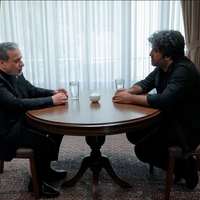
Fariba Naderi (right) and her friend and colleague Narges Mohammadi
100%
Fariba Naderi (right) and her friend and colleague Narges Mohammadi

“There's a big class difference (between Narges and I),” she said with a grin. “But class differences don’t matter to me... We live in Shahid Fallahi (the upscale neighborhood of Zafaraniyeh), and they live below Vanak Square (in northern Tehran).”

She added that for people like her, “below Vanak” meant paeen-shahr — a phrase used for lower-class districts of Tehran, though Vanak Square itself is considered upscale.

Host Amir-Hossein Qiyasi encouraged the joking tone, but many viewers saw her remarks as glorifying privilege and reinforcing the city’s “uptown versus downtown” divide.

The outrage beyond the joke

The clip quickly became a symbol of elitism and cultural detachment among Iran’s celebrities. Politicians, journalists, and critics from across the spectrum joined the debate.

The state-run ISNA news agency noted that even humor about class now provokes collective anger in a society where inequality is deeply felt. “Tangible economic hardship and the lived experience of inequality have made even jokes about wealth sound like arrogance.”

Fariba Naderi on Pump YouTube show
100%
Fariba Naderi on Pump YouTube show

Conservative commentator Farhad Rezazadeh wrote: “Class difference is not just an economic reality but the moral decline of a nation. Whoever glorifies it shares in its corruption.”

“Thank Fariba Naderi—no one could have so simply shown how deep Iran’s class divide has become… There’s a gulf between privilege and survival,” reformist journalist Davoud Heshmati remarked on X.

A deeper anxiety over inequality

Naderi’s supporters say she was merely joking and that decades of economic disparity cannot be blamed on an actress. They argue the backlash shows a tendency to scapegoat celebrities rather than confront systemic inequality.

Others, however, saw her comments as trivializing hardship and exposing simmering resentment beneath Iran’s economic stagnation.

Journalist Rasoul Asadzadeh wrote that the controversy evokes memories of corruption and humiliation in daily life: “It’s a reminder of the humiliation of begging for school tuition, taking a second job to pay rent, working extra hours for dental costs, and the crushing load we Iranians—men and women alike—carry just to live with dignity.”

Critics also tied the outrage to Iran’s broader economic trajectory. Some users cited Ayatollah Khomeini’s 1979 promise that his revolution would “turn the slum dwellers into palace dwellers.”

Despite Iran’s per-capita GDP roughly doubling since then, chronic inflation and soaring living costs have made ordinary Iranians poorer and eroded the middle class.

“In a country where inflation has hit unprecedented levels and the middle class—the stabilizing pillar of any society—has practically vanished, jokes about class difference are not funny. They are disrespectful to people’s pain,” journalist Azadeh Mokhtari posted on X.

She added: “A society where living costs crush citizens doesn’t need laughter at its own suffering—it needs empathy and a reflection of reality. Turning inequality into comedy only normalizes injustice.”

Most Viewed

Iran diplomacy wobbles as factions compete to avoid looking soft on US
1
INSIGHT

Iran diplomacy wobbles as factions compete to avoid looking soft on US

2
ANALYSIS

The politics of pink: how Iran uses cuteness to rebrand violence

3

Scam messages seek crypto for ships’ safe passage through Hormuz, firm warns

4
EXCLUSIVE

Family told missing teen was alive, then received his body 60 days later

5
INSIGHT

Is Iran entering its Gorbachev moment?

Banner
Banner

Spotlight

  • Diplomacy tolls at Hormuz as conflict returns to its doorstep
    OPINION

    Diplomacy tolls at Hormuz as conflict returns to its doorstep

  • Opposition to US talks grows in Tehran as ceasefire deadline nears
    INSIGHT

    Opposition to US talks grows in Tehran as ceasefire deadline nears

  • Tehran moderates see ‘no deal–no war’ limbo as worst outcome
    INSIGHT

    Tehran moderates see ‘no deal–no war’ limbo as worst outcome

  • The future has been switched off here
    TEHRAN INSIDER

    The future has been switched off here

  • Lights out, then gunfire: Witnesses recount Mashhad protest crackdown
    VOICES FROM IRAN

    Lights out, then gunfire: Witnesses recount Mashhad protest crackdown

  • Is Iran entering its Gorbachev moment?
    INSIGHT

    Is Iran entering its Gorbachev moment?

•
•
•

More Stories

Revolutionary road: a family row captures Iran's political gridlock

Oct 26, 2025, 16:26 GMT+0
•
Tehran Insider

This week marked the anniversary of a vast Berlin rally in October 2022 gathering tens of thousands filled in solidarity with Iran’s Woman, Life, Freedom protest movement—a day that now feels almost impossibly distant.

The chants of that autumn have given way to vindictive attacks online and heated but more cordial arguments in living rooms, where friends and families debate what should come next as if the Islamic Republic had already fallen—or as if anyone truly knew how, or when, it could.

It was meant to be a relaxed family gathering: tea glasses on the table, satellite television murmuring in the background, the usual jokes about officials and inflation. Then images appeared on the screen: young women waving pre-revolutionary flags in Berlin.

The room fell quiet. Auntie Nahid sighed.

Uncle Saeed, Nahid’s brother, mimicked her sigh. “You still don’t get it, do you?” he said. “You really think such protests could lead anywhere without a leader?”

That was all it took.

Nahid—my mother’s sister—had been a leftist before and after the 1979 revolution, a university activist who opposed the monarchy but refused to board the Islamic bandwagon. Decades later, she still rejects the idea of restoring either.

Saeed, once a quiet junior employee at the trade ministry, had joined the wave of early believers in Khomeini’s revolution. For a year or two he called it sacred. Now, in his early seventies, he’s our family’s most ardent supporter of the fallen Shah and his exiled son, Reza Pahlavi.

“You’re being as ridiculous as you were forty-five years ago,” Nahid snapped. “Then you kept asking ‘Do you believe in Khomeini or not?’ You wanted allegiance then, you want allegiance now.”

“I don’t want allegiance,” Saeed replied, his voice rising. “I just say let’s rally behind Pahlavi, because he’s the only alternative. You’re being as evasive as you were back then. If it’s between Pahlavi and the Islamic Republic, which one do you choose?”

“I won’t go along with your false binary,” Nahid said. “We must try to bring about real change, something that’s neither this nor the past.”

Saeed shook his head. “That’s just nice words. Reality is he’s the only one with a chance of bringing them down. He’s got international support, which is necessary in this ruined land. You may not like it, but it’s always been like this. Big powers decide who comes and who goes—or at least they have to be okay with it, or nothing happens.”

“That support,” Nahid replied, “is exactly why I don’t like it. It’s 2025, for heaven’s sake, not 1925. We should at least aspire to do better than that.”

“There, that’s your problem,” he said with a bitter smile. “You’re idealistic. And your idealism keeps us from getting rid of this regime.”

Nahid shook her head so fiercely you feared her neck would crack.

“You’re being ridiculous again,” she shouted. “Who’s this ‘us’? And how am I stopping it? Take to the streets and I’ll be the first to back you. But where’s the organization? Where’s the call to action? If any group were really an alternative and thought it stood a chance, they wouldn’t waste their time arguing with others. They’d just take over and deal with obstacles like me later.”

“All I’m saying,” Saeed muttered, clearly trying not to aggravate his younger sister further, “is we should gather around one figure and give it a go. Otherwise we’ll be stuck with this bunch forever.”

Nahid turned toward him, voice softer but no less bitter. “You loved getting behind one figure back then, and we know how that ended. You followed me two blocks on the way to protest the compulsory hijab in March 1979 to dissuade me, because it would ‘harm the revolution,’ remember?”

The room went still. My father, sensing where it was headed, stepped in: “Could you not ruin the night for the hundredth time? To hell with them all.”

The quarrel dissolved into silence, then small talk. But the argument lingered in the air—one that feels as old as the Islamic Republic itself.

What unfolded that night could have taken place in any number of Iranian households. Families that once shared the same dreams now sit on opposite sides of the country’s unhealed divide.

Some who once chanted for revolution now argue for reform. Many who once preached patience now want collapse—foreign intervention even.

What separates people like Nahid and Saeed is not only ideology but the shape of their disillusionment. Both, in their own ways, are haunted by the 1979 choices that promised liberation and delivered repression.

As the evening wore on, the conversation drifted back to the mundane: rising prices, the neighbor’s noisy parties—and of course, the leaked wedding video of Shamkhani’s daughter.

On the muted television the images from Berlin looped once more—a bright moment fading into memory as we quarrel over who should bring down a theocracy that shows no sign of budging.

Iran’s ancient sites face rising land subsidence risk, experts warn

Oct 26, 2025, 14:08 GMT+0

Land subsidence driven by decades of groundwater over-extraction is emerging as a direct threat to some of Iran’s most treasured heritage sites, including Persepolis, Naqsh-e Jahan Square and the Tomb of Cyrus, Iranian scientists and officials say.

Geologists cited by Tasnim news agency said subsidence has accelerated across provinces such as Isfahan, Fars and Tehran, with field observations of cracks, surface fissures and foundation instability near historic structures.

“Nearly half of Iran’s valuable historic fabric lies in subsidence-prone zones,” geologist Ali Shahbaz was quoted as saying, adding that “63 nationally registered monuments and 27 world-class sites” are in affected areas.

In Isfahan, the long-dry Zayandehrud river has been linked to ground settlement of roughly 16-25 cm a year in the city’s north, raising stability concerns for Naqsh-e Jahan Square, the Shah and Sheikh Lotfollah mosques, and the Safavid-era Si-o-se-Pol and Khajou bridges, Tasnim reported.

In Fars province, subsidence in the Marvdasht plain -- estimated around 14 cm a year -- has prompted warnings about drainage systems and stone platforms at Persepolis and potential long-term risks to the Tomb of Cyrus at Pasargadae and the rock-cut tombs of Naqsh-e Rostam.

The concerns come amid broader alarms over nationwide land-subsidence.

Tasnim, citing official tallies, said 380 cities and about 9,000 villages have reported some level of subsidence, with roughly 42 million people living on sinking ground.

Iran’s Geological Survey says two decades of drought and sustained over-pumping, compounded by fragmented water governance, have pushed 106 plains into non-recoverable subsidence.

Cultural-heritage specialists stress there is no immediate risk of collapse at marquee sites, but warn that cumulative deformation, coupled with drying soils and sporadic heavy rains, could inflict irreversible damage over years to decades.

“No site is on the brink today,” Shahbaz said. “But without curbing withdrawals and restoring groundwater, we are setting the stage for losses that cannot be repaired.”

Iran’s foot-and-mouth outbreak cuts milk output as feed shortage deepens

Oct 26, 2025, 11:35 GMT+0

Iran’s raw milk production has fallen sharply as a new outbreak of foot-and-mouth disease spreads through livestock farms and feed shortages drive up costs, the head of the national dairy farmers’ association said on Sunday.

Ahmad Moghadasi, chairman of Iran’s Cattle Farmers Association, told state media that provinces including Tehran, Alborz, Qazvin, Qom, and Markazi have reported widespread infections, including among vaccinated herds.

“Even herds that were immunized have been struggling for over three weeks without recovery,” he said, blaming the introduction of a new SAT1 African strain of the virus.

He warned that the epidemic, coupled with the near-total halt of government feed distribution, has left dairy farms facing critical shortages.

“No feed is available in the agriculture ministry’s online system,” Moghadasi said. “Farmers are forced to buy on the open market, where corn costs 360,000 rials (about 33 USD cents) per kilo and soybean meal 400,000 rials (about 37 cents) -- double official rates.”

iran-dairy-milk (file photo)
100%

The government had set a purchase price of 230,000 rials (about 21 cents) per kilo for raw milk, based on subsidized feed costs, but the official system has failed to deliver supplies, Moghadasi added. “The government has not met its commitment, so input prices and milk prices are both rising,” he said.

Foot-and-mouth disease (FMD), a highly contagious viral infection affecting cloven-hoofed animals, has been reported in 270 locations nationwide, according to Iran’s Veterinary Organization.

Its head, Alireza Rafieipour, said more than 36 million animals have been vaccinated this year, adding that the situation remains under control with intensified quarantine and disinfection measures.

Industry groups, however, warn that recurring outbreaks and rising production costs are exacerbating Iran’s dairy crisis.

  • Iran’s dairy intake less than half recommended level as prices soar

    Iran’s dairy intake less than half recommended level as prices soar

  • Families in Iran say soaring dairy prices are eating into daily budgets

    Families in Iran say soaring dairy prices are eating into daily budgets

Domestic milk output and consumption have both declined amid inflation and poverty, with the Health Ministry reporting this month that per capita dairy intake has dropped to less than half the recommended level.

Officials blame soaring prices, reduced subsidies, and the lingering impact of US and UN sanctions on feed and veterinary imports.

The Agriculture Ministry has promised to stabilize supplies and maintain sufficient vaccine stocks, but farmers say they face mounting financial strain. “We are witnessing conditions similar to 2012 and 2018, when sanctions caused widespread drug and feed shortages,” according to Moghadasi.

According to the UN Food and Agriculture Organization, Iran’s per capita dairy consumption fell from 101 kilograms in 2010 to 70 kilograms in 2023, less than half the global average, reflecting a deepening food security crisis as inflation erodes purchasing power.

Nine-year-old girl dies at school in western Iran

Oct 26, 2025, 09:09 GMT+0

A nine-year-old student died suddenly during a school break in the western Iranian city of Ilam on Saturday, local media reported, amid a spate of student deaths and allegations of mistreatment in schools across the country.

The student, identified as Parnia Rezaei, collapsed during recess at Naderi Elementary School, according to the news outlet Didban Iran. The cause of death has not yet been determined.

Abbas Omidi, the head of Ilam’s education department, said the death occurred suddenly and that school staff immediately called emergency services.

“The student was transferred to hospital for urgent medical care, but resuscitation efforts were unsuccessful,” Omidi told reporters.

Authorities in Ilam said an investigation into Rezaei’s death is underway.

Rezaei’s death follows several recent incidents involving students’ deaths and alleged abuse in schools since the start of the new academic year in late September.

Earlier in October, 12-year-old Sam Zarei in Shiraz took his own life after psychological pressure from school officials, according to reports on Iranian media.

Also in October, Zahra Golmakani, a 10-year-old student in Mashhad, died of what authorities described as cardiac arrest during class.

Similar reports have emerged from the provinces of Mazandaran, Qazvin, and Zanjan, where students have died or been injured following disciplinary actions.

Despite an education ministry directive explicitly banning corporal punishment and verbal abuse, rights advocates and teachers’ unions say such incidents remain frequent, reflecting systemic failures in oversight and student protection.

Iran’s top social affairs official on Sunday warned of a rise in suicide among children under 12, calling it a troubling shift that was once “very rare.”

Mohammad Bathaei, head of the National Organization for Social Affairs, told ILNA that schools and universities lack effective curricula to build resilience and coping skills, saying “education systems have not started preventive work in a meaningful way.”

Bathaei said emergency responses also remain inadequate despite efforts by the Social Emergency network and Health Ministry.

Iran shuts Instagram pages of several female singers over ‘criminal content’

Oct 25, 2025, 19:10 GMT+1

Iranian authorities have shut down the Instagram pages belonging to several female singers in Iran’s Mazandaran province over the past few days, according to local media.

The accounts of Mandana Akbarzadeh, Azadeh Kebriya, Zeinab Berimani, and Fatereh Hamidi have been taken offline, displaying a message that reads: “This page has been blocked due to the production of criminal content."

The message displayed in the closed pages also says: "Warning: Users’ criminal activities are being monitored.”

100%

The crackdown comes as part of a broader effort to limit the visibility of women vocalists, whose performances have been banned in public settings since the 1979 Islamic Revolution.

The Islamic Republic has banned women from singing or dancing in public and enforces the Islamic veil or hijab on women.

Despite the official ban, female singers in Iran continue to find ways to share their music—whether in private gatherings, underground performances, or online.

One such artist, Zara Esmaeili, gained widespread attention last year when a video of her singing Amy Winehouse’s Back to Black went viral. However, shortly after the video gained traction in July, Esmaeili was arrested on August 1.

The restrictions on female artists have escalated since the protests following Mahsa Amini’s death in custody in 2022 over hijab, as many female performers supported the demonstrations. Several have been arrested or barred from professional activities.

Artistic defiance has become a hallmark of Iran’s protest movements, with musicians such as Shervin Hajipour, Mehdi Yarrahi, Saman Yasin, and Toomaj Salehi facing arrest for their roles in mobilizing dissent.