Give up on revolution and spare region destruction, US envoy tells Iran
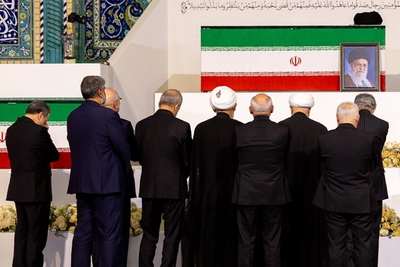
Members of Iran's Revolutionary Guard attend Friday prayers in at the University of Tehran mosque, July 2010.
The US ambassador to the United Nations on Thursday urged Iran to abandon its revolutionary ambitions and end what he called destructive interference in neighboring Mideast states.
“The international community must urge the Iranian regime to give up its false hope of revolution, forego its ambitions toward its neighbors, and stop meddling in the politics of other countries in the region,” Michael Waltz said in a speech at the UN.
“Instead, Iran should engage in direct and good-faith dialogue with the United States for the benefit of the Iranian people and the security of the region,” Waltz added.
Iran's relations with Washington appear to be deteriorating as an impasse over Iran's disputed nuclear program festers and European countries triggered the so-called snapback of international sanctions on Tehran last month.
Supreme Leader Ali Khamenei said in a speech on Monday that Washington sought to bully Iran by making it concede defense capabilities, appearing to reject a peace overture the previous week by US President Donald Trump.
Speaking on the Gaza peace plan, Waltz praised the Trump administration for its achievement and called for greater pressure on Iran to ensure full implementation.
“Because of tough action against Iranian proxies, we are seeing historic opportunities in Lebanon, Syria, Iraq and across the region. In this spirit, the United States supports the reimposition of UN snapback sanctions on the Iranian regime,” he said.
The sanctions have further strained Iran's economy after a punishing 12-day war with Israel and the United States in June.
“The regime will continue to face consequences as long as it remains on its path of destruction,” Waltz said.
Iran’s ambassador to the United Nations, Amir Saeid Iravani, rejected the remarks, saying Iran’s foreign policy is based on “respect for sovereignty and territorial integrity, non-interference and good neighborliness,” and that it “has always been ready for fair and genuine dialogue.”
Tehran maintains that its nuclear program is peaceful and that repeated US accusations were aimed at justifying what it calls its aggression.
Western countries have called for Tehran to engage in renewed diplomacy with Washington and restored access to international nuclear inspectors.
Iranian security chief Ali Larijani, second from right, attends a commemoration for a slain Iranian commander, Tehran, October 23, 2025.
Iran's security chief Ali Larijani on Thursday launched into a withering critique of Donald Trump, likening the US President to Hitler and tarring him as a "mere businessman" whose Gaza peace summit Tehran gladly missed.
The scorching comments in a speech delivered by Larijani, a key aide to Iranian Supreme Leader Ali Khamenei, have few parallels among top officials in recent months even amid a US-Israeli war in June.
Coming after Khamenei addressed Trump directly in a speech on Monday to "keep dreaming" about the president's "nonsense" on destroying Iran's nuclear program, the remarks signal a hardened line among Iran's top decision-makers on their top foe.
"Trump’s statement that he wants to create peace through strength is a strange one — because Hitler said the same thing," Larijani said in a speech at an event in Tehran commemorating an Iranian commander killed in the civil war in Syria in 2015.
Larijani was appointed Secretary of Iran's National Security Council following the summer conflict and is Khamenei's personal representative to the key body.
He dismissed a summit held in the Egyptian resort town of Sharm al-Sheikh on Oct. 12 to formally clinch a US-brokered ceasefire in Gaza as a “Trump show” to which the president arrived late, "spoke only by himself, did not allow anyone to speak and even mocked the heads of the countries present."
Trump had invited Iran to participate in the event and had raised eyebrows in an address to the Israeli Knesset earlier in the day in which he said Washington hoped Tehran could be folded into a broader Mideast peace.
Iranian officials bristled at the attacks by their two top foes, calling them illegal, asserting that its nuclear activities are peaceful and lamenting that the military campaign was launched while Washington and Tehran were in the midst of talks.
The summit “was low-level and had no place for revolutionary Iran," Larijani said.
It was attended by several heads of state from Western and Islamic countries but not those of Saudi Arabia, the United Arab Emirates or Israel. A video of Trump shaking a senior Emirati official's hand at the summit and intoning with a smile, "A lot of cash!" circulated widely online.
Trump's relationship with Arab states also came into Larijani's crosshairs, a veteran navigator of the highest echelons of Iran's opaque security and political establishment, who said the property developer turned president exploited his wealthy Mideast allies.
"Trump ... sees the Arabs as money and is merely a businessman," Larijani said.
Iran's top officials have for months held off on direct criticism of Trump or commentary on the US relationship with Arab neighbors as it has pursued a rapprochement with the latter and appeared to weigh dialogue with the West.
An impasse over Iran's nuclear activities has persisted despite the war in June and disagreements have festered since European countries triggered the restoration of UN sanctions last month.
Western states seek the resumption of US-Iran talks and inspections by the UN nuclear watchdog while Tehran has ruled out what they call US demands to rein in its missile program and support for armed Mideast allies.
Iranian journalist and rights activist Masih Alinejad
A US court will hold a sentencing hearing next week for two men convicted over an alleged Tehran-backed plot to kill Iranian dissident and journalist Masih Alinejad, she said on X on Thursday.
Alinejad said the hearing would take place in Manhattan on Wednesday and that she planned to appear in person.
She said she would come “face-to-face with the two Russian hitmen sent by Iran’s regime,” adding that she has survived one kidnapping and two assassination plots on US soil.
“I lost my Brooklyn home, my garden, my peace, but not my voice,” she wrote. “Transnational repression is dictatorship without borders. It must end.”
The charges against them included murder for hire, firearms possession and conspiracy to commit money laundering.
Prosecutors said the convicted men, Rafat Amirov and Polad Omarov, were members of the Russian mob. Their lawyers argued that they were innocent and evidence presented at trial was flawed.
Khalid Mehdiyev, a member of the Thieves in Law gang, said he received orders from the two to kill the journalist who uses her platform to expose the Islamic Republic’s repression.
As a government witness, who has made a deal with prosecutors, Mehdiyev pleaded guilty to attempted murder and gun charges, but Omarav and Amirov stood trial.
Alinejad, who has long criticized Iran’s compulsory hijab laws and its treatment of women, said she will speak at the sentencing not just for herself, but "for every woman who refuses to be afraid.”
A branch of the Ayandeh Bank in Tehran in this 2022 file photo.
Iran’s Central Bank revoked Ayandeh Bank’s operating license on Thursday, dissolving one of the country’s largest lenders due to massive losses and chronic inefficiency in another sign of gathering economic storm clouds as sanctions bite.
“Despite all the efforts made, this bank could not be placed on the path of reforms as desired by the central bank,” official media cited Central Bank Governor Mohammadreza Farzin as saying.
Farzin said that the bank had 5.5 quadrillion rials ($5.1 billion) in accumulated losses, 3.13 quadrillion rials ($2.9 billion) in overdrafts, and a negative 600 percent capital adequacy ratio.
Iran’s economy minister said all customer deposits will be transferred to state-owned Bank Melli Iran, with branches rebranded and funds accessible from October 25.
“Serious measures for banks that did not comply with regulations were necessary, but in the past, legal shortcomings prevented decisive action,” Ali Madanizadeh said.
Madanizadeh said the accumulated losses of Ayandeh Bank would be covered by the bank’s main shareholders, without providing further details.
The collapse underscores Iran’s deepening banking crisis, worsened by sanctions and mismanagement. Earlier this year, the Central Bank warned that eight other banks risk dissolution without reforms.
The Central Bank of Iran has not publicly disclosed the names of the eight banks at risk of dissolution due to financial instability.
Ayandeh Bank was established in 2013 following the merger of several smaller financial institutions, most notably Tat Bank, Saman Bank’s credit institutions, and Ansar Financial and Credit Institute.
Iran’s banking system has been one of the hardest-hit sectors under decades of United States and international sanctions, which have crippled access to global finance, cut off dollar transactions, and eroded confidence in the rial.
Belarusian troops take part in the Victory Day parade, which marks the anniversary of the victory over Nazi Germany in World War Two in Minsk, Belarus May 9, 2020.
Iran’s defense minister on Thursday told a senior visiting military-industrial official from Belarus that Tehran seeks to deepen military cooperation with Minsk as both countries grapple with deep Western sanctions.
“Iran welcomes the expansion of defense and industrial cooperation with friendly and independent countries, and Belarus holds a special place in this partnership,” Defense Minister Aziz Nasirzadeh told Belarus’s chairman of the State Authority for Military-Industrial Cooperation in a visit to Tehran, according to state media.
Iran and Belarus have both turned to Russia for economic and defense support amid harsh sanctions imposed by the United States and Europe, but advanced air defense systems provided by Moscow were likely destroyed in Israeli attacks last year.
Dmitry Pantus, head of the Belarus State Authority for Military-Industrial Cooperation meets with Iranian Minister of Defense Brigadier General Aziz Nasirzadeh in Tehran on Oct. 23, 2025.
Tehran has supplied Moscow with drones and ammunition for its invasion of Ukraine, while Minsk has hosted Russian troops and allowed its territory to be used as a launchpad for attacks.
Both governments see closer coordination with Russia as a counterweight to Western pressure.
Minsk and Moscow have been joined in a supranational Union State since 1999.
US sanctions on Belarus include prohibitions on transactions with key government entities such as the Ministry of Finance of the Republic of Belarus and the Development Bank of the Republic of Belarus, as well as restrictions on exports and re-exports.
Facing sanctions
Iran remains under broad US sanctions targeting its energy, financial and military sectors over its nuclear activities and arms transfers to Russia.
Following a 12-day war with Israel in June and the return of UN sanctions last month, Iran is seeking to rebuild its economy and strengthen its military readiness.
Western countries have called for Tehran to engage in renewed diplomacy with Washington and restored access to international nuclear inspectors.
Russian Foreign Minister Sergey Lavrov said last week that Russia would help Iran meet its military needs even after European-triggered international sanctions further restricted trade with Tehran.
Iran denies seeking nuclear weapons, decried the attacks in June as illegal and say US demands that Tehran rein in its defense capabilities are unacceptable.
US President Donald Trump points a finger while speaking at the White House in Washington, DC, US, October 10, 2025
US President Donald Trump said US attacks in June on three nuclear sites had left Tehran weakened to the point that it is no longer respected, adding in an interview with TIME magazine that his actions knocked out a "big bully" in the region.
“(Iran) was a very big, strong bully. And they used that power very strongly across the Middle East, and they really controlled it. But they don't control it anymore. They're not respected anymore at all,” Trump said in the interview conducted on October 15 and published on Thursday.
Trump said US airstrikes in June “bombed the hell out of” Iran’s nuclear facilities and “knocked out their nuclear potential,” leaving Tehran “fighting for survival."
The return last month of UN sanctions triggered by European powers has further strained Iran's economy after a punishing 12-day war with Israel and the United States.
Trump added that sanctions had left Iran “very weak,” citing the killing of senior Iranian military commanders, including Qassem Soleimani in a US drone strike in 2019, as key to curbing Tehran’s power.
Talks with Tehran over its disputed nuclear program began earlier this year with a 60-day ultimatum. On the 61st day, June 13, Israel launched a surprise military campaign which was capped with US strikes on June 22 targeting key nuclear sites in Esfahan, Natanz and Fordow.
“By doing it, we were able to—you see, if Iran was sitting there, powerful and a bully, it would have been impossible to make a deal like this, because you would have had this looming threat over the region. Now it’s not a looming threat,” Trump said, referring to a Gaza ceasefire he clinched this month.
Iran denies seeking nuclear weapons and has called the attacks illegal.
The US President told the Israeli Knesset last week that it would be ideal if Tehran could be folded into a broader Middle East peace deal. Still, he has often mooted bombing Iran again if it seeks to rebuild its nuclear program.
Iranian Supreme Leader Ali Khamenei appeared to rule out any renewed talks with Tehran in a rare speech on Monday. He denied the attacks had destroyed the nuclear program, telling Trump, to "keep dreaming".
Bush invasion, Obama deal
Trump criticized previous administrations for their Middle East policies, saying the so-called War on Terror disrupted the balance between Iran and Iraq.
“The problem was when Bush went in and blew up Iraq, he destabilized the region, because when we blew up one of the two powers, all of a sudden you had one bully," Trump said, referring to Iraq and Iran. "See, they weren’t bullies when they were fighting each other. But when one fell, Iran became a serious bully.”
Trump called the 2015 nuclear deal with Iran under the Obama administration another grave mistake, arguing it failed to stop nuclear proliferation.
“Under the Iran nuclear deal, they would have had a massive nuclear weapon by now. You know, it expired a long time ago. I canceled it, but I said it was ready to expire anyway. They had a clear road to a nuclear weapon—unchallenged,” Trump said.
Iran said its nuclear program was peaceful and that repeated US accusations were aimed at justifying aggression.