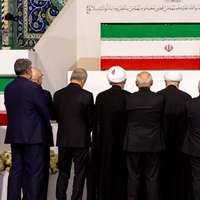
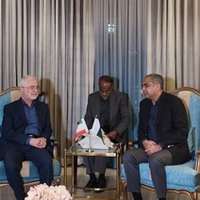
Iranian lawmakers debate in multiple huddles during a tense open session in parliament, Tehran, Iran, October 14, 2025
Tehran’s catalogue of political feuds appears to have grown with the dwindling presence of Supreme Leader Ali Khamenei following the June war with Israel—a trend that, Iranian scholars warn, could push a country already rife with discontent to the brink.
Khamenei, long the ultimate arbiter among rival factions, has been seen in public only a few times since Israeli strikes killed his most senior commanders.
His absence—coupled with a pervasive sense of imminent crisis—has sharpened long-standing rivalries among factions that now see it as more urgent than ever to position themselves for an inevitable post-Khamenei era.
Tensions between former security chief Ali Shamkhani and ex-president Hassan Rouhani’s camps have grown so fierce that the IRGC-linked daily Javan urged both sides to “declare a ceasefire.”
Earlier this month, Shamkhani accused Rouhani of knowing immediately that the Ukrainian airliner was downed by IRGC missiles in 2020, despite his claims of learning about it days later.
Last Friday, a video appeared on social media from the wedding of Shamkhani’s daughter, which was far from Islamic standards promoted by Iran’s establishment, leading many to say it was Rouhani’s response.
‘Flying the Russian flag’
In another episode, hardliners sided with Russian Foreign Minister Sergey Lavrov, who last week blamed former foreign minister Javad Zarif for a clause in the 2015 nuclear deal that Lavrov and his supporters in Tehran say led inevitably to return of UN sanctions in September 2025.
Hardline MP Mojtaba Zarei went as far to urge the public prosecutor to summon Zarif to court. In response, Hessamoddin Ashna, a former aide to Rouhani and Zarif, warned on X that everyone would lose if the duo were to “open their mouths.”
The reformist outlet Rouydad24 also came to Zarif’s defense, quipping that “the Russian flag was flying over the hardline camp in Tehran.”
Former IRGC commander Yahya Rahim Safavi escalated tensions by making a veiled threat against Rouhani, sarcastically recalling the death of former president Akbar Hashemi Rafsanjani in a swimming pool.
Rouhani’s aides reminded him that Rafsanjani had once saved Safavi from execution on treason charges in 1988. Safavi went on to accuse Rafsanjani of seeking power beyond his presidential authority—a pointed analogy aimed at Rouhani.
‘Mind the gaps’
Commenting on the rising tensions, former lawmaker Gholam Ali Jafarzadeh Imanabadi accused president Masoud Pezeshkian of recklessly fueling popular discontent with hiring thousands of new hijab enforcers, saying it was “funding the dangerous social divide.”
“The government is funding the escalation of social divides,” Imanabadi told business daily Jahan-e San’at, adding that the moderate president may be overlooking the consequences.
Renowned Iranian sociologists such as Mohammad Fazeli and Taqi Azad Armaki have long warned that widening divides between rich and poor, urban and marginal, old and young, and men and women could trigger a “social tumour.”
They say reckless decisions by unelected hardliners—or by those elected with the backing of a small minority—risk reigniting widespread unrest like that of 2022.
With Khamenei’s presence waning and factional rivalries deepening, the state may find itself more vulnerable than ever to the very unrest its leaders fear most.
It remains to be seen whether, after such bitter feuds, the ruling elite can again close ranks in the face of popular adversity — as they have so often done before.
Hardline cleric Alireza Panahian, who enjoys close ties with supreme leader Ali Khamenei, addresses the first conference of the New Islamic Civilization Party, Tehran, Iran, October 9, 2025
Iran’s ultra-hardliners have launched a new political party this month amid intensified factional rivalry following the June war with Israel and the return of UN sanctions. Here’s what we know so far about the New Islamic Civilization Party.
The grouping promotes a vision of “Islamic civilization” that supporters hail as moral renewal—but critics see as another bid to consolidate control within the ruling system.
Positioning itself as an ambitious civilizational force, the party pledges disciplined ideology, elite-cadre training, and governance rooted in “revolutionary justice.”
It rejects technocratic reformism, presenting itself as guardian of the revolution’s founding ideals and the “discourse of resistance” championed by Supreme Leader Ali Khamenei.
Establishment and structure
The party formally launched its activities at its first congress on October 9, which also elected a central council for a two-year term.
It announced plans to form national expert commissions and provincial offices devoted to “discourse-building,” “cadre development,” and “strategic planning” to steer its political, cultural, and social outreach.
Funding sources remain undisclosed, raising questions about the scale and backing of its operations. It is also unclear whether the party intends to field candidates or focus primarily on ideological and institutional work.
Key Figures
All major figures in the party backed Saeed Jalili in the 2024 presidential race, underscoring its alignment with the hardline “resistance” camp.
Yaser Jebraili, secretary-general, formerly headed the Expediency Council’s Strategic Supervision Center and advocates a “state-guided market,” blaming free-market dominance for Iran’s economic crises.
Hossein Mehdizadeh, a cleric tied to the Islamic Sciences Academy founded by the late Ayatollah Mesbah Yazdi, serves as secretary of the central council.
Hossein Samsami, institutional economist and former lawmaker once close to Ahmadinejad, favors long-term planning over market mechanisms and was named Jalili’s “shadow” economy minister by media.
Alireza Panahian, an ultra-hardline preacher with close links to Khamenei’s office, is known for backing vigilante groups and mobilizing conservative youth networks.
Ideology and tenets
The party’s social-media platforms invite participation in “ummah-building” and the realization of a new Islamic civilization.
Its rhetoric draws heavily on the writings of Khamenei and his predecessor—Iran’s first supreme leader—Ruhollah Khomeini, emphasizing “revolutionary governance” centered on Islamic justice and resistance.
It opposed a recent proposal by the semi-official House of Parties to grant amnesty to security convicts, arguing that such measures encroach on the Khamenei’s prerogative as supreme leader.
The party’s ideological terrain overlaps with existing ultra-conservative networks such as the Paydari (Steadfastness) Front and Jebhe-ye Sobh-e Iran (MASAF)—signaling its role as part of a broader effort to institutionalize Khamenei-era orthodoxy through new organizational channels.
A screen-grab from a leaked video that appears to show Iran's former security chief Ali Shamkhani in his daughter's wedding
Tehran's establishment is defending former security chief Ali Shamkhani on privacy grounds after a video of his daughter’s wedding leaked online, angering many Iranians who say the elite shields itself while invading the privacy of ordinary citizens.
Shamkhani, a member of Iran’s Defense Council and a senior adviser to Supreme Leader Ali Khamenei, briefly appears in footage from a women-only ceremony where some guests were unveiled.
In his first reaction to the leaked video, Shamkhani told state media, “As I said earlier: Hey you bastards, I’m still alive,” referencing a quote from Papillon (1973).
He had previously used the same line when addressing Israel after surviving an airstrike on his home in Tehran during June’s war.
Shamkhani also posted the same line on his X account in Hebrew, implicitly accusing Israel of involvement in the leak of his daughter's wedding video. An X account allegedly run by Mossad earlier hinted at possible Israeli role.
Shortly after the leak, state-aligned media closed ranks around him.
The IRGC-affiliated Javan newspaper declared that “addressing personal ethical or behavioral misconduct is prohibited,” insisting the event involved neither alcohol nor “moral corruption.” It cited eyewitnesses who described Shamkhani’s behavior as “proper and acceptable.”
‘Revenge’
Ezzatollah Zarghami, former head of state broadcaster IRIB, likened the hacking of private gatherings to “a new form of Israeli assassination,” while moderate cleric Mohammad-Ali Abtahi rejected any wrongdoing, saying the video merely showed unveiled women in a female-only section.
Abdullah Ganji, a pro-government commentator and adviser to Tehran’s mayor, called the leak “immoral” and “revenge by any means.”
But critics argue that the real insult lies in the establishment’s double standard.
“Their message to people like us is always the opposite — that your private life is fair game,” said a female civil activist who was imprisoned during the 2022 protests.
She told Iran International that interrogators repeatedly pried into her personal life: “They said, if you continue your activities, we will shame you publicly before your family and colleagues by exposing details of your private life.”
Two rules for all
Authorities routinely surveil and punish citizens—sometimes costing them jobs—for unveiled photos or mixed-gender gatherings.
“When ordinary people are humiliated for the slightest breach, calls to respect the privacy of the powerful ring hollow,” one social media user wrote.
Leaked images have destroyed the careers of environmental official Kaveh Madani and parliamentary candidate Minou Khaleghi, while detainees have reported being threatened with the release of personal photos to extract confessions.
Despite the uproar, few expect consequences for Shamkhani, one of Khamenei’s closest allies who has survived previous allegations of corruption involving his family.
‘Private is political’
Germany-based journalist Massoud Kazemi, who has investigated Shamkhani’s economic dealings, described him as “one of the leaders of Iran’s mafia networks—in oil, shipping, and security,” adding that “using such leaks to oust him is improbable.”
The timing of the leak may point to internal rivalries.
In a recent interview, Shamkhani revisited the 2020 downing of a Ukrainian passenger jet, claiming he immediately informed then-President Hassan Rouhani—a statement Rouhani’s team has denied.
The hardline daily Vatan-e Emrooz suggested those comments might have provoked “revenge” from rival factions.
Regardless of who was behind it, the episode has exposed the growing fragility of Iran’s ruling elite and the public’s deep resentment of its privileges.
As one online commentator put it, “When power is above scrutiny, even privacy becomes political.”
Prices of Iranian-made and assembled cars have surged as the rial weakened against the dollar, with major manufacturers raising official rates to offset mounting costs, Iranian media reported on Monday.
Fluctuations in the exchange rate remain one of the most decisive factors shaping the car market, according to Tabnak website.
“When the dollar is stable, the car market stays calm, but even a slight rise in the exchange rate causes an immediate increase in vehicle prices,” the outlet wrote.
Khabar Online website described the latest changes as “an unusual wave of price adjustments,” saying that prices of several popular models climbed sharply after the dollar strengthened.
Automakers announce new price hikes
Iran Khodro, the country's largest car makers, on Sunday announced updated prices for 42 models, showing an average increase of 6.3 percent -- equivalent to about 389 million rials, or $350 per car. Kerman Motor also raised prices for five of its vehicles by over 14 percent.
Iran Khodro’s Dena Plus Turbo automatic (model 2025) rose by 100 million rials to about 13.3 billion rials -- roughly $12,090. The 2024 version was priced around 11.4 billion rials ($10,360). The Peugeot 207 automatic reached about 13.3 billion rials ($12,090), while its manual model traded near 9.9 billion rials ($9,000). The Tara automatic was listed at 12.7 billion rials ($11,540).
Market pressure mounts amid currency slide
Economists say the dual effect of a weakening rial and official price revisions is fueling rapid inflation in the auto sector.
“Manufacturers and assemblers have formally raised their prices, and that immediately drives another wave of market increases,” said Reza Gheibi, an analyst at Iran International.
The depreciation of the rial -- now trading around 1.1 million per dollar -- has intensified broader economic strains, which analysts link to renewed pressure following the reactivation of UN sanctions under the snapback mechanism.
A lawmaker warned on Sunday that Iran’s new energy plan could raise gasoline prices by up to 266%, even as officials deny any plan to hike fuel costs — a move widely seen as a potential trigger for protests amid rising poverty.
Based on a recent cabinet decision, Tehran lawmaker Hamid Rasaei wrote on X, the cost of fuel delivery and station commissions will soon be added to the pump price, raising the state-subsidized rate from 15,000 rials (about $0.014) per liter to roughly 55,000 rials ($0.05) per liter.
The administration insists no price hike is planned. However, the cabinet recently approved a comprehensive energy-allocation program, which President Masoud Pezeshkian has pledged to implement.
The measure obliges the government to fix the widening gap between Iran’s gasoline production and consumption — known as the fuel imbalance — without resorting to the sudden price shocks seen in November 2019.
A series of nationwide protests in Iran, known as Bloody November, took place in 2019. Initially triggered by a 50 to 200-percent increase in fuel prices, the demonstrations quickly turned into calls for the overthrow of the Islamic Republic and Supreme Leader Ali Khamenei.
At least 1,500 people were killed by the Islamic Republic's security forces during those protests, Reuters reported at the time.
Gradual reform and multiple pricing scenarios
Officials say the policy will unfold gradually through non-price reforms such as modernizing vehicles, expanding public transport, promoting compressed natural gas (CNG) use, and improving energy efficiency.
A step-by-step rise in prices would come only after these measures are in place and would follow annual inflation rates.
Several pricing models are under review, according to the local media. One option would introduce a tiered system: subsidized gasoline for low-income households at about 30,000 to 40,000 rials ($0.027–$0.036) per liter, semi-subsidized fuel at 60,000 to 70,000 rials ($0.054–$0.063), and a market rate near 100,000 rials ($0.09) for luxury or high-consumption vehicles.
Another plan would assign monthly fuel quotas per person rather than per car (60 liters now), letting unused portions be sold at market rates. Broader adoption of CNG and incentives for electric and hybrid cars are also being considered to cut reliance on gasoline imports.
Debate over fairness and timing
Analysts estimate that aligning prices with inflation could raise overall consumer prices by 5 to 10 percent but help reduce smuggling, energy waste, and budget deficits.
Parliament Speaker Mohammad-Bagher Ghalibaf said on Sunday that economic reform must start with fairness rather than price hikes.
“The first step is not raising prices but making these public resources truly people-centered,” he said.
The government is expected to announce its final decision before presenting the next year’s budget, amid mounting debate over how to balance fiscal needs with public tolerance.
Supreme Leader Ali Khamenei's political advisor, Ali Shamkhani
A video showing the wedding of the daughter of Ali Shamkhani, a top advisor to Iran's Supreme Leader, has reignited public anger in the country, with social media users accusing officials of hypocrisy amid worsening poverty and revived hijab patrols.
The video leaked on X on October 17 shows Shamkhani, a member of Iran's Expediency Council, escorting his daughter, Fatemeh, into a grand wedding hall.
The footage, reminiscent of Western-style weddings where the father walks the bride down the aisle, drew immediate attention for the bride’s revealing gown and her mother’s low neckline — both unusual in a country where mandatory hijab and modesty laws have been enforced for decades.
The event, reportedly held in April 2024 at Tehran’s luxury Espinas Palace Hotel, had already drawn scrutiny at the time when Iranian media estimated its cost at around 14 billion rials (over $21,000). The family has never publicly commented on those reports.
Such gatherings are typically held in secrecy. “Without hypocrisy, why would there be such secrecy?" a user named Esmail Esbati wrote on X.
A pattern of elite excess
Some social media users have downplayed the wedding video, describing it as comparable to countless other ceremonies in Iran in terms of scale and expense.
However, for many Iranians, the Shamkhani wedding fits a familiar pattern — senior officials publicly preaching austerity and revolutionary simplicity while privately enjoying privilege.
Iran’s long economic crisis has magnified public resentment. After years of sanctions, mismanagement, and inflation exceeding 40 percent, the middle class has largely collapsed.
Hundreds of thousands suffer from malnutrition, and many young Iranians postpone or abandon marriage altogether as costs soar.
From wedding in mosques to wedding in luxury hotels
Social media reaction was swift and cutting. Users accused Iran’s ruling elite of flaunting their privilege while ordinary Iranians struggle with soaring costs of living and widespread poverty.
Posting on X, one user criticized leaders of the Islamic Republic for preaching modest living and anti-capitalism slogans, calling them “lies and deceptions.”
“When millions of Iranian youths cannot even afford the cost of holding a simple wedding, and wedding halls are going bankrupt due to the economic situation that these very gentlemen have created for the people, holding any kind of ceremony by the regime's officials is unlawful and haram,” the user added.
Another user mocked the ruling class’s rhetoric: “Hold the most luxurious parties you want for your children— we’re not jealous. But don’t say sanctions are a blessing or that people have chosen to live like this. When the majority of citizens live in poverty, marry your child in a mosque [not in Espinas Palace].”
Against this backdrop, images of unveiled women and opulent décor at the Shamkhani wedding have sparked outrage.
One user, posting under the handle “Son of Nietzsche,” wrote: “This video is the Islamic Republic in miniature. Rulers forcing hijab on the people while keeping them poor, and throwing hijab-free luxury weddings for their own children.”
Hardliners join the backlash
The scandal also drew reactions from within Iran’s conservative ranks. Ultra-hardline politician Ali Akbar Raefipour posted on X: “Can we ask how we can tell people to be patient with economic sanctions when the former Secretary of the Supreme National Security Council holds his daughter's wedding in one of the country’s most luxurious hotels?”
Raefipour also asked mockingly if hijab enforcement vans would be parked outside such venues.
Referring to Shamkhani’s upscale apartment, damaged in an Israeli strike earlier this year, and to alleged corruption cases involving his sons, ultra-conservative user Seyed Ali Mousavi wrote:
“From the mansion revealed in the Israeli attack to his children’s oil ventures and now this costly wedding, Mr. Shamkhani’s lifestyle shows a deep divide with the people in dire economic circumstances. Such extravagance and the claims that he makes destroy public trust.”
Ezzatollah Zarghami, the former head of Iran’s state broadcaster, on Sunday defended Shamkhani amid the controversy, saying the bride’s father kept his head down as he walked his daughter toward the groom during the “female-only” ceremony.
“Some women were veiled, and the rest were mahram (close relatives),” he added.
He also accused Israel of leaking the video, saying “hacking into people’s privacy is Israel’s new method of assassination.”