• العربية
  • فارسی
Brand
  • Iran Insight
  • Politics
  • Economy
  • Analysis
  • Special Report
  • Opinion
  • Podcast
  • Iran Insight
  • Politics
  • Economy
  • Analysis
  • Special Report
  • Opinion
  • Podcast
  • Theme
  • Language
    • العربية
    • فارسی
  • Iran Insight
  • Politics
  • Economy
  • Analysis
  • Special Report
  • Opinion
  • Podcast
All rights reserved for Volant Media UK Limited
volant media logo

Iran Revolutionary Guards chief says navy ready to counter threats

Oct 5, 2025, 19:55 GMT+1Updated: 23:30 GMT+1
Major General Mohammad Pakpour visits Revolutionary Guards units on Persian Gulf islands, Sunday, October 5, 2025.

Iran’s naval forces are fully prepared to confront any threat across its islands, coasts, and territorial waters, the Revolutionary Guards chief said during a visit to an IRGC naval base, warning that any move by adversaries will be met with a firm response.

“There is full preparedness so that if any move comes from the enemy, it will receive a strong response,” Major General Mohammad Pakpour said during a visit to naval units stationed on Abu Musa, Greater Tunb, Lesser Tunb, and Siri islands in the Persian Gulf.

He said the forces demonstrated high readiness and strong morale, adding that the same spirit that enabled Iranian forces to bring “the Zionist regime (Israel) and the United States to their knees” during the 12-day war in June remains in place.

Iran has long sought to highlight its military presence around the Strait of Hormuz, a strategic waterway for global oil shipments, amid heightened tensions with Western powers over its nuclear program.

About a fifth of the world’s oil and gas shipments pass through the chokepoint, which was a major flashpoint during the Iran-Iraq War in the 1980s.

Last week, Iran’s armed forces chief of staff Major General Abdolrahim Mousavi said the country’s naval units were at an “extraordinary level of readiness” for any potential future conflict.

Iranian officials have repeatedly threatened to close the strait as tensions with Israel and the United States flared in recent years.

In August, Iran staged its first major naval exercise since the June war with Israel. The two-day drill covered the Strait of Hormuz, the Gulf of Oman and the Indian Ocean.

IRGC commander Pakpour monitors a US destroyer on screen at a naval base in southern Iran
100%
IRGC commander Pakpour monitors a US destroyer on screen at a naval base in southern Iran

Most Viewed

Iran diplomacy wobbles as factions compete to avoid looking soft on US
1
INSIGHT

Iran diplomacy wobbles as factions compete to avoid looking soft on US

2
ANALYSIS

The politics of pink: how Iran uses cuteness to rebrand violence

3

Scam messages seek crypto for ships’ safe passage through Hormuz, firm warns

4
EXCLUSIVE

Family told missing teen was alive, then received his body 60 days later

5
INSIGHT

Is Iran entering its Gorbachev moment?

Banner
Banner

Spotlight

  • Diplomacy tolls at Hormuz as conflict returns to its doorstep
    OPINION

    Diplomacy tolls at Hormuz as conflict returns to its doorstep

  • Opposition to US talks grows in Tehran as ceasefire deadline nears
    INSIGHT

    Opposition to US talks grows in Tehran as ceasefire deadline nears

  • Tehran moderates see ‘no deal–no war’ limbo as worst outcome
    INSIGHT

    Tehran moderates see ‘no deal–no war’ limbo as worst outcome

  • The future has been switched off here
    TEHRAN INSIDER

    The future has been switched off here

  • Lights out, then gunfire: Witnesses recount Mashhad protest crackdown
    VOICES FROM IRAN

    Lights out, then gunfire: Witnesses recount Mashhad protest crackdown

  • Is Iran entering its Gorbachev moment?
    INSIGHT

    Is Iran entering its Gorbachev moment?

Tweet unavailable

•
•
•

More Stories

Iran protests neighbors allowing enemy drones and missiles to fly through airspace

Oct 5, 2025, 10:50 GMT+1

Iran has formally protested to some neighboring countries for allowing what it described as “enemy drones, missiles and micro-aircraft” to fly through their airspace during recent regional hostilities, the commander of Iran’s Border Guard said.

Brigadier General Ahmadali Goudarzi told state media that Tehran had documented the incidents and submitted official complaints, without naming the countries involved.

He said Iran’s borders remain “among the most secure in the region” thanks to advanced monitoring systems and coordination with neighboring states.

Goudarzi added that about 96% of Iran’s borders are under direct control of border forces and that operations continue against smuggling and illegal crossings.

Iran says upgraded communication satellite ready for December launch

Oct 5, 2025, 08:06 GMT+1

Iran’s upgraded Do-Namay 1 satellite, described as the country’s first hybrid remote-sensing and communications satellite, is ready for launch and expected to be placed in orbit in December, a senior aerospace official said.

Hossein Shahrabi, head of the Tehran-based knowledge-based company Omid Faza, told Tasnim news agency that preparations for the satellite were complete and that it would be launched aboard the same rocket that carried Iran’s Kosar and Hodhod satellites last year.

He said the new spacecraft combines Earth observation and telecommunications functions, integrating improved solar arrays and communication links to address problems that limited image transmission in earlier models.

“The issue linking attitude control to solar energy absorption has been resolved,” Shahrabi said. The satellite adds an S-band link, enabling full attitude control from the ground, he added.

The Do-Namay 1 is a modified version of the Kosar platform and marks Iran’s growing use of private-sector firms in its space program.

According to Shahrabi, image resolution has improved to about 3.5 meters, and its optical payloads now achieve near-ground-test performance levels.

The official said the satellite would be delivered to the launch operator within a month, with a target launch date in Azar, the ninth month of the Iranian calendar (November–December).

Iran loses two satellites

Shahrabi, referring to technical issues with the Kosarsatellite, said its attitude control and power absorption systems had become unintentionally interdependent.

“This prevented us from first stabilizing the satellite’s orientation and then delivering the necessary power according to the original design,” he explained.

“Although the satellite remains in orbit and we receive signals in some areas with sufficient sunlight, we ultimately failed to obtain any imagery from it.”

He added that communication with the Hodhod satellite was lost about two weeks before the 12-day war.

“I don’t want to directly link the satellite’s condition to that event,” he said, “but a series of incidents occurred, and unfortunately the satellite received an unauthorized command from outside the control system. After that, we completely lost contact with Hodhod.”

He added that Hodhod had been turning on and off repeatedly since the incident. “Unfortunately, we now have even less communication with Hodhod than with Kosar. I emphasize that I am not attributing this to the war -- since I am not certain -- but I mention it simply to inform those who want to know the latest status of the satellite.”

“We consider a technical malfunction more likely,” he added, “but there are two ambiguities -- first, the coincidence of this incident with the 12-day war, as it occurred roughly two weeks before; and second, the fact that we received a command from outside the guidance system prior to it.”

  • Iran plans maiden launch of its first satellite constellation by March

    Iran plans maiden launch of its first satellite constellation by March

  • Iran vows to launch four satellites, open new spaceport by March

    Iran vows to launch four satellites, open new spaceport by March

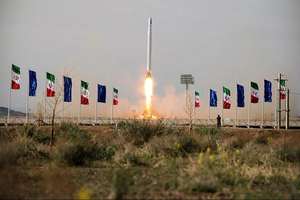
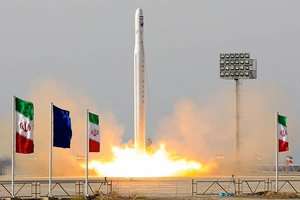
The announced launch comes as Iran accelerates plans to expand its space activities. The head of the Iranian Space Agency, Hassan Salarieh, said last month that Iran aims to launch four satellites by March 2026 and inaugurate a new spaceport in Chabahar, in the country’s southeast.

These include an updated Kosar Earth-observation satellite and prototype satellites from the planned Soleimani narrowband constellation, intended to support Internet of Things services.

Western governments have repeatedly expressed concern that Iran’s satellite launches could aid its ballistic missile program, citing overlapping technologies. Tehran says its space program is purely civilian and aimed at scientific and communication applications.

Israeli officials see no sign of imminent Iran strike - reports

Oct 4, 2025, 12:19 GMT+1

Israel’s military and defense establishment said on Saturday there was no indication of an imminent Iranian strike or an Israeli plan to hit Iran, Israeli media reported, after opposition politician Avigdor Liberman warned that Tehran was preparing a surprise attack.

Senior Israeli officials were quoted by Hebrew media as calling Liberman’s post on X “bizarre and detached from reality.”

Defense officials cited by Channel 13 said that such comments could lead to a “miscalculation” in which Iran might assume Israel was preparing an assault and respond preemptively.

Sources cited by Ynet said Israel had chosen not to officially reply “so as not to bolster” Liberman’s remarks, adding there was “no substance to them.”

Liberman, head of the Yisrael Beytenu party and a former defense minister, wrote on X on Friday that “whoever thinks the conflict with Iran is over is misled and misleading,” saying that Tehran was restoring activity at its nuclear sites and “trying to surprise us.”

He urged Israelis to celebrate the Sukkot holiday “close to protected spaces,” adding, “This government cannot be trusted. Until we’ve fixed their damage, we have only ourselves and the IDF to rely on.”

In a new post on Saturday, he listed what he called “open-source intelligence,” showing Iran’s missile and nuclear activity since late July, including satellite images at Natanz, reports of missile tests, and new sanctions by the United States and Europe. “All these facts together must lead us to the conclusion that the Iranians are not seeking a Nobel Peace Prize, but revenge,” he wrote, adding that the next confrontation with Iran was “not a question of if, but when.”

The IDF Home Front Command said there were “no changes to its guidelines,” while defense officials accused Liberman of fearmongering.

Officials warn against political missteps

Defense sources told Hebrew outlets that intelligence agencies have not detected preparations for a new Iranian offensive or for Israel to launch one. They warned that inflammatory rhetoric from politicians could prompt Tehran to misread Israel’s posture.

Israeli assessments cited by Ynet indicate that Iran is attempting to rebuild its air defense systems destroyed in the June war and to restart limited ballistic missile production, reportedly seeking technical help from China, Russia, and possibly North Korea. However, the reports said there are no signs Iran has resumed uranium enrichment or nuclear weapons development, and Supreme Leader Ali Khamenei has yet to decide on reactivating those programs.

Officials expressed concern that Iran’s suspension of cooperation with International Atomic Energy Agency inspectors has left critical blind spots, including uncertainty over its stockpile of roughly 400 kilograms of uranium enriched to 60 percent. Intelligence officials view the chance of Iran producing a crude device or “dirty bomb” as remote.

An anti-Israel billboard is displayed on a building in Tehran, Iran, October 2, 2024.
100%
An anti-Israel billboard is displayed on a building in Tehran, Iran, October 2, 2024.

Kayhan says confrontation 'very probable'

In Tehran, Kayhan—a newspaper supervised by Khamenei’s office—published a Saturday editorial asserting that the world stands “on the brink of a historic turning point.” The paper said a renewed confrontation between Iran and what it called “the American-Zionist front was very probable,” citing Liberman’s own words as proof that Israel was bracing for another war it might not win.

“It is not necessarily the case that this time the opponent will strike first,” Kayhan wrote, arguing that Iran’s unity and deterrence capabilities had prevented its defeat in the 12-day war in June. The editorial linked economic volatility in Iran to foreign hybrid warfare and urged authorities to reinforce “military strength, domestic cohesion, and resistance economics” as protection against renewed aggression.

While Israel’s defense establishment insists calm prevails, Kayhan portrayed the same moment as an approaching inflection point—one in which, it warned, “the future will be shaped by vigilance and strength, or lost to weakness.”

Revolutionary Guards say Oct. 7 attacks caught them unawares

Oct 3, 2025, 19:50 GMT+1

A top commander in Iran's Revolutionary Guards said on Friday the Oct. 7, 2023 Hamas attack on Israel came as a surprise to them, its Hezbollah allies and even the Palestinian group's political leaders.

Iran, slain Hezbollah chief Hassan Nasrallah, and senior Hamas leaders such as Ismail Haniyeh "were unaware of the October 7 attack,” said Esmail Qaani, head of the foreign operations wing of Iran's Islamic Revolutionary Guard Corps (IRGC), the Quds Force.

Israel has accused Iran of orchestrating the October 7 attacks, with Prime Minister Benjamin Netanyahu insisting that Tehran funded, trained and planned the assault as the culmination of its longstanding support for Hamas.

Successor to Qassem Soleimani, who was killed in a US drone strike in Baghdad in 2020, Qaani has mostly maintained a low profile and survived serial Israeli assassinations of IRGC commanders during a surprise military campaign in June.

According to Qaani, Haniyeh was preparing for a trip to Iraq when he was surprised to learn of the assault on Israel by Hamas. Haniyeh, a senior Palestinian politician and Hamas’s political leader, served as chairman of the group from 2017 until his assassination by Israel in Tehran in July 2024.

Qaani said he traveled to Lebanon on the afternoon of October 7 and met Hezbollah chief Hassan Nasrallah to discuss next steps.

“During the meeting, Nasrallah decided to launch attacks on Israel on October 8,” he said, noting that a large number of Lebanese civilians were holidaying away from homes in southern Lebanon at the time.

On October 8, Hezbollah fired rockets and artillery at multiple Israeli military sites in northern Israel, including around the disputed Shebaa Farms in solidarity with Hamas. Israel responded with heavy artillery fire.

The Jewish State carried out multiple strikes against Hezbollah in Lebanon, including pager explosions in September 2024 that killed more than 30 Hezbollah commanders.

Later that month, an Israeli airstrike in Lebanon killed most of Hezbollah’s senior leadership, including Nasrallah. A subsequent air campaign and ground incursion killed over 3,000 people.

Hezbollah disarmament

Qaani added that if Israel could disarm or destroy Hezbollah militarily, it would have continued fighting without pause, but instead Israel requested a ceasefire to regroup.

“While some Israeli officials prematurely claimed Hezbollah’s destruction, battlefield realities showed otherwise,” he said.

Lebanon’s government has unveiled plans to disarm Hezbollah by the end of 2025, aiming to make the Lebanese Armed Forces the country’s sole armed force even as Israel maintains an armed presence in parts of the country's south.

Hezbollah, with backing from Iran, has resisted handing over its weapons.

Iran talks down war fears but US deployments stir anxiety

Oct 2, 2025, 17:20 GMT+1
•
Maryam Sinaiee

Iranian officials are downplaying talk of another war with Israel and the United States but US carrier and tanker movements have sparked anxiety as weary citizens weigh readiness for a possible re-run of a punishing summer war.

Mohammad-Jafar Ghaempanah, the President’s executive deputy, told reporters after a cabinet meeting on Wednesday that Iran is “fully prepared” for any new war, though he judged it unlikely Iran's foes would “repeat the mistake”.

Ali Saeedi, head of the Supreme Leader’s Ideological-Political Office, told state media he “could not give a clear answer” on whether war will come.

“The armed forces must be fully prepared, but people should continue their lives and should not be inflamed. At present, we do not observe signs of an enemy attack.”

Flight tracking data over the weekend showed a rapid deployment of aerial refueling craft to the Al Udeid airbase in Qatar, the largest American military installation in the region.

The last large-scale movement of such assets coincided with surprise US and Israeli attacks on Iran in a brief June war. That conflict sent tens of thousands of Iranian civilians heeding Israeli warnings to flee major urban areas. Hundreds were killed.

Open-source satellite imagery and flight tracking date shows the USS Nimitz aircraft carrier and its attendant aircraft operating in the Persian Gulf and docked at Dubai's Jebel Ali port as of last month. Such port calls are largely routine.

Behnam Saeedi, secretary of parliament’s National Security Committee, rejected a link between snapback of UN sanctions and war: “Whether a war restarts or not, in the current circumstances, it has nothing to do with the snapback.”

Still, he described the situation as “not a ceasefire but a suspension of combat operations.”

Military posture: beefing up deterrence

Nour News, a news outlet close to Iran's mercurial ex-security boss Ali Shamkhani, on Tuesday framed new US deployments as a “political message” of support to regional allies and a warning to Iran that the military option is still on the table.

Chief of the General Staff Major-General Amir Mousavi declared the Army and the Revolutionary Guards maintain “extraordinary readiness for a possible future clash.”

Brigadier General Mohammad-Jafar Asadi of the Khatam al-Anbiya headquarters promised Iran would “increase the range of its missiles as far as necessary,” while maintaining that Tehran “will not initiate a war but will give a decisive response to any aggression.”

Competing calculations: low or high risk?

Journalist Hossein Yazdi assessed the probability of renewed large-scale strikes as low. He argued Iran’s nuclear sites, already hit, have not been rebuilt; Israel has extracted its revenge; and the US would likely block further escalation.

“The military phase is over,” he wrote on X, suggesting Israel is now using psychological pressure to sap Iran’s economy.

But others warn that the prospect of strikes are high.

“If you think that the deployment of this volume of armaments, refueling aircraft, fighter jets, and so on by America is random, accidental, or merely for the sake of creating fear and intimidation, congratulations," writer Mohammad-Reza Mohajer posted on X. "You are extremely optimistic, and no other event can destroy this optimism in you."

Political analyst Ali Nasri called endless speculation corrosive: “Keeping society continually struggling to ‘predict’ or ‘await’ a military attack is itself a tool of psychological warfare and collective torture of the Iranian people."

"It aims to further damage the economy and disrupt life. If there is a war, we will respond proportionately," he added on X. "For now, our challenge as citizens is to continue ordinary life.”

Street-level voices: fear, anger, fatigue

Signals of potential conflict are already being priced in Iran's moribund markets.

The rial and gold have reacted, with the dollar rate again breaking records against the prone rial and gold hitting new highs. On social media, frustration dominates.

One user lamented: “Instead of enjoying the weekend, everyone I meet talks about war and the dollar and the misery the clerics have given us!”

Another wrote: “Dollar, sanctions and the possibility of war — I really have no strength left to continue.”