A man holding a photo of late president Ebrahim Raisi, Hamas leader Ismail Haniyeh, and IRGC-Quds commander Qasem Soleimani during a funeral procession for Haniyeh in Tehran on August 1, 2024
Hamas’s conditional acceptance of Donald Trump’s peace plan has left Tehran’s hardliners scrambling—pivoting from predictions of rejection to praise—while their detractors watch bemused at their being outmaneuvered by a Palestinian ally.
Hardline outlets such as Kayhan, Hamshahri, and Jam-e Jam had forecast Hamas would reject the proposal.
Once the group issued its nuanced response, they quickly fell into line.
Seday-e Iran, a site linked to the Supreme Leader’s office, set the tone by dismissing Trump’s initiative as “an attempt to escape a deadlock” but hailing Hamas’s answer as “intelligent.”
Nour News, tied to former security chief Ali Shamkhani, insisted Hamas had “smartly accepted only the parts of Trump’s plan related to the release of hostages and the cessation of war, while rejecting disarmament and the presence of foreign forces.”
Trump’s quick praise, it added, showed “his need for the hostages” and a political victory for the Nobel, not a real achievement. The line was clear: Hamas’s flexibility was acceptable only if it fit within Iran’s “resistance logic.”
On X, former Foreign Ministry spokesman Nasser Kanaani reinforced the script, calling Hamas’s move “responsible and intelligent” and proof that “the Resistance still holds the initiative on both the diplomatic and battlefield fronts.”
Jab at October 7 mastermind
Other hardliners played variations on the theme, not striking the same note but not diverging far.
Vatan-e Emrooz branded Trump’s proposal a “deceptive plan” that would “sideline Hamas and turn Gaza into a demilitarized zone under Israeli and American supervision, without guarantees for refugees or an end to the blockade.”
Even so, it conceded Hamas’s “yes, but…” response gave the group leverage and kept talks alive.
Ahmad Janjan, a political activist close to Speaker Mohammad-Bagher Ghalibaf, vented at late Hamas leader Yahya Sinwar: “Not only did Sinwar's solo act ruin the entire zero-day plan, but also Hamas accepted peace tonight, only after the destruction of the resistance axis!”
His anger echoed Quds Force commander Esmail Qaani, who admitted “neither Iran nor even Ismail Haniyeh was informed” of Hamas’s October 7 operation in advance—a rare admission that undercut Tehran’s claim of coordination.
‘Help clear Gaza rubble’
Outside hardline circles, the tone was markedly different: a mix of blame and ridicule.
“I wish hardliners themselves could show this kind of ‘wisdom’—or at least let the Pezeshkian administration respond as ‘wisely’ to some international initiatives!” reformist commentator Ahmad Zeidabadi wrote on his Telegram channel.
He argued that pro-government factions now face “a crisis in taking a stance” so severe they may soon ban discussion of the issue altogether.
Some opposition activists were harsher, framing Hamas’s shift as another loss for Tehran and its allies.
“Israel and the US have taken another step forward,” one activist posted on X. “It’s time to deal with the biggest destabilizer of the region: the Islamic Republic.”
Cutting deepest was journalist Hossein Yazdi: “Send those who were giving out sweets around Palestine Square on October 8 to Gaza to help clear the rubble,” he wrote, torching hardliners who celebrated the Hamas ambush two years ago to the day.
Smoke rises from Gaza after explosions, as seen from the Israeli side of the border with Gaza, October 5, 2025.
Iran’s foreign ministry on Sunday expressed cautious support for Hamas’s response to Donald Trump’s Gaza ceasefire plan, but warned against what it called the proposal's dangerous dimensions and Israel’s alleged failure to honor past commitments.
Iran welcomes any decision “that would result in stopping the genocide of Palestinians, the withdrawal of the occupying Zionist army from Gaza, respect for the Palestinian people’s right to self-determination, the entry of humanitarian aid, and the reconstruction of Gaza,” the Foreign Ministry said in a statement.
However, it warned about the risks surrounding the ceasefire plan and the “dangerous aspects of this plan.”
It also cautioned against what it called Israel’s “obstruction (of peace efforts) and bad faith in fulfilling its promises—especially in light of the regime’s expansionist and racist schemes.”
Despite the risks, it said, “Tehran maintains that any decision on this matter rests with the Palestinian people and resistance.”
Trump said on Saturday that Israel had agreed to an initial withdrawal line in Gaza and that a ceasefire would take effect once Hamas confirms acceptance.
Hamas said it accepts several parts of Trump’s ceasefire plan including the release of Israeli hostages it is holding since October 7 2023, but added that some elements still require further negotiations.
On Sunday, Al-Arabiya quoted a Hamas source as saying that the Palestinian group had agreed to hand over its weapons to a Palestinian-Egyptian authority under international supervision.
However, a Hamas source denied the report later in the day, telling Qatar’s Al-Araby TV the claims were misleading, incorrect, and baseless.
Israeli Prime Minister Benjamin Netanyahu's office said on Sunday that an Israeli delegation led by Strategic Affairs Minister Ron Dermer will fly to Egypt on Monday to take part in talks on Trump's Gaza plan, also attended by White House special envoy Steve Witkoff and Trump’s son-in-law Jared Kushner.
The war in Gaza began after an attack on Israel on October 7, 2023 by Hamas militants, in which 1,200 people, mostly civilians, were killed and about 251 were taken hostage, according to Israeli figures.
Since then, more than 67,000 people, also mostly civilians, have been killed in Gaza, according to Hamas-run health authorities.
Brigadier General Ahmadali Goudarzi, the commander of Iran’s Border Guard
Iran has formally protested to some neighboring countries for allowing what it described as “enemy drones, missiles and micro-aircraft” to fly through their airspace during recent regional hostilities, the commander of Iran’s Border Guard said.
Brigadier General Ahmadali Goudarzi told state media that Tehran had documented the incidents and submitted official complaints, without naming the countries involved.
He said Iran’s borders remain “among the most secure in the region” thanks to advanced monitoring systems and coordination with neighboring states.
Goudarzi added that about 96% of Iran’s borders are under direct control of border forces and that operations continue against smuggling and illegal crossings.
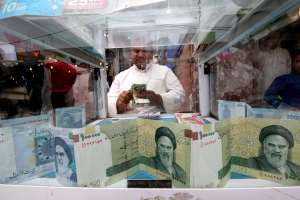
People walking past a mural at Tehran’s Enqelab square showing the Iranian 10,000-rial banknote worth less than one cent now
Iran’s parliament on Sunday approved a long-debated plan to remove four zeros from the national currency, the rial, in a bid to simplify financial transactions and improve the efficiency of banknotes.
Lawmakers passed the measure with 144 votes in favor, 108 against, and three abstentions out of 262 present. The reform amends the Monetary and Banking Law to redefine the rial as equal to 10,000 current rials and introduces a new subunit, the qiran or gheran, worth one hundredth of a rial.
Under the legislation, both old and new rials will circulate for up to three years during a transition period. The Central Bank of Iran (CBI) must establish operational procedures within two years of enactment and publicly announce the start of the change through official media.
According to the new law, after the transition period, all financial obligations denominated in the current rial will be settled using the new unit.
The CBI will also be responsible for managing the withdrawal of old banknotes and coins and for setting foreign exchange rates under the country’s current exchange regime.
The plan -- first proposed by the government in 2019 and discussed across three administrations and parliamentary terms -- has undergone multiple revisions. The latest version retains the rial as Iran’s official currency, dropping earlier proposals to rename it the toman.
Shamseddin Hosseini, head of parliament’s Economic Committee, said the measure’s main purpose was to “make banknotes more functional and facilitate financial transactions.”
He added that the abundance of zeros in the national currency had caused accounting and operational difficulties, adding that similar redenominations had been undertaken by countries such as Turkey in 2003 and 2005.
Hosseini acknowledged that cutting zeros would not directly reduce inflation or address Iran’s underlying economic challenges, but called it “an unavoidable adjustment” given years of high inflation and declining purchasing power.
Iran’s central bank governor Mohammad Reza Farzin said in May that the redenomination would take place this year as part of wider banking reforms.
The change, he added, would align official usage with common practice among Iranians, who already express prices in tomans -- equivalent to 10,000 rials.
The reform comes amid persistent inflation of about40%, a more than 90% loss in the rial’s value since US sanctions were reimposed in 2018, and widespread economic hardship.
Economists say that while the move could have short-term psychological benefits, it is unlikely to solve Iran’s deeper structural issues, including fiscal imbalances, monetary instability, and limited central bank independence.
“This policy is largely cosmetic,” economist Ahmad Alavi told Iran International in August. “Without tackling the roots of inflation -- from liquidity growth to systemic inefficiencies -- removing zeros will not restore the rial’s value.”
Iran has debated currency reform for decades, with earlier efforts raised under the administrations of Hashemi Rafsanjani, Mahmoud Ahmadinejad, and Hassan Rouhani. The current legislation, delayed several times by the Guardian Council, now returns to the body for final review before becoming law.
Turkish President Recep Tayyip Erdogan’s sudden decree to freeze the assets of dozens of Iranian individuals and entities linked to Tehran’s nuclear program has jolted Tehran, provoking sharp criticism across Iranian media.
On October 1, the Turkish president froze the assets of the Atomic Energy Organization of Iran, Bank Sepah and several firms involved in nuclear fuel production and uranium conversion, moving in lockstep with the latest UN sanctions against Tehran.
Erdogan's order revived provisions of earlier UN Security Council resolutions that had been put on hold after the 2015 nuclear agreement with Tehran.
However, the Atomic Energy Organization of Iran (AEOI) rejected reports that its assets had been frozen in Turkey.
Iranian media also said that several blacklisted bodies—including Bank Sepah and the AEOI itself—have no operations in Turkey, limiting the practical effect of the order.
Still, the move was significant: so far, the E3 (France, Britain and Germany), the European Union, the United States, Japan, Australia, New Zealand, and now Turkey have announced compliance with the reinstated UN sanctions.
The United States welcomed Ankara’s step, while Russia and China dismissed the measures as “null and void.”
Iran's friend or foe?
Iranian media and political commentators reacted with sharp criticism.
“Turkey’s early alignment with anti-Iran sanctions resolutions and its symbolic recognition of them is objectionable,” the conservative daily Farhikhtegan wrote in an editorial titled “The Realities of Turkey’s Sanctions Against Iran".
Conservative commentator and former Javan editor-in-chief Abdollah Ganji expressed disbelief on X: “Apparently, Turkey has taken the lead in the snapback… it has outpaced the Westerners. It's unbelievable. 18 companies? By Erdogan's decree? Is this true? What is the opinion of the Ministry of Foreign Affairs?”
Ehsan Movahedian, another conservative analyst, told state TV: “While Russia and China have not joined anti-Iran sanctions and Pakistan seeks barter trade, Turkey has taken the lead. We must correctly identify our friends, enemies, and rivals, and act accordingly.”
Counterpoint: ‘only compliance with UN resolutions’
Not all commentary was condemnatory. Some argued Turkey’s action was more a matter of obligation than betrayal.
“Even if (Turkey) was an ally, it would still do so. So would Iran if it were in Turkey’s place,” journalist Reza Ghobeishawi wrote on X. “The problem is not with Turkey but in the mind and mistaken perceptions inside (Iran) that brought things to this point.”
Reza Nasri, an international affairs commentator, however, accused Erdogan of lacking courage to break with Western frameworks in post on X.
He argued that most states recognize that Iran's nuclear program poses no threat to international peace to be subjected to UN Charter's Chapter VII measures, so Turkey and other states have every legal justification not to comply.
“Only courage to stand by the law is required.”
Signal to the West?
Several Iranian outlets suggested Turkey’s decision was more about geopolitics than legality.
“These sanctions are mostly symbolic since many of the listed entities are not active in Turkey. Erdogan seems to be sending a message to Trump that he stands with the West,” Ali Heydari, a Turkey analyst at the IRGC-linked Tasnim News Agency, posted on X.
Shaya News argued: “At first glance, Ankara justifies the measure as compliance with international obligations and legal commitments toward the UN. But at a deeper level, the decision raises serious questions about neighborly relations, bilateral principles, and the extent of Turkey’s foreign policy independence under international pressure.”
Impact on Iran–Turkey relations
Iran’s Foreign Ministry has so far remained silent. But commentaries warn the move could hurt trust and trade between the two neighbors, particularly in energy and finance.
“This choice comes at the expense of sacrificing bilateral relations with Iran,” Shaya News wrote.
“The asset freeze not only casts a shadow over Iranian investors and businessmen’s trust in Turkey but could also deprive Turkey of the benefits of its thriving economic relations with its eastern neighbor.”
Farhikhtegan similarly warned that Tehran’s response should be “proportionate to Ankara’s alignment with the White House’s anti-Iran policies.” It added that Turkey’s status as a NATO member and US security ally cannot be ignored.
“Should Ankara move toward serious anti-Iran measures—whether sanctions or security-related—then Iran’s approach to Turkey must necessarily be recalibrated within a security framework,” the newspaper wrote.
With Russia’s UN Security Council presidency and China’s economic leverage, Tehran is betting Moscow and Beijing can shield it from the impact of UN sanctions through legal maneuvers, committee vetoes, and strategic investments.
Both countries have condemned the Council’s decision, leading some in Iran to hope the rhetorical rejection will be followed by action.
“China and Russia currently intend either not to implement the resolutions under Resolution 2231 or to apply them selectively,” political analyst Mehdi Kharatian said in a post on X.
Former diplomat Kourosh Ahmadi put forward ways in which the duo could help Iran.
“China and Russia can play an effective role in reducing the impact of reinstated UN resolutions in three areas,” he wrote in the reformist daily Shargh, “preventing the implementation of the six reactivated resolutions, obstructing the work of the Sanctions Committee … and blocking any new measures.”
Obstruct sanctions
Ahmadi asserted that decisions in the Committee require consensus, enabling Beijing and Moscow to delay appointments, hinder panel functions, and limit enforcement—as they did on occasion in relation to North Korea.
Another former diplomat, Nosratollah Tajik, struck a more hopeful tone.
“China and Russia… can use existing legal mechanisms within the United Nations to obstruct the implementation of sanctions,” he told moderate outlet Jamaran.
In a joint letter to the UNSC president on September 28, China and Russia, together with Iran, argued that the snapback move by the E3 (Britain, France, and Germany) was “inherently flawed both legally and procedurally,” branding it “null and void.”
Russia’s UN Ambassador Vasily Nebenzia declared on October 1: “We’ll be living in two parallel realities, because for some snapback happened, for us it didn’t.”
Invest in Iran
Alongside legal avenues, some experts asserted, Russia and China could also try to neutralize the sanctions with hard cash.
Conservative politician Mansour Haghighatpour said Tehran and China could be looking at a new chapter in their economic cooperation if China takes “concrete steps to invest in and finance Iran’s infrastructure projects using the digital yuan.”
Such a move would prove that Beijing “will not allow imposed obstacles to block the implementation of ambitious initiatives such as the Belt and Road Initiative,” Haghighatpour argued in a piece for the moderate daily Etemad.
The optimism has been invariably met with doubt and even ridicule from ordinary Iranians on social media.
“Russia and China did not invest in Iran when we only had the US sanctions—so now they don’t recognize UN sanctions?” one user commented on X.
Another posted: “China buys only a small amount of oil from Iran … and it forces Iran to barter with Chinese goods! Humiliation higher than this?!”
‘They didn’t even abstain’
Bloomberg reported this week that Qingdao Port, a major Chinese oil terminal, plans measures targeting vessels transporting sanctioned Iranian oil, highlighting the limits of Beijing’s support.
Iran has signed strategic partnership treaties with Russia, a 20-year pact that took effect on October 2, and with China, a 25-year deal agreed in 2021 but still only partly implemented.
Some in Tehran are betting on these agreements.
“We are witnessing the emergence of a trilateral strategic partnership among Iran, Russia, and China, which could have significant implications for the balance of power,” academic Jalal Dehghani told the state-run Iran newspaper.
Another anonymous user on X reminded him of ominous precedents: “Russia and China voted in favor of all the sanctions resolutions between 2006 and 2011 … They didn’t even abstain!”