Iran to table resolution against attacks on nuclear sites at IAEA conference
Iran’s nuclear chief Mohammad Eslami
Iran’s nuclear chief Mohammad Eslami departed for Vienna to attend the IAEA’s annual general conference, saying Tehran would push for a ban on attacks against atomic facilities, as the Supreme National Security Council outlined strict conditions on future inspections.
“The annual conference is an important opportunity to present our positions and explain the unlawful measures that have targeted our nuclear industry,” Eslami told state television before leaving Tehran to attend the 69th General Conference of the International Atomic Energy Agency (IAEA).
He said Iran would use the platform to introduce “a clear and transparent narrative” of recent events and to stress what he described as the IAEA’s inaction against such incidents.
Eslami said the trip would include multilateral meetings with various countries and that Tehran had prepared a resolution for the conference “to condemn attacks on nuclear facilities and ensure this issue is formally raised.”
Supreme National Security Council statement
Iran’s Supreme National Security Council (SNSC) also issued a statement on the recent arrangement signed in Cairo between Foreign Minister Abbas Araghchi and IAEA chief Rafael Grossi, setting out principles for future cooperation.
The council said the text “was reviewed in the nuclear committee of the SNSC and corresponds with what was approved there.” The committee, composed of senior officials from relevant institutions, has been authorized to decide on nuclear issues, it added.
On facilities attacked by Israel and the United States in June, the SNSC said Iran would first provide its own report after obtaining the view of the Supreme National Security Council and then negotiate with the agency on implementation methods.
Any action, it added, “must be approved by the Supreme National Security Council.”
The statement emphasized that “if any hostile action is taken against the Islamic Republic of Iran and its nuclear facilities, including the reinstatement of previously closed Security Council resolutions, the implementation of these arrangements will be halted.”
The remarks come as Britain, France and Germany push ahead with a “snapback” process to restore UN sanctions on Iran unless inspections resume and missing uranium is accounted for. Sanctions will automatically return by late September unless the UN Security Council votes otherwise.
Araghchi has warned the European powers that pursuing the mechanism would mean they “lose everything,” and Tehran has made clear that the new cooperation framework with the IAEA is conditional on no further hostile action.
The IAEA reported this month that Iran’s stockpile of uranium enriched to 60% reached 440.9 kilograms before the June airstrikes. Grossi said the Cairo deal covers all declared facilities, including those bombed, and aims to re-establish inspections once technical procedures are agreed.
Eslami said Iran would use the Vienna conference “to highlight that our rights and concerns have been recognized and to reaffirm that cooperation will proceed in a way fully consistent with our national legislation.”
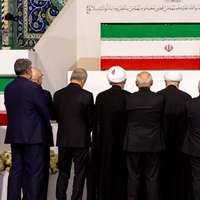
Iran's Supreme Leader Ali Khamenei along with his military commanders
Tehran on Sunday rejected a joint statement by G7 members and partners accusing Iran of assassination plots, kidnappings, and harassment of dissidents overseas.
“The allegations are sheer projection and a distortion of reality,” Iran’s foreign ministry said in a statement.
The governments behind the statement—particularly the United States, Britain, France, and Germany—were responsible for “unlawful and destabilizing conduct” in West Asia, read the statement.
G7 statement
The G7 Rapid Response Mechanism, which includes Canada, France, Germany, Italy, Japan, the United Kingdom, the United States, and the European Union, along with Australia and New Zealand, issued the statement on Friday.
“Iranian intelligence services have increasingly attempted to kill, kidnap, and harass political opponents abroad, following a disturbing and unacceptable pattern of transnational repression, and clearly undermining state sovereignty,” the group said.
“Other malign activities include operations to obtain and disclose the personal information of journalists and attacks designed to divide societies and intimidate Jewish communities.”
“We will continue to safeguard our sovereignty, keep our communities safe, and defend individuals from the overreach of foreign governments trying to silence, intimidate, harass, harm, or coerce them within our borders,” the G7 added.
Iran dismissed the accusations. “The governments involved should correct their mistaken and criminal policies instead of deflecting responsibility,” the foreign ministry said.
Iranian security institutions act “only in defense of national stability,” it added.
Examples of Iranian operations abroad
Western officials have pointed to multiple cases in recent years. In 2018, European security services foiled a plot to bomb a rally of Iranian opposition figures near Paris. In 2021, US prosecutors charged four Iranian operatives in a plot to kidnap Iranian-American activist Masih Alinejad from New York.
Iranian President Masoud Pezeshkian welcomes Qatari Emir Sheikh Tamim bin Hamad Al Thani at the Sa’dabad complex in Tehran, Iran, February 2025
Senior Iranian officials are using the recent Israeli attacks on Doha to justify calls for the formation of a unified military front among Muslim nations as the Organization of Islamic Cooperation (OIC) gathers for an emergency summit in Qatar on Monday.
Mohsen Rezaei, a former chief commander of the Islamic Revolutionary Guard Corps and now a member of the Expediency Council, warned that Saudi Arabia, Turkey and Iraq could face future Israeli attacks if the OIC fails to act decisively.
“The only solution is forming a military coalition,” he said in remarks carried by Iranian media.
Reinforcing that call, Jalal Razavi-Mehr, a Shia cleric who heads the Assembly of Seminary Students’ Representatives in Qom, called for the creation of a joint Islamic army.
“This army should be composed of the defensive and military forces of Islamic countries, operating under a single command, with a shared defensive and, if necessary, offensive doctrine,” he said.
Inside Iran’s diplomatic corps, however, officials took a more cautious line.
Mehdi Shoushtari, the Foreign Ministry’s director general for West Asia and North Africa, said it was “still too early” to speak of a regional security pact, though he argued that conditions for such a framework are “more favorable than in the past.”
He emphasized the need for “a shared understanding” at both expert and governmental levels before any agreement could take shape.
Ahead of the OIC assembly, the remarks underscore Iran’s bid to assert itself in the bloc’s mostly Sunni Muslim deliberations.
President Masoud Pezeshkian is expected to attend the Qatar summit.
Despite brief tensions after Iran fired rockets at a US base in Qatar during a 12-day clash with Israel in June, the two countries have in recent years deepened political and economic ties and often aligned on regional and international issues.
The OIC, which brings together 57 member states, has often limited its response to joint statements.
Monday’s gathering in Doha will test whether calls for a stronger response translate into concrete action, with its stance on the latest escalation still to be defined.
Iranian Foreign Minister Abbas Araghchi warned on Saturday that Britain, France, and Germany risk “losing everything” if they move ahead with restoring UN sanctions on Tehran through the so-called snapback mechanism.
"It is not just that the E3 has no legal, political, or moral entitlement to invoke "snapback", and that even if they did, "use or lose it" doesn't work," Araghchi said in a post on X.
"It's that the correct expression for the E3's dilemma is "use it *and* lose it". Or better yet, "use it and lose it *all*"," he said, without providing further details.
The three European powers triggered the snapback process on August 28 under Resolution 2231, demanding Iran return to talks, grant wider access to inspectors, and account for its missing uranium stockpiles.
Sanctions will be automatically reimposed within 30 days unless the Security Council votes otherwise.
“Our enriched uranium is buried under the rubble of bombed nuclear facilities,” he said, marking the first official acknowledgment the material survived.
The Supreme National Security Council would decide on Iran’s response if sanctions return, he added without giving details.
The UN nuclear watchdog (IAEA) reported earlier this month that Iran’s 60% enriched uranium stockpile rose nearly eight percent before the June strikes, reaching 440.9 kilograms.
Reuters reported in June that most of the enriched uranium at Iran’s Fordow facility appeared to have been moved days before the attacks.
The United States on Wednesday urged Iran to take “immediate and concrete action” to meet its nuclear safeguards obligations, warning the IAEA board may need to act if Tehran fails to cooperate.
Slain conservative activist Charlie Kirk had privately pressed President Donald Trump in the Oval Office not to launch a war against Iran, even while donors aligned with him opposed that stance, US right-wing commentator Tucker Carlson said.
Kirk was one of the only people close to Trump who raised the risks of escalation, Carlson said at the Megyn Kelly Show on Friday.
“He went to the Oval Office and said, ‘Sir, I totally understand and think Iran’s really bad. But a war with Iran is something that could really hurt our country,’” Carlson said.
He added that Kirk showed him “intense” donor messages criticizing his position but argued he stuck to it because “he was for doing the right and wise and difficult thing.”
In 2020, after the US killing of Iranian general Qassem Soleimani on Trump’s order, he warned against deeper involvement, saying: “Iran is an evil regime … Critical we remain restrained and disciplined against another endless, reckless war in the region. NO WAR with Iran!”
In the midst of Israel's 12-day war against Iran in June, and before the US airstrikes, Kirk cautioned that Iran’s size, history, and resilience made open war a dangerous prospect.
“They were a great power for a thousand years. Not even the Romans could defeat Persia,” he told Newsmax on June 20.
Yet his stance shifted when Trump ordered strikes on three Iranian nuclear sites, known as Operation Midnight Hammer. While other conservative allies questioned the wisdom of the move, Kirk applauded it.
"America stands with President Trump," he wrote on X. "President Trump has been navigating this quite well in fact, he could potentially declare victory," he added in a video testimonial posted online.
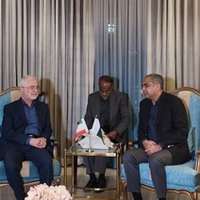
Egyptian Foreign Minister Badr Abdelatty, Iran's Foreign Minister Abbas Araghchi and Director General of the International Atomic Energy Agency (IAEA) Rafael Grossi in Cairo, Egypt, September 9, 2025.
The Iranian parliament on Saturday convened an emergency meeting with Foreign Minister Abbas Araghchi to review the government’s new cooperation agreement with the International Atomic Energy Agency (IAEA) signed in Cairo.
"The lawmakers had questions and concerns that are legitimate and stem from their supervisory role, which they must exercise, and we also have a duty to provide answers," Araghchi told reporters after the meeting.
Lawmakers were supposed to seek explanations on how the accord, signed in Cairo on Tuesday, complies with legislation suspending cooperation with the agency after June's conflict with Israel.
"In today’s session, some of these concerns were raised, and there was consultation on how to move forward more effectively, neutralize the enemies’ tricks in political and international arenas against the people, and safeguard the country’s interests," Araghchi said.
He described the meeting with lawmakers as "very good, constructive, and scientific."
More than 60 MPs earlier backed a request for a special session with Foreign Minister Abbas Araghchi and Supreme National Security Council secretary Ali Larijani to provide clarification. The move came after parliament went into recess until September 27, prompting criticism that oversight was being avoided.
Conservative MP Hamed Yazdian, who initiated the request, said the session was needed to assess “the extent of conformity of the Cairo agreement with the law passed by parliament.”
Strong criticism of Grossi
The deal has sparked sharp reactions from hardline lawmakers. Javad Hosseini-Kia called IAEA chief Rafael Grossi “a Mossad agent” and urged that he be arrested if he enters Iran.
Another MP, Mohammadreza Mohseni-Sani, said inspectors “have no right” to enter Iran until damaged nuclear facilities are restored, warning that if UN sanctions are reimposed under the “snapback” mechanism, parliament would pursue leaving the Nuclear Non-Proliferation Treaty (NPT).
Some lawmakers, such as Ahmad Bakhshayesh, have argued Iran should no longer limit itself to peaceful nuclear activities, while others, including Mahmoud Nabavian, have branded the Cairo accord a “cursed agreement.”
By contrast, former nuclear chief Ali Akbar Salehi has described it as “positive” but cautioned that time is running out for diplomacy.
Araghchi insists the Cairo accord safeguards Iran’s interests and is consistent with the law suspending cooperation. He said it recognizes Tehran’s security concerns, guarantees Iran’s rights, and “creates no access” for inspectors at this stage.
Any monitoring, he added, would only be discussed later with approval from the Supreme National Security Council.
The debate in Tehran comes as France, Germany, and Britain have triggered the UN “snapback” mechanism, which could restore sanctions at the end of September. One of their conditions for pausing the process is renewed IAEA access, a demand the United States and European Union have also emphasized.