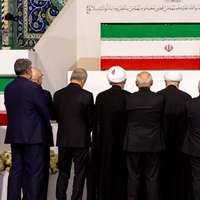
Iranian flags and drapes with religious quotes cover a building destroyed by Israeli strikes, Tehran, Iran, September 6, 2025
Iran’s Foreign Minister Abbas Araghchi on Wednesday cast doubt on a potential opening in the nuclear standoff, appearing to undermine the deal he had signed just a day earlier with IAEA Chief Rafael Grossi in Cairo.
Grossi had announced Tuesday that Tehran would grant inspectors access to nuclear sites. But Araghchi quickly walked it back, saying it was only “a one-time access to the Bushehr Power Plant that had been granted earlier.”
He added that any future agreement depended on halting “hostile actions against Iran, including activation of the trigger mechanism.”
The mixed signals captured Iran’s familiar pattern: apparent concessions abroad, followed by dismissive clarifications at home.
Araghchi himself has a record of burnishing his toughness after negotiations.
In 2014, he claimed he had shouted at US negotiators and thrown his pen at Wendy Sherman; the tale was later debunked, with witnesses recalling a calm exchange and even small talk about grandchildren.
Reasons for optimism
Despite Araghchi’s backtracking, many in Tehran saw Grossi’s visit as a sign Iran may be edging toward engagement.
With the snapback of international sanctions due in less than ten days, moderates urged the government to seize the moment.
Khabar Online called the Cairo deal “a first step to stop the snapback and pave the way for constructive negotiations with the United States.”
Reformist Rouydad24 and conservative Farhikhtegan alike said “Iran appears to be taking a new approach.”
That chorus grew louder on Sunday.
Prominent reformist Behzad Nabavi told Etemad that “a change in paradigms” is needed, insisting “wisdom calls for negotiations with the United States.” Former lawmaker Ali Motahari went further, urging President Masoud Pezeshkian to meet Donald Trump at the UN General Assembly in New York.
Missed Openings
The precedent is shaky.
In 2000, President Mohammad Khatami was moments from a handshake with Bill Clinton before hardliners stopped him; he reportedly ducked into a bathroom to avoid the encounter.
In 2013, Hassan Rouhani’s brief phone call with Barack Obama drew a public rebuke from Supreme Leader Ali Khamenei.
Both moments revealed how even modest steps toward dialogue can be reversed in Tehran.
Araghchi’s Cairo reversal echoed past retreats and left many questioning whether Tehran can commit to real engagement. Skeptics argue that optimism will always be checked by the system’s instinct for resistance.
News of the Grossi agreement briefly pushed the dollar below one million rials on Tuesday, only for it to rebound above one million and ten thousand by Wednesday. Traders complained of volatility, while regional insecurity after Israel’s strike in Doha added to the pressure.
Even the markets seem unsure which way Iran is heading.
US and EU flags pictured at European Commission headquarters in Brussels, Belgium.
The United States on Wednesday urged Iran to take “immediate and concrete action” to meet its nuclear safeguards obligations, warning the IAEA board may need to act if Tehran fails to cooperate.
Howard Solomon, the acting US envoy in Vienna, told the IAEA’s Board of Governors that Iran had “ceased implementing its most basic and fundamental obligations under its safeguards agreement.” He said the board should be “extremely concerned by this near-complete and prolonged loss of required information and access.”
“Iran does not get to pick and choose when and how to implement its legally binding safeguards obligations,” Solomon said. “If Iran’s failure to cooperate with the IAEA continues … this Board will need to be prepared to take further action to hold Iran accountable.”
He noted the agreement announced on Tuesday in Cairo between IAEA chief Rafael Grossi and Iran’s Foreign Minister Abbas Araghchi but stressed: “Immediate and concrete action by Iran is both essential and urgent.”
EU backs Grossi but demands safeguards access
The European Union also welcomed the Cairo accord but said Iran must now deliver full cooperation. “We take positive note of the DG’s statement that this is a step in the right direction. We look forward to further details and to the immediate implementation of the agreement,” the EU said in a statement.
It warned that “the proliferation risk remains profound and urgent,” citing IAEA data that Iran’s stockpile of uranium enriched up to 60% had exceeded 440 kg — “more than 10 significant quantities.”
“We call on Iran to immediately enable the full resumption of the Agency’s in-field verification activities, the conduct of which must be in line with the standard safeguards practice and is therefore non-negotiable,” the EU said.
E3 warn of sanctions clock
The remarks came after France, Germany and Britain told the agency they were “alarmed” by the lack of clarity on Iran’s near-bomb-grade uranium stockpile. “It is not enough for Iran to make promises for tomorrow, we need to see evidence from Iran today,” the E3 said in an open letter.
The three countries last month triggered the UN snapback mechanism, which could restore global sanctions at the end of September unless a new Security Council resolution extends relief.
Grossi described the Cairo agreement as “a step in the right direction,” saying it covered inspections at all declared facilities, including those damaged in June’s strikes. Araghchi, however, said the deal “does not currently allow inspectors into nuclear sites,” and access would be defined only in later talks.
UN nuclear chief Rafael Grossi is “a Mossad agent” who should be arrested if he visits Tehran, Iranian lawmaker Javad Hosseini-Kia said on Wednesday, as Grossi and Foreign Minister Abbas Araghchi signed a cooperation deal in Cairo.
Parliament pushes back
Hosseini-Kia’s remarks reflect a broader backlash in parliament, where lawmakers say the Cairo accord ignores legislation suspending cooperation with the agency. National Security and Foreign Policy Commission member Mohammadreza Mohseni-Sani said inspectors have “no right” to enter Iran until nuclear sites damaged in June’s US and Israeli strikes are restored. “If the 30-day snapback period ends with sanctions restored, we will pursue and approve a plan to leave the NPT,” he warned.
Calls for tougher measures
Some lawmakers have gone further, arguing Iran should no longer limit itself to peaceful nuclear work. Ahmad Bakhshayesh, also on the security commission, told state media Iran should build a bomb because it has already “paid the costs” in the 12-day conflict. “We should have built it long ago,” he said. “We should have built it without leaving the NPT.”
Parliament is already considering a bill to withdraw from the treaty, though former nuclear chief Ali Akbar Salehi has said only Supreme Leader Ali Khamenei can make that decision.
Former officials urge caution
While hardliners demand confrontation, Salehi has struck a different note. The former atomic energy chief called the Cairo accord “positive and a step forward” but warned time is short. “Opportunities are like passing clouds,” he said. “The longer it takes, the more complicated the problem will become.”
‘Cursed agreement’ denounced
Even those who stop short of calling for a bomb or leaving the NPT have used sharp words. Hardline lawmaker Mahmoud Nabavian described Araghchi’s Cairo accord as a “cursed agreement.” On X, he accused Grossi of being “the spy and the cursed one, who caused the martyrdom of hundreds of our commanders, scientists and compatriots.”
Pattern of hostility toward Grossi
The latest attacks on Grossi build on threats voiced earlier this summer. In July, deputy judiciary chief Ali Mozaffari said Grossi could face trial in absentia for “deceptive actions and falsified reports” that Iran claims enabled strikes on nuclear facilities. At the time, a hardline newspaper even called for his execution.
Those comments drew condemnation from Britain, France and Germany, which expressed “full support” for Grossi and the IAEA. European powers last month triggered the snapback mechanism, giving Tehran until later in September to comply or face restored UN sanctions.
Government defends Cairo deal
Despite the criticism, Araghchi insists the Cairo agreement safeguards Iran’s interests. He said it “recognizes Iran’s legitimate security concerns” but “creates no access.” Any inspections, he explained, will only be discussed after Iran submits reports in later talks
A crowd sets fire to Israeli and American flags, Tehran, Iran, March 5, 2024
Israel’s strike in Doha targeting senior Hamas leaders has given Tehran a chance to present itself as the true defender of Arab sovereignty and Palestinian resistance.
The rare attack on Qatari soil—a US ally and mediator in the Israel-Hamas conflict—took place Tuesday during a Hamas leadership meeting to consider a US-backed ceasefire proposal. Qatar’s Prime Minister denounced the assault as “state terrorism,” saying it sabotaged peace efforts.
Iranian officials moved quickly to condemn the strike. President Masoud Pezeshkian phoned Qatar’s Emir Sheikh Tamim bin Hamad Al Thani within hours, calling the attack an “illegal, inhumane and anti-peace action.”
Foreign Ministry spokesman Esmaeil Baghaei described it as a violation of international law and Qatar’s national sovereignty, warning: “Global inaction in the face of Zionist regime’s crimes in Palestine and West Asia threatens all.”
“The message of the Zionist entity’s recent crime in Qatar: O countries of the region! Prepare yourselves for my upcoming dominance!” he posted on X.
Qatar-Iran relationship
Tehran’s framing draws on recent memory. Ismail Haniyeh, Hamas’s political bureau chief, was assassinated in Tehran in July 2024 while attending Pezeshkian’s inauguration—a killing Iran cast as part of a broader campaign to decapitate the Hamas leadership.
Iran has also sought to distinguish its conduct from Israel’s.
When it struck the US Al Udeid air base in June, Tehran notified Qatar in advance and emphasized that Doha was not the target. Qatar condemned the strike but acknowledged Iran’s outreach and later expressed hope for continued good ties.
On September 4, Pezeshkian sent a message through top diplomat Abbas Araghchi requesting Sheikh Tamim’s help in facilitating dialogue with the US and the E3 to resume nuclear negotiations.
‘Lesson for US allies’
Many in Tehran framed Israel’s strike as a gift to the Islamic Republic’s regional narrative.
Mohammad Mokhber, a former vice president and close advisor to Khamenei, said the incident shows the futility of relying on the Abraham Accords.
Hardline activist Hatef Salehi called it a “lesson” for US allies in the region.
“It demonstrated, in the clearest way, that no matter how much Arab states serve US interests … Washington’s absolute priority is always the protection of the Israeli regime,” he posted on X.
Even moderate voices highlighted potential benefits for Tehran.
Journalist Reza Ghobeishavi argued the incident may push Gulf states closer to Iran.
“Previously, there was an idea that Israel would defend the Gulf countries against Iran, but that notion has now been weakened,” he wrote on X. “Israel’s attack on Qatar benefits Iran’s camp and Israel’s opponents, while harming the camp that supports normalizing relations with Israel.”
Ahmad Bakhshayesh, member of The National Security and Foreign Policy Commission of the Iranian Parliament
An Iranian lawmaker said on Wednesday the country should pursue building a nuclear weapon since it already paid a heavy price for its nuclear activities in a 12-day conflict with Israel and the United States in June.
“I’ve always believed we should have built it long ago. I’ve always supported building a nuclear bomb because we’ve already paid the costs for it,” national security committee member Ahmad Bakhshayesh told state media on Tuesday.
Bakhshayesh argued that nuclear-armed China is a member of the nuclear Non-Proliferation Treaty and that Iran should have taken the same path long ago.
“We should have built it without leaving the NPT,” he added. “We’ve been entangled in this nuclear issue in our country for 25 years now.”
Beijing acceded to the NPT in 1992 but conducted its first nuclear weapons test in 1964. China is one of the five recognized nuclear-weapon states under the agreement, alongside the US, Russia, the UK, and France.
NPT debate in Tehran
Iran maintains that its nuclear program is peaceful.
France, Germany, and the United Kingdom last month triggered the so-called "snapback" mechanism within a 2015 international nuclear deal to which they are party along with Iran, giving Tehran 30 days to comply with the agreement or face restored international sanctions.
Calls have grown inside Iran to withdraw from the NPT in response.
A bill to exit the agreement is under review in the Iranian parliament. Some lawmakers argue the legislature can pass the measure on its own, while former nuclear chief Ali Akbar Salehi said the ultimate decision rests with Supreme Leader Ali Khamenei.
'No inspection yet'
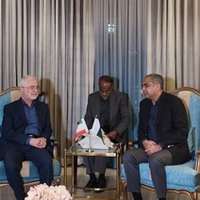
UN nuclear chief Raphael Grossi on Wednesday inked a deal to pave a way forward on resuming cooperation with Iran alongside its foreign minister Abbas Araghchi at a ceremony in Cairo.
Araghchi later told state TV that the Cairo agreement “recognizes Iran’s legitimate security concerns" and does not by itself reopen facilities to inspectors.
The three European powers said on Wednesday they were alarmed by the lack of clarity on Iran's stockpile of near-bomb-grade uranium and that Tehran must show not claim if it wanted to avoid more sanctions.
France, Britain and the United Kingdom on Wednesday said they were alarmed by the lack of clarity on Iran's stockpile of near-bomb-grade uranium and that Tehran must show not claim if it wanted to avoid more sanctions.
"To put it bluntly, there up to this moment near zero IAEA oversight of Iran’s nuclear programme, and there are thousands of kilos of enriched uranium in Iran which the IAEA has not been able to verify for nearly three months," the European troika said.
"It is not enough for Iran to make promises for tomorrow, we need to see evidence from Iran today that demonstrates it is ready for a diplomatic solution that addresses the international community’s concerns."
"That starts by showing, not claiming, that it is meeting the fair and reasonable conditions set by the E3 for a Snapback extension," the statement read.
The E3's remarks came in the form of an open letter to the International Atomic Energy Agency, which is tasked with inspections of Iranian nuclear sites.
"Iran is obfuscating the status and location of this material from the international community, and Iran refused to allow the Agency to verify this stockpile," it added.
Sanctions loom
The three powers last month triggered the so-called "snapback" mechanism within a 2015 international nuclear deal to which they are party along with Iran, giving Tehran 30 days to comply with the agreement or face restored international sanctions.
IAEA chief Raphael Grossi inked a deal to pave a way forward on resuming cooperation with Iran alongside its foreign minister Abbas Araghchi at a ceremony in Cairo on Wednesday.
Grossi said the new deal covers inspections at all of Iran’s declared nuclear sites, including those hit by Israeli and US strikes in June, in what he called a step in the right direction toward restoring safeguards.
IAEA inspectors quit the country for safety reasons during the war but subsequently returned, though they have not resumed most of their duties.
Araghchi said on Wednesday the deal does not currently allow inspectors into nuclear sites and access would be discussed in future talks, adding the accord’s survival depends on Western powers refraining from restoring UN sanctions.
'Critical jucnture'
The E3 in its letter said Iran must swiftly engage in diplomacy to provide an extension to the sanctions and meet what it called its "fair and achievable" conditions: unconditional talks with Washington, compliance with safeguarding obligations and transparency on its uranium stockpile.
"We are at a critical juncture," it wrote. "The E3 have been clear to Iran and the international community that we remain committed to diplomacy."
"It is now up to Iran to quickly take concrete steps to demonstrate it is serious about finding a diplomatic solution and to engage meaningfully with our offer, which will remain on the table during the 30-day window before snapback takes effect," the E3 added.
Iran’s parliament has since adopted a law suspending cooperation, a serious obstacle to renewed cooperation.
'No guarantee'
The IAEA-Iran agreement on Tuesday appears to provide few concrete guarantees on when the watchdog's work can resume and may give little impetus to the European powers to take a softer line.
"I understand that the European view is that Tuesday’s agreement is very UNLIKELY to shift the plans on SnapBack," Wall Street Journal correspondent Laurence Norman wrote on X on Wednesday.
"The Europeans see the absence of clear timelines and deadlines as a major problem — effectively guaranteeing nothing."