Ex-Mossad chief says Israel dropped plan to kill Soleimani to avoid war with Iran
People walk past a billboard with a picture of Iranian Major-General Qassem Soleimani in Tehran
Israel’s former Mossad chief Yossi Cohen said he had drawn up plans to assassinate Iranian Quds Force commander Qassem Soleimani, but the idea was abandoned over fears it would trigger a war with Tehran. Soleimani was later killed in a US drone strike in Iraq in 2020.
Speaking to Channel 12, Cohen said: “I always wanted to be proactive, identify threats, neutralize them. But the prevailing approach was avoidance—‘Oh, what will happen next?’ For example, I had a full plan to eliminate Qassem Soleimani in Syria. Everything was ready—intelligence, surveillance, logistics—but I was told I couldn’t carry it out because it would spark a war with Iran.”
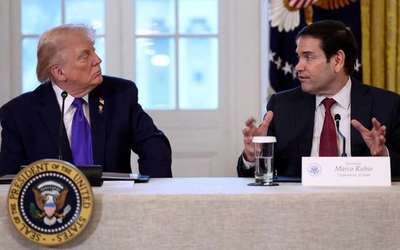
During the interview, aired Saturday evening, he recalled then US President Donald Trump accusing Netanyahu of cowardice for backing out of the strike.
Cohen said Israeli reluctance “wasn’t because of the prime minister -- but because [Netanyahu] accepted the army and military intelligence’s position,” referring to then chief of staff Aviv Kohavi.
He recalled a security meeting in which he proposed that the IDF strike a site linked to Qassem Soleimani that the military had itself labeled a serious strategic threat, without giving a date. “The chief of staff opposed me, right there,” he said. “I told the prime minister: ‘Instruct him.’ But no directive was given.”
Cohen said Netanyahu sided with the generals, a stance he described as a “policy of consequences.”
Asked if the generals intimidated the premier, he said: “Absolutely.”
Yossi Cohen during his time as Mossad chief
On June 13, Israel launched surprise attacks on Iran, killing many senior military leaders and nuclear experts, and triggering a 12-day war that brought destruction to both sides.
After Cohen’s remarks were aired Saturday evening, Kohavi issued a statement saying the IDF had opposed a different operation proposed by Cohen to kill Soleimani, and had backed what proved to be a successful operation.
Asked if Netanyahu might have acted differently in another environment, Cohen replied: “Yes, absolutely.”
Under Cohen's tenure, from 2016-2021, Operation House of Cards saw Israel target dozens of Iranian targets in Syria in 2018.
During his Saturday interview, Cohen said one of his major successes was acquiring Iran’s nuclear archive.
He said he devised the “exploding beepers” tactic used against Hezbollah last year, when pagers and walkie-talkies belonging to the Iran-backed group were rigged to detonate simultaneously, killing and wounding hundreds of its fighters across Lebanon.
“I’m the father of the concept," the long-time agent said. "In 2004, I told then-Mossad chief Meir Dagan I wanted a special operations center that would also handle equipment sales.”
A photo released by the Halvash rights group shows IRGC Intelligence Commander Iraj Shams who was killed in southeast Iran
Gunmen shot dead a local Revolutionary Guards intelligence commander in the town of Pishin, Rask county, in Iran’s Sistan-Baluchestan province on Saturday night, a rights group reported.
The commander, identified as Iraj Shams, was gunned down inside a barbershop in the city market and died at the scene after multiple shots, Halvash -- a website covering Sistan-Baluchestan -- quoted local sources as saying.
“Around 9 p.m. in the city bazaar, when Iraj Shams was inside a barbershop, he was targeted in a shooting. Armed assailants fired repeatedly at the commander, and he died at the scene,” Halvash wrote.
The motive and identity of the attackers remain unknown and no group has claimed responsibility so far.
Shams had taken part in security missions in the Pishin area, including detentions and crowd control, local sources said.
Halvash reported that residents had accused him of involvement in arrests and repression in the district. Authorities have not provided details.
“Eight armed men were killed and one hostage was freed” in operations across Iranshahr, Khash and Saravan, said Brigadier General Hassan Mortazavi, commander of the Guards’ Quds base, who also reported several arrests without details.
Police spokesman Saeed Montazerolmahdi said special police units acted alongside the Guards and confirmed that one officer was killed and another wounded.
The Sunni militant group Jaish al-Adl — designated a terrorist organization by both Iran and the United States — later acknowledged it had suffered casualties in those confrontations, saying details were still being verified.
Sistan-Baluchestan, which borders Pakistan and Afghanistan, has long been a center of insurgency by Sunni militant groups and is considered one of Iran’s most restive regions. Jaish al-Adl says it fights for greater rights for Iran’s Baluch minority; Tehran accuses it of links to cross-border militant networks.
Iran’s AnzaliLagoon, a wetland on the Caspian coast, is facing “serious challenges and human-inflicted wounds” and could disappear without urgent action, provincial governor Hadi Haghshenas said, according to state media.
Haghshenas said restoring the wetland requires $300 million and called for measures to stop industrial, agricultural and household wastewater from flowing into it.
He warned that decades of untreated sewage, sediment and pollution, compounded by falling Caspian water levels, have left the wetland on the brink of ecological collapse.
A
The wetland, registered under the international Ramsar Convention in 1975, is a critical habitat for fish, birds and local livelihoods.
Environmental officials said invasive plants, shrinking water flow and mismanagement have deepened the crisis, but stressed that “Anzali is not dead and can recover” if pollution is curbed and water retained.
In August, a senior Iranian environment official warned that Lake Urmia in northwestern Iran, once the Middle East’s largest, will completely dry up by the end of summer if current conditions persist.
“The lake's water level on August 1, 2025, was 1,269.74 meters, its area had shrunk to 581 square kilometers, and its volume was down to about half a billion cubic meters,” said Ahmadreza Lahijanzadeh, deputy for marine and wetland affairs at Iran’s Department of Environment.
Flames are seen at a station in al-Zubair oilfield, near Basra, Iraq April 21, 2020
Iraq’s prime minister has ordered the formation of a high-level committee to investigate allegations of corruption and smuggling of Iran's oil after the US Treasury sanctioned a network accused of exporting Iranian crude under falsified Iraqi origin.
The prime minister’s office said the committee, composed of relevant government agencies, will review information and reports pointing to corruption and suspicious operations in Iraq’s ports and territorial waters.
The US Treasury on Tuesday imposed sanctions on a vast network accused of blending Iranian oil with Iraqi crude and selling it as exclusively Iraqi, generating hundreds of millions of dollars in revenue for the Islamic Republic.
Washington said the network covertly blended Iranian and Iraqi oil through ship-to-ship transfers in the Persian Gulf and in Iraqi ports.
The sanctions target Waleed Khaled Hameed al-Samarra’i, based in the United Arab Emirates, along with his firms Babylon Navigation DMCC and Galaxy Oil FZ LLC, and nine Liberia-flagged tankers.
The Treasury estimated the operation generated about $300 million annually for both Iran and al-Samarra’i.
“Iraq cannot become a safe haven for terrorists, which is why the United States is working to counter Iran’s influence in the country,” Treasury Secretary Scott Bessent said in a statement.
“By targeting Iran’s oil revenue stream, Treasury will further degrade the regime’s ability to carry out attacks against the United States and its allies.”
The measures follow sanctions announced in July against another network accused of blending Iranian and Iraqi oil.
Tehran will not return to the negotiating table under the same conditions that existed before the June war with Israel, Iran’s foreign minister said Saturday, days after Europe triggered the snapback leaving Iran to engage with the US or face UN sanctions.
“We were serious about the negotiations on sanctions relief. We had five rounds of negotiations and had fixed a date for the sixth round, but two days before that Israel launched a military attack and the US joined it,” Abbas Araghchi said.
“After this unjust war, naturally the negotiations will have a different shape compared to before the war. It is not the case that after the war, we would just return to the negotiating table and as you call it 'business as usual'."
"This is certainly not possible as the circumstances have changed. It is not possible to enter negotiations as before the war," he said in an address to a business and investment conference.
The June conflict began with a surprise Israeli strike on Iranian military and nuclear sites on June 13. Tehran said 1,062 people were killed, including 786 military personnel and 276 civilians.
Israel said it killed more than 30 senior Iranian security officials and 11 nuclear scientists. Iran retaliated with missile strikes that killed 31 civilians and one off-duty Israeli soldier.
In his Saturday remarks, Araghchi stressed that while talks have not been taken off the agenda, they will enter a new phase.
“We are not saying negotiations are off the table, but they definitely have a new format and dimensions, and new concerns and factors have entered them that we must understand and design for."
Talks with US and Europeans
Araghchi said Iran is exchanging messages with Americans through intermediaries.
"The day the Americans reach a point where they are ready for dialogue based on mutual interests and mutual respect, we will resume negotiations," he said.
The foreign minister said Tehran's talks with the Europeans are continuing and that he hopes the two sides would reach a mutual understanding.
“I think a better understanding of the situation is emerging," he said, referring to his meeting with EU Foreign Policy Chief Kaja Kallas in Doha and his phone calls with E3 foreign ministers.
Iran 'very close' to deal with IAEA
Araghchi said Iranian diplomats in Vienna continued their negotiations with the UN nuclear watchdog on Saturday to reach a new framework for cooperation.
"As far as I have been informed, they had very good talks," Iran's foreign minister said. "We are very close to reaching an agreement on a new framework of cooperation with the Agency in line with the parliament’s law."
His remarks come as Iran has three weeks to reengage in negotiations with the United States and the UN nuclear watchdog or face the reimposition of UN sanctions, after the Europeans triggered the so-called "snapback" mechanism.
On August 28, Britain, France and Germany triggered the mechanism, demanding that Tehran return to talks, grant IAEA inspectors wider access and account for its uranium stockpile.
Under Resolution 2231, sanctions will automatically return after 30 days unless the Security Council votes otherwise.
A patient lies on a stretcher in a dark hospital corridor during a power cut in Iran.
At least five people have died in recent months in incidents linked to electricity outages across Iran, the reformist daily Etemad reported on Saturday.
Two children were killed on August 5 in a village in northern Golestan province when a gas leak ignited as power was restored, the paper said.
Ten days later, two youths aged 16 and 18 in Fars suffocated after sheltering from the heat in a running car inside a garage; and a Tabriz resident died in an elevator-related accident as power disruptions multiplied,” according to Etemad.
“I wish we had never had electricity. It took the lives of my two children. They had just begun to live, had just stepped into society full of hopes and dreams. Suddenly, when the power came back, my house exploded. I came and saw the wall had collapsed on my daughter. Blood was coming from everywhere,” the bereaved mother said in a video shared after the Golestan blast.
Fatal incidents and urban hazards
Fire officials in Isfahan reported a 284% jump in elevator entrapments over a one-month period tied to outages. In the southwestern city of Yasuj, up to 20 people were trapped at once during blackouts, while reports from Khorramabad in west put such incidents at three to four times last year’s level, Etemad wrote.
Families sit in a dark hospital corridor during a blackout in Iran
A young woman in Shiraz said a routine 10-minute eye procedure stretched to over an hour because a surgical microscope repeatedly failed.
“Power fluctuations burned the microscope lamp in the middle of my eye surgery,” she said, adding that repeated replacements failed until the device was swapped out, leaving lasting damage to her right eye.
Patients with chronic conditions described blackouts as dangerous and costly. Frequent cuts forced daily dressing changes and purchases of pricier creams, A butterfly disease patient in Yazd said.
A man with a spinal injury in rural Urmia feared his anti-bedsore mattress would fail in surges: without it, he said, pressure ulcers were likely. Others said that when electricity goes, well pumps stop and mobile networks and home internet also drop, compounding risks for those needing help.
Surgeons continue an operation during a blackout in Iran, relying on flashlights for light.
Strain on daily life and business
Shopkeepers and small businesses reported spoiled food and lost inventory; one confectioner filmed trays of discarded cakes, blaming a single outage for rent, labor and waste. Poultry farmers in Dezful, Khuzestan province, cited higher mortality and reduced chick placement amid daily cuts.
Etemad’s reporting underscores how prolonged outages—often four to five hours a day—are cascading through homes, clinics and city infrastructure. The accounts point to a growing public safety challenge where routine power cuts are now measured not just in inconvenience, but in injuries and deaths.