Iran executed 730 this year including 100 in July, rights group says
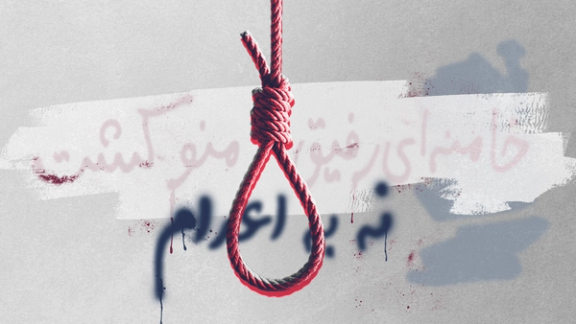
At least 730 people have been executed in Iranian prisons over the past seven months, including 102 in July alone, the US-based Abdorrahman Boroumand Center for Human Rights reported on Friday, citing its investigations.
The report was released a few days after the UN Human Rights Office said at least 612 people were executed in the first half of 2025, more than double the number recorded in the same period last year.
The UN said more than 40 percent of the executions so far this year were for drug-related offences, while others were convicted under broad and vaguely worded charges, including “enmity against God” and “corruption on Earth.”
Human rights experts have repeatedly warned that such charges are often used to criminalize political dissent and suppress freedom of expression.
On Monday, the United Nations' top human rights official urged Iran to impose an immediate moratorium on the use of the death penalty, citing the surge in executions across the country.
“Reports that there have been several hundred executions in Iran so far this year underscore how deeply disturbing the situation has become and the urgent need for an immediate moratorium in the country on the use of the death penalty,” UN High Commissioner for Human Rights Volker Türk said in a statement.
The rise in executions follows a wave of repression in the aftermath of the 12-day war between Iran and Israel in June.
Iran rejected a joint statement by the United States and thirteen allied governments that said Tehran has engaged in plots targeting individuals in Europe and North America, the Iranian foreign ministry said on Friday.
“This is a clear fabrication and a desperate move to divert attention,” Iranian foreign ministry spokesman Esmail Baghaei said in remarks carried by state media. “These baseless narratives are part of a broader Iranophobia campaign designed to justify hostile policies toward Iran.”
The US and countries including France, Germany, the United Kingdom and Canada issued a statement this week warning that Iranian intelligence services are cooperating with international criminal networks to surveil, intimidate and potentially harm journalists, activists and political figures living abroad.
In response, Baghaei said the countries involved “must be held accountable for their open support of violent and terrorist groups who have committed acts of bloodshed against the Iranian people.” He added, “Instead of answering for their illegal behavior, they resort to media campaigns based on lies.”
Western concerns grow after publicized incidents
The Western statement followed a string of recent warnings from European and US authorities. The UK’s counter terrorism police said Iran is among the most active foreign states involved in plots to harm people on British soil. Officials in London said the Islamic Republic uses criminal intermediaries and targets vulnerable individuals to carry out surveillance or attacks.
“We are increasingly seeing these three states — Iran, Russia and China — undertaking threat-to-life operations in the United Kingdom,” said Dominic Murphy, head of London’s Counter Terrorism Command, earlier this month.
Belgian lawmaker Darya Safai said this week that local police told her about a plot to abduct her via Turkey, which she linked to her calls to label Iran’s Revolutionary Guards a terrorist group.
A pattern of pressure and denials
Western governments say Iran’s operations abroad are growing more frequent and bold. A report by the UK Parliament’s Intelligence and Security Committee this month said Iran was behind at least 15 attempted assassinations or kidnappings on British soil since 2022.
Iran denies involvement in such operations and frequently calls international criticism part of a politically motivated campaign.
Maryam Rajavi speaking during a conference in Rome, Italy on Thursday, July 31, 2025.
The leader of exiled opposition group the National Council of Resistance of Iran on Thursday vowed the armed ouster of its decades-old nemesis the Islamic Republic and the founding of a democratic, non-nuclear state in its place.
“The solution to changing this regime lies in the hands of the people and the Iranian Resistance. With the regime’s overthrow by the people and organized resistance, Iran will move toward democracy and prevent a major regional war,” Maryam Rajavi told attendees at a conference in Rome.
“We will have a free, non-nuclear Iran, without executions, without mandatory hijab, without forced religion and without coercive rule,” she added.
Audience members, some wearing matching red and white outfits and headscarves, frequently interrupted her remarks with fist-pumping chants of praise.
The banned Mujahideen-e-Khalq (MEK) group is the largest component of the NCRI whose leaders are based in Paris.
A leftist-Islamist group, the MEK carried out attacks against the shah's government and US targets in the 1970s but fell out with other factions during the 1979 revolution which toppled the monarchy and has been at war with Tehran ever since.
Opposition figures have stepped up calls to rally against Tehran following a punishing 12-day war with Israel last month, but there have been no significant protests.
Iranian exiled prince Reza Pahlavi urged unity among Iran's opposition during a pro-monarchy conference in Munich on Saturday, saying the Islamic Republic's downfall would lead to sustainable peace and prosperity in the Middle East.
The Rome gathering was titled “Neither war nor appeasement - change by the hands of the Iranian people and organized resistance” and hosted a series of senior Western ex-officials who criticized Iran's leadership and praised the NCRI.
These included former New York mayor Rudy Giuliani, former UK foreign minister James Cleverly and former Belgian prime minister and former president of the European Council Charels Michel.
Senior former Western officials flank Maryam Rajavi, NCRI president, at Rome conference, July 31, 2025.
Iran executed two MEK members accused of targeting civilian sites with improvised weapons, state media reported on Sunday.
“We hold this gathering while the religious tyranny, by executing heroic fighters Behzad Ehsani and Mehdi Hassani, expresses its desperation against the people and organized resistance. They never bowed and said “no” to the executioner,” Rajavi said.
The men were accused of like baghi or armed rebellion, moharebeh or waging war against God, efsadfel-arz corruption on earth, membership in a terrorist organization, gathering classified information and conspiracy against national security.
Amnesty International described their trial as "grossly unfair". Iran executed at least 901 people in 2024 - the highest number since 2015 - according to the UN High Commissioner for Human Rights.
Since 2013, some 2,500 of the MEK members have been sheltered in Albania, where they are banned from engaging in political activity.
Islamic Revolutionary Guard Corps (IRGC) personnel assemble at a military parade in this file photo.
The United States and thirteen allied countries have accused Iran of plotting to kill, kidnap and intimidate individuals in Europe and North America, citing violations of sovereignty and links to international criminal networks.
“These services are increasingly collaborating with international criminal organizations to target journalists, dissidents, Jewish citizens, and current and former officials,” the US State Department said in a joint statement with European countries.
They included the United Kingdom, Albania, Austria, Belgium, Canada, Czechia, Denmark, Finland, France, Germany, the Netherlands, Spain and Sweden.
The governments called on Iranian authorities to immediately halt the activities and pledged to work together to prevent further threats.
On Monday, a Belgian lawmaker of Iranian descent, Darya Safai said the European country's police warned her of an Iranian plot to abduct her via Turkey after she backed labeling the Revolutionary Guards a terrorist group.
Earlier this month, British counter terrorism police said Iran alongside Russia and China is behind a growing number of life-threatening operations on UK soil including assassination and kidnapping plots carried out by criminal proxies.
Additionally, the European Union sanctioned an Iran-linked network over their alleged role in assassination plots and enforced disappearances of dissidents abroad, including on European soil.
Since January 2022, there have been at least 15 attempts at murder or kidnap against British nationals or UK-based individuals, according to a report by UK Parliament’s Intelligence and Security Committee (ISC) this month.
Iran has previously been accused of involvement in the kidnapping and killing of foreign nationals abroad.
In 2020, German-Iranian dissident Jamshid Sharmahd was kidnapped by Iranian operatives from Dubai and forcibly taken to Iran via Oman. He was sentenced to death and executed in what Amnesty called a "grossly unfair trial" in 2023.
Iran also abducted dissident journalist Rouhollah Zam from Iraq after luring him to leave Paris for the Arab country in September 2019. He was later sentenced to death and executed in Iran in 2021.
A British couple held in solitary confinement in Iran since January on espionage charges was beaten, deprived of sleep and threatened with execution, a source familiar with the matter told Iran International.
Lindsay and Craig Foreman were recently moved to the Gharchak Women’s Prison and the Greater Tehran Central Penitentiary, added the source familiar with the situation who spoke on condition of anonymity citing security concerns.
The couple had been held by Iran’s Ministry of Intelligence for the past seven months.
According to the source, the couple were subjected to torture including sleep depravation, beating and threats of execution by security agents seeking to extract confessions but have maintained their innocence.
The couple, both in their 50s, entered Iran from Armenia during a motorcycle world tour. After visiting Tabriz, Tehran and Isfahan, they planned to travel to Kerman.
On January 4, 2025, they were arrested on their way to city of Kerman and charged with spying. Britain has rejected the charges and demanded their release.
The UK foreign office said the couple was receiving consular assistance in response to a request for comment by Iran International.
“We are deeply concerned by reports that two British nationals have been charged with espionage in Iran. We continue to raise this case directly with the Iranian authorities," it said in a statement.
“We are providing them with consular assistance and remain in close contact with their family members.”
Iran has long detained and convicted foreign nationals in a bid for to gain financial or political concessions from foreign powers.
Tehran has consistently denied that the detentions are politically motivated.
Political prisoners at Iran's Ghezel Hesar prison have launched a hunger strike in response to a violent raid by guards and their transfer to solitary confinement, a source told Iran International on Wednesday.
On July 26, security forces raided Unit 4 of Ghezel Hesar prison in the town of Karaj, which houses political prisoners, to suppress detainees involved in a campaign against the death penalty.
Since the raid, families of about 20 prisoners have raised concerns about their whereabouts and filed petitions and requests for information.
A source familiar with the situation who declined to be named for security reasons told Iran International that the prisoners were beaten before being placed in solitary confinement. In protest, they launched a collective hunger strike.
The raid targeted approximately 25 prisoners who had participated in a campaign known as “No to Execution Tuesdays.”
The campaign began on January last year, when political prisoners in the women’s ward of Tehran’s Evin Prison started holding weekly hunger strikes every Tuesday to protest the rising number of executions.
Two men accused of belonging to the outlawed Mojahedin-e-Khalq (MEK) opposition group were executed on July 26.
The executions of Behrouz Ehsani-Eslamlou and Mehdi Hassani were carried out in Evin Prison, where they had been held since their arrest. Both were convicted in September 2024 by a Tehran revolutionary court on a range of national security charges.