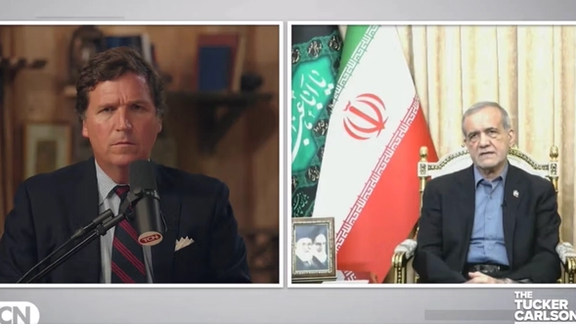
Tucker Carlson's interview with Iran’s president Masoud Pezeshkian was all Tehran could wish for, experts told Iran International: a global stage, no pushback, and a direct line to Donald Trump’s base.
“This was a major victory for Iranian information warfare operations,” said Marcus Kolga, a leading expert on foreign disinformation. “Whether intentionally or not, Carlson is acting as a significant conduit and amplifier for Iranian government information operations.”
The interview was recorded remotely, unlike the one Carlson did with Russia's president Vladimir Putin in February 2024.
"(Carlson) offers Pezeshkian and the Iranian regime a platform—without context or pushback—allowing Tehran to shape the record to Carlson’s viewers and listeners unopposed,” Kolga added.
A moment highlighted by many critics was when Pezeshkian asserted that Israel had tried to assassinate him without offering any evidence.
“He was trying to... put forward the message that this is Israel tricking America into getting involved in this. This really isn't America's war. Iran and America, we have nothing to fight about.” director of the Yorktown Institute's Turan Research Center Joseph Epstein said.
Epstein argued the interview fit Carlson’s broader pattern of offering authoritarian figures a platform to rewrite narratives without scrutiny—an approach that often blurs the line between journalistic curiosity and ideological alignment.
MAGA :' forever wars'
That alignment, analysts say, extended deep into the language Pezeshkian used.
From “forever wars” to calls for dialogue, his remarks were crafted to appeal to Trump-aligned isolationists and feed growing calls for US disengagement from the Middle East.
The use of such language is no accident, said Holly Dagres, a senior fellow at the Washington Institute, who has long studied Iranian strategic messaging.
“One of the main goals of the Islamic Republic is to get the US out of the Middle East... and when you're pushing this isolationist rhetoric or America First, you're basically saying America needs to get out," Dagres told Iran International.
Dagres noted that Pezeshkian’s emphasis on business cooperation with the US and his softened tone on slogans like “Death to America” appeared to be an overture to Trump himself, even if the message didn’t land as clearly in today’s post-war political climate.
•
•
The interview was praised by Iran's moderates, but hardline voices slammed the president's for what they called 'appeasement'.
"A lot of conservatives condemned it because (they said) the US just bombed us. Why are you making these appeals to them?”
The messaging, several experts said, fits into a broader long-term goal: undermining the US-Israeli alliance.
“He used this as an opportunity to weaken and to increase America's skepticism of support for Israel,” said Casey Babb, senior fellow at the Macdonald-Laurier Institute. “In 50 years or 100 years, if America and Israel are not aligned the same way they are right now, Israel could be in a very precarious situation.”
Carlson, Babb said, handed that message a valuable platform by failing to press Pezeshkian on Iran’s human rights record, nuclear activities, or assassination plots.
“There were definitely softball questions with no follow-up,” said Dagres. “Carlson didn’t challenge Pezeshkian on well-documented plots to target American officials or on the regime’s broader ambitions.”
“In failing to counter these narratives,” Kolga said, “Carlson becomes a conduit for regime propaganda—allowing this high-profile ‘conversation’ to turn into a successful Iranian strategic disinformation operation.”
The US President and Secretary of Defense said the military operation targeting three nuclear sites in Iran sent a strong message to the world, including US adversaries.
"Our so-called enemies were watching. They watched every minute of it," Trump said at a televised Cabinet meeting on Tuesday.
"It was a perfect military performance, the likes of which we haven't seen in a long time," he added recalling the operation codenamed Midnight Hammer.
“What was demonstrated on the world stage was American military might and capability,” Pete Hegseth said in his brief before the president spoke.
“It was not just Fordow and Isfahan and Natanz, but the whole world took notice of that.”
The June 22 strikes targeted Iran's three key nuclear sites with bunker-buster bombs. It was hailed "perfect" by the Trump administration but questioned by some Democratic lawmakers citing an early intelligence assessment.
Trump rejected doubts about the strikes' impact, praising the pilots and others involved.
“Those machines flew for 37 straight hours. They didn’t stop. They went skedaddle... They dropped the bombs, and somebody said skedaddle... And every bomb hit its mark—and hit it incredibly,” he said
"They were right in the most dangerous airspace in the world…and they went right through…by the time they (Iran) found out they were there, they were already gone. That was the word, skedaddle, get the hell out of here," he added.
US President Donald Trump said on Monday that Iran has requested negotiations with Washington and expressed his willingness to lift sanctions “at the right time.”
“I would love to be able to take those sanctions off and give them a chance,” Trump said during a White House dinner with Israeli Prime Minister Benjamin Netanyahu. “They want to meet and make peace. We have scheduled Iran talks. They want to talk.”
US Special Envoy to the Middle East Steve Witkoff told reporters that nuclear negotiations between the two countries are expected to take place “in the next week or so,” in what would mark the first official diplomatic engagement between Washington and Tehran since the 12-day conflict between Iran and Israel.
Iranian Foreign Ministry spokesperson Esmail Baghaei on Tuesday denied that Iran had requested a meeting with the American side."No meeting request has been made to the American side from our end."
Trump, speaking to reporters before the dinner, said Iran had “taken a big drubbing” from joint US-Israeli strikes but now appeared ready for dialogue. “I hope the war with Iran is over,” he added.
When asked for a specific date for the talks, Trump declined to provide details. “I’d rather not say, but you’ll be reading about it tomorrow or seeing it tomorrow,” he said.
Iranian President Masoud Pezeshkian said this week that he believes Iran can resolve its differences with the United States through dialogue, but trust would be an issue after US and Israeli attacks on Iran.
"I am of the belief that we could very much easily resolve our differences and conflicts with the United States through dialogue and talks," Pezeshkian told conservative US podcaster Tucker Carlson in an interview released on Monday.
US President Donald Trump holds a bilateral dinner with Israeli Prime Minister Benjamin Netanyahu, at the White House in Washington, July 7, 2025.
The US president also spoke warmly about the Iranian potential. “They have the oil power. They have great people, smart people, energetic people—amazing,” he said.
“I would like to see Iran build itself in a peaceful manner. They were the bully of the Middle East and now they are not any more.”
During the dinner, Netanyahu said that Iran’s influence in Syria had waned and described the Islamic Republic as "out of the picture" there, suggesting that this shift could open the door for a new peace process between Israel and Syria. He also told Trump he intended to nominate him for the Nobel Peace Prize.
Trump said that Netanyahu had asked for US sanctions on Syria to be lifted—a request that Trump said was granted. “We took the sanctions off because we want to give them a chance,” he said, adding that similar relief could be considered for Iran if progress is made.
Mehrzad Boroujerdi, a US-based Iran analyst, said that the dinner remarks exposed a gap between American and Israeli positions on Iran.
“Netanyahu has never accepted any form of negotiation with Iran and has consistently advocated for the destruction of its nuclear program,” Boroujerdi told Iran International. “His comparison of Iran’s nuclear and missile ambitions to ‘cancerous tumors’ shows he seeks perpetual control over Iran’s military activities.”
However, he said that Trump’s remarks reflect a more pragmatic view from the White House. “Trump is entering these talks from a position of strength,” he said. “This isn’t about appeasement—it’s about leverage.”
The dinner was Netanyahu’s first in-person meeting with Trump since the strikes on Iran.
A religious decree or fatwa issued by two senior Iranian clerics calling for the killing of Donald Trump and Benjamin Netanyahu has reportedly gained support from about 10 other clerics and attracted alleged fundraising online.
The ten state-appointed clerics issued an open letter on Monday referring to US President Donald Trump and Israeli Prime Minister as "infidel combatants", an Islamic legal term for a non-believer at war with Muslims who deserves death.
In a speech delivered in Azeri, another state-appointed cleric in Iran's West Azarbaijan Province announced a reward of 100 billion tomans (approximately $1.14 million) for anyone who kills Trump.
“We will give 100 billion tomans to anyone who brings the head of Trump,” said Mansour Emami, the provincial director of the official Islamic Propagation Organization in West Azerbaijan.
An Iranian website, thaar.ir, alleged that it was running a public campaign to solicit money for the assassination of Trump. The site most recently displayed more than $20 million raised.
There was no immediate confirmation of the authenticity of the figure.
“To the best of my knowledge, they have not issued decrees or fatwas against any individual or against Donald Trump. It has nothing to do with the Iranian government or the Supreme Leader of Iran,” Pezeshkian said.
Last month, Alireza Panahian, a hardline Iranian cleric close to the Supreme Leader, called on Muslims to kill Trump and Netanyahu in retaliation for their threats on the life of Khamenei during a 12-day war.
Panahian cited fatwas labeling those who made such a threat a “mohareb,” or enemy of God.
Ayatollah Naser Makarem Shirazi and Ayatollah Hossein Nouri Hamedani had previously issued separate fatwas against Trump and Netanyahu. In his statement, Shirazi declared:
“Any regime or individual threatening the leaders of the Islamic Ummah (nation) and acting on those threats qualifies as a mohareb.”
Ahmad Alamolhoda, Khamenei’s representative in Iran's Razavi Khorasan Province, on Monday expressed support for the two clerics' fatwa.
“Labeling those who insult or violate the sanctity of the Supreme Leader as apostates and enemies of God will strengthen the foundations of the Islamic Republic and the Revolution," Alamolhoda said.
In 1989, Iran’s former leader Ruhollah Khomeini issued a fatwa against British author Salman Rushdie for allegedly blaspheming Islam in his novel The Satanic Verses.
Despite living under heavy security for decades, Rushdie was stabbed and blinded in one eye by an assailant in New York in 2022—an attack widely linked to Khomeini’s fatwa.
The head of the International Atomic Energy Agency (IAEA) said on Monday that only a negotiated solution can end the international standoff over Iran's nuclear program, as the diplomatic outlook following a 12-day war remains unclear.
“The solution cannot be military, as it is impossible to completely destroy the potential of such an important country with a technological and industrial base,” said IAEA Director General Rafael Grossi at a press conference in Warsaw on Monday.
Grossi emphasized that any lasting solution must include a robust verification mechanism.
“In each of the possible scenarios, a diplomatic agreement must be reached. The appropriate systemic verification should be part of such an agreement, and the necessary structure should be in place,” Grossi said.
“Otherwise, we will be dealing with a very fragile agreement,” he added.
Tehran has accused the IAEA of sharing sensitive information with Israel and the United States and of failing to condemn last month’s airstrikes on Iranian nuclear facilities.
IAEA inspectors remained in Tehran throughout the 12-day conflict between Iran and Israel but left the country last week.
Grossi said he remains hopeful about resuming cooperation with Iran soon, adding that talks are ongoing through intermediaries.
Iran’s state TV reported that Tehran believes Israel seeks further attacks which Trump is unlikely to oppose, as US news outlet Axios cited sources saying Israel sees Trump backing strikes on further nuclear activities.
“The (Israeli) regime seeks war, and we doubt Trump would oppose it. We, too, are in a state of full readiness,” state-run Press TV quoted what they called an informed Iranian source as saying.
Iran assesses the meeting due for Monday between Israeli Prime Minister Benjamin Netanyahu and US President Donald Trump will be no different from their consultations before the 12-day war, the report cited the source as saying.
The source described such meetings as “deceptive,” adding “everything has been agreed upon in advance.”
“If Trump believes that after a military strike on our nuclear program, we would trust a diplomatic agreement with them, then he is not a good dealmaker,” the source said, referring to the possibility of renewed nuclear talks between the United States and Iran.
The comments came as Axios reported Israeli officials believe Trump could give them the green light for renewed military action if Iran moves to restore elements of its nuclear program.
Israel is preparing for further strikes, with discussions between Trump and Netanyahu expected to focus on future US nuclear negotiations and potential triggers for renewed Israeli attacks, Axios cited two sources with knowledge of the matter as saying.
Israeli officials cited two scenarios: an Iranian attempt to extract enriched uranium from the damaged Fordow, Natanz or Isfahan sites, or efforts to rebuild enrichment facilities, the report said.
According to Axios, Netanyahu’s top adviser Ron Dermer told colleagues he left Washington last week convinced the Trump administration would support Israeli military action under certain conditions.
Dermer held meetings with Vice President JD Vance, Secretary of State Marco Rubio and White House envoy Steve Witkoff.