Iran’s hardline daily frames enrichment as pillar of economic independence
A newspaper affiliated with Iran’s Islamic Revolutionary Guard Corps (IRGC) said on Friday that uranium enrichment is a “strategic investment” in the country’s future and not subject to compromise, amid ongoing talks with the United States.
In an editorial titled Sustainable Prosperity through Enrichment, the hardline Javan daily argued that Iran’s uranium enrichment program goes beyond energy security and represents a critical foundation for technological development, economic independence, and national sovereignty.
“Investing in enrichment is investing in a future that is independent, stable, and competitive,” the editorial said. “There is no place for bargaining here.”
The paper warned that relying on global nuclear fuel markets would leave Iran vulnerable to political pressure and economic coercion. It also emphasized the role of enrichment in enabling domestic progress in agriculture, nuclear medicine, and advanced industries.
The commentary echoed remarks made earlier this week by Supreme Leader Ali Khamenei, who called uranium enrichment “the key to Iran’s nuclear industry.”
Iran on Saturday condemned a US decision to bar citizens of 12 countries, including Iran, from entering the United States, calling it a "racist and discriminatory measure" that violates international law.
The response came after US President Donald Trump signed a proclamation on Wednesday banning nationals from a dozen countries, including several Muslim-majority states, citing the need to protect against “foreign terrorists” and security threats.
Alireza Hashemi Raja, director general for Iranian Affairs Abroad at Iran’s Foreign Ministry, said the policy reflects “a supremacist and racist mindset” among American policymakers.
“This decision targets Iranian nationals solely based on their religion and nationality,” he said in a statement. “It constitutes racial discrimination and systemic racism within the American ruling establishment.”
He urged the United Nations and international human rights organizations to oppose what he called a clear violation of human rights norms, and said Iran would take “all necessary measures” to defend its citizens.
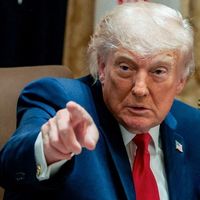
US President Donald Trump warned on Friday that Iran must not resume uranium enrichment, saying military action would be considered if Tehran proceeds.
“They won’t be enriching,” Trump told reporters. “If they enrich, then we’re going to have to do it the other way. And I don’t really want to do it the other way, but we’re going to have no choice. There’s not going to be enrichment.”
US President Donald Trump speaks to reporters aboard Air Force One en route to New Jersey, US, June 6, 2025.
President Ahmed al-Sharaa meets with US Congressman Cory Mills - April 19, 2025
The first American lawmaker to meet Syria’s new president told the Eye for Iran podcast that Washington must give the new rulers of Damascus a chance if it hopes to banish Iran from the country.
Key to that mission, Congressman Cory Mills said, was enabling de facto president Ahmed al-Sharaa to scotch what remains of Iran's influence in Syria.
"What do we truly have to lose in this? You know, we know what we have to lose if they ... allow Iran to create a proxy state and what that means for the region and what that means for our allies," Mills said.
Syria’s new leadership is working to stamp out any Iranian activity on its soil, just months after a rebel advance led by al-Sharaa uprooted the Assad dynasty, Tehran's oldest Arab ally.
Damascus has been expelling proxy fighters, cutting off arms transfers to Hezbollah and pursuing new diplomatic partnerships across the region, including potential ties with Israel, Mills told Eye for Iran.
“He’s not allowing these proxy militias to continue to operate there as they did under the Assad regime,” Mills said.
Syria for Syrians
Mills argues this shift presents an opportunity for Washington to engage—both diplomatically and economically—before Russia, China or Iran move to fill the vacuum.
“If we actually open up the platform to allow for contract bidding, to rebuild infrastructure, that is a great first start,” he said, pointing to areas like water, electricity, and telecoms. “This is one of the most strategic geolocations in the entire region.”
Such engagement, he added, would not only counter authoritarian influence—it would create opportunities for American companies, reinforce regional stability, and help prevent Syria from sliding back into sectarian violence.
“The Iranian people could take a lot away from what has happened in Syria,” he said. “This could be them too. But it has to be an Iranian strategy, not an American strategy.”
Sanctions and Syria's new leadership
Until recently, Ahmed al-Sharaa was himself under US sanctions due to his leadership of Hay’at Tahrir al-Sham (HTS), an Al-Qaeda affiliated group designated as a foreign terrorist organization by the State Department.
On May 13, 2025, President Donald Trump while visiting Saudi Arabia last month made a shock announcement that he was lifting US sanctions on Syria.
Mills stressed that engagement with al-Sharaa must come with clear-eyed realism. “Trust but verify,” he said during the interview. “I think he knows what he has to do. He’s already taken actions that are not just words.”
Diplomatic overtures and regional stability
Mills revealed that al-Sharaa expressed interest in normalizing relations with Israel—albeit cautiously. While no formal talks have begun, the signal alone marks a dramatic shift from the Assad era, which was defined by hostility toward Israel and alignment with Iran and Hezbollah.
“He actually said that we would look at a good relationship and partner with Israel—not the 'Zionist state' ... but he knows the risk that he's taking,” Mills said.
The potential for Syrian-Israeli normalization would echo the Abraham Accords, a US-brokered framework that reshaped parts of the Middle East by bringing Israel into diplomatic relations with several Arab states.
Mills said any future agreements must respect Syria’s sovereignty. “What I don’t support is a balkanization of other sovereign territories,” he said. “I think that good fences make good neighbors.”
The trip to Damascus, however, was not without danger. Mills told Eye for Iran that Islamic State had allegedly plotted to assassinate him while he was in Syria. “They had already put together where they were going to utilize a car bomb,” he said. “They had already put together the location.”
Despite the risks, Mills argued that Syria’s political realignment offers the United States a rare chance to help shape a post-war roadmap—one that sidelines Iran, opens new diplomatic channels and bolsters long-term regional stability.
Tehran will respond to Washington's nuclear deal proposal in the coming days, Iran's Foreign Minister Abbas Araghchi said on Friday.
“This response will be based on the fundamental principles of the Islamic Republic of Iran and aligned with the interests of the Iranian people,” Araghchi said in an interview with Egypt's Nile News channel.
Araghchi also said that no exact date has been set for the next round of nuclear talks between Iran and the United States but added that Oman continues to play an active role as a mediator in organizing and facilitating the negotiations.
The Iranian top diplomat added that once Iran responds, Oman’s foreign minister will set the time and location for the next round of talks.
On March 7, US President Donald Trump announced in a Fox Business interview that he had sent a letter to Iran’s Supreme Leader Ali Khamenei offering terms for a new nuclear agreement.
Days later, Axios reported that the letter included a two-month deadline for Iran to respond, citing one US official and two sources briefed on the contents of the message.
US officials said the White House began counting this deadline once the talks with Iran started on April 12, according to Axios.
Based on that timeline, the deadline is expected to fall around June 12 - next week.
The United States on Friday sanctioned over 30 people and entities it said were tied to an Iranian shadow banking network used to launder billions of dollars for sanctioned institutions affiliated with the Islamic Republic.
The network—run by Iranian brothers Mansour, Nasser and Fazlolah Zarringhalam—relied on front companies in Hong Kong and the United Arab Emirates to evade sanctions and move funds through a parallel financial system, the US Treasury said.
The Zarringhalam brothers’ network
“Iran’s shadow banking system is a critical lifeline for the government through which it accesses the proceeds from its oil sales, moves money, and funds its destabilizing activities,” Treasury Secretary Scott Bessent said in the statement.
According to the Treasury, the Zarringhalam brothers used Iran-based exchange houses—GCM Exchange, Berelian Exchange and Zarrin Ghalam Exchange—alongside dozens of front companies to facilitate transactions for entities such as the National Iranian Oil Company, the Quds Force, and Iran’s Ministry of Defense.
The operations involved fictitious invoices and payments routed through jurisdictions with limited financial oversight, the department said.
State Department spokesperson Tammy Bruce wrote on X that the network had “laundered billions of dollars for the Iranian government.”
“Under @POTUS’s maximum pressure campaign, we will starve Iran of the funds it uses to further its destabilizing activities.”
Friday’s sanctions were the first US measures targeting Iran’s shadow banking infrastructure since President Trump re-imposed “maximum pressure” on Tehran in February, the department said.
Last Sunday, The Wall Street Journal reported that the White House had temporarily paused new sanctions in parallel with ongoing nuclear negotiations, citing a directive from Press Secretary Karoline Leavitt.
Following Treasury’s announcement, Wall Street Journal reporter Elliot Kaufman wrote on X that the sanctions-pause policy had ended after the newspaper’s coverage. “We can now confirm what we heard Monday and Tuesday: The sanctions‑pause policy has been killed after it was exposed in our WSJ editorial,” he said.