Iran's parliament condemns UK over potential IRGC terror listing
Iranian lawmakers chanting slogans during a session of the Iranian parliament (File photo)
Iran’s parliament on Tuesday condemned a motion by over 550 British lawmakers calling to label the Islamic Revolutionary Guard Corps (IRGC) a terrorist group, warning of legal repercussions from Tehran.
The statement, read aloud by parliamentary presidium member Ahmad Naderi during an open session, described the UK’s move as “reckless and hostile”.
“The UK’s potential designation of the IRGC violates fundamental principles of international relations and will provoke lawful, reciprocal action by the Islamic Republic of Iran,” Naderi said.
The parliament’s response came amid rising tensions between Tehran and London following the arrest and charging of three Iranian nationals in the UK under its National Security Act.
British authorities allege the men acted on behalf of Iranian intelligence and conducted surveillance targeting journalists from Iran International, a London-based Persian-language broadcaster critical of the Islamic Republic.
The charges follow counter-terrorism raids earlier this month in which eight people, including seven Iranian nationals, were detained.
UK Home Secretary Yvette Cooper said on Monday that the Islamic Republic poses an “unacceptable threat” to Britain’s domestic security.
“We will not tolerate growing state-backed threats in the UK,” Cooper told parliament.
Amid pressure from lawmakers, UK officials are reviewing options to strengthen legal measures against IRGC affiliates.
A government terrorism advisor on Monday proposed new powers to sanction individuals and entities linked to the IRGC, calling for measures to criminalize public displays of support, including insignia, and expand arrest and deportation capabilities under what he termed a "Statutory Alert and Liability Threat (SALT)" notice.
The Iranian parliament’s statement listed a long history of grievances against the UK, including the 1953 CIA- and MI6-backed coup against Prime Minister Mohammad Mossadegh, the occupation of Iran during World War II, the 1917 famine, and British support for Iraqi leader Saddam Hussein during the Iran-Iraq war.
“These black marks in British history against the Iranian people are undeniable and shameful,” the statement said.
It also warned that if the UK proceeds with the designation, Iran would respond under Article 7 of a 2020 domestic law mandating reciprocal measures.
According to the law, British military forces and bases in West Asia and the Persian Gulf could be labeled as hostile entities and subjected to retaliatory measures.
“The Revolutionary Guards are a constitutional and sovereign force charged with defending Iran’s territorial integrity,” the statement read. “Labeling them as terrorists amounts to aggression against Iran’s national sovereignty and a breach of the UN Charter.”
Lawmakers in Tehran ended the session with chants of “Death to England,” and Parliament Deputy Speaker Hamidreza Haji Babai said: “The British have never stood with the Iranian people. They have always been our enemy.”
The UK has not formally designated the IRGC a terrorist organization, though it has imposed sanctions on many of its commanders and affiliated institutions. The United States added the IRGC to its list of foreign terrorist organizations (FTOs) in 2019.
Retired US Army General David Petraeus speaks at the Qatar Economic Forum in Doha on May 15, 2024
Former CIA Director and retired US Army General David Petraeus said that a new nuclear deal with Iran could pave the way for Tehran to become a more constructive player in the region.
“There’s a chance that there could be a nuclear deal that doesn’t have some of the shortcomings of the previous nuclear deal that could enable the lifting of sanctions progressively and so forth as confidence is built,” Petraeus said during a panel discussion at the Qatar Economic Forum 2025.
“And that could lead to them being a more constructive player in the region than they certainly have been for many decades.”
Asked whether Iran could be “brought back into the fold” like Syria, Petraeus responded: “That’s overly optimistic.”
He pointed to Iran’s role in supporting its allied forces in the region such as the Houthis in Yemen. “Assuming Iran then also stops some of the terrible activities that they’re doing through proxies in the region which have been so destabilizing, then you can start to see the contours of something that could be much more positive.”
Petraeus said there are signs of narrowing differences between Washington and Tehran, and a possible compromise could include restrictions on uranium enrichment for a limited period.
“Maybe that ends up being for three years and then you have an opportunity to do something small again. But you can actually see this deal starting to come together,” he said.
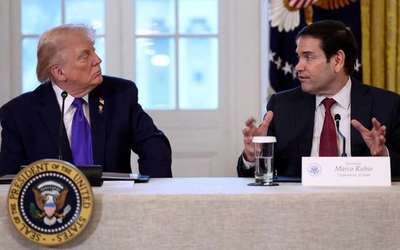
Amid indirect Iran-US talks, US President Donald Trump has insisted Iran must fully cease enrichment, leading Supreme Leader Ali Khamenei to warn on Tuesday that talks look unlikely to progress under those conditions.
On Sunday, Trump's Middle East envoy Steve Witkoff told ABC News: “We cannot allow even one percent of an enrichment capability. Everything begins from our standpoint with a deal that does not include enrichment. We cannot have that.”
On the question of regime change, Petraeus dismissed it as unrealistic. “You have to deal with the world the way it is, not the way you would like it to be. And I never thought that regime change was at all realistic, frankly.”
Iran will retaliate with costly and damaging measures against any attempt by Europe to activate the snapback mechanism and reimpose UN sanctions, a hardline Iranian newspaper affiliated with the Revolutionary Guards warned on Tuesday.
In a scathing editorial, Javan daily criticized the threat of snapback — a mechanism in the 2015 nuclear deal that allows the return of UN sanctions — as a “European stick for blackmail” and warned of punitive and high-cost actions against the economies of the United States and Europe.
The editorial said such sanctions would be countered with restrictions in trade routes and geographies under Iran's control, adding that these areas would expand through alignment with other actors "frustrated by US and European policies.”
"The US and European economies should expect punishment and cost-imposing actions. The sanctions will be followed by bans and restrictions on their access to routes and geographies under Iranian control. These geographies, motivated by other actors frustrated with US and European policies, will expand into major commercial corridors," it said.
While Javan did not name locations directly, the paper implied that Iran could disrupt major trade corridors such as the Strait of Hormuz, where a significant portion of the world's oil passes, and possibly the Bab al-Mandeb Strait, through Tehran-aligned Houthis in Yemen, as has been seen since the militant group imposed a maritime blockade in the wake of the war in Gaza.
“Any new sanctions must be met with real costs,” the editorial said, adding that the current Iranian negotiating position is no longer based on “Westoxicated thinking” but on firm demands for compensation and full sanctions relief from the outset of any agreement.
The paper said that Iran would only allow meaningful negotiations if its rights to enrichment and the preservation of enriched uranium stocks are recognized, and if all material and immaterial damages from what it called “illegal and inhumane” sanctions are paid in full.
'Trump eyes Arab wealth, not Iran investment'
Amid the ongoing indirect US-Iran nuclear talks, the editorial targeted US President Donald Trump, Javan accusing him of having no intention or ability to invest in Iran, saying his only objective is to “loot the wealth of Arab countries” to patch up America’s struggling economy.
“Trump, who is chasing after the pockets of Arab states, has no capacity for investment in any country,” the editorial stated. “He only dreams of healing the crisis-hit American economy.”
The piece mocked Trump’s recent regional tour and his military posture, claiming that US aircraft carriers and advanced weaponry had underperformed in conflicts such as Yemen and South Asia.
It argued that despite Trump’s rhetoric, “the US military's threatening gestures lack economic backing and have led to humiliating failure against Iran and China,” adding that Washington’s strategy had shifted to diplomacy out of necessity.
The editorial dismissed recent remarks by Trump’s Middle East envoy Steve Witkoff, who said that the US would not tolerate even 1% uranium enrichment by Iran, as bluster intended to sway negotiations and distract from Washington’s weak hand.
“This time, Iran is not negotiating with illusions, but with demands. If the West wants a deal, it must stop threatening, start compensating, and lift sanctions from day one,” the editorial added.
On Monday, the European Union and the United Kingdom voiced deep concern over Iran’s expanding nuclear program and its continued imprisonment of foreign nationals, according to a joint statement issued after high-level talks.
Iran’s oil revenues should be deposited into a national fund before being spent, the country’s budget chief said on Monday, urging greater transparency and fiscal discipline as the military's share of the revenue continues to rise.
A third of Iran’s projected oil revenue for the year ending March 2026—worth $12.4bn—will go directly to the armed forces and military projects, three times more than last year.
The rest of the oil income, along with $33.5bn in gas revenues, will be split between the government’s budget, the National Development Fund (NDF), and the national oil company.
“The best course of action is to deposit all oil revenues into the National Development Fund,” the head of Iran’s planning and budget organization Hamid Pourmohammadi told a forum in Tehran on Monday.
“This way, we can determine at the start of the year how much the government needs, and based on that, the government can plan how much it can spend by year’s end.”
Pourmohammadi offered no detail on the existing arrangements which allow the fund to be bypassed and institutions such as the Revolutionary Guards (IRGC) access a portion of Iran’s oil revenue before it reaches the government’s coffers.
He conceded, however, that the administration of moderate president Masoud Pezeshkian lacks consensus on how to implement the NDF-takes-it-all idea.
The NDF was established in 2010 to replace the Foreign Currency Reserves Fund (FCRF). While the FCRF was meant to safeguard oil income for future generations, the NDF has increasingly been used to cover budget deficits, despite the state objective of investing oil revenues.
The fund has long operated under the direct control of supreme leader Ali Khamenei, with administrations needing his approval for withdrawals.
One of Pezeshkian’s first moves in office was to request funds to pay wheat farmers.
In recent years, billions have been syphoned to the IRGC and the state broadcaster, functioning as main vehicles of Khamenei’s hard and soft power.
The NDF’s share of oil and gas revenues dropped from 40% to 20% in the two years ending December 2024, according to Didban Iran citing a deputy of Iran’s budget office Hamid Amani Hamadani.
Iran’s private sector owed $7bn to the fund in January 2025, according to senior NDF official Mehdi Ghazanfari. This is a debt repaid slowly in local currency, which the fund must convert to dollars at below-market rates.
Ghazanfari put the total pay-outs from the fund to the administration at just above $103bn in 12 years. He also said $45bn had been loaned to private-sector in the same period—often to firms with ties to the IRGC or the supreme leader’s office
British Secretary of State for the Home Department Yvette Cooper at the House of Commons in London, Britain January 21, 2025.
British interior minister Yvette Cooper said Iran posed an "unacceptable threat" to the domestic security of the country after authorities charged three Iranian nationals under a national security law following a major counter-terrorism investigation.
"Let me be clear, we will not tolerate growing state backed threats on UK soil. The Iranian regime poses an unacceptable threat to our domestic security which cannot continue," Cooper told parliament on Monday.
"The UK will not accept any Iranian state threat activity in the UK."
The sharp statement comes after the arrests of Iranian nationals on UK soil this month in terrorism-related cases.
On Saturday, three of the Iranian nationals were charged with offences under the National Security Act, accused of acting on behalf of Iran’s intelligence service and carried out surveillance targeting Iran International journalists.
All three are accused of engaging in conduct likely to assist a foreign intelligence service between August 14, 2024 and February 16, 2025.
New counter-terror powers against IRGC
Meanwhile an advisor to the UK government on Monday recommended new powers targeting Iran’s Islamic Revolutionary Guard Corps, as calls for the IRGC’s proscription have grown following the spate of arrests.
The UK government’s independent reviewer of terrorism legislation Jonathan Hall published findings on Monday advising greater powers for ministers to designate people affiliated with the IRGC as terrorists.
Hall's report called for legislation proscribing public demonstrations of support for Iran's paramilitary organization such as displaying its insignia in public and recommended stiffer sentences for those aiding or benefiting from the IRGC.
The Revolutionary Guards cannot be blacklisted the same way non-state actors are, Hall argued, but he recommended its agents and supporters be targeted through a Statutory Alert and Liability Threat or Salt notice.
"It will allow the government to communicate decisive stigma at an international level for certain State and State-backed entities. Naming and shaming in a high-profile manner, accompanied by open reasons, can help address attempts at plausible deniability for serious harm caused to the UK or its allies," the report said.
"The Liability Threat Notice ... (puts the IRGC) on notice that its operations, and its minions and influence networks, are at greater risk of executive action, by way of arrest and prosecution, or deportation, or other forms of disruption, from UK authorities."
Palestinians ride bicycles past the ruins of houses and buildings destroyed during Israel’ military offensive, amid the ongoing conflict between Israel and the Palestinian Islamist group Hamas, in the northern Gaza Strip March 31, 2024
The October 7 Hamas attack on Israel aimed to halt approaching diplomatic normalization between the Jewish state and Arab heavyweight Saudi Arabia, according to documents allegedly belonging to the militant group cited by the Wall Street Journal.
The Hamas documents contain minutes of a high-level meeting by the Iran-aligned militant group in Gaza purporting to show that days before the assault, Yahya Sinwar, Hamas’s former leader in Gaza, said an “extraordinary act” was required to derail the talks that he said risked marginalizing the Palestinian cause.
The WSJ report said the meeting minutes were from an October 2, 2023 gathering of Hamas’s political bureau in Gaza, just five days before the deadly attacks on Israel. They cite Sinwar as saying, “There is no doubt that the Saudi-Zionist normalization agreement is progressing significantly.”
Sinwar, who was killed last year, warned a deal would “open the door for the majority of Arab and Islamic countries to follow the same path.”
Since the October 7 attacks which saw at least 1,200 people killed and more than 250 more taken hostage by the militant group, Israel’s military campaign has seen over 53,000 people in Gaza killed, according to the Hamas-run Ministry of Health statistics.
The Israeli military says at least 20,000 of those are militants.
Normalization on hold
The Gaza war has for now succeeded in halting the normalization, which was aimed to be an extension of the 2020 US President Donald Trump-brokered Abraham Accords that saw Israel form diplomatic ties with Arab states such as Bahrain and the United Arab Emirates.
Around two-thirds of Gazans have been displaced with huge swathes of the strip now in ruins after Israeli military bombing and ground incursions as international aid agencies warn the population is on the brink of famine.
During a trip to Riyadh last week, Trump reiterated his calls for Saudi Arabia to establish relations with Israel but said, “You’ll do it in your own time.”
In November, Iran International reported that an official in White House national security advisor Jake Sullivan's office leaked information about Saudi-Israeli peace talks just before the Hamas attack on Israel, suggesting it had been the final spur for the group to attack.
Speaking on the Eye for Iran podcast, Jeff Sonnenfeld, a US academic who assisted Jared Kushner in the Abraham Accords told Iran International that a deputy on Sullivan’s team leaked information on the diplomatic push.
The potential disclosures dealt with the Biden administration's talks with Saudi Arabia and Israel on expanding the Abraham Accords just prior to Oct. 7.
“It would have been amazing but by tempting fate like that Hamas realized this was their last moment to strike,” Sonnenfeld said.
A spokesperson from the national security advisor denied the allegations.
'Strategic shift'
The Palestinian militant group which has controlled Gaza since a 2007 takeover has long voiced its opposition to the normalization of ties between Israel and the kingdom, whose vast oil wealth and custodianship of the Islam's holiest sites give it heft in the region.
Hamas calls for the destruction of Israel and the creation of a Palestinian state in its place.
In the alleged meeting minutes, Sinwar said the time had come “to bring about a major move or a strategic shift in the paths and balances of the region with regard to the Palestinian cause”, expecting support from other Iranian-backed forces of the so-called axis of resistance to Israel.
Since the Hamas attacks, Israel has come under fire from other Iranian allies, including Hezbollah in Lebanon and the Houthis in Yemen, as well as facing two direct missile barrages from Tehran. Most were handily repelled by Israel and its allies.
In September, Saudi’s de-facto ruler, Crown Prince Mohammed Bin Salman, said explicitly that there would be no normalization before the creation of an independent Palestinian state, telling the country's Shura Council that "we affirm that the kingdom will not establish diplomatic relations with Israel without one."
It came just a year after the kingdom was more openly suggesting formal ties were close, bringing the once-secret ties into the open.
In June 2023, Saudi Arabia’s ambassador to the US went as far as saying Saudi Arabia hopes to see a “thriving Israel” as part of a unified Middle East, a tacit nod to finally acknowledge the Jewish state.
Princess Reema bint Bandar al-Saud, a member of the Saudi royal family, told an event in Colorado: “We want to see a thriving Israel, we want to see a thriving Palestine.”
Referring to Bin Salman’s long-term agenda, in which Israel would be a part, she added: “Vision 2030 talks about a unified, integrated, thriving Middle East and last I checked, Israel was there.”