Iran says it completed refueling at Bushehr nuclear plant, eyes expansion
Bushehr nuclear power plant
Iran announced the completion of major maintenance and refueling at its Bushehr nuclear power plant this week, preparing the country’s only operational nuclear facility to meet peak summer electricity demand.
The announcement comes as Tehran accelerates work on two new reactor units at the site and reiterates its long-term commitment to nuclear energy amid stalling US nuclear talks.
The head of the Bushehr nuclear power plant, Reza Banazadeh, said the 1,000-megawatt (MW) facility is now fully prepared to contribute to the national grid during the hottest months of the year.
Daily electricity consumption in Iran can vary, with peaks reaching over 72,000 MW, exceeding the actual power generation capacity of 60,000 MW during the summer.
Since its commissioning, the plant has generated more than 72 billion kilowatt-hours of electricity, equivalent to saving over 110 million barrels of oil, Banazadeh said in an interview with Iranian state media.
"Nuclear energy is one of the safest, cleanest, and most cost-effective sources of power,” Banazadeh said, adding the plant avoids burning fossil fuels and thereby prevents the emission of an estimated 7 million tons of greenhouse gases annually.
Bushehr, Iran’s first commercial nuclear facility, sits on the Persian Gulf and is central to the country’s broader nuclear ambitions.
Mohammad Eslami, head of the Atomic Energy Organization of Iran (AEOI), said earlier this year that 5,000 workers are involved in the construction of Units 2 and 3, which are expected to triple the plant’s output when completed.
“Our aim is to increase nuclear power capacity to 20,000 megawatts by 2041,” Banazadeh said, adding that new projects across the country will help meet rising energy demands and reduce reliance on fossil fuels.
While Iranian officials highlight the civilian and environmental benefits of nuclear energy, the program remains under international scrutiny amid concerns about its potential military dimensions.
Tehran maintains its program is peaceful and conducted under the oversight of the International Atomic Energy Agency (IAEA) despite the restrictions that Tehran has put on the agency’s activities such as expelling inspectors and reducing monitoring equipment.
Iranian President Masoud Pezeshkian during a visit to `Bushehr Nuclear Plant (February 2025)
Tensions around Iran's nuclear facilities resurfaced in recent months, with Israel and the US warning of potential military action. During a February visit to Bushehr, Iranian President Masoud Pezeshkian warned: “If they strike a hundred [nuclear sites], we will build a thousand more ... They can hit the buildings, but they cannot erase the minds of our scientists.”
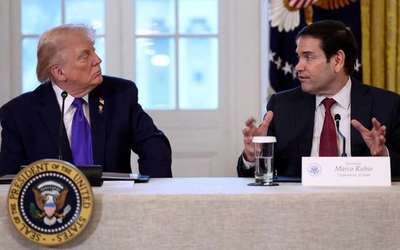
US President Donald Trump, in a Fox News interview, said he would prefer a diplomatic solution to prevent Iran from acquiring nuclear weapons but acknowledged concerns over possible Israeli military action.
Iran's air force commander Hamid Vahedi said that the country’s defense posture is deterrent but warned of “forceful” retaliation if attacked.
Despite geopolitical strains, Iran’s nuclear chief Eslami highlighted the use of domestically manufactured equipment and engineering milestones in the Bushehr expansion, including 34,000 rod injections to stabilize the reactors’ foundations and a record 22,000 cubic meters of concrete poured in a single day.
The AEOI aims to increase this figure to 65,000 cubic meters daily next year, showing Iran’s intent to push ahead with nuclear infrastructure development.
The IAEA has not yet commented on the latest developments at Bushehr.
Iran's cooperation with the IAEA remains central to international efforts monitoring and constraining its nuclear program under a potential new deal, with the next round of indirect Iran-US negotiations scheduled for this weekend.
US Vice President JD Vance participates in a discussion at a Munich Security Conference event in Washington, DC, May 7, 2025.
US Vice President J.D. Vance said on Wednesday that Iran must not be allowed to enrich uranium to levels that would enable it to develop nuclear weapons—remarks that may be seen as an apparent nod to Iran’s insistence on maintaining low-level enrichment.
"They can have civil nuclear power. OK, we don't mind that, but... no one right now has a civil nuclear program with their entire enrichment infrastructure that can enrich to the 90-plus percent needed to get to fissile material and a nuclear weapon," Vance said at the Munich Security Conference in Washington DC.
Vance said the Trump administration has no problem with Iran having nuclear power.
"We're fine with that. But you can't have the kind of enrichment program that allows you to get to a nuclear weapon, and that's where we draw the line," he said.
The United States and Iran appear to be on a collision course over whether Tehran should be allowed to enrich uranium in any nuclear deal between the two arch-foes, potentially endangering talks headed for a fourth round this weekend.
Last month, US Secretary of State Marco Rubio said "there’s a pathway to a civil, peaceful nuclear program if they want one, but if they insist on enriching, then they will be the only country in the world that doesn’t have a 'weapons program,' quote-unquote, but is enriching. And so I think that’s problematic."
The UN nuclear watchdog said last month that Iran is only non-nuclear armed state enriching uranium to 60%. Several countries which do not possess nuclear weapons, including Japan, Brazil, Germany and the Netherlands, enrich uranium at lower levels.
In his Wednesday remarks, Vance said his country is seeking a deal with Iran that would not only completely eliminate the possibility of it acquiring a nuclear weapon but also pave the way for Tehran’s return to the global economy.
"We think that there is a deal here that would reintegrate Iran into the global economy. That would be really good for the Iranian people, but would result in the complete cessation of any chance that they could get a nuclear weapon,"
"That's what we're negotiating towards."
Vance said the Trump administration has been "very happy by how the Iranians have responded to some of the points that we have made" in the Omani-mediated talks.
"Without prejudging the negotiations, I will say so far so good... We've been very happy that some of the intermediaries and some of the folks who are in the room, the role that they've played, the Omanis in particular, have played a very positive role, and we're very grateful to that."
He said "so far we're on the right pathway. But this is going to end somewhere. And it will end either in Iran eliminating their nuclear program, their nuclear weapons program."
An Israeli police officer investigates a crater at the site of a missile attack, launched from Yemen, near Ben Gurion Airport, in Tel Aviv, Israel May 4, 2025.
An apparent truce to a blazing Yemen front in Iran's regionwide confrontation with Israel and the United States could deal a fillip to flagging Iran-US talks that had been dogged by the uptick in fighting.
US President Donald Trump made the shock announcement in the White House on Tuesday that he was calling off a bombing campaign on Yemen's Houthis after the Iran-backed group "capitulated" by agreeing to halt attacks on shipping.
Oman said on Tuesday it was mediating a Houthi-US ceasefire deal, but adding to the fog of war, Mohammed al-Bukhaiti was quoted by Bloomberg as saying after Trump's announcement that it would continue its campaign until Israel halts attacks on Gaza.
Tehran and Washington have signaled continued commitment to nuclear negotiations but stepped-up combat between the Iran-backed Houthis in Yemen and Israel had cast a shadow over the diplomatic efforts.
The Houthis pierced Israel's air defenses to land a ballistic missile near Israel's main airport on Saturday and Israeli fighter jets attacked Yemen's main port on Monday and airport on Tuesday along with power plants and a factory.
"Our choice of when to respond, how to respond, and on what targets to respond - this is a consideration we make every time," Israeli Prime Minister Benjamin Netanyahu said on Tuesday.
"And this also concerns the patron of the Houthis - Iran, without whose approval and their long-term support, the Houthis cannot carry out their criminal missile attack."
The uptick in violence suggests the religious militia and perhaps its backers in Tehran are not deterred despite the painful blows Israel has meted out to Iran and its armed affiliates in over a year of regional fighting.
Before the Ben Gurion airport attack, US Defense Secretary Pete Hegseth also warned of unspecified payback for Tehran, citing its continued support for the Houthis despite an explicit warning from President Trump that they desist support or face attack.
Iran’s Supreme Leader Ali Khamenei has long rejected the notion that groups like the Houthis act at Iran’s direction. “The Islamic Republic does not have proxies. Yemen is fighting because of its faith,” he said in a December 2024 speech.
In a letter to the United Nations on Monday, Iran's UN ambassador Saeid Iravani rejected allegations of complicity in the Houthi attack on the airport, warning that “the United States and the Israeli regime will bear full and unequivocal responsibility for all consequences” arising from any aggression on the Islamic Republic.
The future of Iran-US indirect talks currently hangs in the balance after a fourth round is due to be held in Oman over the weekend after they were delayed by a week for unclear reasons.
Hardline Iranian media and officials, including the IRGC-linked Javan newspaper, praise the Houthis for their anti-Israeli and anti-American positions. “Ansarullah's missiles on Ben Gurion shook Israel’s psychological security,” Ali Shamkhani, a Khamenei advisor, wrote Tuesday on X.
“The attack from Sanaa was a strategic blow to the delusion of the Resistance’s collapse — a front that now holds the initiative, with an ever-growing presence from Lebanon and Gaza to Iraq and Sanaa,” he wrote.
Yet, the strike's timing has led some commentators to posit that that factions within Iran may be actively undermining diplomatic progress.
Iranian-Canadian analyst Shahir Shahidsaless raised the question directly: “Is the hardline faction of the Iranian government once again trying to sabotage and disrupt the talks?” he posted on X.
Even some conservatives have acknowledged that the timing of the strike could be damaging to the US talks. Military analyst Behzad Atabaki, writing on a Telegram channel, argued that Iran should have at least called for a pause in Houthi attacks during the negotiation period. “Maybe it’s too late, maybe not,” he said.
Iran's Foreign Minister Abbas Araghchi on Tuesday briefed the Assembly of Experts for Leadership in the holy city of Qom on the latest developments in the country's foreign policy, including ongoing indirect negotiations with the United States.
Speaking to the Tasnim news agency on the sidelines of the Assembly's meeting, Araghchi said that members of the influential clerical body expressed their appreciation for the Foreign Ministry's effort.
He added that the ministry's approach continues "with dignity within the framework of national consensus."
Araghchi detailed the topics covered in his briefing, which included responses to questions and concerns from Assembly members regarding various foreign policy areas.
These included indirect talks with the US, the rationale behind the foreign ministry's approach, relations with regional organizations like the Shanghai Cooperation Organization and BRICS, US policies of pressure and threats, and future prospects, according to Tasnim.
Supporters of Iran's Islamic Revolutionary Guard Corps (IRGC) with a banner in central London, UK, June 2022
As Tehran and Washington cautiously inch forward their nuclear negotiations, the United Kingdom is positioning for a stronger hand in shaping any potential agreement amid Iranian-linked security threats and a standoff over detained Britons.
British Foreign Secretary David Lammy’s high-level meetings with Omani officials on April 27—just one day after Iran and the United States held indirect talks in Rome under Omani mediation—underscored the United Kingdom's efforts not to remain a bystander in one of the region’s most consequential diplomatic processes.
The UK was also set to meet Iranian officials along with France and Germany on May 2 just before the planned fourth round of US-Iran talks in Rome. However, that meeting was canceled following the postponement of the latest round of Tehran-Washington negotiations. No further plans have been announced yet.
The UK or any of the other signatories to the 2015 nuclear deal (JCPOA) has until October to activate the JCPOA’s so-called snapback mechanism which would reimpose all UN sanctions on Iran.
Lammy had already signaled alignment with Washington in late March, expressing a shared commitment to ensuring Iran "never develops or acquires a nuclear weapon." On April 15, he also discussed Iran’s nuclear program with Israeli Foreign Minister Gidon Saar during a meeting in London.
Iran’s foreign ministry and state television have remained silent on the arrests. While some domestic outlets cautiously reported the news by citing international coverage, they refrained from offering analysis or commentary. In contrast, the hardline Quds daily responded swiftly and critically on Monday.
In a commentary titled “Security Dossier to Disguise Diplomatic Blackmail,” Quds accused the UK of exploiting the arrests for political leverage in the nuclear talks. “The latest move comes at a time when indirect nuclear talks between Tehran and Washington are taking place, and in this context, London's decision seems meaningful.”
Tehran-based analyst Sohrab Sadreddin quoted in the piece suggested that the arrests were intended as a signal to the US—especially Trump-aligned factions—that Iran remains a strategic threat to the West.
Sadreddin added that Britain, France and Germany are keen to be included in any future agreement between Washington and Tehran: "If an agreement is to be reached, Europe must also be included in it.”
Adding another layer of complexity and pointing to the recent arrest of two British nationals in Iran, the commentary also raised suspicions about a possible prisoner swap strategy.
The Foremans are not the only UK-linked detainees in Iran. Mehran Raouf, a 68-year-old British-Iranian labor activist, has been imprisoned since October 2020. He is currently serving a 10-year sentence on charges related to national security offenses.
Iran, which does not recognize dual nationality, has a long history of detaining dual citizens and foreigners on security-related charges, often using them as bargaining chips in its dealings with Western powers, including Britain.
In April 2022, British-Iranian nationals Nazanin Zaghari-Ratcliffe and Anoosheh Ashouri -- both accused of espionage -- were released following Omani mediation, after Britain settled a long-standing £400 million debt owed to Iran.
Iran remains committed to pursuing diplomatic engagement with the United States amid delays to talks, but expanding negotiations beyond the nuclear issue is unacceptable, the foreign ministry spokesman said on Monday.
“We have announced our commitment to continuing the path of dialogue and diplomacy. We have shown our full readiness by participating in several rounds of negotiations,” Foreign Ministry spokesperson Esmail Baghaei told reporters in Tehran.
“The decision regarding the timing of the negotiations was made based on the proposal of the Omani side and with the coordination of both parties," he said, Oman a key mediator.
"The decision to postpone was logistical,” Baghaei said.
Talks between Iran and the US remain focused on nuclear-related issues and sanctions relief, the spokesman emphasized, pushing back against French calls to expand the negotiations to include non-nuclear matters.
“Such statements are not new, and they are not acceptable to us,” he said. “The scope of the talks is limited and confined to the nuclear issue and the lifting of sanctions.”
Responding to US President Donald Trump’s recent comments that Iran does not need nuclear energy given its fossil fuel reserves, Baghaei said, “Our peaceful nuclear program is based on rights enshrined in international law and dates back to the 1970s, when Iran’s energy needs were even less than today.”
Addressing recent Israeli military threats, Baghaei warned that Iran would respond decisively to any aggression. “The Iranian armed forces will respond to any act of hostility or adventurism in the strongest possible manner. There should be no doubt about that,” he said.
Baghaei criticized what he called Washington’s mixed signals that include both sanctions and calls for dialogue but reaffirmed Tehran’s willingness to continue diplomacy.
“If the US is sincere in its claim that Iran should not possess nuclear weapons, many issues can be resolved,” he said. “We have already declared clearly, and shown in practice, that we are not seeking to weaponize our nuclear program.”
Baghaei maintained that Iran is not orchestrating military actions through proxies, particularly in Yemen. “Iran needs no proxies in the region,” he said. “Yemen’s decisions are sovereign and independent, and the accusations are baseless.”
The US, which has designated the group a terrorist organization, has repeated warnings to Tehran that a failure to curb the Houthis' military attacks on the US and Israel, in addition to the militant group's blockade on global shipping, will result in military consequences for Iran.