• العربية
  • فارسی
Brand
  • Iran Insight
  • Politics
  • Economy
  • Analysis
  • Special Report
  • Opinion
  • Podcast
  • Iran Insight
  • Politics
  • Economy
  • Analysis
  • Special Report
  • Opinion
  • Podcast
  • Theme
  • Language
    • العربية
    • فارسی
  • Iran Insight
  • Politics
  • Economy
  • Analysis
  • Special Report
  • Opinion
  • Podcast
All rights reserved for Volant Media UK Limited
volant media logo

Israel, new US envoy warn Iran seeks their destruction

Apr 21, 2025, 13:22 GMT+1
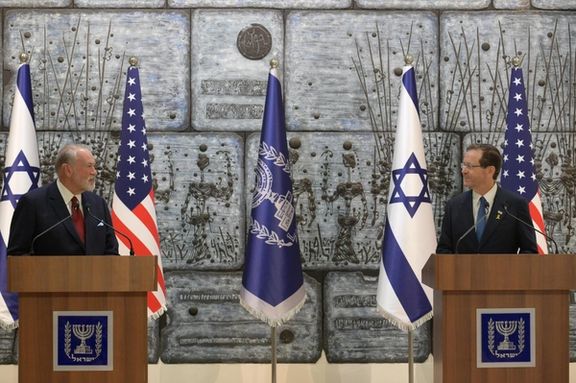
US Ambassador to Israel Mike Huckabee and Israeli President Isaac Herzog on April 21, 2025

The Israeli president and new US Ambassador Mike Huckabee warned Monday of what they called Iran's nuclear ambitions and regional aggression, saying Tehran seeks the destruction of both Israel and the US.

“The Ayatollah regime in Iran continues to pursue its radical vision of regional dominance and destabilisation – on its own and via its proxies – while pursuing nuclear arms and openly calling for the destruction of Israel,” President Isaac Herzog said at the ceremony to reci.

“History has taught us that when a radical regime declares, ‘Death to Israel and Death to America!’ we must take these threats seriously — and counter them with all of our determination, resolve, and might. For the sake of the safety of our people. For the sake of peace.”

The comments come as Israel continues to fight Iran's allies, Hamas in Gaza and Houthis in Yemen.

Huckabee echoed the fears of the looming threat posed by Iran, saying, “There are challenges, and I share with you that concern that the Iranian regime and all of its hostility, which has been inflicted upon the world for 46 years, continues to threaten not just the peace of Israel, but the peace of the United States,” he said.

“And I constantly remind people that the Iranians have always said ‘Death to Israel’, and chapter two is ‘Death to America’. It has always been their desire that Israel would be the opening act, and then it would be America's turn to face destruction.”

Since the Gaza war broke out in October 2023, scores of attacks have also been launched at US infrastructure and personnel around the region.

The US is also leading a global coalition against the Houthis amid the group's attacks on ships in the Red Sea, an initiative pushed by Iran's Supreme Leader.

Most Viewed

Iran diplomacy wobbles as factions compete to avoid looking soft on US
1
INSIGHT

Iran diplomacy wobbles as factions compete to avoid looking soft on US

2
ANALYSIS

The politics of pink: how Iran uses cuteness to rebrand violence

3

Scam messages seek crypto for ships’ safe passage through Hormuz, firm warns

4
EXCLUSIVE

Family told missing teen was alive, then received his body 60 days later

5
TEHRAN INSIDER

The future has been switched off here

Banner
Banner

Spotlight

  • Diplomacy tolls at Hormuz as conflict returns to its doorstep
    OPINION

    Diplomacy tolls at Hormuz as conflict returns to its doorstep

  • Opposition to US talks grows in Tehran as ceasefire deadline nears
    INSIGHT

    Opposition to US talks grows in Tehran as ceasefire deadline nears

  • Tehran moderates see ‘no deal–no war’ limbo as worst outcome
    INSIGHT

    Tehran moderates see ‘no deal–no war’ limbo as worst outcome

  • The future has been switched off here
    TEHRAN INSIDER

    The future has been switched off here

  • Lights out, then gunfire: Witnesses recount Mashhad protest crackdown
    VOICES FROM IRAN

    Lights out, then gunfire: Witnesses recount Mashhad protest crackdown

  • Is Iran entering its Gorbachev moment?
    INSIGHT

    Is Iran entering its Gorbachev moment?

•
•
•

More Stories

Iran, Hezbollah eyeing renewed foothold in Syria - Israeli think tank

Apr 21, 2025, 09:15 GMT+1

Iran and its Lebanese ally Hezbollah seek to re-establish a presence on Syrian territory through increased cooperation with local forces, Israel's Alma research institute said in a new analysis.

Alma, which focuses on threats to northern Israel, assessed that Iran and Hezbollah want to reactivate the original land corridor stretching from the Iraqi border in eastern Syria to the Lebanese border in the west.

The institute highlighted recent reports of a potential halving of US troop numbers in Syria and the commencement of some withdrawals, such as from the Conico base in the Deir ez-Zor region.

Alma argued that this US drawdown would likely further embolden Iran and Hezbollah to solidify their foothold in the Syrian part of the corridor.

Alma institute- Iran-Hezbollah
100%
Source: Alma

Even before a possible US withdrawal from the al-Tanf region in southeastern Syria, the analysis warned that a reduced American presence could lead to a significant shortening of the corridor route towards Lebanon and southern Syria.

This would potentially re-expose the Daraa province, bordering Israel, to increased Iranian influence and presence, Alma concluded.

Reports indicate a significant withdrawal of Iranian forces and allied militias from Syria after President Bashar Assad's removal in December, with personnel moving to Iran, Iraq, and Lebanon, abandoning military equipment.

While the dominant Hayat Tahrir al-Sham (HTS), which toppled the Assad government, is expected to block an immediate IRGC return due to past support for Assad, the Wall Street Journal cited US officials as saying that Iran will eventually attempt to re-establish its regional presence.

At its height, Iran maintained a substantial military infrastructure in Syria.

According to the Moshe Dayan Center for Middle Eastern and African Studies, Iran had as many as 10,000 IRGC forces in Syria at its peak during Syria's civil war, and another 5,000 army troops, plus thousands more Iranian-backed militia forces.

Their research showed that Iran held 55 military bases in Syria in addition to 515 military points.

The Saudi-owned Al Majalla news site reported similar numbers, citing that Syria had 830 foreign military sites under Assad, 70% of which belonged to Iran, 570.

Hezbollah’s arms may be folded into Lebanese army, president says

Apr 15, 2025, 17:07 GMT+1

The Lebanese state must have a monopoly on weapons in the country and the transfer of Iran-backed Hezbollah's arms to Beirut should proceed via direct talks between the presidency and the group, Lebanon’s president Joseph Aoun said on Tuesday.

“The decision has been made to restrict the possession of weapons to the state,” Aoun told the London-based Al-Araby Al-Jadeed in an interview published ahead of his visit to Qatar, saying the move ought to be carried out this year.

“The implementation process remains to be decided through dialogue, which I see as bilateral between the presidency and Hezbollah.”

Washington has pressed for Hezbollah’s disarmament, but Aoun said he warned US envoy Morgan Ortagus about the risk of triggering civil strife.

Hezbollah receives extensive military and financial support from Iran, including arms, training, and strategic guidance from the Islamic Revolutionary Guard Corps. Iranian help has allowed the group to grow into one of the most formidable non-state military organizations on earth.

However, both Iran and Hezbollah have faced strategic setbacks in recent months. Israeli strikes killed many high-ranking Hezbollah commanders and key IRGC personnel in Syria, while Iran’s influence over its proxies in Iraq and Yemen appears to be shifting under regional and international pressure.

Outlining a future security transition, Aoun rejected forming a Hezbollah-only military unit along the lines of Iraq’s Iran-backed Popular Mobilization Forces. Instead, he said Hezbollah members who meet military standards could be absorbed individually into the Lebanese Armed Forces.

Tehran hardliner daily hits back: US is crumbling, not Iran

Apr 15, 2025, 09:30 GMT+1

In a scathing response to an op-ed article by former US Secretary of State John Kerry, Iran's hardline Kayhan daily dismissed his assertion that Tehran is backed into a corner due to recent developments.

Kayhan’s editorial, responding to a Wall Street Journal op-ed by John Kerry and Thomas Kaplan that suggested President Donald Trump now has an opportunity for a broader nuclear deal with Iran due to Tehran’s weakened regional position, dismissed the analysis as based on false premises and a fundamental misunderstanding of Iran’s strengths.

Tehran has seen its regional influence weakened, with Hamas, Hezbollah, and the Houthis under increasing pressure, and Bashar al-Assad no longer in power in Syria.

"Mr. Kerry, although you still seem to dream of leading the world, there is ample and undeniable evidence that today’s America is no longer the powerful nation it once was," Kayhan wrote. "How can a country whose president speaks of hardship, whose senators describe this as the worst period in its history, and whose people stand in line for food and shelter, expect to pressure others?"

In contrast to Kerry's portrayal of Iran's weakened hand, Kayhan argued that the Islamic Republic is in the center of regional and global developments and continues its path with "authority and dignity."

Kerry's original article had argued that "Ten years after the last nuclear agreement with Iran, the balance of forces has changed dramatically... Iran, often a master of miscalculation and geopolitical malpractice, has backed itself into a corner, and that paradoxically boosts the odds for a peace initiative." He also called on President Trump to seek a deal that "prevents Iran from ever possessing a potentially lethal nuclear program."

"So Mr. Kerry! Accept the reality: It is not Iran that is in the corner of the ring; it is America that is counting down," Kayhan editorial read.

Also on Tuesday, Tasnim News Agency, a media outlet affiliated with the Revolutionary Guards, analyzed the reasons behind Supreme Leader Ali Khamenei's approval of indirect negotiations with the United States.

The author, Mehdi Khodaei, refuted three common interpretations for this decision: that it was due to Trump's threats, that Iran had no other choice, or that it was imposed upon Khamenei by the government or other high-ranking officials.

It argued that Iran's willingness to engage in indirect talks is not out of fear or frustration, as Iran possesses the capability to respond and doubts the US would initiate a conflict.

New Iran-backed militant group emerges in Syria - Newsweek

Apr 8, 2025, 22:10 GMT+1

A new Iran-backed militant group, Uli al-Baas, has emerged in Syria, positioning itself against the United States and its regional allies, Newsweek reported on Tuesday.

Newsweek quoted the group, officially known as the "Islamic Resistance Front in Syria - Uli al-Baas," as saying it is aligned with the broader Axis of Resistance, a coalition of Iran-backed political and military actors in the Middle East such as Hamas in Gaza, the Houthis in Yemen, and Hezbollah in Lebanon.

"Uli al-Baas is a faith-based, revolutionary, nationalist movement with an Arab nationalist dimension, unaffiliated with any existing organization in Syria," the group's political office told Newsweek, adding that it does not support the current ruling government.

"It [the group] has its own political project of resistance that guarantees the establishment of a strong, capable, and freedom-supporting state," the group added.

While Uli al-Baas said that it is "not affiliated with any regional party or any country," logos used, particularly the raised Kalashnikov-style rifle, mirrors the signature style of Iran's Revolutionary Guards (IRGC) and has been adopted by other Axis of Resistance groups, including Hezbollah and Iraqi militias.

Newsweek also quoted the group speaking about the Islamic Republic, in what appeared to echo similar manifestos of Tehran's allied groups.

"As for the constant threat posed to the Islamic Republic of Iran, this is because it maintains an independent identity and refuses to submit," Uli al-Baas said,

"However, the truth is that Iran is challenging the advanced state in West Asia, namely the Zionist entity," the group added.

Experts suggest that the group may have originated from Iran’s efforts to maintain influence in Syria, a key Arab ally under the ousted Bashar al-Assad government.

“While UAB’s kinetic capabilities remain unproven, its emergence could signal the early stages of a new Iran-backed militia formation in Syria, an outcome that was always likely post-Assad,” a Washington Institute analysis said in March.

The group has since published the Newsweek story on their Telegram channel.
Iran’s Quds Force oversees weapons transfers to Hezbollah via sea - Al Arabiya

Apr 8, 2025, 15:07 GMT+1

Iran’s Quds Force is overseeing the transfer of weapons, equipment and money to Hezbollah in Lebanon via maritime routes, a Western security source told Al Arabiya on Tuesday.

Iran’s Quds Force is managing the operation through its Unit 190 and Unit 700, according to the unidentified source. Shipments are arriving either directly to Lebanon or through intermediary countries.

Intelli Times also reported the same information about Quds Force involvement, citing the same two units.

“Hezbollah has refocused and reimposed its control over the port of Beirut,” the source said, referring to the facility’s gradual return to normal operations following the August 2020 explosion.

The Iran-backed group turned to sea routes after losing access to overland supply lines through Syria following the fall of former Syrian president Bashar al-Assad and after Lebanese authorities curtailed its influence at Beirut’s Rafic Hariri International Airport following a US-French brokered ceasefire with Israel in November.

The source said Hezbollah operates freely at the port through a network inside customs and port oversight bodies, directed by senior Hezbollah official Wafiq Safa.

“Safa is seeking, through his agents at the port, to facilitate the smuggling of equipment, weapons and money without any inspection or oversight,” the source said.

The source warned that the use of Beirut Port by Hezbollah - designated a terrorist group by countries such as the UK and US - risks Lebanon’s economic interests and may deter foreign investment.

“The Lebanese state must act urgently in light of Hezbollah’s violations and plans, which could repeat the August 2020 catastrophe,” the source said.

Speaking in a separate interview with LBCI aired Sunday, US Deputy Special Envoy for the Middle East Morgan Ortagus said Hezbollah and all militias in Lebanon must be disarmed “as soon as possible.”

“We, of course, always bring up disarming Hezbollah, but not just Hezbollah, all militias in this country,” Ortagus said.

“Only by disarming militant groups could the Lebanese people be ‘free from foreign influence, free from terrorism, free from the fears that have been so pervasive in society.’”

Ortagus added that President Joseph Aoun had made it clear in his inaugural speech that “he wanted the state to have the monopoly of force, he wanted the state to be the one with the weapons. That is a position that we support.”