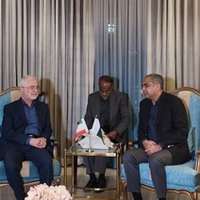
US Middle East envoy Steve Witkoff will lead talks with Iran in Oman
Iran insists that upcoming nuclear talks with the United States in Oman will be indirect, pushing back against US President Donald Trump’s announcement that direct negotiations will be underway.
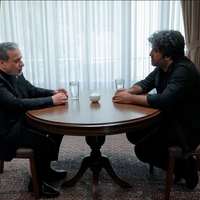
The Iranian side, as reiterated by government spokeswoman Fatemeh Mohajerani and Foreign Minister Abbas Araghchi, maintains that Araghchi’s upcoming talks with US envoy Steve Witkoff in Oman will be conducted indirectly. However, Mohajerani did not explicitly rule out the possibility of direct negotiations, noting that Araghchi will lead Iran’s nuclear negotiating team as its highest-ranking official.
Both Araghchi and foreign ministry spokesman Esmaeil Baqaei had previously denied any negotiations were taking place—until Trump’s surprise Monday evening announcement during his meeting with Israeli Prime Minister Benjamin Netanyahu changed the calculus.
Shahram Kholdi, a Middle East and international relations expert, told Iran International TV that Iran’s insistence on indirect talks stems from Supreme Leader Ali Khamenei’s stance that direct negotiations with the US would be dishonorable.
Jason Brodsky, policy director at United Against Nuclear Iran (UANI), offered a different interpretation. In a post on X, he suggested that Tehran may have been caught off guard by Trump’s announcement. According to Brodsky, the announcement was likely meant “to pressure Tehran and make it look unreasonable should it reject the meeting.” He added that indirect negotiations might still occur on Saturday, but both sides would be creative in defining what counts as direct or indirect.
Meanwhile, Nour News, a website close to Iran’s Supreme National Security Council, dismissed suggestions that Iran was responding to US pressure. In a post on X, the outlet stated that Iran had set the time and location of the talks in Oman and communicated them to the US through Omani intermediaries. “No one-sided narratives—the initiative was in Tehran's hands,” the post read.
Ali Nasri, a Tehran-based foreign relations expert, criticized the ongoing obsession with terminology. “The bias regarding the words ‘direct’ or ‘indirect’ in the matter of negotiations does not benefit the lives of the Iranian people,” he wrote on X. “What matters is whether the negotiation process is effective or ineffective. Whichever method is more effective in securing national interests is the right path.”
Hossein Mousavian, Iran’s ex-ambassador to Germany (1990–1997) and a former senior nuclear negotiator, offered a historical analogy. In an X post, he recalled how negotiations during the Obama administration in Istanbul began under the supervision of EU’s supervision Catherine Ashton but soon transitioned to direct talks between Iranian and American officials. He predicted a similar setup in Oman. “It seems that Washington and Tehran have adopted a wise approach, and there is a chance for an agreement. Both negotiators [Witkoff and Araghchi] are capable, experienced, moderate, and wise,” he wrote.
Reza Nasri, another political commentator, argued that Iran has strategic reasons to consider negotiating with Trump. “Biden couldn’t deliver due to internal weakness and fear of the anti-Iran lobbies. Obama reached a deal, but Republicans killed it. Ironically, Trump may be the only U.S. president strong enough to defy the establishment, bypass Washington’s foreign policy elite, and strike a deal that actually lasts,” he posted on X.
The Iranian market has responded favorably to the prospect of talks, whether direct or indirect. Tehran’s Stock Exchange (TSE) rose by 59,000 points, reaching 2.8 million, while the rial rebounded slightly from last week’s record low, climbing to around 960,000 per dollar from 1,050,000.
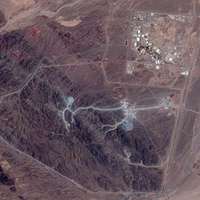
A general view of the Bushehr main nuclear reactor, 1,200 km (746 miles) south of Tehran, August 21, 2010.
New nuclear watchdog data indicates Iran has significantly expanded its uranium mining, suggesting much larger reserves than previously estimated, with plans to operate six more mines by the first quarter of 2024.
“The AEOI (Atomic Energy Organization of Iran) also indicates that Iran’s uranium reserves are much larger than previously estimated,” said the 2014 biennial Red Book report by the International Atomic Energy Agency (IAEA) and the Nuclear Energy Agency' published Tuesday.
It added that Iran planned to operate six more uranium mines by the end of the first quarter of 2024.
A screengrab of the 'Uranium 2024: Resources, Production and Demand' report showing Iran's mid-term uranium production projections
Iran could increase its ore production by almost four times, reaching 71 tons this year, according to the report.
In addition to the current Ardakan uranium production facility in Yazd Province, feasibility studies are underway for the development of the Narigan production center, also located in the same province.
Iran has always maintained that its uranium enrichment activities are for peaceful purposes. However, last year, the US-based Institute for Science and International Security said that while Iran's uranium resources could support a nuclear weapons arsenal, they are insufficient to fuel its growing nuclear power reactors.
Last month, the UN nuclear watchdog found that Iran's stock of near-bomb-grade uranium rose to levels which in principle could be refined further into the equivalent of six nuclear bombs.
Iran’s nuclear program remains a focal point of international tensions, particularly following Washington’s withdrawal from the 2015 nuclear deal and the imposition of economic sanctions.
The United States, meanwhile, has reinstated its "maximum pressure" policy on Iran, with President Donald Trump insisting that Tehran must never acquire nuclear weapons and has threatened military action against the country should it fail to reach a deal on its nuclear program.
Iran’s currency strengthened modestly on Tuesday, recovering from historic lows as anticipation grew over high-level indirect talks with the United States scheduled to take place this weekend in Oman.
The rial, which hit a record low of 1,050,000 per US dollar last month, bounced back to about 960,000 rials on Tuesday amid growing anticipation of renewed diplomacy between Tehran and Washington.
Iranian government spokesperson Fatemeh Mohajerani confirmed on Tuesday that the talks will be held indirectly, mediated by Oman’s Foreign Minister Badr bin Hamad Al Busaidi. “In the negotiation, what is important for the people and the national interests will be our focus,” she said.
The Iranian delegation will be led by Foreign Minister Abbas Araghchi, while the US side will be represented by Donald Trump’s Mideast envoy, Steve Witkoff, according to Iranian and US media reports.
While US President Donald Trump has said the talks will be direct and at a senior level, Iranian state-affiliated media said otherwise.
Nournews, a site close to Iran’s Supreme National Security Council, described Trump’s comments as part of a “psychological operation” meant to shift blame and shape public perception.
The rial’s gains follow a period of sharp decline, triggered by the absence of negotiations, ongoing US sanctions and Trump's 'maximum pressure' policy on Iran, and escalating regional tensions fueled by Iran's allies.
Inflation in food and other essentials has soared, with local producers citing rising packaging and transport costs as major drivers. Over one third of Iranians now live below the poverty line in the midst of the worst economic crisis since the founding of the Islamic Republic in 1979.
Iran’s currency has halved in value since President Masoud Pezeshkian took office in August.
US president Donald Trump talking to reporters at the Oval Office, April 7, 2025
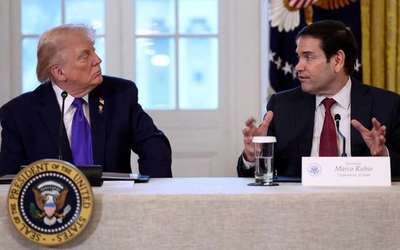
Tehran and Washington have begun direct talks over Iran's nuclear program and will hold a "very big meeting" at a senior level on Saturday, US President Trump said in a surprise announcement on Monday.
“We’re having direct talks with Iran, and they’ve started,” Trump told reporters during an Oval Office meeting with Israeli Prime Minister Benjamin Netanyahu. “It'll go on Saturday. We have a very big meeting, and we’ll see what can happen.”
Officials in Tehran had consistently ruled out direct talks with Washington — until just hours before Trump’s surprise announcement.
The US president said the negotiations are being conducted “almost at the highest level,” brushing aside Iran's public preference for indirect talks.
“A lot of people say, ‘Oh, maybe you’re going through surrogates,’” he said. “No, we’re dealing with them directly.”
The announcement came amid heightened tensions in the region and growing concern in the United States and Israel over Iran’s nuclear activities.
The talks pursued by the Trump administration have been cast as a last-ditch effort to avoid military action.
“I think everybody agrees that doing a deal would be preferable to doing the obvious,” he said. “And the obvious is not something that I want to be involved with, or, frankly, that Israel wants to be involved with, if they can avoid it.”
Trump did not specify what concessions the United States might be willing to offer or what demands it would bring to the table, but his comments suggested a focus on Iran’s nuclear capabilities.
“Iran cannot have a nuclear weapon. That’s all there is,” he said, adding that "it'll be a very bad day for Iran," if the negotiations were to yield no results.
Netanyahu, sitting beside Trump, did not speak at length but nodded as the president spoke. Israel has long been skeptical of diplomacy with Tehran.
The announcement follows weeks of backchannel maneuvering and comes at a moment when both nations face domestic and international pressure.
Iranian officials did not immediately comment on the planned meeting.
Israeli Prime Minister Benjamin Netanyahu will seek to persuade the Trump administration during a visit to Washington to push for the complete dismantling of Iran’s uranium enrichment program, diplomatic sources in the Middle East told Iran International.
Israel believes that if the Islamic Republic is allowed to retain even a small part of its nuclear program, the sources added, it could rapidly resume enrichment once Trump’s presidency ends or anytime it deems conditions favorable.
The diplomats told Iran International that Israel assesses that Tehran’s sole aim in pursuing talks with the United States is to preserve its enrichment program.
The Israeli prime minister is meeting the US president at the White House, with Iran's nuclear issue among the key focuses of their negotiations, according to Netanyahu's office.
Netanyahu will not advise American officials against engaging in negotiations with Iran, the diplomats told Iran International, but he will urge them to make any talks conditional on the enrichment program's total end.
Earlier in the day, Axios reported that Netanyahu believes the chances of a nuclear deal between Tehran and Washington are extremely low but will present to Trump today how "a good deal should look like".
"Netanyahu wants the Libya model. Full dismantling of Iran's nuclear program", the report said, citing an Israeli official referring to a 2003 decision by Libya's leader Muammar Qadaffi to surrender weapons of mass destruction.
The veteran autocrat was deposed and killed in a Western-backed uprising in 2011.
Iran's Foreign Minister Abbas Araghchi said on Sunday that Washington can only dream of an agreement with Iran similar to the 2003 deal with Libya.
His comments came after Republican Senator Tom Cotton said the deal President Trump wants with Iran would be one that neutralizes Tehran's threat completely.
"He prefers a deal like Libya cut with the United States in 2003," Cotton said in an interview posted on X.
Iran's and US' flags are seen printed on paper in this illustration taken January 27, 2022.
Iran's President Masoud Pezeshkian said Tehran remains committed to negotiations but rejected engaging under pressure, signaling no shift in its stance toward the United States as tensions have flared.
“We believe in negotiations, but not at any price,” Masoud Pezeshkian said during a meeting with political party representatives late Sunday, according to the official news agency IRNA.
“We are not seeking war, unrest or nuclear weapons. But how can we talk when the US puts us under maximum pressure and threatens us daily?”
US President Donald Trump has extended an offer to Iran for direct negotiations aimed at addressing concerns over its nuclear program.
But the overture was accompanied by a stern warning: failure to engage would result in bombing "the likes of which they (Iran) have never seen before."
Iran's Supreme Leader, Ali Khamenei, swiftly rejected the proposal for direct talks, deeming them meaningless under the prevailing circumstances. Instead, Tehran expressed openness to indirect negotiations facilitated by intermediaries such as Oman.
In response to the US threats, Iran elevated its military readiness and cautioned neighboring countries against supporting any US military actions, warning of repercussions for neighbors who might facilitate an attack.
The escalation has raised international concerns, prompting nations like Russia to offer mediation.
During the meeting, Pezeshkian added that he had phone conversations with all the regional leaders, saying that Tehran’s relations with these countries have improved significantly compared to the past. However, he distinguished the US as a separate case, citing Washington’s longstanding sanctions and coercive policies.
“We negotiate with the world and we are not looking for conflict,” he said. “But we will not submit to humiliation.”
Pezeshkian once again said Iran's nuclear program is not geared toward military purposes. “This isn’t just my personal assurance,” he said. “It’s a religious ruling by the Supreme Leader.”
In 2003, at the onset of Iran's nuclear crisis, Khamenei first said the production, stockpiling, and use of nuclear weapons are forbidden. Six years later, during a more complex phase of the crisis in February 2008, he announced the prohibition in a public speech.
The fatwa by Ali Khamenei prohibiting nuclear weapons has frequently been cited by Iranian officials as evidence of the peaceful nature of the country’s nuclear activities.
However, critics have pointed out that legal opinions can be reversed and public figures in Iran are more frequently mooting the desirability of seeking a bomb.
The official government newspaper - Iran - said on Monday that Khamenei’s alleged fatwa against atomic weapons does not necessarily ban their production – only their deployment and use.
“The issue of nuclear weapons generally involves three components: production, stockpiling, and use or deployment,” the newspaper wrote—drawing a distinction that is rarely considered meaningful in academic or military discussions on nuclear strategy. The article went on to assert, “In the modern era, the possession of nuclear weapons—rather than their use—is inherently deterrent in nature.”
The government’s official newspaper appears to be suggesting that producing and stockpiling atomic bombs is not a big issue as long as Iran says it has a fatwa prohibiting their use.