Strikes on Iran nuclear sites could trigger long campaign - think tank
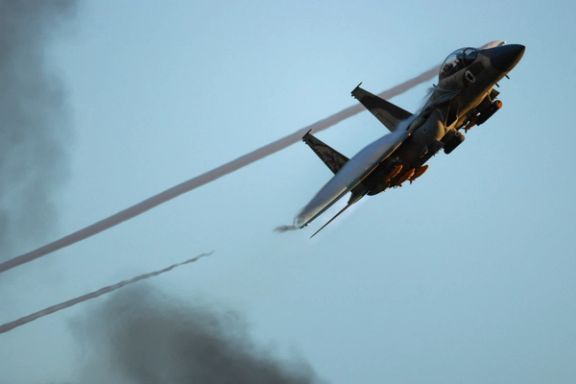
A F-15 fighter jet flies during a graduation ceremony for Israeli Air Force pilots at Hatzerim Airbase, in southern Israel, June 29, 2023.
A military strike against Iran's nuclear facilities would likely not be a singular event but mark the start of a protracted campaign involving military strikes, covert operations and economic pressure according to the Washington Institute think tank.
Outlining the challenges facing policymakers considering such action, the Washington Institute for Near East Policy argued that such an action would be the opening round of a long campaign built upon decades of covert efforts and will escalate in pace and intensity.
"A preventive attack is unlikely to be a solitary event, but rather the opening round of a long campaign employing military strikes, covert action, as well as economic, informational, and other elements of national power," the report said.
The research, written by Michael Eisenstadt, said that a successful preventive strike against Iran's nuclear program requires: eliminating materials and facilities, enabling covert rebuilding disruption, securing political support, and crafting a post-strike strategy to deter Iran from rebuilding.
However, the threat of military action could prompt Iran to hide materials, complicating future strikes. It also risks pushing Iran to abandon its current nuclear hedging strategy and accelerate weaponization.
Eisenstadt suggested that the preparatory phase has already begun, citing Israel's airstrikes targeting Iranian radar systems in April and October 2024, which weakened air defenses around key nuclear and missile sites.
A satellite photo shows suspected tunnel expansion (in the upper-right quadrant of the picture) at Shahid Modarres Garrison, near Tehran, Iran, in this handout image obtained by Reuters on July 5, 2024.
"A lengthy campaign would be required because key installations associated with Iran’s nuclear program are located at over a half-dozen sites," the report said, noting that some are hardened and buried, making complete destruction unlikely.
According to the research, Israeli leaders view Iran's current vulnerability as an opportunity to degrade its nuclear capabilities. "Many Israelis believe that Iran’s current weakness provides a unique opportunity to destroy, or at least set back, its nuclear program through a military strike".
US President Donald Trump has reaffirmed his position that "Iran cannot have a nuclear weapon," expressing readiness for diplomatic engagement but suggesting military action as a last resort. He said there are "two ways of stopping [Iran], with bombs or with a written piece of paper."
The report also warned of Iran’s likely response to a possible attack, saying that it could range from measured retaliations to severe escalation, including potential withdrawal from the Nuclear Nonproliferation Treaty (NPT) or further restrictions on the UN nuclear watchdog's operations in the country.
"Tehran might feel a need to respond massively to a preventive strike, although recent setbacks inflicted by Israel on its proxy forces and missile production capability may limit its ability to do so. It could also respond by withdrawing from the Nuclear Nonproliferation Treaty and expelling International Atomic Energy Agency (IAEA) inspectors," it added.
In 2023, Iran already banned at least one third of inspectors with the UN's nuclear chief voicing frustration at Iran's intransigence.
Eisenstadt also highlighted Iran's resilience, warning that following a strike, Iran would likely attempt to rebuild its nuclear capabilities, potentially hiding clandestine facilities in civilian areas or deeply buried sites believed to be beyond the reach of Israel or the United States.
"Thus, in the aftermath of a strike, Iran will likely try to rebuild, perhaps hiding small clandestine centrifuge-enrichment and weaponization facilities in plain sight (e.g., in residential areas or civilian industrial parks), or more likely, in hardened, deeply buried facilities which it believes are beyond the reach of Israel or the United States."
It is not the first time experts warn of Iran's resilience. Last month, Sina Azodi, an expert on US-Iran relations, told the Eye for Iran podcast that Iran can easily rebuild nuclear facilities hit by air attacks.
"Once you know how to make a car, it doesn't matter how many times you get into a car accident. You can still rebuild it," he said.
The potential for clandestine rebuilding necessitates "follow-on covert action and military strikes to disrupt and delay efforts to rebuild" in the years following an initial attack, according to the Washington Institute report.
The analysis concluded that if diplomacy fails to dismantle Iran's nuclear program, policymakers must weigh the risks of a nuclear-threshold Iran against military intervention. While a strike risks triggering nuclear proliferation, it may also enable the long-term containment of a weakened Iran, Eisenstadt argued.
He said that fearing a change in its leadership, which US assurances may not alleviate, Iran might retaliate more aggressively and accelerate its nuclear program after a preventive strike.
US President Donald Trump signs a document in the Oval Office at the White House in Washington, February 4, 2025.
A senior Emirati diplomat will personally convey to his Iranian counterparts in Tehran a letter from US President Trump urging a nuclear deal, Iran’s foreign ministry said on Wednesday.
"Anwar Gargash, the diplomatic advisor to the President of the United Arab Emirates, will meet and hold consultations with Abbas Araghchi, the Foreign Minister, later today. During this visit, he is carrying a letter from Donald Trump, the President of the United States, to Iran," said Esmail Baghaei, Iran’s foreign ministry spokesperson in an interview with ISNA.
Earlier on Wednesday, Iran’s Foreign Minister Abbas Araghchi said that an Arab intermediary would deliver a letter from US President Donald Trump to Tehran, just days after Iran had denied the existence of such a letter.
On Friday, Trump said that he had sent a letter to Iran's Supreme Leader Ali Khamenei, offering negotiations while warning of military consequences if talks over its nuclear program failed.
A day after Trump publicly revealed his letter, Khamenei made a speech in which he made no mention of the letter but declared that the Islamic Republic would not negotiate with "bullying" powers.
During the week, Iran’s foreign minister and the ministry’s spokesman said that Tehran had not received any letter from Trump,
The belated admission by Iran of Trump's reaching out his hand for negotiations comes on the back of Wednesday's announcement of a closed doors UN Security Council meeting over Iran's nuclear program, news which has infuriated Tehran.
Araghchi said: "A closed-door meeting of the UN Security Council has been requested, which is a completely new procedure and surprising, and questions the goodwill of the countries requesting this meeting."
It had been requested by France, Greece, Panama, South Korea, Britain and the US as Tehran's nuclear program edges ever closed to weapons grade uranium.
"We have always been ready to negotiate on the nuclear issue from an equal position, and we have also negotiated on the JCPOA, and negotiations are ongoing," Araghchi added.
He said that Iran would soon have a fifth round of talks with the European powers forming part of the nuclear deal -- France, Britain and Germany -- and confirmed a meeting in Beijing on Friday with the other members, Russia and China.
"The United States withdrew from the JCPOA a long time ago, and we are negotiating with three European countries, and a new round of it will be held soon," he noted.
On Tuesday, President Masoud Pezeshkian lambasted Trump's threat of military action if Tehran did not come to a nuclear deal, saying the Islamic Republic would not be forced to negotiate.
"What (Trump) did to that Zelensky is truly shameful," the relatively moderate president said, referring to an Oval office showdown between Trump and the Ukrainian president - Washington's erstwhile wartime partner.
Iranian officials have cited the blowup as a sign of the United States' bullying on the world stage. Tehran has resisted Trump's overtures for a new deal over its nuclear program and its Supreme Leader Ali Khamenei has ruled out talks.
Khamenei, Iran's top decision-maker, has repeatedly rejected the notion after insisting the United States cannot be trusted.
China will host discussions with Russia and Iran on the Iranian nuclear issue in Beijing on March 14, the Chinese foreign ministry announced on Wednesday.
Vice Foreign Minister Ma Zhaoxu will chair the meeting, the ministry confirmed during a regular press conference.
While details of the agenda were not immediately disclosed, the Beijing meeting is expected to focus on potential avenues for reviving diplomatic efforts as the Trump administration has demanded talks for a new deal that would permanently block Tehran's ability to produce nuclear weapons.
The announcement follows remarks by Russian Foreign Minister Sergei Lavrov, who said that Russia has discussed the situation surrounding Iran's nuclear deal with the United States and maintains some contact with European nations on the issue.
"We discussed the situation in the Persian Gulf. We discussed the joint comprehensive action program on the Iran nuclear issue. We are in favor of restoring the original program from which the Americans dropped during the first Trump government. There are some contacts on the European side," Lavrov said, according to Russia's TASS news agency.
"What is worrying is that there are some indications that the Americans would like this new deal to be accompanied by political conditions, insisting that there should be some verifiable arrangement for Iran not to support groups in Iraq, in Lebanon, in Syria, anywhere, which I don't think is going to fly," he added.
He said Russia would be in favor of resuming the format which developed the original JCPOA deal endorsed by the Security Council, though recently, the UN's nuclear chief said it was "an empty shell", with little hope of its revival.
Russia and China have close ties with Iran and were signatories of the 2015 JCPOA nuclear agreement which US President Donald Trump withdrew from in 2018 before imposing heavy sanctions on Tehran.
As Iran’s nuclear standoff with the West intensifies, Russia has positioned itself as a key diplomatic actor, proposing talks with Washington.
Russian Deputy Foreign Minister Sergei Ryabkov met with Iranian Ambassador Kazem Jalali last week to discuss international efforts to resolve issues surrounding Iran's nuclear program.
Moscow has agreed to assist the US in communicating with Iran on various issues, including its nuclear program and support for regional anti-US proxies, according to a Bloomberg report.
Esmail Baghaei, the spokesperson for Iran's Ministry of Foreign Affairs, was also quoted by Iranian domestic media on Wednesday confirming that the trilateral meeting between Iran, China, and Russia at the level of deputy foreign ministers will be held this Friday in Beijing, focusing on developments related to the nuclear issue and the lifting of sanctions.
According to Baghaei, discussions will also cover other topics of interest such as trade and economy.
Iran's President Masoud Pezeshkian lambasted US President Donald Trump's threat of military action if Tehran did not come to a nuclear deal, saying the Islamic Republic would not be forced to negotiate.
"What (Trump) did to that Zelensky is truly shameful," the relative moderate president said, referring to an oval office scrap between Trump and the Ukrainian president - Washington's erstwhile wartime partner.
Iranian officials have cited the blowup as a sign of the United States' fickleness and bullying on the world stage. Tehran has resisted Trump's overtures for a new deal over its nuclear program and its Supreme Leader Ali Khamenei has ruled out talks.
"It is unacceptable to say, ‘We give orders to do this (or) not to do that," Pezeshkian said. "I will not come to (negotiate with you). Do whatever the hell you want!"
Faced with deepening economic malaise wrought by US-led sanctions, Pezeshkian had repeatedly advocated for talks with Washington to chip away at Iran's isolation and mitigate deepening financial pain which threatens unrest.
Khamenei, Iran's top decision-maker, has repeatedly rejected the notion after insisting the United States cannot be trusted.
The European Union's top diplomat on Tuesday called for an international nuclear deal with Iran along the lines of a 2015 agreement, days after US President Donald Trump mooted military action to dismantle it.
High Representative Kaja Kallas's remarks signal an important policy statement by the bloc after Washington and Tehran jousted over whether the so-called Joint Comprehensive Plan of Action (JCPOA) from which Trump withdrew in his first term can be a basis for a renewed agreement.
"The constant expansion of Iran’s nuclear programme fully contradicts Iran’s own commitments as endorsed by the Security Council," Kallas said at a United Nations Security Council session on EU-UN cooperation.
"At the same time, a multilateral approach, like the JCPOA was, is key. There is no sustainable alternative to a diplomatic solution."
Iran denies seeking a nuclear weapon but the UN's nuclear watchdog last week pointed to a sharp rise in Tehran's stockpile of highly enriched uranium.
The United States and European Union said Iran's activities serve no credible civilian purpose and demanded it immediately desist.
Trump said on Thursday that Tehran would need to ditch a nuclear program much of the West views as a precursor to building nuclear weapons or face military force.
The hawkish US president has not specified whether the JCPOA, from which he withdrew in his first term after bashing it as too lenient, would be the basis of the talks or whether he sought any international buy-in for a new deal.
Rejecting the idea of a renewed agreement, the Revolutionary Guards' Tasnim news agency said a deal already existed in the form of the JCPOA.
Iran's ally Russia has said it is willing to mediate and Moscow's envoy to the UN nuclear watchdog said on Monday that the JCPOA remains the essential foundation for any future negotiations on Iran's nuclear program.
Kallas went on to criticize Iran's aid to Russia in its full-scale invasion of Ukraine.
"Russia has brought others – North Korea, Iran – to support its colonial battle too."
"Iran’s military support to Russia, including the delivery of ballistic missiles, is a major threat to international security," she added.
Iran's First Vice President Mohammad Reza Aref said Tehran will not seek permission from any country for its nuclear activities, while rejecting allegations that it is pursuing nuclear weapons.
"We neither take orders nor seek permission regarding our nuclear technology," Aref said on Tuesday.
He said that Iran's nuclear program is focused on peaceful development and guided by religious principles, pointing out that Iran abides by the Supreme Leader’s fatwa (religious decree) prohibiting the development of nuclear weapons.
“If a fatwa prohibits nuclear weapons development and permits peaceful nuclear technology, all state institutions will comply," he said.
In an October 2019 speech, Khamenei said that building and maintaining nuclear weapons is "absolutely haram," meaning strictly forbidden under Islamic law.
Several officials have in the last year hinted at Iran's nuclear capabilities. Last April, after Iran's inaugural aerial barrage on Israel, a senior IRGC commander warned that Tehran could change its nuclear policies if Israel continues to threaten to attack Iran’s nuclear sites.
Ahmad Haghtalab, who is in charge of the security of Iran’s nuclear sites, said: “If the Zionist regime wants to use the threat of attacking nuclear sites to put pressure on Iran, it is possible and conceivable for the Islamic Republic to revise its nuclear doctrine and policies, and deviate from its past declared considerations."
Just this week, Iran's foreign minister said the country’s nuclear program cannot be destroyed by military means, citing the program's widespread dispersion and robust protection.
During an interview at the Iranian consulate in Jeddah on Friday, Abbas Araghchi told AFP, “Iran's nuclear program cannot be destroyed through military operations" because the technology is ingrained, facilities are dispersed and protected, and Iran would retaliate proportionally.