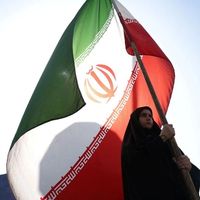
Jimmy Carter and The Late King of Iran, Mohammad Reza Shah Pahlavi - Picture: Radio California - Free for all Platforms
Nearly fifty years later, Iran International can reveal the untold story of a critical US mission to Tehran ordered by President Jimmy Carter to determine whether Mohammad Reza Pahlavi Shah could fend off a revolution.
Their conclusion, after facing militants' bullets and a ghostly encounter with the shell-shocked monarch, was that the US could no longer support its longtime ally's rule.
The consequences of Islamic Revolution to follow reverberate to the present day.
Ambassador John Craig, 80, was a young American diplomat when he was tasked with joining an exclusive group to meet the Shah alongside Senate majority leader Senator Robert Byrd.
It was a mission that went undisclosed even to American Ambassador to Iran William Sullivan, Craig told Iran International in an interview in Elizabethtown, Pennsylvania, where he teaches at the local university.
In a storied career, Craig went on to serve as US ambassador to Egypt and Oman.
“President Carter asked Senator Byrd to make a special trip to Tehran to give him a personal assessment of the longevity of the Shah. There was great concern in Washington”, said Craig, “Could the Shah hold on? Could the Shah defeat the revolution?”
Their task was to help Carter transcend the disagreements within the US foreign policy over whether one of Washington's key allies in the turbulent region could be salvaged and provide an unvarnished take on the Shah's mettle.
“Some were saying, yes, the Shah could hold on, others no. One of the issues in that debate was how much force should be used to put down the revolution,” said Craig.
"There were those who felt that the Shah should really be aggressive and shoot people. And there were those who felt that reforms were the way to defeat the revolution.”
Ambassador John Craig has Ambassador-in-Residence in the Center for Global Understanding and Peacemaking at Elizabethtown College in Elizabethtown, Pennsylvania.American politician who served as a United States House of Representatives from West Virginia for over 57 years, from 1953 until his death in 2010.
Mission: Tehran
To camouflage the trip's true purpose, Craig and the rest of the group made a diplomatic tour across the Middle East and the North Africa before arriving in Tehran.
Craig touched down in December 1978, just a few months before the Shah was ultimately toppled and as rebellion roiled cities nationwide.
Violence was escalating and martial law was in place as armed anti-Shah demonstrators roamed the streets chanting ‘death to the Shah!’
Iranian demonstrator holds poster of Khomeini as uprisings swept Iran in 1978.
Because of the security risk, Craig and the team were not able to drive to the Shah’s Niavaran palace and instead flew by helicopter.
“We were flying. You could see out the windows that people were shooting at us,” Craig said.
When they arrived, Craig said he was astonished to see bare walls - no paintings, no antiques - in what was once among the world's most opulent palaces.
It became clear that the Shah was preparing to flee.
Interior of Niavaran palace which is now a museum open to the public in Northern Tehran.
“I'm saying to myself, this is really weird. I said to myself immediately, these guys have packed up. They are ready to go. No question about that,” Craig said.
Entering the palace’s Hall of Mirrors, Craig caught sight of the Shah and his wife, Empress Farah Diba, standing to greet them.
'Inert' emperor
“He was comatose. Standing, but inert,” said Craig.
“I noticed that the Shah was looking straight ahead. He was not interacting. His eyes weren't moving. He did not raise his hand. But when the person put their hand in his hand, he didn't grasp it and he didn't shake it,” Craig said.
Mohammad Reza Shah Pahlavi, his wife Empress Farah Diba and their son, the crown prince.
They went on to have lunch in the palace. Craig said the Shah did not speak once over the course of the meal, leaving the Empress to do all the talking. She appeared to be in control and running the country in the last days of their rule, Craig concluded.
“He didn't eat. He didn't move. He didn't say a word,” said Craig about the Shah.
Pleasantries and small talk dominated the discussion and the violence in the streets went unmentioned. Senator Byrd and Ambassador Craig left convinced that the Shah was unfit to rule.
Little did anyone at the time realize it, but the lunch was to help determine US policy and Iran's future course for the coming decades.
Screaming match
What followed next was a visit by Senator Byrd and Ambassador Craig to Ambassador Sullivan’s house in Tehran to break the news on the special visit.
While Ambassador Craig did not partake in the conversation, he could hear what Sullivan and Byrd were saying.
“There was a lot of screaming and yelling. They were arguing about what our policy should be going forward,” said Craig on the encounter between the two men.
William H. Sullivan, the last American ambassador to Iran.
The conversation lasted about three hours, with Sullivan coming to the defense of the Shah and pushing to have the Americans keep him in power. Byrd argued the Shah was already done for and unable to rule over a people in revolt.
On the flight back to the United States, Senator Byrd prepared his report to Carter.
“We were such a small group, of course, that we could hear what the senator was dictating in the memo to the president. So we we all knew what the senator was saying in his memo,” said Craig.
Once they arrived back to D.C, the Senator had a car waiting to take him straight to the White House, where he informed the president of his dire conclusion: the scion of Iran's 2,500-year monarchy was doomed.
“He went back and told the president: This is not going to work," Craig said.
"The Shah cannot continue.”
You can watch the full interview with Ambassador John Craig on YouTube.
Hungarian Prime Minister Viktor Orban speaks to the media next to Israeli Prime Minister Benjamin Netanyahu, in Budapest, Hungary, April 3, 2025.
Israeli Prime Minister Benjamin Netanyahu accused Iran of leading what he called an “assault on civilization” during joint remarks with Hungarian Prime Minister Viktor Orban in Budapest on Thursday.
Netanyahu's visit followed Hungary’s formal decision to withdraw from the International Criminal Court earlier in the day. The Israeli leader is sought under an ICC arrest warrant for alleged war crimes in Gaza.
“This is important for all of civilization as we fight this battle against barbarism,” Netanyahu said. “We are fighting a similar fight for the future of our common civilization.”
He said that civilization itself is “under assault from radical Islam” spearheaded by Iran.
Iran-backed Hamas militants launched an attack on Israel on Oct. 7 2023, killing some 1,200 people and taking around 250 hostages to Gaza.
Israel's ongoing incursion into Gaza has killed more than 50,000 people, according to Palestinian health authorities, with nearly a third of the dead under 18.
Tehran and its allies were dealt significant setbacks last year, including Israeli attacks that severely weakened Iran's ally in Lebanon Hezbollah and helped dislodge the Assad dynasty in Syria, Tehran's oldest Arab ally.
On Oct. 26, Israel launched air strikes on Iran which it said knocked out Iran’s Russian-supplied air defense system.
Since Donald Trump took office in the United States for his second term as president, Tehran has issued repeated warnings against further attacks.
It has also conducted continuous military drills since early January. After reviving the "maximum pressure" campaign of sanctions from his first term, Trump on Sunday mooted bombing Iran if it does not agree to a new nuclear deal.
A high-ranking Iranian judge and member of the so-called Death Committee which oversaw the execution of thousands of dissidents in the late 1980s, has died.
The head or Iran's judiciary issued a condolence message on Thursday saying Hossein Ali Nayeri had been bedridden due to a lengthy illness, attributing the sickness to his years of work.
"Certainly, this ailment was due to many years of service to the holy system of the Islamic Republic of Iran and the judiciary," Gholamhossein Mohseni Ejei was quoted as saying by the judiciary's Mizan news agency.
Nayeri's death comes after a court employee in January shot dead two veteran Supreme Court judges, Mohammad Moghiseh and AliRazini, before killing himself. Initial news reports at the time mentioned a third judge being injured but officials said an injured bodyguard was the only other victim.
Born in 1956, Hossein Ali Nayeri served as the religious judge of Tehran's Evin Prison from 1983 to 1989 and was appointed by the founder of the Islamic Republic Ruhollah Khomeini.
During this period authorities routinely executed political prisoners. Nayeri was a key member of a judicial panel - later known as the "Death Committee" - which condemned thousands of prisoners to death in the summer of 1988.
Following his tenure at Evin Prison, Nayeri served as the Deputy Chief Justice of the Supreme Court from 1989 to 2013 and as the head of the Judges Disciplinary Court from 2013 to 2022.
On Wednesday, a hacktivist group said the Iranian police intelligence agency has issued thousands of gun permits to senior state officials to fend off assassination.
Iran's Supreme Leader Ayatollah Ali Khamenei attends a graduation ceremony for student officers and guard trainees in Tehran, Iran September 13, 2019.
Iran's newly published budget law reveals the Islamic Revolutionary Guard Corps’ (IRGC) major share of oil revenues and public funds—and opens the door for the IRGC and Supreme Leader–linked institutions to take control of state assets.
In the past Iranian year, which ended on March 20, a portion of the country’s oil exports was allocated to the armed forces—particularly the IRGC—under the pretext of “strengthening national defense.” This year not only has the military’s share of oil export revenues grown significantly, but direct government budget allocations to the armed forces have also sharply increased. Additionally, the law expands the authorization for crude oil transfers to other entities, including those involved in nuclear programs.
Meanwhile, the budget law allows IRGC-affiliated entities—such as Khatam al-Anbiya Construction Headquarters—as well as institutions linked to Supreme Leader Ali Khamenei’s office, like the Execution of Imam Khomeini’s Order (EIKO), to acquire state assets as a means of settling government debt owed to them.
Military's share of oil
President Masoud Pezeshkian’s government has projected daily oil exports of 1.85 million barrels for the current fiscal year, which began on March 21. Of this, one-third—valued at $12.4 billion—will be directly allocated to the armed forces and their specialized military projects, a figure that has tripled compared to the previous year. The remaining oil revenues, along with total gas export earnings, estimated at $33.5 billion, will be divided among the government budget, the National Development Fund, and the National Iranian Oil Company.
Another key point is that the government has set the exchange rate for oil allocated to the armed forces at roughly 600,000 rials per euro—while the euro trades at around 1.14 million rials on the open market. This disparity creates a major financial windfall for the military, enabling them to sell the oil and convert the proceeds at market rates, effectively pocketing the difference.
Moreover, the military has priority in oil sales, meaning any decline in national exports will primarily impact the government’s share. If the armed forces are unable to export their allocated share, the government is obligated to compensate them with equivalent cash payments.
Despite the government’s target of exporting 1.85 million barrels of oil per day this fiscal year, data from commodities intelligence firm Kpler—obtained by Iran International—shows that the average daily delivery of Iranian crude to Chinese ports, Iran’s sole oil customer, stood at approximately 1.34 million barrels in the first quarter of 2025. That’s down from a daily average of 1.5 million barrels in 2024.
Additionally, the Trump administration has launched a campaign to reduce Iran’s oil exports to “zero”, and several tanker tracking and energy consulting firms previously told Iran International that Iranian oil exports could drop by about half a million barrels per day in the coming months.
Kpler also reported this week that Chinese independent refineries, known as "teapots," appear to be pausing new orders of Iranian crude oil following Washington's first imposition of sanctions on a Chinese refinery, Shandong-based Shouguang Luqing Petrochemicals.
In addition to the armed forces, the Iranian government has authorized five other entities—including those involved in “nuclear energy projects”—to sell oil directly.
At least part of these funds will likely be directed toward nuclear activities unrelated to electricity production, like sensitive and controversial uranium enrichment that the US and its allies object to.
Moreover, beyond revenues from direct oil sales under the so-called “strengthening national defense” initiative, the military and security forces are also set to receive 10% of the government’s general budget for personnel salaries.
Transfer of state assets to the military and supreme leader's office
Amid a lack of transparency surrounding the economic activities of the IRGC and institutions under the Supreme Leader’s control, unofficial reports suggest these entities dominate roughly half of Iran’s informal or “shadow” economy. Over the past two decades, much of the government’s privatization program has veered off course—rather than transferring assets to the true private sector, state-owned properties have been handed over at heavily discounted rates to the IRGC and Supreme Leader–affiliated institutions.
These entities also play a major role in Iran’s infrastructure development. Yet the exact amount the government owes them for state-assigned construction projects remains unclear. What is clear, however, is that the 2025 budget law specifically authorizes the IRGC-linked Khatam al-Anbiya Construction Headquarters and the Supreme Leader–controlled Execution of Imam Khomeini’s Order (EIKO) to receive up to two quadrillion rials (approximately $2 billion) worth of state assets as repayment for outstanding government debts.
This year, the government plans to sell 15.8 quadrillion rials in state-owned assets, of which 13% is earmarked for transfer to the military and institutions tied to the Supreme Leader—if budget targets are met. Given the weakness of Iran’s private sector, it is widely expected that, once again, entities under the IRGC and Supreme Leader’s control will acquire the lion’s share of these assets.
Former Iranian diplomat and ambassador, Jalal Sadatian
A former senior Iranian diplomat has warned that certain actors are actively working to prevent improved relations between Iran and the West, emphasizing the need for Tehran to maintain a balanced foreign policy with all global powers.
Jalal Sadatian, who previously served as Iran’s ambassador to the United Kingdom, told the ILNA news website in Tehran: “It is important to recognize that there are serious enemies of Iran’s national interests who do not want to see improved relations with Europe and the United States.”
In recent months, numerous media outlets, political figures, and former officials have cautioned against relying on Russia as a mediator between Tehran and the West, accusing Moscow of seeking to keep Iran within its own geopolitical orbit.
“Maintaining a balanced foreign policy is essential to safeguard the country’s national interests and security,” Sadatian said, adding, “We must remain aware of the severe risks posed by sanctions in order to navigate this critical phase successfully.”
The former diplomat pointed out that the dynamics of the Middle East have shifted dramatically, citing Israeli strikes on Hamas and Hezbollah, as well as the fall of Syria’s Bashar al-Assad. He emphasized that the Islamic Republic has effectively lost its military foothold in Syria.
Sadatian also noted a shift in Iraq’s political landscape—one that appears unfavorable to Iran. He highlighted growing pressure from senior Iraqi officials and Shiite religious leaders on pro-Iran militias to either disarm or formally integrate into the Iraqi army.
On the prospect of renewed talks with the United States, Sadatian warned that Tehran must remove “serious and illogical impediments rooted in domestic political disputes.” He added, “We must be aware of the serious dangers posed by sanctions in order to navigate through this phase successfully.”
Ali Larijani, senior advisor to Iran's Supreme Leader
Remarks by a senior adviser to Iran’s Supreme Leader warning of Iran being pushed to produce nuclear weapons by US threats have sparked intense debate in Iran.
In a televised interview on Monday, Ali Larijani suggested that if Iran were attacked and public demand for nuclear weapons emerged, even the Supreme Leader’s religious decree (fatwa) against weapons of mass destruction could be reconsidered. Nonetheless, he insisted that Iran is not pursuing nuclear arms and remains committed to cooperating with the International Atomic Energy Agency (IAEA).
Khamenei’s ruling was presented by Iranian officials at the International Conference on Nuclear Disarmament in April 2010. But such religious decrees could be altered or overturned given the ‘requirement of time and place’ as many historical instances prove.
Many hardliners and ultra-hardliners in Tehran—typically staunch critics of the moderate conservative Larijani—have embraced his remarks on social media.
“Had any other political figure raised the possibility of the Islamic Republic moving toward nuclear weapons, they would have been accused of warmongering or bluffing. Dr. Larijani’s decision to bring it up was a wise move and a timely act of sacrifice,” wrote Vahid Yaminpour, a prominent ultra-hardliner and former state television executive, on X.
“The Iranian nation wants nuclear weapons,” declared Seyed Komail, an ultra-hardliner social media activist with 27,000 followers, in response to Larijani’s remarks.
Abdollah Ganji, former editor of the IRGC-linked Javan newspaper, dismissed concerns over potential US or Israeli strikes, arguing that Iran’s nuclear facilities are too deeply fortified to be destroyed. He warned that an attack could lead to Iran's withdrawal from the Non-Proliferation Treaty (NPT) and retaliation against US military bases and Israel.
However, Larijani’s remarks stand in contrast to official government positions. Soon after his interview, Iran’s Foreign Minister Abbas Araghchi reaffirmed on X that Iran “under no circumstances” would seek, develop, or acquire nuclear weapons, emphasizing that diplomacy remains the best course of action.
Nour News, an online outlet believed to be affiliated with Iran’s Supreme National Security Council (SNSC), also weighed in, questioning whether the US is prepared to face the consequences of further escalation.
Larijani’s statements have drawn strong criticism as well. Detractors argue that such rhetoric provides the US and Israel with an excuse to justify pre-emptive military action. “The Leader’s fatwa prohibiting nuclear weapons is absolute and without exceptions,” posted cleric Saeed Ebrahimi on X, adding that raising the prospect of nuclear bombs would only give Iran's enemies justification for aggression.
Mohammad Rahbari, a prominent political commentator in Tehran, suggested that Larijani’s remarks signaled Iran may be alarmingly close to nuclear capability—precisely the kind of pretext Israel has been seeking for a preemptive strike. Senior reformist journalist Mohammad Sahafi also warned that such nuclear posturing could alienate potential allies who might otherwise support Iran in the face of Western pressure.
“Larijani's comment was unprofessional and came from a position of weakness; it had no merit. It also gave the other side an excuse to have strong reasons for pre-emptive action and to shape a global consensus. In short, if we are concerned about our homeland, we should not take such a reckless stance,” Hemmat Imani, an international relations researcher in Iran, wrote.
Others speculate that Larijani’s remarks are part of ongoing indirect negotiations with Washington. “Ali Larijani’s ‘warning’ should be seen as a calculated move in high-level negotiations,” suggested Iranian environmental journalist Sina Jahani.
Describing Larijani’s remarks as “a form of nuclear blackmail the Islamic Republic has used as a tool of threat for years,” Arvand Amir-Khosravi, a Norway-based academic and monarchist, wrote on X that the threat was “nothing more than a propaganda ploy to gain leverage in potential negotiations,” adding that pursuing nuclear weapons would invite military retaliation rather than enhance Iran’s security.
The United States Office of the Director of National Intelligence reported in November 2024 that, as of September 26, Iran was not actively building a nuclear weapon. However, last month, Rafael Grossi, director general of the International Atomic Energy Agency (IAEA), described Iran’s nuclear program as extremely ambitious and wide-ranging. He warned that the country's uranium enrichment had reached near weapons-grade levels and was alarmingly close to the threshold for acquiring nuclear weapons.