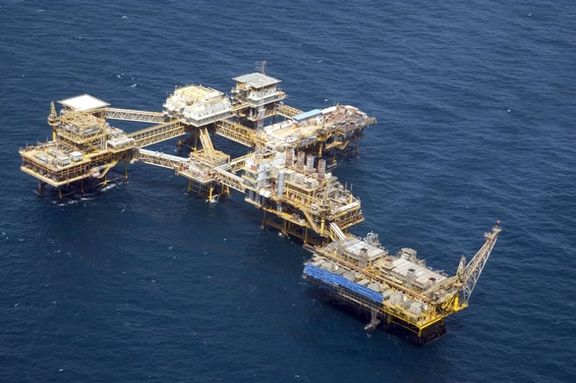
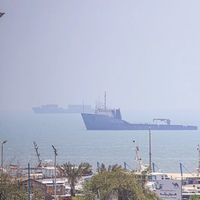
Iran's Salman oil and gas field in the Persian Gulf
The 2001 gas supply agreement between the National Iranian Oil Company (NIOC) and the UAE-based Crescent Gas Corporation (CGC) remains one of the most controversial topics in Iranian politics.
The agreement, signed during the administration of reformist President Mohammad Khatami, was never implemented.
Iran has been ordered to pay substantial damages to Crescent and has lost billions of dollars in potential revenue after gas exports under the deal, which were supposed to begin in 2008, failed to materialize.
The controversy primarily centers on allegations of corruption leveled by ultra-hardliners against former Oil Minister Bijan Zanganeh and other officials aligned with the so-called reformist faction, unfavorable rulings by international arbitration courts against NIOC, and the loss of substantial revenue from the Salman oil and gas field.
Q: What is the Crescent Deal?
The Crescent gas deal was a 25-year contract to export natural gas from Iran's offshore Salman field in the Persian Gulf to the United Arab Emirates.
Under the agreement, Iran was to deliver approximately 500 million cubic feet of natural gas per day to the UAE, starting in 2008.
Crescent Gas invested approximately $300 million in infrastructure, including a gas sweetening plant and transmission facilities, while NIOC spent over $1.5 billion developing the Salman gas field and its related transport infrastructure.
Negotiations with the UAE side over pricing terms continued after the government transitioned to populist President Mahmoud Ahmadinejad in 2005. These talks initially broke down due to Tehran's insistence that the previously agreed price was too low compared to rising global prices at the time.
The Ahmadinejad administration later dropped its opposition to the agreement and chose to implement it. However, under political pressure, NIOC ultimately refused to begin supplying gas to CGC as agreed.
Q: Who opposed the Crescent deal and why?
Saeed Jalili, ultra-hardline politician and secretary of Iran's Supreme National Security Council (SNSC) under then-President Ahmadinejad, is known as the staunchest critic of the Crescent Deal.
Former Oil Ministry official Mahmoud Khaghani claimed in July 2024 that in early 2010, Ahmadinejad urged the Supreme National Security Council to resolve the Crescent issue in order to avoid litigation.
Khaghani, accused Jalili of sabotaging the deal due to personal grudges against former Oil Minister Zanganeh, the architect of the deal, and insisted that the deal should never be implemented. According to Khaghani, Jalili argued that CGC would not be awarded more than $850 million in damages if the case went to court.
Proponents of the deal have also accused Jalili of attempting to create insurmountable obstacles in nuclear talks with world powers while he headed the nuclear negotiation team.
Despite repeated challenges from Zanganeh to publicly debate the matter, Jalili has declined, stating that the issue is too complex for a debate and should instead be resolved in court.
Q: What legal steps has CGC taken against NIOC?
In 2009, Crescent Gas filed a lawsuit against NIOC with the Permanent Court of Arbitration (PCA) in The Hague. In 2014, the arbitration court ruled that NIOC had breached its contractual obligations.
In 2021, the arbitration tribunal awarded CGC $2.43 billion in damages for lost profits due to NIOC's failure to deliver gas. NIOC appealed the ruling to the Court of Appeal in London, but the appeal was rejected in July 2023.
As of January 2025, the award, including accrued interest, amounts to approximately $2.75 billion.
Separately, in September 2021, another tribunal awarded Dana Gas, an affiliate of Crescent Petroleum, $607.5 million for NIOC’s failure to supply gas under the same agreement. This award only covers the first 8.5 years of the 25-year contract.
Additional arbitration claims could raise the total damages sought from NIOC to as much as $18 billion.
Q: Has NIOC paid the sums awarded to the UAE side?
To date, NIOC has not fulfilled its payment obligations. However, Crescent Petroleum has successfully obtained orders to seize NIOC assets abroad in order to enforce the arbitration awards.
In April 2024, a UK court ordered the transfer of the NIOC House in London to CGC as partial settlement of the damages. More recently, another NIOC-owned building in Rotterdam, the Netherlands, was seized for the same purpose.
The Iranian government stressed that any decisions on potential nuclear talks would be made within the framework of the Supreme National Security Council, in a nod to the conservative establishment.
The remarks from the spokeswoman of the relatively moderate government appeared aimed at reassuring hardliners that any talks will be subject to strict oversight and not diverge from the priorities of Supreme Leader Ali Khamenei.
President Masoud Pezeshkian’s said earlier this month he was ready to engage in talks with the US administration of Donald Trump.
However, the move prompted questions within Iran about whether he had higher-level approval for such an initiative.
Government spokeswoman Fatemeh Mohajerani addressed domestic concerns, particularly from hardliners wary of negotiations with the West, emphasizing the established and controlled nature of the decision-making process.
"In important matters such as the nuclear issue, the matter is raised and reviewed in the Supreme National Security Council (SNSC), and the approvals of the council also specify what path must be followed for implementation," Mohajerani said in an interview with ILNA news agency on Sunday.
Mohajerani further urged against internal political disputes affecting foreign policy: "We should all be aware that foreign policy issues and national issues in general should not become an arena for factional and transnational disputes. We must proceed with consensus and agreement on foreign policy issues."
The SNSC is tasked by the Constitution to define national security and defense policies within the framework set by Khamenei.
The Supreme Leader appoints the SNSC secretary and holds final approval power over all SNSC decisions, placing him and the council at the center of Iran's foreign policy apparatus.
The SNSC formulates Iran's nuclear policy, subject to the Supreme Leader's ratification. The SNSC secretary also led nuclear negotiations until 2013, when the responsibility was assigned to the foreign ministry.
In recent weeks, several politicians and commentators in Iran have indicated that President Masoud Pezeshkian has received approval from the Supreme Leader and the Supreme National Security Council to initiate negotiations with the United States despite the two nations breaking ties in 1980.
However, none of the authorities have officially confirmed that they have authorized any such negotiations with the United States regarding Iran's nuclear program or other contentious issues.
Pezeshkian has tacitly conveyed Tehran's willingness to engage in talks with the US, but Khamenei’s hardline allies have strongly criticized both his remarks and those of other officials who advocate for talks.
Such discussions in Iran come as the International Atomic Energy Agency (IAEA) continues to express concerns about the level of access its inspectors have to Iranian nuclear facilities.
IAEA chief Rafael Grossi, speaking at the World Economic Forum in Davos last week, said, "We are not inspecting at the levels or at the places that we believe we should be inspecting.”
He also highlighted that Iran has accumulated approximately 200 kg of uranium enriched to up to 60% purity, a level dangerously close to weapons-grade.
While Grossi acknowledged the IAEA has no concrete evidence of a current Iranian nuclear weapons program, he reiterated that Tehran is not fully cooperating with the agency.
UN Secretary-General Antonio Guterres also addressed the issue at Davos, calling on Iran to definitively renounce nuclear weapons and improve relations with its regional adversaries and the United States.
"The most relevant question is Iran and relations between Iran, Israel and the United States," Guterres said. "Here my hope is that the Iranians understand that it is important to once and for all make it clear that they will renounce to have nuclear weapons, at the same time that they engage constructively with the other countries of the region."
Oman's Sultan Haitham bin Tariq arrives at Mehrabad Airport in Tehran, Iran May 28, 2023.
Iran and Oman have taken significant steps to boost bilateral trade, including resolving key banking issues and eliminating trade tariffs, the head of the Iran-Oman Joint Chamber of Commerce said on Sunday.
In an interview with state-affiliated ILNA, Jamal Razeghi Jahromi said that economic stakeholders can now open accounts for both personal and corporate purposes, adding that the changes aim to unlock the full potential of the two nations' ties and reach a target of $20 billion in annual trade.
“The main challenge Iranian investors faced in Oman was the inability to open bank accounts there. Part of these issues has been resolved, and the rest are under review," he said.
Iran is under tough US banking sanctions and on the blacklist of international watchdog, the Financial Action Task Force, FATF. If Iranian companies open bank accounts in Oman, it can help them maintain business ties with other countries. However, many of these companies are government owned entities or controlled by Iran's military.
Razeghi added that Iran and Oman have had a historically strong political relationship over the past 70 years, but trade has not kept pace.
Despite annual trade growth between 42% and 60% in the last three years, the initial trade volume was low, preventing the achievement of the targeted $5 billion in trade for the current Iranian year, which ends on March 20. He projects trade to reach $3-$3.5 billion by the year's end.
"The value of trade between Iran and Oman should reach at least $20 billion per year, and if this figure is not achieved, the friendly political relations between the two countries will not have any achievements for either side," Razeghi said.
To address this, a joint committee has been established to identify and resolve obstacles hindering trade growth, he added.
“Trade tariffs were one of the obstacles hindering trade between the two countries. This obstacle was resolved thanks to the new agreement that can effectively reduce trade tariffs to zero when implemented,” he said, referring to a deal signed during a recent visit by Iran's Minister of Industry, Mines and Trade Mohammad Atabak to Muscat.
At the 21st Joint Cooperation Meeting in Muscat last week, Atabak announced the tariff agreement, saying, “The elimination of tariffs between Iran and Oman marks an important step in fostering economic cooperation, and the implementation will begin next week.”
Measures to streamline logistics were also discussed during the minister’s trip to Muscat. A major challenge in Iran-Oman trade has been the lack of a direct and regular shipping line.
Oman has now agreed to subsidize 50% of the costs for such a line for six months to a year, with Iran's Trade Promotion Organization covering the remainder.
While this subsidy is crucial to address underutilized shipping capacity, Razeghi stressed the need for increased trade volume to make the shipping line economically viable in the long term.
Razeghi also talked about a two-year-old initiative encouraging Iranian manufacturers to complete the final 30% of their production chain in Oman.
This strategy potentially allows them to leverage Oman's existing zero-tariff trade agreements with 16 other countries, including the United States. It will also allow Iranian products manufactured in Oman to enter international markets tariff-free.
Oman attracted approximately $140 billion in foreign investment last year, demonstrating its potential as a regional economic hub, Razeghi said, noting that while cooperation opportunities exist across various industries, overcoming sanctions and addressing Iran's non-membership in the Financial Action Task Force (FATF) remain crucial for realizing the full potential of the bilateral economic relationship.
Oman's potential role as mediator
Beyond trade, Oman continues to play a vital role as a mediator between Tehran and Washington.
Last month, the Iraqi newspaper Baghdad Alyoum reported that Iran received a message from US President Donald Trump, delivered through Oman, proposing high-level talks on issues including the nuclear program, according to a source close to Iranian President Masoud Pezeshkian’s administration.
Additionally, during Joe Biden's administration, the Iranian mission to the United Nations confirmed that indirect contact between the US and Iran through Oman had been an ongoing process. The administration also authorized Iraq to transfer $10 billion in restricted Iranian funds to Oman.
Iranian Foreign Minister Abbas Araghchi meets with Amir Khan Muttaqi, acting Taliban Foreign Minister, during a diplomatic visit to Kabul on January 26, 2025.
In a move signaling renewed engagement, Iranian Foreign Minister Abbas Araghchi visited Kabul on Sunday for high-level talks with the Taliban leadership.
The visit, the first by an Iranian foreign minister since the Taliban's 2021 return to power, focused on trade relations, the return of Afghan migrants, and Iran’s contentious water rights from the Helmand River.
Esmail Baghaei, spokesperson for Iran’s Ministry of Foreign Affairs, wrote in a message on X: "This visit could be a turning point in leveraging the numerous ties between the two nations to secure the mutual interests of both countries."
On Sunday, Araghchi met with Mullah Mohammad Hassan Akhund, the Taliban's acting prime minister, and Amir Khan Muttaqi, the acting foreign minister.
Water rights dominate discussions
One key issue discussed was Iran's longstanding dispute over water rights from the Helmand River, vital for Iran’s drought-stricken Sistan-Baluchestan province which relies on the Helmand River to sustain its wetlands, including the Hamoun Lake.
Iranian officials emphasized that Afghanistan must honor its obligations under the 1973 Helmand Water Treaty.
Iranian media reported on Sunday that Taliban representatives assured Araghchi they were working to ensure water flowed to Iran without waste.
Water reservoir of the Helmand Dam in Afghanistan
There have been escalating tensions over the construction of dams on transboundary rivers, which have significantly reduced water flow to Iran’s drought-stricken eastern provinces.
The recently completed Pashdan Dam on the Harirud River in Afghanistan has become the latest focal point in the longstanding dispute.
Afghanistan’s water management projects have attracted foreign investment, adding complexity to the issue.
Countries such as China and Turkey are leveraging Afghanistan's water sector to establish strategic footholds in the region. The Pashdan Dam itself was built with assistance from an Azerbaijani firm, highlighting the international dimensions of the dispute.
The issue now dates back decades. In 1999, the Taliban completely halted the flow of the Helmand River, causing significant environmental and economic hardship for Iran.
Although a 1973 treaty guarantees Iran a share of the river's water, enforcement has been inconsistent, often leaving Iran's eastern provinces in a state of crisis.
Migration challenges and security concerns
Araghchi’s visit also addressed the repatriation of undocumented Afghan migrants. Iran, which hosts millions of Afghans, has ramped up deportations, with nearly three million undocumented individuals sent back in the past three years, according to government figures.
A group of Afghan migrants at Iran border
The discussions come against a backdrop of heightened border tensions and security concerns for both sides. Amir Khan Muttaqi called the visit “an opportunity to deepen brotherly ties between two neighboring Muslim nations that have shared both grief and joy."
Iran shares over 900 kilometers (560 miles) of its border with Afghanistan and hosts one of the largest refugee populations globally, predominantly Afghans who fled during more than two decades of war.
Afghanistan has historically seen a steady flow of migrants into Iran. However, following the Taliban's takeover of Afghanistan, this influx has surged, with millions crossing the border.
Many Iranians have criticized the government for failing to secure the border, suspecting that it intends to use Afghan migrants as foot soldiers—both to suppress discontent within the domestic population and to deploy across the region to bolster its military allies and proxies, as documented by Human Rights Watch.
In December, Iran's ambassador to the United Nations, Amir Saeid Iravani, said that "over six million Afghans have sought refuge in Iran."
Economic prospects in focus
Trade featured prominently in Araghchi’s agenda, with a specialized Iranian delegation accompanying him, Afghanistan a key partner for Iran, with bilateral trade volumes reaching $3.2 billion last year.
Iran aims to increase this figure to $5 billion in two years, supported by infrastructure projects like the Khaf-Herat railway and the development of the Dogharoon trade zone.
"The economic relations between Iran and Afghanistan are at a very good level," Araghchi said during the meetings, expressing hope for their further enhancement.
Zakir Jalali, a senior Taliban foreign ministry official, hailed Araghchi’s visit as a “gateway to a new phase in relations.” Economic cooperation, Jalali noted, is essential for addressing mutual challenges and leveraging shared cultural and historical ties.
Iran has not officially recognized the Taliban as the legitimate government of Afghanistan, with countries such as the EU, US and UK still designating them as a terrorist organization.
However, Iran maintains a pragmatic approach. Following the Taliban's takeover of Afghanistan in August 2021, Iran kept its embassy in Kabul open and has continued to engage with Taliban officials.
Iran's Vice-President for Strategic Affairs Javad Zarif speaks during the 55th annual World Economic Forum (WEF) meeting in Davos, Switzerland, January 22, 2025.
Mohammad Javad Zarif, a top presidential aide, has sparked a political firestorm in Tehran with remarks made at the World Economic Forum in Davos last week, drawing criticism from hardliners who argue that his comments portray Iran as weak.
After Zarif suggested the country was more open to international diplomacy under the new presidency, including with its archenemy the US, Mohammad Bagher Ghalibaf, Speaker of the Parliament, warned officials to tread carefully in their public statements to avoid emboldening adversaries.
Ghalibaf said that projecting a perception of weakness from Iran’s leadership could prompt “miscalculations by the incoming US administration and worsen economic pressures.”
Iran faces a serious economic crisis, expected to get worse if US President Donald Trump puts more sanctions pressure. As a result, debate is now raging in Tehran as Iran's Supreme Leader has not authorized any new negotiations.
Zarif, a former foreign minister and now Iran's Vice-President for Strategic Affairs, stirred controversy when he suggested in a Wednesday interview with CNN host Fareed Zakaria that if conservative politician Saeed Jalili had been elected president instead of Masoud Pezeshkian last July, a major war might have been underway in the region.
Zarif’s attempt to portray Iran as seeking de-escalation and potentially relaxing hijab laws backfired, drawing heavy criticism from both the Iranian public for denying pressure on women, and officials. A senior official called for his immediate arrest.
Hardliners have launched an online petition urging the IRGC Intelligence Organization to arrest Zarif immediately over his hijab remarks, which they claim amount to an effort for regime change. Nearly 55,000 people have signed the petition so far.
Ahmad Khatami, a senior Friday prayer leader, has also criticized the idea of US-Iran negotiations, describing them as “a tactic to counter the revolution.”
The conservative Kayhan newspaper and figures close to Supreme Leader Ali Khamenei amplified the critiques, with some calling for Zarif’s prosecution.
Iran's Vice-President for Strategic Affairs Javad Zarif speaks during the 55th annual World Economic Forum (WEF) meeting in Davos, Switzerland, January 22, 2025.
“This individual has brazenly mocked God’s explicit command at an international forum,” Raisi said, referencing Zarif’s comment about unveiled women in Tehran and saying the government has relaxed hijab enforcement in Iran.
Raisi also criticized institutional inaction, saying that efforts to address Zarif’s remarks had stalled.
The Ham Mihan newspaper, however, defended Zarif’s remarks, saying that Fareed Zakaria's question was based on the premise that the presence or absence of moderates in the political structure of the Islamic Republic makes no difference, and Zarif sought to refute this notion.
The paper argued that Zarif’s engagement at Davos sought to portray Iran as a rational actor committed to international norms, despite significant internal and external challenges.
Domestic Debate on Negotiations
Citing European officials, Axios recently reported that Iran may be signaling openness to a new agreement distinct from the 2015 Joint Comprehensive Plan of Action (JCPOA). Despite this, opposition to dialogue with the US remains fierce among hardliners.
Fatemeh Mohajerani, the Government Spokeswoman speaking to ILNA, sought to assuage concerns about negotiations on Sunday, emphasizing that decisions on critical issues like the nuclear program are made within the Supreme National Security Council.
“We assure concerned individuals that decision-making in the country follows a completely rational and well-established process,” she said.
Zarif’s attempt to position Iran as a cooperative global player has drawn fire from conservatives who view his comments as signaling capitulation. Critics argue that such rhetoric undermines the nation’s revolutionary ideals, while supporters see it as a pragmatic effort to mitigate international isolation.
A delegation from Iran's Ministry of Interior, led by the Director General of the Elections Office, has arrived in Minsk to serve as international observers for Belarus's presidential election on Sunday.
The Iranian delegation plans to visit polling stations in the capital to closely monitor the electoral process.
Alexander Lukashenko, who has been in power since 1994, is seeking his seventh term in office.
The election has been widely criticized by opposition figures and international observers as lacking genuine competition. Many opposition leaders are either imprisoned or in exile, leading to allegations that the election is a mere formality to extend Lukashenko's rule.
The European Parliament has denounced the election as a sham, urging the international community not to recognize its results and to support the Belarusian people's pursuit of democracy and human rights.
Iran's own electoral process has been criticized by international observers, including Freedom House, which has noted the influence of Iran's Guardian Council, an unelected body that vets candidates, as a key factor limiting the country's democratic standards.
Freedom House says of Iran's democratic process: "The Islamic Republic of Iran holds elections regularly, but they fall short of democratic standards due in part to the influence of the hard-line Guardian Council, an unelected body that disqualifies all candidates it deems insufficiently loyal to the clerical establishment. Ultimate power rests in the hands of the country’s supreme leader, Ayatollah Ali Khamenei, and the unelected institutions under his control."