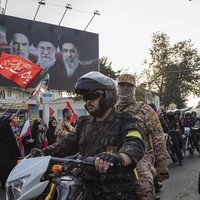
Palestinian Hamas militants take part in a rally marking the 31st anniversary of Hamas' founding, in Gaza City December 16, 2018.
Israel's foreign minister has warned that Iran is attempting to open a new Eastern front in its proxy war against the Jewish state, with the IRGC's support, targeting Jordan and the West Bank.
In a post on X, Israel Katz said that as Iran's proxies in Gaza and Lebanon continue to fight on Israel's northern and southern borders, Iran is now trying to destabilize Jordan and the Palestinian Authority (PA)-controlled West Bank.
Katz stated that the Islamic Revolutionary Guards (IRGC) is working with Hamas operatives in Lebanon to smuggle weapons into Jordan.
"A serious and dangerous situation is unfolding as Iran works to establish a new eastern terror front against Israel’s major population centers," he said.
"Iranian Revolutionary Guard units are collaborating with Hamas operatives in Lebanon to smuggle weapons and funds into Jordan with the aim of destabilizing the regime."
He said that from Jordan, weapons are smuggled across the eastern border, "flooding" the West Bank, particularly refugee camps, with dangerous weapons and large sums of money, "aiming to create a pro-Iranian Islamic terror front, as they have done in Gaza, Lebanon, and other areas, targeting Tel Aviv and Israel’s major population centers".
The foreign minister said: "The Iranian axis of evil today effectively controls refugee camps in Judea and Samaria [West Bank] through its proxies, leaving the Palestinian Authority powerless to act. We must take terror hubs like the Jenin refugee camp and carry out a thorough operational campaign to dismantle the terror infrastructure in the camp."
David Schenker, a Taube Senior Fellow at The Washington Institute said Tehran is aiming to destabilize Jordan, one of Israel's Arab allies, by inciting protests against its ruling Hashemite dynasty. He said Iran is also increasing drug and weapons smuggling through the kingdom in a bid to overthrow the monarchy and turn it into another Iran proxy state.
•
•
He said there's a strong Hamas presence in the West Bank despite being under Palestinian Authority control.
"The Iranians are incredibly incensed by Jordan's Western orientation and the fact that Jordan has a peace treaty with Israel," said Schenker, who was a former Assistant Secretary of State for Near Eastern Affairs.
Jordan has been at peace with its neighbor Israel since 1994. Amman also maintains close ties to Washington, and has a role in administering Muslim holy sites in Jerusalem.
"Iran is interfering in Jordanian internal politics," he said.
Jordan's Reaction: Diplomacy vs. Reality
Katz, Israel's Foreign Minister wrote on X that "the construction of the eastern barrier along the border with Jordan must be expedited to prevent the smuggling of weapons from Jordan into Israel, which threatens both the Jordanian regime and the State of Israel".
Jordanian Foreign Minister, Ayman Safadi, posted to X, seemingly in response to Katz, calling his tweet 'lies' and taking aim at Israel's war in Gaza since the Iran-backed Hamas invasion of October 7. In a single day, Hamas killed over 1,100 mostly civilians and took over 250 more hostage, sparking the longest Gaza war since Hamas took control of the strip.
"No amount of disinformation by radical Israeli officials spreading lies, including about Jordan, will change the fact that Israel’s continued aggression on Gaza, its violation of international law and the rights of the Palestinian people are the biggest threat to regional security," wrote Safadi.
Jordan's top diplomat made a rare visit to Iran on August 4, underscoring Amman's sensitive position, the first official visit of a Jordanian to Tehran in decades.
Despite the public outcry from the foreign minister, Jordan is a key ally for its Jewish neighbor. That was made clear when Jordan was part of a global coalition to thwart more than 350 missiles and drones aimed directly at Israel from Iran in April.
The Islamic Republic launched its first direct attack on Israel's soil in response to an apparent Israeli strike on an Iranian consulate in Syria on April 1 that killed two IRGC generals and several senior officials.
Almost all of the missiles were intercepted by Israel and a US-led coalition including France, Jordan and Britain. It is believed that Saudi Arabia provided intelligence reports about Iran's plans to the US.
While Jordan must speak out against Israel in public, its diplomatic relationship with the Jewish state remains strong, not least in the area of security.
Nearly 60 percent of Jordan's population is of Palestinian origin, putting the country in a precarious position when it comes to supporting Israel publicly given the backdrop of the war against Hamas.
On Episode 10 of Iran International's English podcast 'Eye for Iran', Israeli Knesset member Amit Halevi, said Jordan and other neighboring Arab countries like Saudi Arabia appear one way diplomatically for their populace, but cooperate with Israel for their own security and well-being.
Halevi said that Iran's attempts and activities to undermine the Jordanian regime have "become high level in recent years".
Dr. Walid Phares, an expert in foreign policy and the author of 'Iran, an Imperialist Republic, and US Policy', told Iran International smuggling arms through Jordan is not new. Formed over the years, it has been facilitated since Iran effectively took over areas of Iraq, which shares a long border with Jordan.
Jordan also shares a large border with Saudi Arabia, which impacts not just the Saudis but the Kuwaitis and the UAE.
"That passage or that chunk of Jordan is really very important strategically," he said, a possible means for terrorist groups and militias to use, should there a wider regional war occur between Iran and Israel.
"If Jordan is destabilized or [was to] fall entirely or partially, either to the Iran backed militias or to the Muslim Brotherhood, we are in deep trouble internationally," said Phares, who served as a national security advisor to US Presidential nominees.
Even President Masoud Pezeshkian's supporters criticize his cabinet choice, knowing key ministers, including Foreign, Intelligence and Defense Ministers were selected by Supreme Leader Ali Khamenei.
More than a few Iranian analysts have noted on Sunday and Monday that the list of 19 cabinet ministers handed to Parliament reflect selections made by Khamenei, the IRGC, and other influential power centers. This includes key lawmakers who will review the ministers' qualifications and backgrounds before giving, or withholding, their vote of confidence next week.
At least six of the newly proposed ministers served in former President Ebrahim Raisi's cabinet, either as ministers or deputy ministers. This continuity is partly due to Pezeshkian's campaign pledge to carry forward Raisi's initiatives.
More than a few including Sports and Youths Affairs and Interior ministers are backed by Parliament (Majles) Speaker Mohammad Bagher Ghalibaf. Again, more than a few Iran analysts including Dariush Memar pointed out that the cabinet works like a private joint stock company whose board members are determined by stakeholders.
Referring to the ministers Ghalibaf has imposed on the cabinet, Memar remarked that Ghalibaf's share of appointments is so significant it feels as though he himself won the presidential election.
Farnoosh Amirshahi pointed out that the combination of the cabinet shows that rather than determining Pezeshkian's policies, they reflect shares of Iran's leadership and security organizations, and that there is very little sign to show that the President wants to deliver his promises to those who voted for him.
Nonetheless, Iranian sociologist Mohammad Fazeli, a supporter of Pezeshkian argued that 11 of the Ministers, including Foreign Minister Abbas Araghchi, Economy Minister Abdolnaser Hemmati and Labor Minister Ahmad Maydari are strong and defendable choices. He also pointed out that some others including Intelligence Minister Esmail Khatib, Interior Minister Eskandar Momeni and Justice Minister Amin Hossein Rahimi have been chosen by the hard core of the regime, meaning by Khamenei.
Journalist Faraj Sarkoohi wrote in a post on X that Pezeshkian had said clearly and repeatedly that he was going to carry out Khamenei's ideas and he did that. Meanwhile, Farzaneh Sadegh, the only woman in the list was harshly criticized by hardliners for being "an enemy of Iranian and Islamic architecture," adding that she is against mass housing projects and she was fired by the previous government for the same reason.
Iranian journalist Mazyar Khosravi wrotethat although he believes the proposed cabinet is acceptable in view of the current political circumstances, he opposes some of the ministers and particularly thinks the choices of Intelligence and Interior Ministers are the government's weakest links.
Conservative journalist Mohammad Reza Mohajeri wrote that "The cabinet was supposed to become like a third cabinet for [former moderate President Hassan] Rouhani. They were carried away and they formed President Raisi's second cabinet!"
Although Pezeshkian won the presidential election thanks to Iranian Reform Camp's support, many say that there is only one known reformist figure in the cabinet: Health Minister Mohammad Reza Zafarghandi. The Reform Front's Leader Azar Mansouri and its spokesperson Javad Emam have criticized Pezeshkian for his choices and former reformist lawmaker Parvaneh Salahsouri wrote: "Pezeshkian failed in his first test. The cabinet is formed not based on merits and standards of the steering committee that was tasked to choose the ministers. It is rather formed by factional interests and "others'" intervention. Based on international experience, such cabinets are likely to be short-lived."
Israelis are bracing for Iran’s retaliatory attack as various sources, including US intelligence, say a coordinated operation by Iran and its allied armed groups looks “increasingly likely” in the next few days.
Almost two weeks have passed since Iran vowed a ‘harsh’ and ‘severe’ response to the assassination of Hamas leader in Tehran. Multiple outlets have speculated about the timing and the nature of the Iranian attack, quoting anonymous sources in Iran, Israel or US. Most have proven to be inaccurate, but seem to be converging on a ‘response’ before the end of the week.
“[The attack] could happen as soon as this week,” White House national security spokesman John Kirby told reporters on Monday, reiterating the US position of calling for de-escalation.
In Israel, however, few seem to be optimistic about the chances of the American message being heard in Tehran. The Israeli military is said to be "at peak readiness in attack and defense," amid reports that Iran has undertaken “significant preparatory actions”, resembling what it did in April when dozens of missiles and kamikaze drones were launched towards Israel.
On Monday, Israeli army spokesman Daniel Hagari said his country was watching developments in Iran. “We have very broad attack plans, and are highly prepared for execution" he added. Israeli armed forces are on high alert but no change has been made to public precautionary guidelines as of Monday evening local time.
While most intelligence and military assessments have raised the likelihood of an attack, governments and diplomats are still pushing hard to dissuade Iran from going forward with its plans, or at least “limiting” the scope of the retaliation.
A Washington Post report Monday suggested that such a ‘best case’ scenario may not be as far-fetched as some feared. “We were told [by Iran] that it’s going to be a limited response,” because Tehran “doesn’t want to expand the war," an Iraqi MP close to Iran-backed militants was quoted in the report. The post also claimed that in “private meetings” Iranian representatives have called for caution and a “balance” between show of force and the danger of a full-blown war in the region.
It is expected that Iran’s allied armed groups (the Axis of Resistance) would be involved in the retaliatory operation, with those in Iraq and Syria reportedly planning to target US bases in those countries.
Those groups seem to feel obligated after multiple leaders and commanders, including Haniyeh and Hezbollah’s Fuad Shukr, were killed in Israeli attacks in the past two weeks. “We are confident that Iran and Lebanon's Hezbollah will respond to Israel's actions,” said the Palestinian Islamic Jihad's envoy to Tehran on Monday. He added that Israel’s actions "deserves a decisive response.”
Some Middle East observers have suggested that the ‘response’ could be mitigated by Iran’s stated willingness to avoid an all-out war and the potentially severe consequences that it may bring.
On Monday, leaders of Britain, France and Germany urged Iran to hold back its retaliation plans, reminding Iranian rulers of the repercussions of such an attack for the country beyond. “We call on Iran and its allies to refrain from attacks that would further escalate regional tensions and jeopardize the opportunity to agree a cease-fire and the release of hostages.”
The White House regularly hosted Ariane Tabatabai, a senior Pentagon official with close ties to Iran, even after it was revealed that she had been at the heart of an Iranian influence network, advocating for Tehran and its agendas.
Tabatabai is currently the chief of staff for the assistant secretary of defense for special operations, a position that grants her access to top secret information. In September 2023, a joint investigation by Semafor and Iran International named her as one of the main figures in a network of analysts and scholars tasked by Iran’s foreign ministry officials to echo and amplify Tehran’s talking points.
Now aFree Beacon report has revealed that Tabatabai had eight meetings at the White House in the months following that revelation.
The meetings, which occurred between Nov. 2023 and April 2024, have sparked further concerns about Tabatabai's access to classified information long after US lawmakers called for a suspension of her security clearance and an investigation into her role and her recruitment process.
“Almost one year after I demanded the Department of Defense open an investigation… we continue to find out concerning details regarding the access and influence Ms. Tabatabai has within the Biden-Harris administration," Rep. Elise Stefanik (R-NY) said, according to the Free Beacon. "Ms. Tabatabai’s concerning close ties to Kamala Harris’s national security adviser and their attempts to prop up the Iranian regime by brazenly publishing pro-Iran opinion pieces together is a matter that warrants our highest scrutiny.”
Harris’s national security adviser is Phil Gordon who has co-authored opinion pieces with Tabatabai against US sanctions on Iran.
Senior Republican lawmakers, including Senators Jim Risch (R-ID) and Tom Cotton (R-AK) and Representatives Michael McCaul (R-TX) have also raised concerns about what they see as Iran’s expanding influence operations in the US. In separate letters to Harris and secretary of state Antony Blinken, they have inquired about Gordon and his potential ties to Iran via such channels as Tabatabai.
Both Tabatabai and Gordon are closely associated with Robert Malley, the Biden administration’s former Iran envoy, whose security clearance was revoked in April 2023 and is under investigation for alleged sharing of classified documents.
In their letter to Blinken (August 1) Risch and McCaul expressed deep frustration with the State Department's lack of transparency regarding Malley's case. They said the department's lack of response was "deeply troubling" and threatened to "pursue compulsory processes to secure any documents, materials, and testimony".
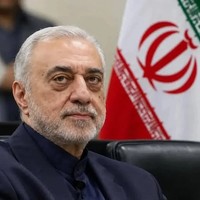
Abbas Araghchi, the 61-year-old diplomat nominated as Iran's foreign minister, declared during a parliamentary commission session that his outlook on global affairs has remained unchanged since his time in the IRGC.
His words could signal a continuation of Iran's hardline approach in foreign policy, rooted in the anti-West and anti-Israel principles that have long guided the IRGC.
During the Monday session, Araghchi emphasized his nearly four decades of experience in foreign policy, including his role in various departments of the ministry. He proudly stated, "I consider myself a soldier of the Supreme Leader and have strived to remain steadfast on this path."
Abbas Araghchi speaking to former US Deputy Secretary of State Wendy Sherman during nuclear talks
"My worldview remains the same as it was during my service in the IRGC and has not changed," he added, as reported by Ebrahim Rezaei, the spokesperson for the National Security and Foreign Policy Commission of the Parliament.
This declaration underscores the influence of IRGC’s ideology on his approach to diplomacy, an approach that often conflicts with international norms and expectations.
Araghchi's deep ties to the IRGC are not just rhetorical; they are foundational to his identity as a diplomat. He served as a key figure in Iran’s nuclear negotiations, a role that began under Mahmoud Ahmadinejad’s presidency and continued through Hassan Rouhani’s administration. Despite his involvement in the negotiations leading to the Joint Comprehensive Plan of Action (JCPOA), Araghchi’s stance has often been at odds with the more pragmatic elements within the Iranian government.
His refusal to engage in factionalism and his Monday claim of not being part of the "New York gang", which might be a reference to former FM Mohammad Javad Zarif, highlight his alignment with the IRGC’s more uncompromising factions.
Araghchi’s tenure has not been without controversy. During the final days of the Rouhani administration, Supreme Leader Ali Khamenei delivered a harsh critique of Araghchi’s efforts to revive the JCPOA, labeling the final draft unimplementable. Khamenei’s rejection of the JCPOA revival, despite Araghchi’s efforts, underscores the limitations of even high-ranking diplomats in a system where ultimate power resides with the Supreme Leader.
Abbas Araghchi signing a book he wrote after his removal from the Deputy Ministry of Foreign Affairs
On the day Raisi’s victory was announced, Araghchi was in Vienna, engaged in the final round of nuclear talks. Despite reports that the Biden administration was prepared to remove the IRGC from the list of Foreign Terrorist Organizations, Khamenei’s refusal to endorse the agreement marked the end of Araghchi’s influence in the foreign ministry.
As Iran’s international isolation deepened during Ebrahim Raisi’s presidency, Araghchi found himself increasingly marginalized.
Retreating into relative obscurity, Araghchi focused on activities like bodybuilding and was eventually appointed as secretary of the Strategic Council on Foreign Relations by Khamenei confidant Kamal Kharazi, a move that sparked criticism among conservatives.
Araghchi’s hardline approach extends to his views on nuclear weapons and Iran’s role in the Middle East. In a speech following an Israeli attack on the Iranian consulate in Damascus, Araghchi hinted that Iran might reconsider its nuclear doctrine, a veiled threat to pursue nuclear weapons if UN sanctions were reinstated.
As he faces a potential new role as foreign minister, Araghchi’s worldview, shaped by his IRGC background, raises concerns about the direction of Iran’s foreign policy.
His conservative, power-centric approach, coupled with his reluctance to challenge autocratic authority, suggests that Iran’s diplomatic efforts may continue to be driven by ideological rigidity rather than pragmatism.
On August 12, 2022, Salman Rushdie, an Indian-born British-American novelist, was viciously attacked as he prepared to speak at the Chautauqua Institution in New York.
The assailant, armed with a knife, rushed the stage and stabbed the renowned author multiple times, inflicting severe injuries. Rushdie, who had spent decades living under the shadow of a fatwa calling for his death, was once again fighting for his life. This brutal incident, occurring more than three decades after the initial controversy over his book “The Satanic Verses,” starkly reminded the world of the enduring dangers faced by those who dare to challenge religious and political orthodoxy.
The Satanic Verseswas published in September 1988. Rushdie's magical realism novel explored themes of religious faith and identity and was met with immediate outrage from many in the Muslim community. Protests began in October 1988 in the United Kingdom and quickly spread across the globe. The book was condemned as blasphemous, leading to its banning in several countries.
By October 1988, the book had been banned in India, and by the end of the year, it was also banned in countries like Bangladesh, Sudan, South Africa, and Sri Lanka. Protests intensified, with public book burnings in the UK, including a high-profile incident in Bradford in January 1989.
The situation escalated dramatically on February 14, 1989, when Ruhollah Khomeini, the Supreme Leader of Iran, issued a fatwa calling for Rushdie's execution, along with anyone involved in the publication of the novel.
Ayatollah Ruhollah Khomeini in the religious city of Qom after the 1979 revolution.
The fatwa posed a personal threat to Rushdieand represented a broader challenge to the principles of free expression. Rushdie was forced into hiding, living under police protection for years. The fatwa led to violence and fear, with translators and publishers associated with the book being attacked, and even killed, in some instances. The global response was mixed; while many condemned the fatwa as an attack on free speech, others supported the outcry against what they saw as an insult to Islam.
The issuance of the fatwa against Rushdie came on the heels of another atrocity orchestrated by Khomeini—the mass execution of over 5,000 Iranian political prisoners in the summer of 1988. These prisoners, many of whom had already served their sentences, were summarily executed following brief, sham trials. The international community largely remained silent, failing to condemn this gross violation of human rights. This silence likely emboldened Khomeini and his regime, leading them to believe they could similarly impose their will through the fatwa without significant global repercussions. Just as they had stifled dissent and eliminated opposition within Iran, they sought to extend their reach by suppressing freedom of speech beyond their borders.
The Tehran Times, a prominent English-language Iranian government newspaper, is closely linked to the Islamic Development Organization, a religious and cultural entity created by Khomeini in 1982 to promote the ideologies of the Islamic regime. During the controversy surrounding Rushdie, the Tehran Times played a pivotal role in spreading the regime's propaganda and fueling global outrage, particularly in advancing the Islamic Republic's objectives abroad.
The Tehran Times became a mouthpiece for the regime, fervently defending the fatwa and condemning Rushdie in line with the directives of the Islamic Republic, echoing its stance on religious and political issues. Its editorial board penned and oversaw numerous opinion pieces defending the fatwa and condemning Rushdie. The newspaper, reflecting the regime's stance, framed the entire affair as a "Zionist plot" aimed at discrediting Islam. One headline read, "Penguin head ‘Peter Mayer’ identified as a Jew. Whole Rushdie affair a Zionist plot to discredit Islam."
Pages of Tehran Times on Rushdie affair
Following this, the Tehran Times editorial board published an opinion piece on March 7, 1989, arguing that Britain should ban the book, citing previous cases like Spycatcher, where books had been banned for much less: "If Spycatcher can be banned and condemned, then why not The Satanic Verses, which has hurt 1 billion Muslims and others who believe that the beliefs of others should be respected."
Statements from other Iranian leaders further reinforced the fatwa. Ali Akbar Hashemi Rafsanjani, then Speaker of the Iranian Parliament, declared that "only burning Rushdie’s book will diffuse the crisis." Tehran Times headlines echoed this sentiment, with proclamations like "Rushdie not forgiven, even if he repents" and "Rushdie is a dead author." The rhetoric was intense, with the Tehran Times reporting on the "rare solidarity" among Muslims worldwide and the increasing death toll in protests, such as the one in Bombay where 12 people were killed.
Despite the passage of time, the fatwa was never officially rescinded, and the threat to Rushdie's life remained. The attack in 2022 underscored that, even after decades, the tensions sparked by The Satanic Verses had not fully abated. The IRI’s hope of riding the wave of religious fervor backfired in the long term, as the protests eventually subsided, and the geopolitical costs became clear. The IRI had overestimated its influence, as demonstrated by headlines such as "European Economic Community (EEC), stand on Rushdie affair not to their interest" and "West losing over its defense of Satanic Verses," both of which reflected the regime’s frustration with the West's steadfast defense of free speech.
If Britain and other European countries had given in to Tehran’s threats, we would be living in a vastly different world today—a world less free, less tolerant, and more fearful. These nations' firm refusal to ban the book and defense of free speech upheld fundamental human rights. It prevented a dangerous precedent where violence and intimidation could dictate the limits of expression. Their refusal to capitulate preserved the principles of liberty and ensured that the forces of censorship and extremism would not easily silence dissenting voices.
Salman Rushdie's resilience in the face of sustained threats has been remarkable. His most recent work, Knife, published after the attack, is a testament to his unyielding spirit. The book explores themes of survival and the power of storytelling, offering a message of hope and defiance. Despite the physical and emotional scars left by the attack, Rushdie's commitment to his craft and the ideals of free expression has not wavered. Knife is more than just another novel; it is a declaration that neither the fatwa nor the violence it inspired can silence Rushdie's voice. Its hopeful message resonates deeply, especially in a world where the threats to freedom of speech continue to evolve.
Reflecting on the attack and the legacy of the fatwa, it's crucial to recognize the broader implications of Rushdie's experience. His story is not just about one man or one book; it represents the ongoing struggle for the right to speak freely, to question, and to create. The endurance of Rushdie's voice, despite numerous attempts to silence it, inspires all who believe in the power of literature and the necessity of defending freedom of expression. The attack on Rushdie in 2022 was a tragic reminder of the enduring dangers he faces, yet it also highlighted the strength of his resolve and the lasting impact of his work. His journey, marked by immense challenges and extraordinary resilience, continues to be a beacon of hope for those who value the freedom to express ideas, no matter how controversial.