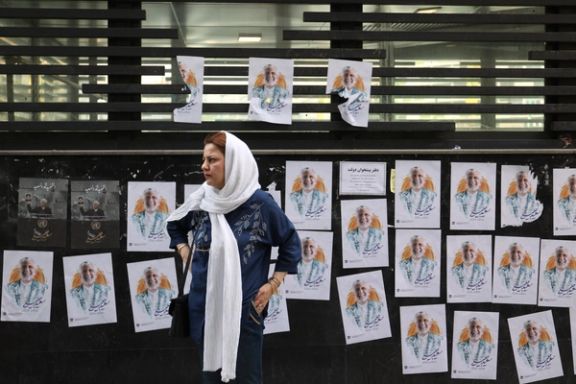
A woman walks past posters of Iranian presidential candidate Saeed Jalili on a street in Tehran, Iran, July 4, 2024.
Whether the 60% who refused to vote in Iran on June 28 will abstain from voting in Friday’s runoff remains to be seen. However, many believe the majority has unequivocally demonstrated its demand for change.
The finalists, hardliner Saeed Jalili and a centrist Masoud Pezeshkian, both are seen by many Iranians as regime insiders, who seem unable to garner the trust of the majority.
Mohsen Renani, a prominent professor of economics and commentator, described Iranians' behavior in last week's elections as politically "mature," regardless of whether they chose to vote or abstain.
"Our nation no longer fears, nor can it be easily influenced. It is not swayed by tempting promises of gold subsidies or free housing, as some candidates have offered. Nor is it influenced by the analyses and solicitations of intellectuals, activists, and academics to take political action,” he wrote.
The Iranian nation "acts according to its own discernment, which represents significant progress in our national pursuit of democracy since the Iranian Constitutional Revolution of 1906," Renani wrote earlier this week. "They know when to act and what to do: when to protest in the streets and when to return home, when to remain silent and when to cry out, when to vote and when to abstain."
For the first time, unlike in any previous presidential elections, Supreme Leader Ali Khamenei remained conspicuously silent until Wednesday. When he finally spoke, he did not refer to the election as "an epic," a term he typically uses. Instead, he acknowledged that the turnout was "less than expected." However, he insisted that the low turnout was not due to popular dissatisfaction or opposition to clerical rule.
Turnout dropped to 39.92 percent in the first round according to official figures. This turnout rate was the lowest in the four decades since the Islamic Revolution of 1979. Only 48 percent voted in 2021 elections which set an earlier record of low turnout. Turnout had not dropped to below 59.7 percent since 2005 and had even been as high as 84.8 percent in 2009.
“There is still not too much enthusiasm to vote in the second round or even to discuss it among those who did not vote earlier,” Farhad, 48, an engineer, told Iran International.
“Of the people I know, family and acquaintances, some people are posting stories on Instagram condemning the vote comparing participation in the elections as betrayal of the blood of the victims of the past few years’ crackdowns on protesters. Others say they are voting to save Iran from the total dominance of ultra-hardliners,” he added.
“But there is also the core Jalili supporters who are enthusiastically campaigning for their candidate to win and to make a statement about the legitimacy of the ruling establishment,” Farhad said. “They are all over social media platforms.”
Of the two candidates, only Pezeshkian has unequivocally acknowledged that the low turnout was a result of popular dissatisfaction, calling it a "meaningful message to the government, society, and political groups." He has repeatedly stated in campaign speeches, films, and televised debates that he wants to represent the 60 percent who did not vote.
Rather than denouncing those who participated in the Woman, Life, Freedom protests of 2022-23 known as Mahsa Protests and calling them “rioters” as hardliners do, Pezeshkian has been criticizing the government for violence against Mahsa and others for hijab as he had done in a tweet a day after her death in custody in September 2020.
Pezeshkian’s supporters in the past few days have expressed their support for the Mahsa movement at campaign meetings. At his campaign gatherings including a gathering at Heydarnia Stadium in Tehran Wednesday, his supporters chanted Woman, Life, Freedom.
At the same time, he agreed with denying internet service to people during times of unrest, which the government did in November 2019 when security forces killed at least 1,500 civilians. He has also pledged to fully follow Supreme Leader Ali Khamenei's policies, exhibiting contradictory signals to voters who are highly mistrustful of regime politicians.
In a renewed call for the boycott of presidential elections, Iran’s exiled prince Reza Pahlavi has emphasized that once the current establishment is ousted, the country will be free of “entrenched mafia-like corruption.”
Pahlavi stated Thursday on X that with the current authorities gone, "there will be a truly healthy open economy," and all forms of "gender, sexual, and religious discrimination" will be eliminated.
“I firmly believe this is achievable, and I am confident that the primary resources to accomplish it are largely within Iran, ready to fill this void swiftly,” Pahlavi said.
Pahlavi urged Iranians to "join the families of the martyrs of Iran's national revolution from December 2017 to November 2019 to the Mahsa uprising" and to stand by political prisoners from various backgrounds.
He warned against the clerical establishment's use of citizens' names and “votes to support terrorists and criminals in Gaza, Lebanon, Syria, Iraq, and Yemen,” which “drags the region and the world into war and chaos.”
Furthermore, he highlighted the regime's misuse of national wealth and the rising costs of essentials like water, bread, and gasoline.
Pahlavi's call for an election boycott resonates with numerous other Iranian activists who have similarly boycotted Iran's presidential elections, making voter turnout a central theme of this campaign.
Smoke rises over the Israeli-occupied Golan Heights and behind the Sea of Galilee, after Lebanon's Hezbollah said it launched more than 200 rockets and a swarm of drones at Israeli military sites, as seen from northern Israel July 4 2024.
An Israeli Lebanese citizen says he was forced to flee his beloved motherland Lebanon 20 years ago because of Iran-backed Hezbollah, but now those same forces are terrorizing him all over again.
Jonathan Elkoury fled Southern Lebanon as a child, seeking refuge in Israel, a place he now calls home.
“We fled away from Hezbollah, and now they're hunting us back again,” Elkoury told Iran International, as Israel and Lebanon's Hezbollah get closer to a full-blown war.
The 32-year-old lives in Israel’s largest northern city, Haifa.
“We have been under constant, daily, threat from Hezbollah since October 8th,” he said.
According to the Alma Research Center, a facility that disseminates information about Israel's security challenges in the North, Hezbollah has launched 29 attacks against Israel using “high-trajectory fire, anti-tank missiles and suicide UAVs from July 3-4.”
Lieutenant Colonel Sarit Zehavi, a former intelligence officer in the Israeli Defense Forces (IDF), and head of Alma, said Hezbollah launched “200 rocket” and “20 drones” at Israel on Thursday.
Reuters reported on Thursday that Hezbollah claimed responsibility for the barrage of rockets and drones in Israel, and said the attacks were a retaliation for the killing of a top Hezbollah commander - Mohammed Nasser on Wednesday.
Some of the drones and interceptor shrapnel set off fires, according to Reuters, citing the Israeli military.
This is just the latest in a dangerous escalation of violence, which has seen an estimated 60 thousand Israeli residents living between 0-5km from the Lebanon border, displaced.
“Since this war started, Hezbollah launched, 2300 attacks against Israel,” said Zehavi.
She said the attacks have been deadly with “nine civilians” and “18 soldiers" killed in the northern front of Israel.
The Hezbollah strikes have led to massive forest firesthat have devastated the agriculture-dependent region, putting the lives of farmers cultivating their land at risk.
Elkoury said his background as a Lebanese and Israeli gives him a unique perspective on this war. In his view, Lebanon needs to understand that peace with Israel will lead to its salvation.
The constant threat of Hezbollah for Elkoury is worrisome, he told Iran International. He believes the escalation is a turning point in the conflict, and said Hezbollah is “dragging Lebanon to a war that has nothing to do with Lebanon.”
“Lebanon's salvation could come with having peace with Israel because Lebanon is in a huge economic crisis and Hezbollah's actions are only driving Lebanon down.”
He said he remembers as a child that Hezbollah’s takeover turned his life into misery.
Jonathan Elkhoury as a child in Southern Lebanon.
“They [Hezbollah] would come in and terrorize the villages. They will come and basically say, you're now obeying us. They made up checkpoints. They did everything in order to make our lives more miserable. And bit by bit, they started taking over all of Lebanon."
He said he remembers stories of people being kidnapped by Hezbollah.
His father belonged to the South Lebanon Army that was fighting alongside the IDF to protect against Hezbollah, but once the IDF pulled out in 2000, the army collapsed.
More than 680 Lebanese families, like Elkoury, fled to Israel.
On 24 May 2000 Israel withdrew from Southern Lebanon after 22 years, under the direction of then president Ehud Barak. Barak also faced immense domestic pressure to withdraw from the grass roots organization, ‘Four Mothers,’ who were the mothers of IDF soldiers killed in Southern Lebanon.
The UN Security Council said that Israel had completed its withdrawal as required by Resolution 425 of 1978. The significance of that move is considerable to the Middle East today, said Elkoury.
The Lebanese-Israeli said the only explanation that has led to more Hezbollah attacks is the Islamic Republic of Iran.
“Hezbollah, at the end of the day, answers for one person, and this is Iran,” he said.
The US government in 2018 stated that Iran funds Hezbollah with an estimated 700 million dollars a year. Prior to that, in 2016 the leader of Hezbollah, Hassan Nasrallah declared publicly in a speech that his organization’s funding comes directly from Iran.
Israeli Security expert Sarit Zehavi said in addition to the financial and tactical support from Tehran, there is also a body of evidence to prove Iran’s direct involvement.
“Beyond the anti-tank missiles that are manufactured in Iran… the drones are either coming in from Iran completely or the components are coming from Iran.… The rockets, maybe both from Iran and in Lebanon itself.”
Zehavi said Iran is creating “a war of attrition” that will last “several years” as part of “multi-front campaign against the state of Israel,’ which she said started with Hamas in the South.
While Elkoury is a proud Israeli, he also wears a pendant of the cedar tree around his neck, a symbol of Lebanon, a reminder of his roots and his homeland that he longs to visit one day.
"This is something that makes me sad because we are at war, where we shouldn't be at war."
The issuance of a death sentence to Sharifeh Mohammadi, a labor activist imprisoned in Iran, has sparked condemnation and promises of protest.
Facing charges of armed rebellion, she has become a symbol of the Iranian government's repression of dissent.
Farhad Meysami, a civil activist, has opposed the death sentence issued to Mohammadi on Thursday and has pledged to go on a hunger strike in front of the Revolutionary Court in Rasht if the sentence is not revoked. In a statement, he declared, "If you want to execute Mohammadi, dig two graves."
The Campaign to Defend Mohammadi stated on Instagram, "This sentence is based on the pretext of Mohammadi's membership in an independent, public, and legal labor organization a decade ago, demonstrating the baselessness of the verdict." The campaign labeled the ruling as intended to instill fear among activists as the government continues to oppress any voices of dissent.
Mohammadi, arrested in December 2023, is one of the latest in a wave of executions aimed at quashing dissent. Last year, 834 Iranians were executed, according to the United Nations, marking a record high and a 50 percent increase from the previous year. At least 22 of those executed were women, making Iran the world's number one executioner of women. The 2023 figures were the highest since 2014, according to Iran Human Rights.
The campaign has called for Mohammadi's acquittal and unconditional release, declaring, "This sentence is not only against Sharifeh but is a declaration of war and a death sentence against all social and civil activists."
In January, the UN called for an end to the "horrific wave of executions" underway, with 67 executions in May alone.
According to rights groups, during her detention, Mohammadi was deprived of basic prisoner rights, such as in-person visits and phone calls. For a long time, she was denied visits with her family, especially her child, and was not allowed to contact them by phone. The physical and psychological torture inflicted on Mohammadi by Ministry of Intelligence officials was so severe that prison authorities protested out of fear for her life.
Vida Mohammadi, Sharifeh’s cousin, reported to Radio Farda about the torture she endured during her two-month imprisonment in Sanandaj prison. She stated that inmates in other cells had repeatedly witnessed Mohammadi being tortured. According to Vida, Sharifeh was a member of the Coordination Committee for the Establishment of Labor Organizations, an independent and legal organization, until 10 years ago, but she has not been a member since. She emphasized that Mohammadi has no affiliation with any political organizations inside or outside the country and has only conducted independent activities for women or in support of workers. Vida stated that issuing such a sentence after 10 years and the charge of "rebellion" is baseless.
The Syndicate of Workers of Tehran and Suburbs Bus Company on Wednesday condemned the charges against the labor activist in a statement, calling the charge of "rebellion" against her "completely baseless" and "pure falsehood" and demanded her immediate and unconditional release.
Earlier, on June 26, Mohammadi's mother expressed concern about her daughter's condition in a video and called for information about her. Mohammadi's husband was also arrested for following up on her situation and was recently released.
This incident occurs amid increasing security and judicial crackdowns on labor activists, teachers, and retirees. Following rampant inflation in recent years and the wide gap between income and household expenses, various groups, including workers, teachers, and retirees, have staged widespread protests and strikes. The protests intensified amid the "Woman, Life, Freedom" demonstrations following Mahsa Amini's death in morality police custody, but they were met with repression by the government.
The European Union, joined by over 50 members of parliament and senators from several European countries, has called on Iran to cease its systematic persecution of Baha'i faith members.
In a joint statement issued June 27, the MPs and senators highlighted concerns over human rights violations and targeting of Baha’i women in Iran.
"In light of the alarming targeting of women in Iran, we, Members of Parliament and Senators from across Europe express our profound dismay at an escalation in the attacks against Baha’i women who face dual persecution, as women and as Baha’is," the statement read.
The joint statement pointed out that since March this year, 72 out of 92 Baha’is summoned to court were women. "We urgently call upon the Iranian authorities to immediately halt the persecution of Baha'is, release all Baha'i prisoners, and ensure the protection of their full spectrum of human rights," it added.
“The Iranian government must know that their crimes against the innocent Baha’i community in Iran have become evident to all —and that in Europe, and across the world, their abuse of the human rights of women and minorities and systematic persecution of Baha’is is laid bare for the world to see,” said Rachel Bayani, the Baha’i International Community (BIC) Representative to the European institutions in Brussels in a statement.
In April, more than a dozen Iranian Baha'i women from Baharestan, in the central province of Esfahan, were summoned to court on arbitrary charges of propaganda against the state and participating in activities contrary to Islamic law.
In March, Anisa Fanaiyan, an Iranian Baha'i, was sentenced to 16 years in prison on charges including "establishing and managing a group with the intention of undermining national security," and "deviant educational and propagandistic activities contrary to Islamic law."
Iran is home to over 300,000 Baha'is, making them the largest non-Muslim religious minority in the country. They have faced systematic persecution since the 1979 revolution, with over 200 Baha’is executed in the early 1980s.
The current Iranian constitution recognizes only four religions: Islam, Christianity, Judaism, and Zoroastrianism, thereby excluding the Baha'i faith and subjecting its followers to widespread discrimination and persecution.
Labour Party's Shadow Foreign Secretary, David Lammy, attends a press conference with the foreing media in London on July 1, 2024.
Before the Thursday British election, the IRGC was name-checked in the Labour party's 2024 election manifesto as a "hostile state actor" - but what will the new Labour government do about it or Iran.
It's a question David Lammy will face from the start as the UK's new Foreign Secretary, a post he shadowed in opposition from 2021.
Talking to London-based foreign journalists a few days before the election (a foregone conclusion at that stage though he was careful not to say so), Lammy said that he would be engaged with the Middle East “from Day One”.
Up to then, questions to the Foreign Secretary-to-be were focused on Europe, Asia, the US. Lammy even worked in a nod to a possible future Trump presidency by talking of his good working relations with senior Republican figures.
He turned to the Middle East last - it’s always a tricky subject for British foreign secretaries but Lammy sounded confident and even enthusiastic when he spoke of his many trips there and the “very close working relations” he maintained across the region.
Talking about the Israel-Gaza conflict, Lammy said that “ working with our partners is essential, we’ve talked about the need for a new contact group that will include some Arab partners and I remain very concerned about the risk and prospect of escalation in Lebanon. I was in Lebanon a few months ago and I’m in good contact with Amos Hochstein, the US coordinator for Lebanon and of course I will be very engaged from Day One…”
And engagement from Day One on the Middle East, said Lammy “of course (was on) Iran, too.” He was, Lammy said, “very concerned about Iran’s proxy relationship with many of the actors that are causing a lot of problems across the region, Hamas, Hezbollah, the Houthis particularly, as you would expect me to be and we’ve always raised our concerns within Iran about the IRGC and repression within Iran and I think you’ll find on Labour backbenches particularly a lot of concern about that.”
And Labour front benches, too, where shadow Home Secretary Yvette Cooper as well as Lammy himself and other prominent Labour politicians have called for tough action against the IRGC, including proscription.
The cross-Party interest in Iran over the past two years across both the House of Commons and House of Lords has been unprecedented. In the weeks before the election, some 500 MPs and Lords called on a new government to proscribe the IRGC in two separate letters to the then government.
The mood of the new Parliament has yet to be known. But the Labour manifesto is clear that “assassination plots by the IRGC” are among the rise in threats in the UK from hostile states and state-sponsored groups “but Britain lacks a comprehensive framework to protect us. Labour will take the approach used for dealing with non-state terrorism and adapt it to deal with state=based domestic security threats.”
Both the new Home Secretary and Foreign Secretary called on the last Conservative government to amend the UK’s Terrorism Act 2000 to introduce a new category of proscription to cover hostile state actors. Starmer’s government now has the opportunity to do so itself - possibly encouraged by the example of Canada and reports of the European Union’s foreign action service examining the legalities of proscribing the IRGC at Germany's behest.