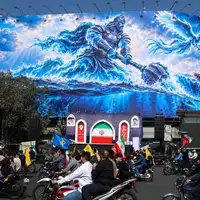
A model of a ballot box is being placed on an avenue in downtown Tehran, Iran, on June 15, 2024, amidst the early presidential election campaigns.
Experiencing tightly controlled and unfree elections for five decades, most voters in Iran have realized since 2020 that they do not have a meaningful role in electing their president or members of parliament.
The most significant reasons for the declining trust include the mass disqualification of candidates by the unelected 12-member Guardian Council, the use of tens of thousands of mobile ballot boxes (up to one-third), voting in military barracks, and the involvement of dirty and non-transparent money.
Although many were aware of the undemocratic nature of elections long before, participation rates in some periods reached more than two-thirds of eligible voters, such as in 1997 and 2013. One of the main reasons for this high participation was the government’s propaganda machine, which effectively "heated up the election."
There are three main methods. The first is dedicating significant airtime on state TV and radio stations, which have dozens of networks, to election-related content to encourage participation. This includes debates between candidates, interviews with them, and election roundtables, all orchestrated by government outlets. For the 2024 elections, the candidates and their consultants have dozens of introductory interviews, and panel discussion programs, other than five collective debates.
A billboard with a picture of the late President Ebrahim Raisi and the presidential candidates is displayed on a street in Tehran, Iran, June 17, 2024.
The second method involves billboards and banners funded by public resources, displayed throughout cities and along roads across the country. These advertisements use quotes from Shia saints, leaders of the Islamic Republic, and celebrities who cooperate with the government to encourage voter participation. These ads are displayed alongside the individual advertisements of the candidates.
However, the most effective method of attracting silent majority voters is to amplify the voices of university professors (especially those residing in Western countries), non-conformist celebrities, and figures occasionally critical of regime policies. This approach helps bring a segment of the undecided population to the polls. Typically, the opinions and positions of these figures, which are not necessarily independent, are not featured by government-controlled outlets during ordinary times.
However, the effectiveness of these methods has waned since the February 2020 parliamentary elections, followed by the presidential vote in 2021 and the second parliamentary election in March 2024. Turnout in these elections was significantly below 50%, according to official figures, which many believe are inflated to portray a more favorable picture.
“A new wave of hope”
During electoral campaigns, supporters of the Islamic Republic have employed three tactics both inside and outside the country to encourage voter turnout.
The first tactic involves instilling misleading hopes in a society desperate for change. "With the announcement of the names of the approved candidates, a new wave of hope has flowed through Iranian society. If political groups use it correctly and follow the right principles, we will have one of the most refreshing choices in the history of Iran since Mr. Khatami," said Saeed Leilaz, a high-ranking member of a 'reformist' party within the Reform Front, supporting the 'moderate' candidate Masoud Pezeshkian.
President Mohammad Khatami (1997-2005) aimed to reform some notorious characteristics and undemocratic practices of the Islamic regime but was stopped by conservatives supported by Supreme Leader Ali Khamenei and the Revolutionary Guard. The same scenario repeated itself during the eight years of relatively moderate Hassan Rouhani (2013-2021), who was constantly pummeled by hardliners.
Leilaz believes 40 million people may participate in this election. Of course, according to the IRNA news agency, based on the content analysis of people's posts on Instagram pages of "about 31 million active users" the electorate has not become mobilized for the election.
Abbas Abdi, one of the leftist figures of the Khomeini era and a leading figure among the students who took the American Embassy staff hostage for 444 days, also repeated the above hope: "The elections of June 28, 2024, can create a social wave with over 60% participation," Abdi predicts, though he does not specify which poll supports this claim. He emphasizes Pezeshkian’s personality rather than his executive performance or experience, which is not particularly notable: "The most important and outstanding feature of him... is that he is an honest person who does not lie, and this is a rare quality among Iranian officials, and people are very hungry for that."
Abdi and Leilaz spent time in prison just for expressing their views in the past, which has made their voices to be heard outside the ruling elite.
“Surprising decision of the Guardian Council”
The second tactic used to stir up election enthusiasm is to portray the Guardian Council's decision to approve Pezeshkian as a surprising move, framing him as a reformist candidate to attract those who still believe in reforms within the regime.
Pezeshkian, who is known more as a ‘reformist’ than a conservative is the only non-hardliner candidate approved by the Guardian Council. All sorts of regime supporters, including some individuals in the United States, portray his candidacy as a good omen showing the Islamic Republic’s goodwill. However, in the past eight days after his candidacy was approved, Pezeshkian has come across more as a conservative loyal to Ali Khamenei than a reformist.
“Not voting is not a political act”
The third tactic is to frame non-participation not as a protest, but as an apolitical act. "I don't consider not voting to be a political act," an American-Iranian supporter of the Tehran government said on social media. This viewpoint fails to distinguish between democratic and totalitarian regimes. In totalitarian regimes, not voting can lead to the loss of certain rights, such as employment in government affairs. Therefore, abstaining from voting is a costly political act. In fact, the decline in election turnout in the past four years has shaken and weakened Islamic Republics claims of legitimacy.
The opinions expressed by the author are not necessarily the views of Iran International.
US and Israeli intelligence agencies are investigating new computer modeling by Iranian scientists which could potentially be used for the research and development of nuclear weapons.
According to reports from Axios citing two US officials and Israeli counterparts, the purpose of the modeling remains unclear, fueling concerns on the back of the UN's nuclear chief warning Iran is "weeks not months" away from a nuclear weapon.
A critical meeting takes place at the White House this Thursday where senior US and Israeli officials will convene for the first detailed discussion on the Iranian nuclear program since March 2023. It is part of the US-Israel strategic consultative group (SCG), aiming to evaluate the recent intelligence and coordinate responses.
The UN recently admitted it had lost "continuity of knowledge" on Iran's program as the country continues to evade inspectors gaining full access.
The International Atomic Energy Organizationhas observed that Iran is installing more uranium enrichment centrifuges at its Fordow facility, reaching enrichment levels of up to 60 percent purity, alarmingly close to the 90 percent required for nuclear weapons.
In March, the E3 - the UK, France and Germany - warned that Iran has "pushed its nuclear activities to new heights" in spite of global sanctions, pointing out that over the past five years, the levels of the country's enrichment “are unprecedented for a state without a nuclear weapons program" as Iran continues to deny intentions of nuclear armament.
Ali Shamkhani, advisor to the Supreme Leader and apparent nuclear negotiator, stated last week that Iran "won't bow to pressure" amidst US warnings regarding its uranium enrichment activities.
Defiantly, he wrote on X, “The US and some Western countries would dismantle Iran’s nuclear industry if they could.”
Four deaths were reported after a 5.0 magnitude earthquake hit Kashmar in northeastern Iran's Razavi Khorasan province around noon on Tuesday.
Governor of Kashmar, Hojjatollah Shariatmadari said that in Tuesday's earthquake in the city, 120 people have also been injured, with 35 of them hospitalized.
According to the US Geological Survey, the earthquake originated approximately five kilometers from Moghan, Razavi Khorasan Province, while local Iranian media reported the magnitude as 5.0, occurring at a depth of six kilometers.
Iran, which is situated on significant fault lines, experiences frequent seismic activity. A notable example occurred in November when a powerful 7.3 magnitude earthquake struck near the Iraqi border, resulting in over 530 fatalities and thousands of injuries.
Iran experiences an average of 10,000 earthquakes per year, according to the UN with the country still reeling from the tragedy of 2003 when a 6.6-magnitude earthquake devastated the historic city of Bam, claiming the lives of tens of thousands.
Last year, at least three people died with over 800 injured after a 5.9 magnitude earthquake hit the city of Khoy, West Azerbaijan province.
At the time of the quake in January, the Mehr news agency said 70 villages had been damaged.
The death toll among Iranian pilgrims participating in this year's Hajj in Saudi Arabia has risen to 11 as extreme heat and crowding see fatalities mounting.
Pirhossein Koolivand, the head of the Iranian Red Crescent, confirmed on Tuesday that an additional 26 pilgrims are currently receiving medical treatment in Saudi hospitals in addition to those who have died at the annual religious event.
Koolivand said the pilgrims' health status is "good and suitable", claiming that medical staff dispatched from Iran to accompany pilgrims attended to over 11,000 cases.
A Muslim pilgrim pours water on his head to cool down from the heat, as he takes part in the annual haj pilgrimage in Mina, Saudi Arabia, June 17, 2024.
On Sunday, Mohammed Al-Abdulaali, a spokesman for Saudi Arabia's Health Ministry, said in one day, over 2,760 pilgrims experienced sunstroke and heat stress at the Hajj attracting around 1.8 million to Mecca in Saudi Arabia.
To combat the mass of yearly deaths that occur, Saudi officials have implemented several safety measures, such as climate-controlled environments and extensive medical services, mitigating the health dangers associated with the extreme heat.
Last year, the pilgrimage saw as many as 240 deaths, with temperatures soaring to about 48 degrees Celsius.
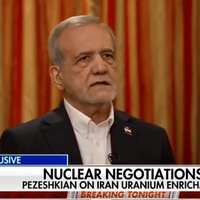
Iran's ex-foreign minister, Mohammad Javad Zarif, announced plans to support Masoud Pezeshkian, a so-called "reformist" presidential candidate, in an upcoming political roundtable on state television.
Zarif, who was Iran’s top diplomat from 2013 to 2021 and a key figure in the controversial nuclear deal negotiations, declared his intentions through a post on the social networking platform X.
The planned discussion is expected to touch on major national issues under a potential Pezeshkian presidency, though skeptics doubt significant change will occur if he were elected.
The event comes as Iran prepares for unexpected presidential elections on June 28 following the sudden death of President Ebrahim Raisi in a helicopter crash.
Critics fear that the roundtable may simply be another example of Iran’s political theater, aimed at maintaining the status quo under the guise of reform.
Skepticism about Pezeshkian’s potential for genuine reform is growing as he aligns closer to the narrative of the ruling theocratic regime. In a recent televised interview, he focused primarily on economic issues without touching on more contentious subjects such as foreign policy, the nuclear program, or the mandatory hijab law, leaving many supporters feeling disillusioned as the country cries out for change.
In the first debate among Iran’s presidential candidates, hardliners denied the impact of nuclear-related sanctions, while two candidates said improving international ties is crucial for fixing the economy.
The three-hour long debate on Monday among six hand-picked candidates was focused on “controlling inflation and growth of production”. Three of the five televised debates planned before the June 28 elections will focus on economy. The next debate is scheduled for June 20.
In the debates and interviews, former nuclear negotiator Saeed Jalili, incumbent Mayor of Tehran Alireza Zakani, and hardliner Amir-Hossein Ghazizadeh-Hashemi defended the “achievements” of Raisi’s administration. They faced opposition from pro-reform Masoud Pezeshkian, moderate-conservative Mostafa Pourmohammadi, and at times Parliament Speaker Mohammad-Bagher Ghalibaf, who criticized the administration's performance in veiled terms.
Hardliner candidates are acutely aware of the Raisi administration's disastrous economic performance, yet they refuse to take responsibility for it and sometimes even praise it, according to France-based journalist Seraj Mirdamadi. “But they blame [the pro-reform Masoud] Pezeshkian unfairly for the performance of [Hassan] Rouhani’s government.”
Speaking in vague and difficult to understand terms, Jalili, insisted that sanctions did not matter, and that the state of the economy could be improved by relying on “domestic potentials,” an argument often made by loyalists of Supreme Leader Ali Khamenei. According to him, an economic growth rate of eight percent as prescribed by the 7th Development Plan is feasible, while others argue that tens of billions of dollars is needed to achieve such a high rate.
Presidential candidates attend an election debate at a television studio in Tehran, Iran, June 17, 2024.
Ghalibaf, however, prescribed negotiations to lift the sanctions if for every step that Iran took, presumably to limit its nuclear program, the Western side was prepared to provide adequate incentives in return.
Ghalibaf has been criticized for calling the removal of sanctions a priority for his government, while the parliament in December 2020 under his leadership approved a bill hardening Iran’s negotiating position. “Why did you approve the catastrophic ‘Strategic Action Plan to Lift the Sanctions’ to prevent the revival of the JCPOA?” reformist commentator Abbas Abdi asked Ghalibaf in a tweet.
The December 2020 legislation called for reducing Iran's commitments under the 2015 nuclear deal and obliged the government to escalate the nuclear crisis.
All of the four hardliners, including Ghalibaf, insist that the sanctions are “unfair” and “cruel” but also argue that Iran has succeeded in circumventing them and is selling its oil without much trouble.
In a tweet after the debates, political commentator Reza Nasri contended that hardliners’ claims were contradictory. “How can sanctions which ‘are not a problem anymore’ and have been neutralized be ‘cruel’ at the same time?” he asked.
However, there is a major divide between Ghalibaf and Jalili who is the candidate of ultra-hardliners. Their supporters have been highly intolerant of each other, insisting that one must withdraw in favor of the other to ensure the presidency remains within the "revolutionary front."
Zakani and Ghazizadeh-Hashemi, neither of whom has a realistic chance of winning, appeared to play a supporting role for Jalili in the debate. They may withdraw in his favor after the debates, similar to how Jalili withdrew in favor of Raisi in the 2021 elections.
In contrast to the hardliners, pro-reformist Pezeshkian and moderate-conservative Pourmohammadi emphasized the crippling impact of sanctions. They called for improving relations with the international community as a means to help Iran overcome its economic difficulties.
Many observers noted that Pourmohammadi, who spoke more clearly and openly than the other candidates, appeared to be the strongest contender in the debate. But there are no independent opinion polls in Iran, and it is impossible to gauge the impact of the debate.
Pezeshkian emphasized the detrimental impact of sanctions and strained international relations on the country’s economy, asserting that all political groups must collaborate to effectively implement existing economic plans. He argued that what his rivals term 'circumventing sanctions' has often led to corruption.
For the first time in the history of election debates, candidates were shown participating in a group prayer before heading to the studio, where they took their seats assigned by a draw.
Candidates largely avoided seriously challenging each other or criticizing the economic failures of the Raisi administration, following the "recommendation" of Supreme Leader Ali Khamenei.
The state broadcaster had warned the candidates beforehand that any mudslinging or discussion of irrelevant topics during the debate would result in immediate and direct intervention by the Election Campaign Regulation Committee.
According to a telephone poll conducted by Shenakht, a polling agency claiming to be private, between June 15-16 with a sample of 1,000 respondents, Ghalibaf secured the support of 29 percent of voters who were certain or undecided about voting. He was followed by Masoud Pezeshkian with 21 percent and Saeed Jalili with 18 percent. However, different polls conducted by different government or political groups reveal different results. Overall, none of these polls can be considered fully reliable.
Some politicians indicate that discussions are currently taking place between the Ghalibaf and Jalili camps to decide whether one of them should withdraw to counter Pezeshkian's competition.
In response to a question during one of his televised interviews about the possibility of one or more “revolutionary” candidates withdrawing to boost another's votes, Ghalibaf claimed he was “more prepared” than the other candidates, hinting that he expected Jalili to withdraw.
However, on Monday, Jalili’s campaign manager Mohsen Mansouri refuted any possibility of withdrawal unless they determine there is “a candidate better than Mr. Jalili.”