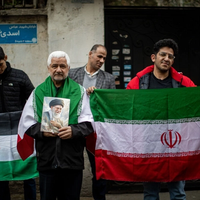
A group of Iranians watching the first presidential debate on June 17, 2024
In the first debate among Iran’s presidential candidates, hardliners denied the impact of nuclear-related sanctions, while two candidates said improving international ties is crucial for fixing the economy.
The three-hour long debate on Monday among six hand-picked candidates was focused on “controlling inflation and growth of production”. Three of the five televised debates planned before the June 28 elections will focus on economy. The next debate is scheduled for June 20.
In the debates and interviews, former nuclear negotiator Saeed Jalili, incumbent Mayor of Tehran Alireza Zakani, and hardliner Amir-Hossein Ghazizadeh-Hashemi defended the “achievements” of Raisi’s administration. They faced opposition from pro-reform Masoud Pezeshkian, moderate-conservative Mostafa Pourmohammadi, and at times Parliament Speaker Mohammad-Bagher Ghalibaf, who criticized the administration's performance in veiled terms.
Hardliner candidates are acutely aware of the Raisi administration's disastrous economic performance, yet they refuse to take responsibility for it and sometimes even praise it, according to France-based journalist Seraj Mirdamadi. “But they blame [the pro-reform Masoud] Pezeshkian unfairly for the performance of [Hassan] Rouhani’s government.”
Speaking in vague and difficult to understand terms, Jalili, insisted that sanctions did not matter, and that the state of the economy could be improved by relying on “domestic potentials,” an argument often made by loyalists of Supreme Leader Ali Khamenei. According to him, an economic growth rate of eight percent as prescribed by the 7th Development Plan is feasible, while others argue that tens of billions of dollars is needed to achieve such a high rate.
Presidential candidates attend an election debate at a television studio in Tehran, Iran, June 17, 2024.
Ghalibaf, however, prescribed negotiations to lift the sanctions if for every step that Iran took, presumably to limit its nuclear program, the Western side was prepared to provide adequate incentives in return.
Ghalibaf has been criticized for calling the removal of sanctions a priority for his government, while the parliament in December 2020 under his leadership approved a bill hardening Iran’s negotiating position. “Why did you approve the catastrophic ‘Strategic Action Plan to Lift the Sanctions’ to prevent the revival of the JCPOA?” reformist commentator Abbas Abdi asked Ghalibaf in a tweet.
The December 2020 legislation called for reducing Iran's commitments under the 2015 nuclear deal and obliged the government to escalate the nuclear crisis.
All of the four hardliners, including Ghalibaf, insist that the sanctions are “unfair” and “cruel” but also argue that Iran has succeeded in circumventing them and is selling its oil without much trouble.
In a tweet after the debates, political commentator Reza Nasri contended that hardliners’ claims were contradictory. “How can sanctions which ‘are not a problem anymore’ and have been neutralized be ‘cruel’ at the same time?” he asked.
However, there is a major divide between Ghalibaf and Jalili who is the candidate of ultra-hardliners. Their supporters have been highly intolerant of each other, insisting that one must withdraw in favor of the other to ensure the presidency remains within the "revolutionary front."
Zakani and Ghazizadeh-Hashemi, neither of whom has a realistic chance of winning, appeared to play a supporting role for Jalili in the debate. They may withdraw in his favor after the debates, similar to how Jalili withdrew in favor of Raisi in the 2021 elections.
In contrast to the hardliners, pro-reformist Pezeshkian and moderate-conservative Pourmohammadi emphasized the crippling impact of sanctions. They called for improving relations with the international community as a means to help Iran overcome its economic difficulties.
Many observers noted that Pourmohammadi, who spoke more clearly and openly than the other candidates, appeared to be the strongest contender in the debate. But there are no independent opinion polls in Iran, and it is impossible to gauge the impact of the debate.
Pezeshkian emphasized the detrimental impact of sanctions and strained international relations on the country’s economy, asserting that all political groups must collaborate to effectively implement existing economic plans. He argued that what his rivals term 'circumventing sanctions' has often led to corruption.
For the first time in the history of election debates, candidates were shown participating in a group prayer before heading to the studio, where they took their seats assigned by a draw.
Candidates largely avoided seriously challenging each other or criticizing the economic failures of the Raisi administration, following the "recommendation" of Supreme Leader Ali Khamenei.
The state broadcaster had warned the candidates beforehand that any mudslinging or discussion of irrelevant topics during the debate would result in immediate and direct intervention by the Election Campaign Regulation Committee.
According to a telephone poll conducted by Shenakht, a polling agency claiming to be private, between June 15-16 with a sample of 1,000 respondents, Ghalibaf secured the support of 29 percent of voters who were certain or undecided about voting. He was followed by Masoud Pezeshkian with 21 percent and Saeed Jalili with 18 percent. However, different polls conducted by different government or political groups reveal different results. Overall, none of these polls can be considered fully reliable.
Some politicians indicate that discussions are currently taking place between the Ghalibaf and Jalili camps to decide whether one of them should withdraw to counter Pezeshkian's competition.
In response to a question during one of his televised interviews about the possibility of one or more “revolutionary” candidates withdrawing to boost another's votes, Ghalibaf claimed he was “more prepared” than the other candidates, hinting that he expected Jalili to withdraw.
However, on Monday, Jalili’s campaign manager Mohsen Mansouri refuted any possibility of withdrawal unless they determine there is “a candidate better than Mr. Jalili.”
In a rebuke of state-run media practices, the office of Iran’s former President Hassan Rouhani has issued a letter of complaint to the head of the Islamic Republic of Iran Broadcasting (IRIB).
The letter demands fair airtime to counter "claims and accusations" made against Rouhani's administration during recent presidential debate roundtables, accusing the IRIB of perpetuating what it describes as "the illegal spread of lies and defamation".
"By law, the Electoral Commission should allocate a specific time for the absent party to defend themselves," the letter stated.
Rouhani's office criticized the IRIB for its historical bias and its disregard for "the observance of electoral ethics." The letter expresses hope that the state broadcaster will alter its course and allow Rouhani or his representatives to address the doubts and accusations.
The call for fairness comes in the wake of pointed critiques from conservative figures, including Tehran Mayor Alireza Zakani, during the first televised debate. On Monday night he pointed fingers at Rouhani’s government as the root cause of Iran's current economic strife.
However, many lay the blame in the hands of the late president, Ebrahim Raisi, whose tenure since 2021 led to the worst economic crisis since the founding of the Islamic Republic. His sudden death last month in a freak helicopter crash has led to a snap election on June 28.
In the absence of independent election polling in Iran, multiple social media channels have launched their own ad-hoc polls, which reveal totally contradictory results depending on who the followers of each channel are.
Amid apparent voter apathy and anti-government sentiment among Iranians, some insights can still be gleaned from a combination of Google Trends analysis and social media polls with shifting interest in candidates and different results depending on the political orientation of social media followers of different channels.
Reformist groups prefer Masoud Pezeshkian, known as a 'moderate' politician, but exhibiting conservative tendencies during his election campaign. On the other hand, hardliners generally favor Saeed Jalili, a firebrand politician opposed to friendly ties with the West and a nuclear deal limiting Iran's atomic program.
The head of Iran's cyberspace police, Vahid Majid, issued a warning on Sunday, emphasizing the prohibition on publishing unofficial polls about the upcoming presidential elections, as reported by Hamshahri Online in Tehran. Additionally last week, Iran's state-run Islamic Republic of Iran Broadcasting (IRIB) also warned against non-IRIB affiliated polls stating that it only recognizes official polls conducted by its research center, dismissing polls online or other channels.
Despite this restriction, Google Trends data is accessible, and some Iran-based media organizations and news channels have run polls on their Telegram channels. In this report, an analysis of ten Telegram channels with unofficial polls has also been included.
Google Trends Data: Pezeshkian Leads the Way
The Google searches of Iranian internet users reflected in the Google Trends data analysis by Iran-based Khabaronline during the past 7 daysprovides a perspective of Iranian users' indication of curiosity in the candidate.
Google specifically outlines that search data is an indication of curiosity about the subject or candidate and that it should not be considered an indication of voter intent.
Graph 1 - Google Trends Analysis
The first Google Trends graph shows a comparison of Google searches of the six candidates' names made by users in Iran from the afternoon of Sunday, June 9, 2024, to the afternoon of Sunday, June 16, 2024, local time.
The search terms include the names of the six candidates in Persian and color-coded in the graph: Masoud Pezeshkian (blue), Saeed Jalili (red), Mohammad Bagher Ghalibaf (yellow), Mostafa Pourmohammadi (green), Amir-Hossein Ghazizadeh Hashemi (purple) and, Alireza Zakani (purple). Given that Google Trends only allows for up to 5 groups of terms at a time Ghazizadeh and Zakani are marked in purple.
In the first hours following the official announcement of the six presidential candidates, the sole 'reformist' candidate Masoud Pezeshkian emerged as the most searched candidate among Iranian users. He was initially followed by Mostafa Pourmohammadi, with Saeed Jalili and Amir-Hossein Ghazizadeh Hashemi trailing behind, and Mohammad Bagher Ghalibaf and Alireza Zakani coming last in search interest.
However, within two hours, Pourmohammadi was overtaken by Jalili. Over the subsequent seven days, except for certain hours, Pourmohammadi remained in fourth place.
As the initial surprise over Masoud Pezeshkian's candidacy subsided, the gap between him and Saeed Jalili in search interest gradually narrowed. Despite this, Pezeshkian continued to attract more attention overall compared to the other candidates. The peak of searches for Pezeshkian occurred at midnight on June 13, when his appearance on state TV significantly boosted his Google searches.
This pattern of heightened interest following television appearances was observed with other candidates as well. When candidates addressed specific topics on TV, it noticeably influenced the trends of Google searches. This trend is stronger in the case of Jalili and Ghalibaf than in the other three candidates (Pourmohammadi, Ghazizadeh Hashemi, and Zakani).
Provincial Breakdown
The national average (Iran) shows that during the past week, Masoud Pezeshkian leads with a significant 43% of search interest, followed by Saeed Jalili at 23%. Mohammad Bagher Ghalibaf maintains a moderate level of interest with 13%, while Mostafa Pourmohammadi, Amir-Hossein Ghazizadeh Hashemi, and Alireza Zakani receive lower percentages of 9%, 7%, and 5% respectively.
National average (Iran) of the 6 candidates’ names searches from the afternoon of Sunday, June 9, 2024, to the afternoon of Sunday, June 16, 2024, local time.
Masoud Pezeshkian is more popular in the northern and western half of the country in West Azerbaijan Province and Ilam Province, and it is only in the provinces of South Khorasan and Qom that Saeed Jalili has attracted more attention by a small margin. Interestingly, the share of search results to the other 4 candidates (Ghalibaf, Pourmohammadi, Ghazizadeh Hashemi, and Zakani) in the provinces of the country does not show a specific and decisive difference.
Google Analytics Regional Breakdown
Social Media Polls
Examining non-scientific polls from prominent Telegram channels reveals varying degrees of candidate support and voter engagement. Pezeshkian consistently leads in several of these online polls. Saeed Jalili also maintains a strong position. Mohammad Bagher Ghalibaf also emerges prominently in Telegram polls with substantial subscriber bases.
"Do You Know Magazine” Telegram Channel
The "Do You Know Magazine" entertainment Telegram channel, with over 2 million users, conducted a now-deleted non-scientific poll that garnered 64,156 votes. According to the poll results, 71% of participants indicated they would vote for none of the candidates. Among those who expressed a preference, Masoud Pezeshkian received 11% of the votes, followed by Saeed Jalili at 10%, Mohammad Bagher Ghalibaf at 5%, Amir-Hossein Ghazizadeh Hashemi at 2%, Alireza Zakani at 1%, and Mostafa Pourmohammadi did not receive any votes.
Do You Know Telegram Poll
Akharin Khabar
Akharin Khabar’s Telegram channel, with over 2 million subscribers, conducted a poll with 143,669 participants. According to the results, Mohammad Bagher Ghalibaf leads with 32%, followed by Saeed Jalili at 28%. Masoud Pezeshkian garnered 19% of the votes, while Alireza Zakani received 3%. Amir-Hossein Ghazizadeh Hashemi and the "View Results" option, which displays the poll results without being a voting choice, each obtained 2% of the viewership. Mostafa Pourmohammadi did not receive any votes in the poll.
Akharin Khabar Telegram Poll
Khabar Farda
Khabar Farda, a Telegram channel with 780,000 subscribers, conducted a poll with 45,747 participants. The results show Masoud Pezeshkian leading with 27%, followed by Mohammad Bagher Ghalibaf with 16%, and Saeed Jalili with 10%. Amir-Hossein Ghazizadeh Hashemi received 2% of the votes, while Alireza Zakani and Mostafa Pourmohammadi did not receive any votes. Additionally, 45% of participants chose the "View Results" option, which displays the poll results without casting a vote.
Khabar Farda Telegram Poll
Khabar
Khabar, a news Telegram channel with 577,635 subscribers, conducted a poll with 23,940 participants. According to the results, Masoud Pezeshkian received a commanding lead with 64% of the votes, showcasing strong support among the channel's audience. Saeed Jalili followed with 20%, Mohammad Bagher Ghalibaf garnered 8%, Amir-Hossein Ghazizadeh Hashemi obtained 4%, while both Alireza Zakani and Mostafa Pourmohammadi received 2% each.
Khabar Telegram Poll
Masaf Institute
The controversial Masaf Institute, associated with a recent fraud and money laundering scandal and headed by ultra-hardliner politician Ali-Akbar Raefipour, conducted a poll on their Telegram channel, which has 183,990 subscribers. The poll received 65,734 votes, with the following results: Saeed Jalili received the highest support with 65%, followed by Masoud Pezeshkian at 19%, Mohammad Bagher Ghalibaf at 10%, Alireza Zakani at 2%, Amir-Hossein Ghazizadeh Hashemi at 3%, and Mostafa Pourmohammadi at 1%.
Masaf Telegram Poll
Efsha News
Efsha News, an entertainment news channel on Telegram with 184,774 subscribers, conducted a poll that garnered 25,594 votes. According to the results, 57% of participants indicated they would not vote, while Saeed Jalili received 19% of the votes and Masoud Pezeshkian 17%. Mohammad Bagher Ghalibaf garnered 4%, Amir-Hossein Ghazizadeh Hashemi received 2%, and Alireza Zakani obtained 1%. Mostafa Pourmohammadi did not receive any votes.
Efsha Telegram Poll
Entekhab News
Entekhab News, a 'reformist' newspaper with a Telegram channel boasting 155,410 subscribers, conducted a poll that garnered 70,099 votes. According to the results, Masoud Pezeshkian leads with 39% of the votes, indicating significant support among the channel's audience. Saeed Jalili follows closely behind with 36%, positioning him as a strong contender in the poll. Mohammad Bagher Ghalibaf received 7% of the votes, while Alireza Zakani, Mostafa Pourmohammadi, and Amir-Hossein Ghazizadeh Hashemi did not receive any votes. Additionally, 17% of participants indicated they have not yet reached a decision.
Entekhab Telegram Poll
Donyaye Eghtesad
Donyaye Eghtesad (World of Economy), Iran's leading economic newspaper, on Telegram with 61,934 subscribers, conducted a poll that received 11,971 votes. According to the results, Mohammad Bagher Ghalibaf leads with 37% of the votes. Masoud Pezeshkian follows with 21%, while Saeed Jalili received 15% support. Alireza Zakani, Mostafa Pourmohammadi, and Amir-Hossein Ghazizadeh Hashemi did not receive any votes in the poll. Additionally, 27% of participants chose to view the results without casting a vote.
Donyaye Eghtesad Telegram Poll
Presidential Election News Channel
In a poll conducted by this Telegram channel with 106,765 subscribers and 51,157 participants, Masoud Pezeshkian leads with 43% of the votes, followed by Mohammad Bagher Ghalibaf at 32%, and Saeed Jalili with 19%. Amir-Hossein Ghazizadeh Hashemi received 3%, Alireza Zakani 2%, and Mostafa Pourmohammadi obtained 1% of the votes.
Akhbare Entekhabat Riasat Jomhoori Telegram Poll
Shargh News
Shargh News, a prominent Telegram channel with 22,527 subscribers, conducted a poll with 11,597 participants. The results indicate that Saeed Jalili is the frontrunner with 30% of the votes, followed closely by Masoud Pezeshkian with 28%. Mohammad Bagher Ghalibaf garnered 22%, Alireza Zakani received 19%, Mostafa Pourmohammadi 1%, and Amir-Hossein Ghazizadeh Hashemi did not receive any votes.
From the confines of Evin prison, political prisoner Mahboubeh Rezaei has slammed the upcoming presidential elections taking place against mass government opposition.
In a public letter, Rezaei said that “the Islamic Republic has no legitimacy, and this is a bet on the government's losing horse, repeating past mistakes.”
Since the 2022 uprising, Iran's government has faced the biggest legitimacy crisis since the founding of the Islamic Republic, with record unemployment, record poverty and mass social crackdowns on the populace.
She stated, "Once again, the Islamic government is seeking legitimacy by creating a choice between bad and worse, which has been the method of reformists for years".
Rezaei was arrested by security forces on May 22, 2023, and sentenced to 26 years in prison for "undermining national security" after supporting the Woman, Life, Freedom movement.
Golrokh Iraee, another political prisoner who criticized the government just a day earlier, called the encouragement to participate in the elections by reformists a "betrayal", though only one of the six candidates in the upcoming June 28 poll is from the reform camp, all others staunchly conservative allies of Iran's theocratic dictatorship.
Both prisoners argue that meaningful change is unattainable through the current electoral system, which they claim is rigged to favor the regime's interests to institute another ally of the ageing supreme leader, Ali Kahemenei.
Participation in the polls, called in the wake of the sudden death of President Ebrahim Raisi in a helicopter crash last month, is expected to hit record lows, similar to the March parliamentary elections. Unofficial reports estimate voter turnout to have been as low as 10 percent, with the last two presidential polls similarly low.
The Office of Iran's Supreme Leader issued a warning against the 'misquoting’ of Ali Khamenei and his officials by presidential candidates and their teams in a bid to further contol the campaign narrative.
A statement released Tuesday stated: "Any quote not documented by existing and written records of the statements and comments of the Supreme Leader of the Islamic Revolution lacks credibility and reference."
The office criticized the "incomplete or incorrect references" made by presidential candidates and their associates, insisting that all quotes must be verified through official documents.
During the televised campaigns for the June 28 snap presidential election, candidates handpicked by the core of the establishment frequently invoked quotes and remarks by Ali Khamenei to lend credibility to their statements.
While the directive is perceived as an effort to tighten control over information and mute independent voices before the elections, many interpret this as Khamenei's strategy to distance himself from any potential failures of the next president.
The elections have been called in the wake of the sudden death of President Ebrahim Raisi last month in a freak helicopter crash.
Golrokh Iraee, a political prisoner currently held in Tehran’s Evin Prison, has expressed her strong disapproval of the 'reformists' participating in the upcoming June 28 presidential elections.
In a letter from prison on Sunday, she stated: "The reformists should know that we, the people of Iran, remember their betrayal from the first day and we will not forget it."
In her letter, Iraee condemned the 'reformists', accusing them of working to "destroy youth and future generations."
Iraee’s letter is a vehement critique of the political faction within the Islamic Republic's system known as 'reformists', accusing them of betraying the Iranian people and recalling the brutal history of political repression and violence in the country.
Iran's 'reformists' emerged in the 1990's advocating for social and political freedoms and the rule of law. However, from the early 2000s, hardliners loyal to Supreme Leader Ali Khamenei reacted by systematically curbing their influence. The election of populist neo-conservative Mahmood Ahmadinejad in 2005 further marginalized 'reformists' from critical government positions.
During the 2009 presidential election, 'reformists' rallied behind their candidate, Mir Hossein Mousavi, who controversially lost to Ahmadinejad. This sparked widespread protests against Ahmadinejad's re-election, met with harsh repression including hundreds of arrests and intimidation. Many opponents of the Islamic Republic argue that the clerical system of government, has been beyond reform all along and that the reformists gave false hope to the people that religious dictatorship can be improved and reformed to address Iran's pressing issues.
Iraee's letter begins by detailing the harrowing history of cultural purges, the expulsion of students and professors, and the systemic use of torture and forced confessions in prisons during that era. She condemned the reformists for their complicity and inaction during these times, as well as their role in the chain murders.
"We will not forget the cultural revolution and the expulsion and house arrest of students and professors, the elevation of ignorance over merit, the killings, torture, rape, forced confessions, and coercing political prisoners to execute their friends in the prisons of the 1980s."
In her statement, Iraee highlighted the mass executions of political prisoners in the 1980s, a period marked by severe human rights abuses. "We will not forget the consolidation of power of the Islamic Republic and the catastrophic killing of young people in the 1980s; in the days when you Hezbollites and followers of the Imam's line were at the head of affairs," she wrote.
"When nearly a thousand people were slaughtered in the chain murders within a few years, you became mere logistical support to avoid accountability," Iraee stated.
Turning to the repression of protestors, Iraee accused the reformists of abandoning the people during the 2009 Green Movement protests and the bloody crackdown on demonstrators in 2019.
"In Ashura 2009, when the protests escalated beyond your controlled narratives and crossed the boundaries of your slogans, you abandoned the people who had come to the streets due to the atmosphere you created and your claims of lost votes, leaving them to be killed, sentenced to execution, and tortured in prisons," she charged.
Iraee criticized the reformists for their repeated failures to stand by the people, instead using them as pawns in their political games. "We, the people on the streets, were always your extras to pressure from below while you negotiated from above to re-enter the power game," she wrote. She continued, "When people came to the streets in 2017 with the slogan 'Reformist, Hardliner, The Game Is Over,' you, as usual, changed your skin and color."
She lambasted the 'reformists' for their role in perpetuating economic hardships and social inequalities, accusing them of exploiting the working class and ignoring their struggles. "You are the continuators of Mohammad Khatami's policies and Akbar Hashemi Rafsanjani's economic policies; symbols of exploitation of the lower class. How dare you speak of the lower class and their struggles when you have reached your positions by feeding off their diminishing resources," Iraee asserted.
In a particularly vivid passage, Iraee declared, "We have passed beyond reform. You continue to recycle the promises of Mohammad Khatami, who in 2019, after the massacre of protesters, called us destructive waves and thanked the Supreme authorities. Now you have returned to once again destroy the youth of future generations just as you did to us. With the people who have not only passed through Khatami but also set fire to the shroud of reforms. Put on the uniform of fundamentalists and shoot from the front."
Iraee’s letter underscores a deep sense of betrayal felt by many Iranians towards the reformists, accusing them of failing to deliver on promises of civil rights and social justice, highlighting their role in sustaining the oppressive regime.
"You have always spread despair in society, and your existence has been an opportunity for the regime's survival,” Iraee added.
Iraee further criticized 'reformists' for standing alongside someone who says, 'We won't introduce new policies because Khamenei sets the general directives.'"
She was referencing Masoud Pezeshkian, the sole approved 'reformist' candidate who in his first interview following his approval from the Guardian Council to run for presidency stressed that his government would not introduce any new economic strategies and policies.
"The people of Iran will not forget your loyalty to the Islamic Republic. The day the people on the streets settle accounts with the Islamic Republic, they will also deal with you, the regime's enablers," Iraee warned. She concluded with a vision of accountability: "When the people of Iran decide the fate of the Islamic Republic on the streets, they will also settle accounts with you, the opportunists and apologists whose names are etched in infamy on the political history of Iran."
Iraee's letter is a testament to the ongoing struggle for justice and accountability in Iran, reflecting the deep-seated grievances of a populace long subjected to political repression and betrayal. Her statement reflects a deep mistrust and resentment towards the Islamic Republic, including the reformist faction.