A pro-Palestinian social media campaign using an image with the text ‘All Eyes on Rafah’ has raised huge controversy among Iranians. Those who oppose the campaign have launched their own ‘All Eyes on Iran’ version.
The AI generated image of tents in a camp of displaced Gazan Palestinians arranged to read ‘All Eyes on Rafah’ turns the spotlight on the situation of the Palestinians who have been displaced after Israel’s deadly offensive.
The image which was created and shared as an Instagram ‘story’ template by a Malaysian Instagrammer named Shahv4012 has been shared by nearly 45 million users of the platform including some Iranian hardliners. The campaign has also found its way to other platforms such as X.
Activists and social media users opposing the campaign argue that Hamas is directly responsible for the war in Gaza and the deaths of Palestinian civilians and children, whom it uses as 'human shields.' They are part of a large segment of Iranians who say their own people have been suffering under the repression of the Islamic Republic, which also supports and arms Hamas with their money.
“It is Hamas that has forced Israel to go to war, with heinous crimes against Israeli civilians. It wants to force Israel to end the war using the civilian card, now that it is on the verge of destruction. My anger and curses over the killing of Palestinian children are all directed at Hamas terrorists,”journalist Sheragim Zand said in a tweet May 29.
All Eyes on Rafah posted by a student Basij militia group in Iran's Sistan and Baluchestan
Israel's Mossad has revealed the foiling of multiple Iran-backed terror attacks against Israeli embassies across Europe including Belgium and Sweden.
According to Mossad's statement, with just two months until the Paris Olympics 2024, Iran is accused of fostering terrorism on European soil. It is alleged that Iran has commandeered European criminal networks to execute its directives, involving violent acts like grenade attacks and shootings at Israeli embassies.
The recent findings are part of an extensive intelligence operation that spanned multiple European countries, involving close cooperation between Mossad, the Intelligence and Special Task Force, and the General Security Service. Their efforts have reportedly led to the discovery of major criminal organizations operating under instructions from Iran, aiming to inflict harm on identified Israeli targets.
An incident last weekend saw two grenades thrown at the Israeli embassy in Belgium, fortunately resulting in no casualties or damage. The event mirrored a similar attempt in Stockholm earlier this year, where a grenade aimed at the Israeli embassy failed to detonate.
The investigation has put a spotlight on the Swedish criminal organization Foxtrot and its leader Rua Majid, who worked under Iranian guidance. Majid, a fugitive operating from Iran, has been implicated in orchestrating attacks targeting Israeli and Jewish entities across Europe.
The use of criminal proxies by Iranian terrorist organizations is a strategic move to minimize direct political backlash while promoting acts of terrorism while Iran continues its proxy war against Israel. Despite the tactics,Mossad's collaborative effortswith global security agencies have repeatedly exposed Iran's involvement, thwarting numerousplanned attacks and highlighting the ongoing threat posed by such operations.
Last year, Mossad chief David Barnea revealed the agency had foiled dozens of Iranian plots against Jewish and Israeli targets across the world from South America to Europe.
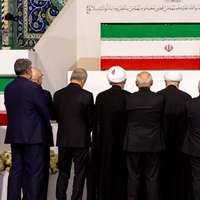
A highly controversial memorial ceremony for former Iranian President Ebrahim Raisi was held at the United Nations headquarters in New York on Thursday, with most countries refusing to attend.
Photos received from the UN show that the General Assembly Hall was almost empty during the event. A US official had earlier indicated that the Biden administration would not send a representative to the meeting, although earlier this month they expressed official condolences for Raisi’s death.
The Islamic Republic's state news agency (IRNA) reported that the UN General Assembly, in its first meeting after the death of Raisi and his entourage, observed a minute of silence "in their honor."
IRNA wrote that "the tribute and expression of sympathy from various countries around the world" following Raisi's death has "angered opponents of the Islamic Republic."
There have also been reports of protests held in front of the United Nations in opposition to the memorial ceremony for Raisi, widely condemned by Iranian activists and others worldwide.
Before the ceremony, the Australian Ministry of Foreign Affairs announced that the country would not participate in Raisi's memorial service at the UN.
A spokesperson for the French ambassador to the United Nations told an Iran International reporter that no representative from France would attend the UN memorial service for Raisi.
Previously, Senator Claire Chandler, Chair of the Senate Foreign Affairs, Defense, and Trade Committee of Australia, emphasized in a statement that the country should boycott and condemn the UN's tribute to the "Butcher of Tehran."
The statement read: "The Australian government is obligated to boycott today's horrific tribute by the UN General Assembly to a man many Iranians know as the 'Butcher of Tehran'."
Raisi was a member of a “Death Committee” that in 1988 ordered the summary execution of 3,000-5,000 political prisoners who were serving their jail terms. He was also president when nationwide anti-government protests broke out in September 2022, when security forces killed around 550 civilians during four months of unrest and arrested 22,000 others. Dozens of protesters lost eyes and limbs when security forces fired guns at close range.
Earlier this month, the UN Security Council held a moment of silence for Raisi, during which the US representative also stood up and paid tribute. This led to vehement criticismby Iranians and Republican lawmakers.
Senator Tom Cotton and others condemned the Biden administration’s stance, accusing President Joe Biden of pursuing a policy of appeasement toward Iran.
“When I saw one minute of silence at the United Nations… it was a slap on the face of Iranian women who got killed simply for showing their hair,” Iranian-American activist Masih Alinejad told ABC News on May 20. “It’s a slap on the face of men getting executed simply for protesting.”
Raisi spent his 45-year career in the Islamic Republic as a prosecutor or Islamic judicial official involved with persecuting dissidents.
Commander Amir-Ali Hajizadeh of Iran's Revolutionary Guards Aerospace Force claims that Israel has offered concessions in Gaza to forestall Iranian retaliation even though Israel continues its relentless offensive on the Gaza Strip.
"Israel sent messages through Egypt's foreign minister that it will compromise in the war in Gaza to avoid Iran's retaliation," Amirali Hajizadeh said.
However, the claims, made through Iran's state media, seem unlikely as Israel has continued to deepen its operation into Rafah, Hamas's last stronghold in south Gaza, in spite of warnings from the International Criminal Court, as the Jewish state continues with its war aims to eliminate Hamas and return the remaining 125 hostages being held in Gaza.
In April, Iran initiated its first direct assault on Israeli soil with over 350 drones and missiles, a response to what Iran claimed was an Israeli attack on its consulate in Damascus, an incident resulting in the deaths of seven officers from the Islamic Revolutionary Guard Corps and a senior commander.
Although the majority of the projectiles were intercepted by Israel and a US-led coalition, Hajizadeh has claimed that Iran's strike nonetheless succeeded in "destroying" targeted Israeli military bases, while imagery from the Nevatim air base shows only limited damage.
Last month, Hajizadeh assertedthat the aerial assault on Israel was executed using limited military capabilities, saying, "We had to use a great number of missiles and drones to get through Israel's Iron Dome, we used 20% of our military capability in the operation".
Saeed Jalili, a figurehead of the Iranian hardliner faction and close ally to Supreme Leader Ali Khamenei, has declared his candidacy for the upcoming presidential election.
Scheduled for June 28, the polls follow the sudden death of President Ebrahim Raisi in a helicopter crash. Jalili, known for his uncompromising stance and deep integration into Iran's ruling elite, filed his candidacy on Thursday, accompanied by conservative lawmaker Amir Hossein Sabeti, a former television host now turned political figure.
This marks Jalili's third attempt at the presidency, having previously contested in 2013, where he finished third, and in 2021, where he withdrew to support the late Raisi.
His background includes roles such as the head of Iran's nuclear negotiation team and multiple senior positions within the ministry of foreign affairs.
Dozens of names suggested by political factions for the upcoming election encompass a range of former high-ranking officials, including past vice presidents like Es'haq Jahangiri and Mohammad Reza Aref; Hossein Marashi, who served as the chief of staff under President Akbar Hashemi Rafsanjani; former Parliament Speaker Ali Larijani; Abdolnaser Hemmati, the former governor of the Central Bank; Mohammad Bagher Ghalibaf, the current Parliament Speaker and Mohammad Sadr, a member of the Expediency Council.
As of now, the confirmed known registrants include reformist Mostafa Kavakebian and conservative figure Saeed Jalili.
Political groups in Iran have been proposing candidates for the June 28 presidential election in a bid to encourage relatively moderate politicians to come forward and change the monolithic political landscape.
As candidate registration began on Thursday, the main question remained whether Supreme Leader Ali Khamenei and other hardliners will signal to reformists and other factions to come forward as candidates in the snap elections following President Ebrahim Raisi's death on May 19.
While moderates and reformists hope that Raisi's death will facilitate their political comeback, they seem to overlook that their isolation and exclusion from political activity are not the results of a democratic competition with Raisi and other hardliners. Rather, it was Khamenei’s loyalists who systematically barred other insiders from three elections since February 2020, pushing them out of the government.
While centrist and reformist newspapers put forward the names of more than 30 reform-minded political figures this week, Khamenei and hardliners in the government have not changed their mind and keep repeating what they said even before Raisi was officially pronounced dead. They are adamant that nothing is going to change. They want someone exactly like Raisi, meaning a hardliner loyal to the Supreme Leader.
During the week after Raisi's death officials and clerics have been glorifying him and fabricating "achievements" for him. And as they know it is difficult to convince the public about those achievements, they have been telling stories about links between Raisi and Muslim saints who died centuries ago.
Posters shout in large fonts: "You were not illiterate," referring to the public view that the late president had only a sixth-grade standard education and he spent the rest of his teenage years in Shiite seminaries. They also claim that under Raisi Iran had the second biggest economic growth rate in the world, while more than 10 million were added to the ranks of the poor under the heavy burden of a persistent 50% annual inflation rate.
Others highlight Raisi's broken promises: building four million homes, providing free Internet for low-income Iranians, supporting online businesses, reforming the banking system, facilitating the return of expats, cracking down on government corruption, halving medical costs, controlling inflation and exchange rates, and reviving the 2015 nuclear deal.
None of these promises have been even partially fulfilled, and the situation has worsened in the three years since Raisi took office. Nevertheless, hardliners still want someone similar to him as the new President. Mohammad Mokhber, the vice president and now acting president, has stated that the plan to build four million houses was intended to begin in Raisi's fourth year in office, had he survived.
A scene of a presidential debate on state TV, Tehran, June 2021
Dozens of names put forward by political groups include vice presidents, cabinet ministers and other state officials from the past, individuals such as former vice president Es'haq Jahangiri; the former chief of staff of President Akbar Hashemi Rafsanjani, Hossein Marashi; former vice president Mohammad Reza Aref; Former Majles Speaker Ali Larijani; former Central Bank Governor Abdolnaser Hemmati, and Expediency Council member Mohammad Sadr who has even prepared an election campaign video days before registration of candidates start.
But politicians proposing these names cannot explain what those individuals and others on their long lists have achieved during their long careers in the past 45 years.
On the conservative side, individuals close to the Supreme Leader's office, such as Parviz Fattah—a key figure in Khamenei’s “charity-business” conglomerate—have been named as potential candidates. Their careers have primarily involved protecting Khamenei's assets and channeling funds into ineffective projects and Iran’s regional ambitions.
During the past week, Vice President Mokhber has been mentioned at least five times as the best candidate to replace Raisi. However, he has repeatedly demurred, stating that he is currently too busy to run for the presidency. Other hardliners, like former Defense Minister Hossein Dehghan, have also declined, saying they have their current jobs and do not need to run for President. It is not clear if they know something others don’t.
With over 30 years of experience in dealing with every one of these possible candidates Khamenei knows them better than anyone else, and when he says there will not be any major change, he means it.
Ashtari argued that the only way for Israel to eliminate the threat of Hamas is a military one. “But unfortunately, a military attack, especially in the densely populated area of Gaza, causes civilian casualties too,” he maintained while accusing Hamas of intentionally seeking higher civilian casualties to force the international community to stop Israel’s military operations.
Another expatriate journalist, Neda Sanji, however, in her tweets warned about“fake news and fallacies” which she listed as “opposing the massacre in Gaza equals support for the Islamic Republic”, “Those who oppose the Gaza massacre were silent about the [government’s] killing of the Iranian people”, “opposing the massacre in Gaza equals supporting Hamas”, and “Israel has no choice other than doing what it does to destroy Hamas”.
Post by former football star, Ali Karimi, is now a social heavyweight in Iran
Sanji also maintained that the social media controversy would benefit the Islamic Republic’s cyber army. “The dust will eventually settle but humanity will be scarred [forever],” she wrote.
Many celebrities in Iran have posted the image as a ‘story’ on their Instagram accounts in the past few days.
Apparently referring to the current controversy over Gaza, Fariborz Karami-Zand, an expatriate activist with a large social media following, in a tweet Thursday criticized celebrities for “closing their eyes to the crimes of the Islamic Republic”. “Why are they silent about issues related to Iran and their fellow countrymen?” he asked.
Instagram stories of Iranian celebrities in support of Palestinians
In protest against the government’s increasing political and financial support for Hamas and Lebanese Hezbollah, some demonstrators chanted “Neither Gaza nor Lebanon, I’ll sacrifice my life for Iran” during the protests that followed Iran's disputed 2009 presidential elections. This marked the first time such a slogan was used in the history of the Islamic Republic.
The slogan has since then become one of the top slogans during anti-government protests.
Supreme Leader Ali Khamenei has repeatedly condemned this slogan. In a Friday sermon in January 2020, following widespread anti-government protests two months earlier, he accused those who chanted it of hypocrisy. “These people have never sacrificed their lives for Iran or forsaken their comfort and interests for the sake of the country’s security,” he said.