US Special Envoy Expresses Concern Over Iran Threats to Protesters Worldwide
Some of the alleged attackers suspected to be non-Iranian elements of the Islamic Republic in the UK
Deputy US Special Envoy for Iran, Abram Paley, has voiced concern regarding Iranian government supporters attacking peaceful protesters demonstrating around the world against the regime.
“Freedoms of peaceful assembly and expression are essential human rights, and efforts to silence these voices are unacceptable.”
On Tuesday, a US court issued a temporary order against Ramezan Soltan-Mohammadi, an employee of the Islamic Republic's Interests Section in Washington DC. Soltan-Mohammadi was caught on video threatening Iranian protesters with death during a May 22 rally outside a memorial service for Raisi in Maryland.
The court's order prohibits him from making any contact, threats, or approaching the residences and workplaces of the protesters, as reported by the National Solidarity Group for Iran.
However, Iranian Americans are asking the Biden administration for a more forceful response to the incident, some demanding that Mohammadi should be expelled from the United States.
In another event, an Iranian protester sustained a severe spinal injury following an attack by Islamic Republic loyalists in London on Friday. The attack, targeting a group of Iranian dissidents celebrating the death of Ebrahim Raisi outside a community center run by regime loyalists, resulted in injuries to at least four people.
The attack has sparked widespread condemnation from political activists and opposition figures such as Iranian exiled Prince Reza Pahlavi and leading activist Masih Alinejad.
A US court has issued a temporary order against Ramezan Soltan-Mohammadi, an employee of the Iran's Interests Section in Washington DC, who was seen threatening Iranian protesters to death last week.
In a video posted to social media, the man is seen making a death gesture according to one of the demonstrators in attendance, Siamak Aram, who said the man in the video directed the death gesture right at him.
"Hethreatened me with death by moving his hand across his throat to indicate he would cut my throat," said Aram.
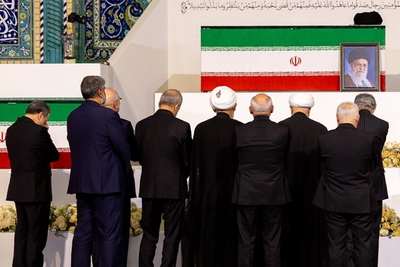
The video was taken on May 22 at a rally outside a memorial service hosted by the Islamic Education Center (IEC) in Maryland for the "occasion of the martyrdom" of President Ebrahim Raisi and Iran's late foreign minister, Hossein Amir-Abdollahian, who both died in a helicopter crash last week. The center posted "condolences and sympathies" notes on their deaths.
Aram, an activist from Iran who left in 2011 to avoid the Islamic Republic's reach, yet this week's incident he said, proved the arm of Iran's repression extends all the way to the United States.
"I didn't expect to feel the same experience I had in Iran, here in United States. It was...15 miles away from White House and the capital," he said.
The man, later identified by Aram as Soltan-Mohammadi, allegedly is an employee of the Interests Section of the Islamic Republic of Iran, which is part of the Pakistani Embassy in Washington DC, which is the de facto consular representation of Iran in the US.
Iran International has reached out to Soltan-Mohammadi for comment but has not heard back.
Jason Brodsky, the policy director of United Against Nuclear Iran (UANI) told Iran International "the fact that he was an employee of the Islamic Republic's Interests Section raises tremendous concerns for me."
"The Islamic Republic has a very checkered past of trying to engage in transnational repression in Western capitals," said Brodsky.
In August 2023, a Fox New Digital report revealed a three-page GOP letter detailing Iranian regime-linked mosques and centers in Maryland, Texas, Michigan and Virginia. It claimed that the Islamic Education Center in Maryland, secured funding from what it says is the Iranian regime-controlled Alavi Foundation and Washington-based Iranian Iman, Abolfazi Bahram Nahidian.
"It is unacceptable for an employee of the Islamic Republic's Interests Section in the United States to threaten an Iranian American on US soil. The Iranian- American community was using their First Amendment right, to protest, as we have in this country. And we cannot allow authoritarian states like the Islamic Republic to try to trample on those rights on American soil," said Brodsky.
The incident allegedly involving Soltan-Mohammadi is just "a microcosm of a much larger Iran policy problem," said Behnam Ben Taleblu, a senior fellow at the Foundation for Defense of Democracies (FDD).
He said the Biden administration's policy towards Iran has been rooted in a belief that pressure drives the threats - rather than pressure being a tool to solve the threats.
The alleged death threats, according to Ben Taleblu, should serve as a wake- up call.
"I'm surprised and also worried. This is something that Iranian Americans and in general, Americans need to be concerned about, that foreign governments can actually benefit from diplomatic cover and adjudicate their fights with diaspora members, dissidents, and even just citizens of a different country on foreign soil," said Ben Taleblu.
He said, the core of the issue is the emboldenment the regime feels, not just in the US but across the Western world.
Ben Taleblu said the Islamic Republic's "threats vectors are evolving in drastic ways."
Earlier this year, two Canadian men with ties to Hells Angels were charged in what US authorities called a “murder-for-hire scheme” allegedly coordinated in Iran to kill Iranian dissidents in Maryland.
Ben Taleblu and Brodsky both commented to Iran International that the US State Department needs investigate and take action.
Iran International has reached out to the State Department, which would not provide comment at this time.
The Office of the Special Envoy for Iran posted to X Tuesday that it is "concerned to see reports of Iranian regime supporters threatening and attacking peaceful protesters worldwide."
Aram said he's just looking for justice.
He said he went to court Tuesday to send a message and exercise his democratic right.
"I hope that we could carry a very clear message that the rule of law prevails here. I wanted to make this message clear and also give the hope to the other dissidents of the Islamic regime," he said.
The court order prohibits Soltan-Mohammadi "from making any contact, threats, or approaching [Siamak Aram] my place of residence and employment," according to Aram whose lawyer posted the order to Instagram.
"You cannot be the member of the government. And also at the same time, making death threats to the citizens. Because if he was in power and if I was in Iran...he would execute the threat."
Two days after reports from Iran suggested that Ali Shamkhani, an adviser to the Supreme Leader, would become the new chief nuclear negotiator, a former official charged that he had previously opposed the 'revival' of the JCPOA.
Shamkhani is an old-guard military figure who served as the secretary of Iran’s Supreme National Security Council until last year. In that role, he oversaw negotiations to mend relations with Saudi Arabia. This background lends credibility to reports that Khamenei has chosen him to handle the nuclear issue, prompting significant reactions.
On Tuesday, however, several Iran-based news websites rehashed an interview from two weeks ago, in which Mahmoud Vaezi, the chief of staff to former President Hassan Rouhani, suggests Shamkhani was against the idea of reviving the JCPOA nuclear agreement, after it was ditched by Donald Trump.
"[Iran’s] Supreme National Security Council Secretariat during Shamkhani's term took a line of non-revival,” Vaezi says in his interview. “If the secretariat had been aligned [with Rouhani’s administration], the nuclear deal would have been revived at that time."
The reason why some outlets in Iran have highlighted this line from Vaezi’s interview remains unclear. It could be an effort by those in favor of a deal—and closer cooperation with the US in general—to undermine Shamkhani before his official announcement in the new role. Alternatively, if the appointment is already finalized, it might be an attempt to put Shamkhani on the defensive from the start. Either way, this appears to be another instance of factional politics that ultimately reinforces Khamenei's position as the ultimate arbiter.
Khamenei has the final say on all matters of security, intelligence and foreign policy. Many view his key appointments as windows into his thinking and an indicator of the direction that Iran would most likely take in the short to medium term. Those opposed to Khameni’s choice of direction can do little but to shoot the messengers –high ranking officials whose role is the implementation of policies developed in Khamenei's office, and who, more often than not, are where they are by virtue of their subservience.
Vaezi’s interview provides a glimpse of this factionalism and the dynamics of power in the Islamic Republic of Iran.
"Some individuals and the secretary in the secretariat adopted different methods. Some pursued policies that were not even discussed in the council meetings,” he says of the alleged disruptive impact of Shamkhani and his team during the negotiations to revive the nuclear agreement with the Biden administration. “As far as the nuclear deal is concerned, they had a line that it should not happen. They didn’t say it explicitly, but their behavior indicated this."
Vaezi then reveals why the situation could not have been rectified, why, in other words, it was out of President Rouhani’s hands.
“To replace the Secretary, there has to be an agreement between the President and the Supreme Leader,” he says in the interview. “That agreement didn't come about. Mr. Rouhani tried several times, about 5-6 times during his four years [second term]."
The nuclear negotiations between Iran and the International Atomic Energy Agency (IAEA) seem to have halted following the death of Iran’s president and foreign minister on May 19 when their helicopter crashed. But rumors persist –just as they have on a number of occasions in the past few years– that back-channel, indirect talks are underway between Iran and the US.
Shamkhani’s appointment as the 'chief negotiator' has yet to be officially confirmed. If and when it is, it will be significant primarily for what it reveals about the intentions of the true chief negotiator, Ali Khamenei.
The re-election of Mohammad Bagher Ghalibaf as the Speaker of Parliament in Iran on Tuesday, with a comfortable margin, demonstrated that ultra-conservatives are weaker than expected.
Before the internal election, the prevailing assumption in the Iranian political landscape was that Ghalibaf had around 70 supporters in Parliament. This was 30 fewer than the ultra-conservative Paydari Party, which backed Qom MP Mojtaba Zolnour in the election for Speaker and the presidium.
This turned out to be not accurate as Ghalibaf won 198 votesout of a total of 290. Whatever the true number of Ghalibaf and Paydari's supporters are at the Majles, the group loosely characterized as "independents" is now better known to have a real weight in the legislature.
This group can potentially swing either way when it comes to the ratification of bills, which will only become law after endorsement by the conservative-dominated Guardian Council. However, this flexibility will remain only until the "independents," or a significant portion of them, form a new faction with predefined political preferences.
Meanwhile, the results revealed that traditional conservatives, once considered a major force in parliament, wielded little political influence. Their representative, former foreign minister Manouchehr Mottaki, received only 5 votes, one of which was certainly his own. This outcome was a surprising and disgraceful blow to their perceived strength.
In the previous parliament, traditional conservatives had 11 members and were believed to have the capacity to garner support for their proposals. However, they failed to present any new ideas and merely followed the hardliners in their efforts to crack down on women's hijab and social media.
Ghalibaf won the Speaker's seat despite widespread smear campaigns by his political rivals and the public's dissatisfaction over his inefficiency in the previous parliament. It remains unclear whether his re-election was influenced by "political decisions from higher up," as many politicians have speculated about the support for Ghalibaf from Khamenei's inner circle.
According to the Khabar Online website, Ghalibaf can now begin his presidential campaign, confident in the safety net provided by his position in the Majles in case his presidential ambitions do not materialize.
He participated in the internal election of the Majles despite numerous calls from lawmakers for him to step back and choose between the presidential race and the competition for the Speaker's seat. However, Ghalibaf opted to continue campaigning on both fronts. In a last-minute shift, Ghalibaf, who had been forging an alliance with the Paydari faction based on trading concessions as in the previous round, instead formed an alliance with the "independents."
Not only this new idea worked, but it gave new leverage to the "independents" as a parliamentary force to be reckoned with. This is particularly important as the "independents" officially declared their support for Ghalibaf minutes before the vote.
Another significance of the election on Tuesday is in the vast difference between the number of votes won by Ghalibaf and his Paydari Party rival Zolnour. Whether Ghalibaf can effectively benefit from this edge during the next four years is another story.
There were 24 void votes, which represented the "independents" who did not support any of the three candidates.
The two deputy speakers came from Paydari, Ali Nikzad with 142 votes, and Haji Babaei with 154. However, although members of the presidium are not known to exert any influence on the proceedings of the Majles, according to Khabar Online, Ghalibaf's supporters have the upper hand in the presidium.
A downed drone found in the Kursk region of Russia was equipped with Iran's newest guided aerial bomb, revealing deepening military ties between Moscow and Tehran.
Analysis of video footage from the site revealed that the drone was armed with a Qaem-5 guided bomb, a recent development in Iranian weapons technology. The incident represents the first documented use of the weapon in Russia's invasion of Ukraine.
The Mohajer-6, primarily used by Russian forces for aerial surveillance, is believed to have been en route to the Sumy region for an attack before its unexpected crash, the cause of which remains unclear.
The Qaem-5 is part of a broader series of air-to-ground munitions designed specifically for compatibility with Iranian UAVs like the Mohajer-6 and Hamaseh. These bombs come in various forms, including laser-guided and infrared variants, with the Qaem-5 and Qaem-9 employing TV guidance systems that may also feature low-light capabilities.
Iran's Qods Aviation Industries manufactures the Mohajer-6, which has been in mass production since 2018 and is noted for its export success. The drone has a wingspan of 10 meters and is powered by either a Rotax engine or an indigenous variant, boasting capabilities suited for both reconnaissance and combat roles.
The event underscores the deepening military ties between Tehran and Moscow, evidenced by the transfer of weapons systems including kamikaze drones and now, potentially, ballistic missiles.
International concern has grown over Iran's role in bolstering Russia'smilitary operations in Ukraine. Since mid-2022, Iran has provided Russia with over a thousand Shahed UAVs, which have been extensively used to target civilian areas and infrastructure across Ukraine.
Forty percent of a gas and oil field in the western end of the Persian Gulf belongs to Iran, one of the top commanders of the Revolutionary Guard was quoted as saying on Tuesday.
Abdolreza Abed, the commander of IRGC’s construction and business conglomerate, Khatam al Anbiya, challenged Saudi Arabian and Kuwaiti claims that the field, off Kuwait’s coast, is within their territorial waters. Abed said that “Iran's entry into the Arash field is more essential than daily bread.”
He added, “The lack of determination and will to utilize Iran's gas resources in the Arash field has allowed neighboring countries like Kuwait and Saudi Arabia to start extracting from this field, while we in Iran watch them, waiting to see when a decision will be made for Iran's presence in the Arash field.“
Kuwait and Saudi Arabia have invited the Islamic Republic to negotiate over their territorial borders in the region.
The two Arab countries agreed in 2022 to jointly develop the field, which was discovered in 1967 and is estimated to have a total proven reserves of around 310 million barrels of oil and 20 trillion cubic feet of gas.
Saudi Aramco Gulf Operations Company signed a Memorandum of Understanding in December 2022 with Kuwait Gulf Oil Company (KGOC) to develop the joint field.
The development aims at producing one billion cubic feet of gas and 84,000 barrels of liquefied gas per day. The Arab countries call the field Al Durra, while Iran calls it the Arash Field.