An independent United Nations expert has issued a warning regarding Iran's ongoing efforts to target Iranian and Iranian-origin journalists working abroad, particularly those associated with foreign Persian-language media outlets.
In her comprehensive report to the UN General Assembly, Irene Khan, a prominent human rights advocate, detailed the extensive pressures these journalists face as part of Tehran's broader campaign to suppress dissenting voices globally.
Khan's findings reveal a trend of increased exile among journalists who flee their home countries to escape persecution and continue their work in an environment free from state interference.
“Fearing for their own safety or that of their families back home and struggling to survive financially and overcome the many challenges of living in a foreign country, many journalists eventually abandon their profession,” she said.
The situation for Persian-language journalists is particularly dire, with numerous reports of threats and physical attacks on individuals and their families. The case of Pouria Zeraati, a presenter for Iran International who was stabbed in London, alongside the IRGC's plots to assassinate two anchors from the same network in 2022 during anti-government protests in Iran, underscores the perilous circumstances faced by Iranian journalists abroad.
Khan's report calls on host countries to provide stronger legal protections, work permits, and more robust support mechanisms to safeguard the journalists' rights and well-being.
She emphasized the need for an international response that not only shields journalists from physical and digital threats but also ensures they can continue their crucial role in fostering transparency and accountability without fear of retribution from their home countries or their proxies.
EU countries will expand Iran sanctions by adding 10 new individuals and entities linked to terror proxies and Russia’s war in Ukraine.
The EU had previously committed to intensifying sanctions against Iran following last month's missile and drone attack on Israel, yet still hasn't designated the Islamic Revolutionary Guard Corps (IRGC) as a terrorist organization.
Iranian forces launched their first direct attack against Israeli territory on April 13 with more than 350 drones and cruise and ballistic missiles, 99% of which were intercepted by Israel and a US-led coalition. Iran had vowed to retaliate after Israel allegedly bombed its consulate in Syria earlier in the month.
In the months following the start of the Gaza war on October 7, the Iranian government avoided direct involvement in the conflict. Until last month, it had used its proxies to target Israeli and American targets in the region, punishing America for supporting Israel's right to defend itself following the most deadly day for Jews since the Holocaust. Over 1,200 people, mostly civilians, were killed and more than 250 were taken hostage.
A resolution adopted by the European Parliament last month following Iran's attack on Israel urged the EU to impose further sanctions against Tehran and deem the IRGC a terrorist organization.
EU Chief Josep Borrell's argument for not listing the IRGC is that the legal grounds have not been met. However, his claim has been dismissed by MEPs such as Charlie Weimers, a Swedish representative who called Borell “a liar” during last month's plenary debate in Strasbourg.
This point of view was also espoused by Iran's exiled prince Reza Pahlavi, citing a group of French-Iranian lawyers who held the view that the European Union does not have any legal obstacles to blacklisting the Revolutionary Guards.
In 2011, the EU first introduced a sanctions regime against Iran in response to serious human rights violations in the country. The restrictive measures have been renewed annually since then and were last extended until 13 April 2025.
Since the brutal suppression of 2022’s uprising, the ongoing support for Russia’s war on Ukraine and the actions of Iran’s proxy militias, the EU has drastically increased restrictive measures, adopting at least 10 packages of sanctions.
Iranian Science Minister, Mohammad Ali Zolfigol, claims that the President Ebrahim Raisi had instructed him to ensure no rights were violated in the dismissal of university professors.
His claim contrasts the realities observed during Raisi's tenure, where dozens of professors were either dismissed or forcibly retired under a systematic suppression of academic freedom under his rule.
Compounding the situation, reports from the period detail the firing and enforced retirement of professors who did not align with the government’s ideologies. In several instances, affected professors took to publishing documents online that evidenced their dismissals or suspensions, bringing to light the oppressive tactics employed by Raisi’s administration.
Further underscoring the severity of government interference, the secretary of the union of Iran’s university professors announced earlier this month that the Ministry of Science had been effectively sidelined. According to the secretary, decision-making for Iranian universities had been usurped by various other state-controlled security entities.
Karen Abrinia remarked that government interventions at universities have alarmingly increased. Since the onset of the Woman, Life, Freedom protests in 2022, it is estimated that about 200 university professors have faced severe restrictions from pay freezes to being forced to sign apologies for supporting protests and pledging loyalty to the regime.
A coalition of Turkish actors have slammed the closure of theaters as the country mourns the Iranian president who they branded a ‘misogynist and bloodthirsty leader’.
President Ebrahim Raisi, along with Foreign Minister Hossein Amir-Abdollahian and other officials, died in a helicopter crash over the weekend, prompting some nations such as Turkey to announce a period of mourning.
"We do not accept the declaration of national mourning for a leader whose hands are stained with the blood of countless innocents," the statement from the Long Live our Theater Initiative read.
Moreover, the group expressed significant concern over the impact of the mourning period on the cultural sector. "Our biggest worry is the cancellation of numerous art and entertainment events across the country under the guise of national mourning. It is unacceptable to stifle artistic expression with such bans," they argued.
The statement concluded, "Declaring national mourning for a misogynist and bloodthirsty leader not only tarnishes our cultural values but also disrupts the customary social life. Art is a social necessity, not merely an activity, and it is an indispensable element of our lives."
A group of a dozen Republican lawmakers are demanding a justification of the Biden administration’s decision to express condolences for the death of Iran’s President Ebrahim Raisi.
“It is highly inappropriate for the United States to express condolences for an individual that was sanctioned by the US Treasury Department and has extensive connections to terrorism,” the GOP members said in a letter to US Secretary of State Antony Blinken.
Iranian President Ebrahim Raisi and Foreign Minister Hossein Amir-Abdollahian were killed on May 19, when the helicopter they were traveling in reportedly crashed over East Azerbaijan in Iran.
The exact circumstances of the crash are not yet clear.Often called the “Butcher of Tehran” Raisi sat on a “Death Commission” in 1988 whereby he persecuted and signed off on the extrajudicial killing of thousands of Iranian dissidents.
Following the news of the deaths of the two officials, Iranians, both within the country and abroad, took to social media to express their jubilation.
Many shared videos of themselves dancing and cheering, and in some parts of Iran, fireworks were set off in celebration.In response, the authorities in Iran have since begun a campaign of threats and arrests of dissidents and their families, as revealed by Iran International this week.
In their letter, posted on X by Congresswoman Claudia Tenney, the Republican members pointed out that in 2019, Raisi was added to the OFAC Specially Designated Nationals (SDN) List, which targets terrorists and criminals with sanctions like asset freezes and business bans. They note that Raisi remained on the list under the Biden administration due to his extensive criminal behavior and call the decision to express condolences for such an individual "shameful."
“President Raisi was a despotic tyrant whose rule directly led to the murder of thousands of innocent individuals and the maiming, repression, and subjugation of the Iranian people,” the lawmakers wrote demanding a “full explanation” by June 5.
In a post on X, Representative Peter Stauber, who also signed the letter, rebuked the condolences, saying that offering them “for the death of this monster is a new low for this Administration.
”Separately on Tuesday, Secretary of State Antony Blinken defended his department's decision to express "official condolences" to the Senate Foreign Relations Committee, calling it the "normal course of business."
"We expressed official condolences as we’ve done when countries — adversaries, enemies, or not — have lost leaders.”
"It changes nothing about the fact that Mr. Raisi was engaged in reprehensible conduct, including repressing his own people for many years," Blinken said.
\In addition to his involvement in human rights abuses in 1988, the letter detailed Raisi's actions during the 2009 Green Movement crackdown, and his support for other violent crackdowns on protests, such as those following the 2022 death of Mahsa Jina Amini.
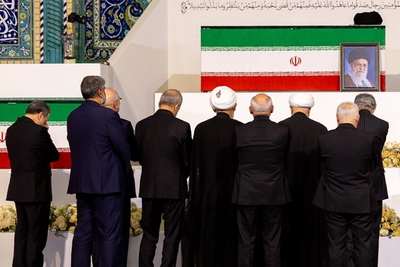
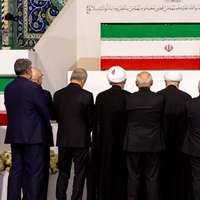
Mourners at the funeral procession of Ebrahim Raisi in Tehran on Wednesday assaulted a news team from Germany’s television.
The German ARD news crew was targeted while filming buses that had brought pro-regime participants to the capital. According to a foreign reporter covering the funeral, there was no apparent provocation that justified the assault by Raisi's mourners.
“It remains unclear what narrative might have incited such anger among the attendees,” the reporter stated, highlighting the arbitrary nature of the aggression.
Iranian security forces intervened only to scrutinize the credentials of the journalists rather than address the hostility they faced. The action raises serious concerns about the freedom and safety of the press within Iran, as well as the government’s tacit endorsement of such attacks.
Some individuals aligned with the government circulated videos featuring chants against the reporters outside the Espinas Hotel, where they were staying. The videos portrayed the German journalists as “deceptive” in their reporting intentions, attempting to discredit their professional integrity.
According to the government supporters, the journalists aimed to falsely portray a low turnout at the funeral, an accusation that underscores the regime’s sensitivity to international perceptions.
Although the German Chancellor extended condolences to Iran over the death of the infamous president, Foreign Minister Annalena Baerbock expressed solidarity with the Iranian people, particularly supporting the women of Iran, who continue to face systemic repression under the current regime.