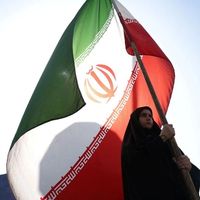
Women covered in dark veils, wailing at the death of Iran's president Ebrahim Raisi in public displays of sadness, couldn't contrast more than the joy exhibited in street parties, morbid jokes, fireworks and more recently - nude photos.
Some Iranians, women and men, posted nude photos of themselves to rejoice in the news.
Using nudity to express joy over Raisi's death is a way to release from a form of "suffocation," said Hanieh Ziaei, a political scientist and associate researcher at the Raoul-Dandurand Chair in Montreal.
"They feel suffocated. So they want to just open everything and it's maybe the expression of this kind of suffocation," said Ziaei.
The call to go nude to celebrate Raisi's death reportedly started off with a tweet by an Iranian social media influencer who allegedly posted to X at the time of Raisi's disappearance that if he is dead she would pose a naked photo.
Iran International is not revealing the account for their safety. It is not known whether she meant it as a joke, a dare or a form of political expression, but it did lead to some Iranians joining the call and going nude. What seemingly started off as a bet, turned into a viral trend.
Given the forced policing of women and even men's bodies in the Islamic Republic, the use of the body to overcome oppression, according to Siavash Rokni, who specializes in subcultures and social movements in social media, fits with the narrative of defying oppression.
Raisi, he said, is the epitome of oppression.
"Nudity and body has always been a taboo. And it has also been an object or something to protest with."
Rokni told Iran International that you don't have to go far back in history to see examples.
"The hippie movement, an anti-war movement in the 1960s and 70s would be an example of it. More recent, the Femen movement that started in Europe and has gone to other countries in North America and Asia, is an example of using nudity as a form of protest movement. The big piece in this whole story is the fact that a body is a form of speech."
Rokni said by going nude, these Iranians started a conversation against patriarchy and against the taboo of body shaming that has been in Iranian society, especially since the 1979 Islamic Revolution, he said.
"Raisi took lives. He was a murderer, but he also suppressed bodies. When people are sharing their bodies, they're literally going against this patriarchy in our society, but they're going specifically against Raisi and the crimes that he committed for the past 40 years," said Rokni.
•
•
Raisi, the so-called 'Butcher of Tehran', was one of four judges who sat on a prosecution committee in 1988 that ordered the execution of thousands of political prisoners - some were reportedly as young as 13 years old.
Raisi denied his role in the 1988 massacre, but in 2021, Amnesty International Secretary General Agnes Callamard urged an investigation of the President for his alleged "crimes against humanity" while he was head of the judiciary.
The conservative hardline cleric took office in August 2021 and was known for enforcing brutal crackdowns on political opposition, and for policing women's bodies.
A recent UN Fact Finding Mission found various cases of rape and other forms of sexual and gender-based violence like gang rape and electric shocks to the genitals. It also uncovered the use of AI technology to identify and punish women who didn't follow the country's strict dress code.
Ziaei said "the body is forbidden," in Iran and by going nude, "it's another way to express their frustration."
"The body is becoming a political space," said Ziaei.
However, it could also be used by cyberbots of the Islamic Republic to discredit the Women-Life-Freedom movement, and it wouldn't be the first time an Iranian women's body was used against her, said Ziaei.
By publishing some nude photos, cyberbots, possibly working for the regime, might try to tell more traditionalist Iranians that this is what opposition activists do. If you trust them and follow their lead, your families can also lose their moral compass.
In 2015, actress and human rights activist Golshifteh Farahani posed nude in a French magazine, and received backlash.
Ziaei said that photo can be seen as a "symbolic act."
Rokni said the negative backlash only exposed the patriarchy in Iranian society.
"Iranians obsessed over the fact that Golshifteh Farahani an Iranian, you know, showed a nude photo of herself, which is interesting because it is okay for the French to be nude, but once it's an Iranian, it's different for some reason. So it just shows you how we have a problem with body," said Rokni.
Iranian-Canadian Lily Pourzand, an expert in gender equality, came to Farahani's defense at the time and said she paid a price for it.
"Part of the society feels that they own women's body," said Pourzand.
As a gender equality expert, Pourzand said, she can't comment on whether going nude after the President's death is effective, but she said it does carry much symbolism.
"That act of protest, which should showcase itself in celebration mood, I think it's a message. That's saying no to the governmental ideology and forceful ownership over women's body, over women's life in Iran," she said.
Pourzand said it could be seen as taking back ownership of one's body.
Whether the nude photos posted in the wake of Raisi's death to celebrate his end, were done in fun, a dare or an act of defiance, is not known but what is known, said Rokni, is nudity is a form of resistance to reclaim control in a repressed society that stands for gender apartheid.
"After the revolution, one of the points that really solidified the Islamic Republic was the domination over body. Domination over body of women by putting scarves over their heads, putting hijab over their heads, but also domination of men by asking them not to wear short sleeved shirts," said Rokni.
Amidst Iran's economic woes, the chief commander of the Islamic Revolutionary Guard Corps (IRGC) says that the country’s recently deceased President "saved" the country from sanctions.
“[President Ebrahim Raisi] began reopening closed factories, visited deprived areas, and enhanced the status of the Islamic Republic internationally,” Hossein Salami said on Saturday.
On May 19, Raisi and Foreign Minister Hossein Amir-Abdollahian were killed in a helicopter crash near the border of Azerbaijan.
Raisi, who began his tenure as president three years ago, faced significant criticism from observers regarding his economic team, with many calling for a cabinet reshuffle to address the issues. Raisi largely ignored these concerns, consistently asserting that the economy was on a growth trajectory.
In the weeks preceding Raisi's death, the criticism intensified further as many critics within Iran, including politicians, clerics, and academics, consistently voiced concerns about inefficiency, mismanagement, and negligence within his administration.
Among state figures, the former chairman of Iran’s central bank harshly criticized the hardliner government of Raisi for creating three-digit inflation of food prices and the impoverishment of tens of millions of people “while Iran has the biggest combined oil and gas reserves in the world.”
According to some insiders and critics in Iran who are generally permitted to comment publicly, Iran's short-term economic outlook is bleak. Since January, the national currency has devalued further, increasing inflation to around 50 percent.
"We can hear the sound of people's bones breaking," said former Vice President Eshaq Jahangiri, emphasizing the severity of soaring prices. "The government must listen to the people's voices and address their grievances," he said.
One of the highest-ranking clerics in the theocracy,Ayatollah Nasser Makarem Shirazi, also addressed Raisi on issues such as escalating food costs, declining purchasing power, and volatile exchange rates, asserting that “the government must address these challenges.”
Amnesty International has warned of the imminent threat of execution for at least 15 individuals involved in the protests, following what it describes as "grossly unfair sham trials."
At least eight of these individuals, Amnesty says, are awaiting execution following their involvement in the "Woman Life Freedom" uprising in Iran.
Among them are Fazel Bahramian, Mahmoud Mehrabi, Mamousta Mohammad Khazrnejad, Manouchehr Mehman Navaz, Mehran Bahramian, Mojahed (Abbas) Kourkouri, Reza (Gholamreza) Rasaei and prominent rapper Toomaj Salehi.
In their guilty verdicts, they were accused of "enmity against God" (moharebeh), "corruption on earth" (efsad-e fel arz), and "armed rebellion against the state" (baghi).
"The authorities have severely violated their fair trial rights and subjected many to torture and other ill-treatment, including beatings, electric shocks and sexual violence," the group added.
According to Amnesty International, two additional individuals, Saeed Shirazi and Abolfazl Mehri Hossein Hajilou, were tried on capital charges, and at least five others are under investigation for serious offenses related to the protests.
The death of Mahsa Jina Amini in September 2022 at the hands of the regime’s “morality police” ignited a series of nationwide protests lasting for months, commonly referred to as the Woman, Life, Freedom movement. During this period, authorities reportedly killed at least 550 protesters and detained tens of thousands. The UN has since found Iranian authorities responsible for the physical violence that resulted in Amini's death.
Amnesty International reported last month that 853 people were executed in Iran in 2023, a record number in the last eight years, pointing out that the government uses execution as a tool of political repression and may continue to execute thousands more if the international community does not take action.
The first official report on the helicopter crash that killed Iran’s late President Ebrahim Raisi was published on Thursday. However, it did little to quell speculations surrounding the fatal incident.
Raisi was on a short flight back from the neighboring Republic of Azerbaijan last Sunday, when his helicopter went missing from radars. The crash site was located several hours later, along with bodies of Raisi and his minister for foreign affairs, Hossein Amir-Abdollahian.
Speculations, often conspiratorial in nature, mushroomed immediately after the news of the crash, long before Raisi and other officials were confirmed dead. More conjecture emerged in the following hours and days, mostly pointing fingers at Mojtaba Khamenei, the Supreme Leader’s eldest son who is widely believed to be the main contender to replace his father.
On Thursday evening local time, Iran’s general staff of the Armed Forces published a brief statement (with 6 articles) to present its ‘early’ finding and dissuade people from speculation.
“Some actions require more time for a definitive opinion...while some issues can be stated with certainty and are mentioned here,” the statement read, “no evidence of bullet impact or similar instances was observed in the remaining parts of the crashed helicopter…The crashed helicopter caught fire after hitting an altitude.”
Rescue team works following a crash of a helicopter carrying Iran's President Ebrahim Raisi, in Varzaqan, East Azerbaijan Province, Iran, May 20, 2024.
This was perhaps the most significant part of the statement, attempting to convince the public that there was no outside attack or interference. It followed another broad remark conveying the same message: “The helicopter continued its pre-planned route and did not deviate from the designated flight path,” implying that the crash was indeed an accident, but offering no reasons for it –a technical problem, for instance, or human error.
The statement was met with skepticism or mockery. Lack of detail, or a rough storyline, at least, raised many more questions that it answered.
“The statement does not address any of the uncertainties surrounding the crash of Raisi’s helicopter,” Iranian journalist and commentator Jamshid Barzegar told Iran International. “All it does is to rid [Iran’s] armed forces of the little credibility that they had, [especially if] you put it alongside the staggering lack of coordination that was displayed at Raisi’s funeral.”
This sentiment was echoed by other analysts and some ordinary Iranians on social media, who judged the statement from ‘not much to offer’ to ‘all lies’, even though it stated clearly that large amounts of evidence had been gathered but “more time is needed to examine some parts and documents.”
Further statements, even with more evidence and detail, are likely to fail to convince ordinary Iranians, many of whom find it hard to trust official announcements –and are often actively looking for inconsistencies or ‘gaffes’ that would discredit the narrative.
This is partly at least due to the Islamic Republic’s long history of deceit which has all but completely eroded trust between the people and the state. And partly a backlash to the regime’s persistent dissemination of its own message and violent suppression of alternative ideas.
One such instance was the downing of a Ukrainian airliner in January 2020, when two missiles fired by the Revolutionary Guard air defense units around Tehran brought down the plane with 176 people on board. All perished in the crash. For three days, military and security officials denied any involvement and argued that it was a technical accident, until videos emerged showing the missiles hitting the plane.
“People are asked to ignore non-expert opinions based on speculations without accurate knowledge of the realities of the scene, or sometimes guided by foreign media in cyberspace and other platforms,” the statement concluded.
Iran’s ‘Reform Front’ says they have not decided whether to field a candidate or participate in the Iran’s upcoming June presidential election, for a successor to Ebrahim Raisi who died in a helicopter crash on May 19.
Media in Tehran quoted Javad Emami, the spokesperson of the Reform Front and an individual close to former President Mohammad Khatami as saying that ‘reformist’ politician will discuss the issue of the elections on Sunday.
The core of the Iranian clerical regime led by Supreme Leader Ali Khamenei has completely sidelined the ‘reformists’ in recent elections. While they are loyal to the essence of maintaining the Islamic Republic as the country’s political system, they have been asking for reforms, such as more media freedom and less interference by the military.
Khamenei, by stage-managing elections in 2020 first packed the parliament by hardliners and then helped elect Ebrahim Raisi, a loyal cleric, to the presidency in 2021. Hundreds of candidates were also disqualified in this year’s March parliamentary elections, further solidifying control by Khamenei loyalists.
Emami stated that “The conditions of the election depend on how the government handles the June elections. These days, the country is in crisis, and we hope to see the correct path for the elections demonstrated as soon as possible.”
The spokesperson of the ‘Reform Front’ was apparently alluding to the fact that all politicians and media await signs to see what Khamenei intends to do during the elections – allow a diversity of candidates or repeat the closed model used in 2021 to elect Raisi.
A former Australian hostage, held in Iran for over two years, has criticized Western governments for their condolences over the death of Iran’s president, saying they lack leadership in denouncing “a man widely regarded to be complicit in mass murder.”
In an op-ed for the Australian Age daily, Australian scholar Kylie Moore-Gilbert criticized recent statements made to the Iranian government by several Western governments, EU officials, and NATO.
She called their condolences "tone deaf to the prevailing view inside Iran and the diaspora that Raisi was a tyrant with an inordinate amount of blood on his hands."
President Ebrahim Raisi and seven others, including Foreign Minister Hossein Amir-Abdollahian, died in a helicopter crash near the Azerbaijan border in northwestern Iran last Sunday.
Raisi, often referred to as the “Butcher of Tehran,” led a "Death Commission" that oversaw the extrajudicial execution of thousands of Iranian political prisoners in 1988. His tenures as judicial chief and later as president were marked by authoritarian measures and brutal crackdowns on dissent.
Moore-Gilbert, a lecturer on Islamic studies, also criticized the Australian government for repeatedly failing to firmly oppose Iran's terrorism sponsorship, hostage-taking of Australians, and transnational repression.
In 2018, she was detained by the Islamic Revolutionary Guards (IRGC) in Iran on alleged espionage charges and sentenced to 10 years. She was released in 2020 in a prisoner exchange.
Australia has faced growing calls since 2022 to list the IRGC as a terrorist unit but has resisted. On Friday, it added the Iran-backed Yemeni Houthis to its terrorist list.