Pundits In Iran Warn, Use Of Force Will Make Protests Worse

As protests in Iran continue well into their third week, pundits and politicians speculate about why the current uprising has happened and where it is going.
As protests in Iran continue well into their third week, pundits and politicians speculate about why the current uprising has happened and where it is going.
Reformist commentator and political analyst Mohammad Reza Tajik has said in an interview with Didban Iran website that Iranians are more angry than scared, and the government needs to be wise enough not step on mental mines. He also warned that suppression will make the protests more violent.
On the other hand, the deputy leader of the reformist National Trust Party Esmail Gerami Moghaddam told Etemad Online website that the people's suppressed demands do not go away by suppression and re-emerge as events unfold. He warned that suppression will make the protests more violent.
Both Tajik and Gerami Moghaddam attached high significance to accumulated and suppressed popular aspirations and warn the government about unmet demands and forgotten promises.
Tajik said that protesters will inevitably return to the streets with an accumulated rage. The academic further said that the ongoing protests are different from what happened in previous years. He warned that the current generation of Iranians who have taken to the streets in recent weeks are part of a movement that has no ideology, no leader nor even an organization. He described the movement as "A unity within a plurality."
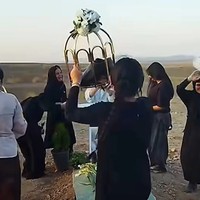
Schoolgirls chanting slogans for the dowfall of the Islamic Republic
The eye-catching presence of women in the uprising is another characteristic of this round of protests. It is a women's uprising, said Tajik, the former chief of the Iranian presidential office's Strategic Studies Center.
Quoting a prominent Iranian poet, Tajik said that the new generation of Iranians "does not like what it sees in society and cannot see what it likes."
He said the government wants the society to be timid and intimidated but the society is full of activists who do not wish to remain passive. Iranians are no longer obedient servants of the government, he said.
On the other hand, politician Gerami Moghaddam said that what we see today is a set of demands that were pushed back to the people's subconscious as a result of previous suppressions.
He reminded that the Iranian Constitution promised in its article 27 that protests are allowed in the Islamic Republic, and although everybody has been talking about this, the right to protest has never been recognized by successive governments during the past four decades. As a result, the people have lost their trust in the government and cannot believe its promises.
Gerami Moghaddam added that trust between the people and the government does not take shape easily, particularly if the government does not allow criticism and protest.
Although scholars and politicians have been debating the reasons of the current protests and although many of their arguments are valid, they are so intimidated by the regime's despotism that they never mention the root-cause of the problem which is the presence of a dictatorship that makes all the decisions without being accountable for their consequences. It is not responsive to people's views and ruthlessly crashes any resistance.
The fact that Supreme Leader Ali Khamenei finally spoke about the protests among military men rather than anywhere else, showed more or less that he feels safe only among the gunmen who protect him. In his speech, he blamed everyone and all foreign powers for the Iranian people's revolt, but it apparently never occurred to him that he and his decisions were responsible for the havoc that pushed him to his comfort zone at the corner of a military garrison to defend himself and attack others.
Previously, when he was more confident, he made such remarks at universities and among preachers at Friday prayers. It appears now, that he fears facing the people, even those who go to Friday Prayers.