Mossad Chief Due In Washington To Dissuade US From Reviving JCPOA
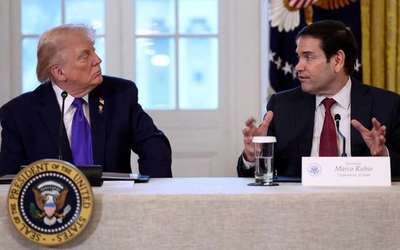
Israel’s Prime Minister Yair Lapid (right) in a meeting with Mossad Director David Barnea
The director of Israel’s intelligence agency Mossad is set to travel to Washington DC next week for talks as the US and Iran seem ready for an agreement to revive the 2015 nuclear deal.
Axios correspondent Barak Ravid quoted a senior Israeli official as saying on Sunday that David Barnea will attend closed door classified meetings of House and Senate intelligence committees.
In remarks that were not coordinated with Prime Minister Yair Lapid, the spymaster described the emerging agreement "a strategic disaster" for Israel and the United States “is rushing into an accord that is ultimately based on lies,” referring to Iran’s claim that its nuclear activities are peaceful in nature.
Shortly after Barnea’s comments were published, Lapid called the Mossad chief, telling him he had gone off script in his criticism of the US and asking for a clarification.
Barnea’s visit is the latest effort by Israel to sway Western powers from returning to the landmark accord.
Earlier in the day, Lapid said that Israel's“diplomatic fight” against the dealincluded its National Security Adviser Eyal Hulata and Defense Minister Benny Gantz holding recent meetings in the US.
“We are making a concerted effort to ensure the Americans and Europeans understand the dangers involved in this agreement,” Lapid said, reiterating that what was signed in 2015 was “not a good deal,” and that the one currently being discussed entails “greater dangers.”
Iran’s President Ebrahim Raisi (center), Parliament Speaker Mohammad-Bagher Ghalibaf (right), and Chief Justice Gholam-Hossein Mohseni-Ejei during a meeting on August 27, 2022
The heads of the three branches of the Iranian government have held a meeting as a major corruption case at Iran's Mobarakeh Steel Plant implicated dozens of state entities.
Following their meeting on Saturday afternoon, President Ebrahim Raisi, Parliament Speaker Mohammad-Bagher Ghalibaf, and Chief Justice Gholam-Hossein Mohseni-Ejei warned against "media speculations" until the review of the case is completed by the judiciary.
Only the judiciary should review and assess the reports of the parliament’s investigation, and it is necessary to refrain from media speculations until these reports are scrutinized in judicial courts, they announced.
Last week, a scathing report about an alleged $3 billion corruption case revealed massive irregularities and mismanagement in government-controlled Mobarakeh Steel Company, the largest steel producer in the Middle East and Northern Africa, which is located near the city of Mobarakeh, Esfahan Province.
The over 250-page report says the company paid astronomical sums of money to various government entities including the Revolutionary Guard (IRGC), ministry of intelligence, police, state broadcaster (IRIB), Friday prayer imam’s offices, religious seminaries, and bribed others such as certain media outlets, individuals, and social media influencers.
The company, which has a share of around 1% in Iran's GDP, employs around 350,000 people directly and indirectly and feeds over 2,800 other large and small enterprises.
A fire in a container storage area caused by an Israeli air strike on the Syrian port of Latakia
An Israeli airstrike on the western Syrian city of Masyaf on Thursday destroyed more than 1,000 Iranian-made missiles, a Syrian war monitor reported Saturday.
According to the UK-based Syrian Observatory for Human Rights, the attack targeted a missile warehouse in the city’s Syrian Scientific Studies and Research Center (SSRC) complex that stored thousands of medium-range, surface-to-surface missiles assembled under the supervision of Iran’s Revolutionary Guard’s “expert officers.”
The observatory added that 14 Syrian civilians sustained injuries with varying levels of severity during the Masyaf airstrike, in addition to casualties reported among Iranian-backed militias guarding the research center– which is heavily damaged during the attack.
Moreover, several fires broke out in areas surrounding the city ignited by the shrapnel from the explosions of the warehouse, with nearby civilian houses and property suffering material damage, the report said. Secondary explosions continued for hours after the strikes, along with the blazes caused by them. Local residents were reportedly instructed to remain in shelters until the fires were brought under control.
In addition to the strikes attributed to Israel, the United States also engaged in a string of tit-for-tat attacks last week against Iranian militias in northern Syria who had targeted US forces with rockets and drones.
Iran-backed militias established a foothold in Syria while fighting in support of President Bashar al-Assad during Syria's civil war.
A group of women allowed into football stadium on August 26, 2022
Under pressure from world soccer federation, FIFA,500 female fans were allowed into Tehran's Azadi Stadiumto watch a local league football match.
Tickets were sold only to 500 female fans and a special forces unit consisting of female anti- riot police was present to lead them to their secluded section of the 100,000-seat stadium. many say the ban on women’s presence at soccer matches was only lifted under pressure from the international governing body of association football (FIFA).
The world’s soccer authority had tried to convince Iran’s government to lift an unwritten ban on women attending stadiums to watch male players for nearly a decade.
The ban has led to many arrests, beatings, detentions, and abuses against women.
Iranian officials have always argued that male football fans swear profanities, so the atmosphere of stadiums is not suitable for women even if they are seated in a different part of the stadium.
“I wish you had voluntarily opened stadium gates to Iranian women and FIFA’s pressure wasn't behind the realization of [female fans’] right [to watch games in stadiums],” Azar Mansouri, the first female party leader in Iran wrote in a commentary in reformist Etemad newspaperSunday.
“Opposingthe demands of half of the country’s population for going to stadiums, cycling in public, and the right to choose how to dress, means the demand to end discrimination. Why should a plea such as going to stadiums be opposed in the name of religion in a society which is susceptible to tension and every kind of protest and violence, so that people say FIFA’s pressure saved Iranian woman,” Mansouri who was elected secretary-general of the Etehad-e Mellat (Nation’s Unity) Party in December wrote.
Many Iranians had urged FIFA to ban their country from the World Cup after hundreds of female fans were once again denied entry into a soccer stadium on March 1 in Mashhad in northeastern Iran to watch a World Cup qualifier between Iran and Lebanon, despite FIFA’s pressure to lift the ban on women entering stadiums. The fans, with tickets in their hands, were stopped from entering and were pepper-sprayed when they demanded to be allowed in.
Authorities tried to use the unprecedented presence of women at Azadi Stadium on Friday for regime propaganda but videos circulating on social mediashow enraged fans booing, during a religious and ideological propaganda song performed by a choir during halftime and drowning the choir’s voice.
The song, ‘Hello Commander’, is heavily promoted by the Islamic Republic, especially among children, and was first performed to a full stadium of mobilized regime supporters and school children on May 27.
‘Hello Commander’ is a song dedicated to Mahdi, the 12th Imam of Shiites who has been in occultation since the 9th century according to Shiite believers. The song and its promotion are unusual as the music is in the often frowned upon pop genre which has no place on Iran’s state media.
‘Hello Commander’ also mentions Supreme Leader Ali Khamenei who is believed by his devotees to be the Imam’s representative on earth and has to be obeyed as the Imam would be if he were present among believers.
A session of Vienna talks aimed at reviving the 2015 nuclear deal
Iran’s review of the US response regarding the possible revival of the 2015 nuclear deal will continue until Friday, while hardliners have called on Tehran not to accept the agreement.
In a tweet on Sunday, Nour News, a website affiliated with the secretary of Iran's Supreme National Security Council (SNSC), Ali Shamkhani, said that “the precise examination of US's responses to Iran's modified pivots regarding the proposal of the European Union coordinator, is still ongoing at expert levels, and this process will continue at least until the end of this week.”
The Iranian week ends on Friday, September 2.
Meanwhile, Iran's hardline Kayhan Daily, affiliated with Supreme Leader Ali Khamenei’s office, has called on the government to leave the negotiations and proceed without reviving the landmark accord.
“The path taken in these years has proven that with negotiations [Iran] cannot remove the sanctions, and with more negotiations only the scope of [other side’s] the demands will become wider,” the newspaper said.
The article noted that the capabilities of the Iranian government and the regional and global developments have provided the administration of Ebrahim Raisi with a good opportunity to correct the deviated path of the nuclear talks.
Removal of sanctions through negotiations is a bait that the US foreign policy officials have set on the hook, and the government can forget this bait and spend all its focus and energy on neutralizing the effects of the sanctions as it has been doing during the past year, the daily underlined.
The Iranian delegation in the Vienna nuclear talks, November 29, 2021
Unconfirmed parts of the US response to Iran in the nuclear talks have been leaked in Tehran, showing Washington’s rejection of three key Iranian demands.
The conservative government-controlled Jomhuriyeh Eslami (Islamic Republic) newspaper on Sunday published parts of the US response to Iran’s demands that were sent through the European Union mediators. The newspaper said that the text was published on “media”, which means it might have been leaked on social media, and there is no certainty if indeed it reflects the contents of the secret US response.
According to Jomhuriyeh Eslami, the US appears to have rejected three demands deemed important by Iran.
The newspaper adds that if indeed the leaked text reflects the American response, then 16 months of nuclear talks have again hit a snag and there won’t be a signing ceremony soon.
One Iranian demand related to guarantees it has been seeking was accepted, and that is submitting the new deal to the US Congress for approval. But this vague alleged promise by the Biden Administration does not say if the agreement will be submitted to the Senate or to both houses of Congress. It also does not say in what legal format the issue will be put to vote.
If it is true that there will be a vote in Congress, what if the agreement fails to pass in the Senate where Republicans can garner a majority on this issue. Even if the agreement is presented for a non-binding vote and it fails, the purpose of giving a guarantee to Iran will be defeated.
The Biden Administration has rejected an Iranian demand for the US to guarantee that Western companies will do business with Iran. The alleged American response has said that the US will permit all companies, except those under sanctions, to deal with Iran, but it cannot force private companies to interact with the Islamic Republic.
Iranian negotiators are well aware that a Western government cannot force private firms to do business with a country if they do not want to, and one can assume that this demand is probably made to be rejected, so Tehran can ask for something else.
The second Iranian demand rejected by the Biden Administration is about the US issuing insurance for multinational companies that would do business with Iran after the agreement. Iran demanded that if the United States withdraws form the nuclear deal again, these corporations be compensated. Washington has responded that this is beyond the powers of the President, and Biden can only give his official assurances as long as he remains the President and not beyond it.
The third Iranian demand allegedly rejected is related to SWIFT, the international banking transfers system. Iran has lost the privilege of using the mechanism since 2018 when the US withdrew from the JCPOA and imposed sanctions. This makes trade and investments extremely difficult.
The US in its response has said that Washington cannot guarantee Iran’s return to the SWIFT, because it has not accepted financial reforms demanded by the Financial Actions Task Force (FATF), an international watchdog based in Paris that requires financial transparency from countries, anti-corruption measures and laws to prohibit financing of terrorism.
Iran has dragged its feet since 2017 to approve the measures demanded by the FATF and is blacklisted along with North Korea.
The revelations that the US has rejected three Iranian demands has cast a shadow over hopes in Tehran of a quick agreement. The Iranian currency that had initially risen 15 percent against the US dollar has again retreated.