• العربية
  • فارسی
Brand
  • Iran Insight
  • Politics
  • Economy
  • Analysis
  • Special Report
  • Opinion
  • Podcast
  • Iran Insight
  • Politics
  • Economy
  • Analysis
  • Special Report
  • Opinion
  • Podcast
  • Theme
  • Language
    • العربية
    • فارسی
  • Iran Insight
  • Politics
  • Economy
  • Analysis
  • Special Report
  • Opinion
  • Podcast
All rights reserved for Volant Media UK Limited
volant media logo

Iran’s Nuclear Negotiators Attend Religious Mourning Ceremony In Vienna

Aug 7, 2022, 12:34 GMT+1
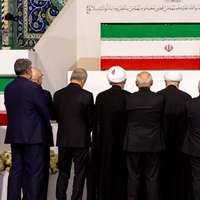
Tehran’s lead negotiator Ali Bagheri-Kani at the mourning ceremonies of the Islamic month of Muharram at Vienna’s Shiite mosque Islamic center of Imam Ali on August 6, 2022

Members of Iran’s negotiating team who are in the Austrian capital for a last-ditch efforts to revive the 2015 nuclear deal have attended a Shiite religious mourning ceremony in Vienna.

The twitter account of the Islamic Republic’s embassy in Austria published photos of Tehran’s lead negotiator Ali Bagheri-Kani at the mourning ceremonies of the Islamic month of Muharram. The event was held at Vienna’s Islamic center of Imam Ali, a Shiite mosque. 

The highlight of the month-long ceremonies of Muharram are the Days of Tasu'a and Ashura, the anniversary of the slaying of Shiite Imam Hussein and his 72 companions by his rivals to the leadership of Muslims. Ceremonies have been held for centuries in Iran and among Shiites in other countries, marking the event in the 680 AD battle of Karbala, in present-day Iraq, and have gained greater state support since the 1979 Islamic Revolution.

100%

This round of the Vienna talks reportedly focus on a text circulated in late July by Josep Borrell, the European Union foreign policy chief, to bridge gaps between the United States and Iran over how the Joint Comprehensive Plan of Action -- or JCPOA -- can be revived. It is unclear how specific are proposals in Borrell’s text and how far he outlines a process.

European officials have presented a tough face to reporters gathered outside the Palais Coburg hotel in Vienna, insisting that the current talks will not be “reopening” negotiations, and urging Tehran not to make “unrealistic demands.”

Most Viewed

Ghalibaf defends Iran-US talks amid hardline backlash
1
INSIGHT

Ghalibaf defends Iran-US talks amid hardline backlash

2
INSIGHT

Iran diplomacy wobbles as factions compete to avoid looking soft on US

3
VOICES FROM IRAN

Bread shortages, soaring prices strain households in Iran, residents say

4
ANALYSIS

The politics of pink: how Iran uses cuteness to rebrand violence

5

War-hit homeowners feel abandoned as Iran’s reconstruction aid fades

Banner
Banner

Spotlight

  • The future has been switched off here
    TEHRAN INSIDER

    The future has been switched off here

  • Lights out, then gunfire: Witnesses recount Mashhad protest crackdown
    VOICES FROM IRAN

    Lights out, then gunfire: Witnesses recount Mashhad protest crackdown

  • Family told missing teen was alive, then received his body 60 days later
    EXCLUSIVE

    Family told missing teen was alive, then received his body 60 days later

  • Is Iran entering its Gorbachev moment?
    INSIGHT

    Is Iran entering its Gorbachev moment?

  • Iran crackdown reaches cemeteries as graves of slain protesters defaced
    EXCLUSIVE

    Iran crackdown reaches cemeteries as graves of slain protesters defaced

  • Iran diplomacy wobbles as factions compete to avoid looking soft on US
    INSIGHT

    Iran diplomacy wobbles as factions compete to avoid looking soft on US

•
•
•

More Stories

Tehran Criticizes Israeli Attacks On Iran-Backed Islamic Jihad

Aug 7, 2022, 11:10 GMT+1

Tehran has criticized the Israeli airstrikes on Gaza that killed at least 10 members of Iran-backed Islamic Jihad militant group, as well as over 20 other people. 

Iran’s Foreign Ministry Spokesman Nasser Kanaani on Sunday also accused the international community of silence about the death of civilians in Israel’s latest operation, codenamed Breaking Dawn, that started on Friday and according to the Israeli military could last for a week.

Iran's Supreme Leader has been still silent about the attacks as Tehran’s negotiators are trying to salvage the 2015 nuclear deal in Vienna. 

About 600 rockets have been launched from Gaza towards Israel since the beginning of the operation but the death toll continues to rise from airstrikes in Gaza as most of the Palestinians’ rockets are intercepted by Israel’s Iron Dome defense system.

Six children and several Islamic Jihad fighters -- including leaders Khaled Mansour and Taysir al-Jabari -- are among the 32 Palestinians reported to have died. More than 200 people are also injured.

The latest bout of violence is the most serious flare-up between Israel and Gaza since an 11-day conflict in May 2021 that left more than 200 Palestinians and a dozen Israelis dead. 

Israeli Prime Minister Yair Lapid also said Friday that Islamic Jihad is an Iranian proxy that wants to destroy Israel, noting that Israel has a zero-tolerance policy for any attempted attacks from Gaza.

During the week, Ziyad al-Nakhalah, the leader of Islamic Jihad -- a militant outfit designated a terrorist organization by the US, EU, and UK -- held meeting with several senior Iranian officials in Tehran.

Loyal Critics Lash Out At Iran’s Raisi On His First Anniversary

Aug 7, 2022, 09:08 GMT+1
•
Iran International Newsroom

President Ebrahim Raisi's critics and political allies alike voiced their disappointment over his performance as he started his second year in office this week.

Some, like lawmaker Mansoor-Ali Zarei, representing Sari, were still hopeful about the government's success and promised "good things to happen in the next month or two. "However, knowing how limited the government’s capabilities and options are, he said, "If this is not accomplished, we will increase our supervision over the administration."

Others, such as member of parliament (Majles) Rahmatollah Norouzi were so disappointed that said: "The Majles is planning to reduce its cooperation with the government," adding that "The Majles is planning to impeach several of Raisi's cabinet ministers."

Most of the complaints made by both groups were about Raisi and his ministers' broken promises and their inability to solve the country's economic problems. Meanwhile, the spokesman for the parliament's Economic Committee Gholamreza Marhab reiterated that US sanctions on Iran are unprecedented in modern history, and the government should try to improve its performance to compensate for the damage.

While acknowledging that the deadlock over the revival of the 2015 nuclear agreement was a major obstacle to this, like most Iranian politicians, he repeated the formulaic rhetoric that the country's economy should not be tied to the problems resulting from the nuclear issue.

Criticism of Raisi and his cabinet began a few weeks after he assumed office in August 2021 and gained momentum earlier this year, but confidence of even his supporters was shaken when a decision by the government in early May led to a sudden jump in food prices.

Iranian lawmaker Mansoor-Ali Zarei
100%
Iranian lawmaker Mansoor-Ali Zarei

Raisi decided to eliminate a key subsidy for food imports, and this led to an across-the-board jump in prices.

An infographic published by Etemad Online website on August 6 indicated that the price of cooking oil has increased by 367 percent in the past year, rice by 200 percent, yogurt by 185 percent, pasta by 168 percent, cheese by 133 percent, butter by 120 percent, eggs by 114 percent, sugar by 102 percent, poultry by 101 percent.

Meanwhile the Tehran Chamber of commerce announced in a new report that meat and rice consumption in Iran has dropped dramatically during the same period.

MP Zarei said it is a shame that Iran has so many economic problems while it owns seven percent of the world's resources and has only one percent of the world population. He added that despite all the economic problems, the members of Raisi's economic team have still not learned to speak in one voice after one year in office.

Norouzi, the lawmaker for Golestan Province also criticized the government for giving a 10 percent pay rise to a small part of workers in Iran while the overall inflation rate in the country is more than 50 percent.

He said, "the Majles has serious criticism of the government's one-year performance, and we expect Raisi to work hard to improve the nation's livelihood."

He added that Iranians are in a very difficult situation and government ministers need to come up with practical plans to solve their problems. He pointed out that costs of housing, meat, dairy products, rice and all other essential commodities have risen dramatically during the one year Raisi and his colleagues were in office.

Norouzi warned that the Majles should put an end to its hesitations and take strict measures against the government if it fails to deliver.

‘Decisive Hours’ For Iran Nuclear Talks?

Aug 6, 2022, 19:57 GMT+1

An adviser to Iran’s nuclear negotiating team said on Saturday that some progress was made in Vienna, but issues remain and chances for an agreement is 50-50.

According to the Iranian government’s news website IRNA, Mohammad Marandi told the Arabic Al Mayadeen television, “I don’t know if we will reach an agreement, but the chance is 50 percent.” He stressed that the remaining issues are between Iran and the United States and “there are no differences with Europe or Russia.”

Earlier, the spokesman for Iran’s Atomic Energy Organization said that experts were discussing nuclear ‘safeguards’ issues during negotiations in Vienna.

Alighting from a car outside the Palais Coburg hotel, Behrouz Kamalvandi, responding to a question from Iran International, said “the flow [in talks] is not bad.” The spokesman’s comments were carried on the official Iranian news agency IRNA, which also cited an unnamed Iranian diplomat saying Friday that negotiations were now in their “decisive hours.”

Kamalvandi’s remarks relate to International Atomic Energy Agency (IAEA) enquiries into uranium traces found at sites not declared as nuclear-related. Iranian state media Saturday emphasized that Tehran demands the IAEA to drop the enquiries as part of reviving the 2015 Iran nuclear deal, the JCPOA (Joint Comprehensive Plan of Action).

The issue, which could derail the European-brokered talks in the Austrian capital aimed at restoring the JCPOA, shows intricate interplay between ‘political’ and ‘technical’ factors.

From a ‘technical’ viewpoint, IAEA head Rafael Mariano Grossi has expressed dissatisfaction with Iran’s explanations of potential military dimensions suggested by the uranium traces, which relate to sites used before 2003. Grossi has conducted enquiries as part of Iran’s ‘safeguards’ commitments under the Nuclear Non-Proliferation Treaty – which are separate from the JCPOA.

‘Wrecking ball’

But Iranian state media Saturday quoted Mohammad Jamshidi, deputy head of President Ebrahim Raisi’s office, saying Raisi had in telephone calls with the presidents of China, France, and Russia expressed a “firm position…that a final agreement [on reviving the JCPOA] could be reached only when safeguards claims were resolved and closed.”

This appeared to refer to the uranium traces Marandi Thursday called the IAEA probe a “wrecking ball” for the talks. Iran argues the IAEA in 2015 concluded its investigations of past nuclear work, and reopened the file – discovering the uranium traces – only in response to allegations made by Israel.

While France, Germany, the United Kingdom, and the United States have argued that IAEA ‘technical’ work on safeguards is independent of the JCPOA, they successfully moved a resolution at the IAEA governing board in June censuring Iran over failing to satisfy the agency.

The Vienna talks reportedly focus on a text circulated in late July by Josep Borrell, the European Union foreign policy chief, to bridge gaps between the United States and Iran over how the JCPOA can be revived. It is unclear how specific are proposals in Borrell’s text and how far he outlines a process.

Tough face

European officials have presented a tough face to reporters gathered outside the Palais Coburg hotel in Vienna, insisting that the current talks will not be “reopening” negotiations, and urging Tehran not to make “unrealistic demands.”

Iran’s foreign ministry Saturday framed the talks as Iran responding positively to Borrell’s text. It quoted Foreign Minister Hossein Amir-Abdollahian telling Wang Yi, his Chinese counterpart, by telephone that “the US should show a pragmatic response to Iran’s constructive proposals [in response to Borrell].” It has been widely reported that Iran has suggested it could drop its demand that the US remove the Iranian Revolutionary Guard Corps (IRGC) from its list of ‘foreign terrorist organizations,’ which was earlier seen as a likely deal-blocker.

Mikhail Ulyanov, Russia’s IAEA ambassador, tweeted Saturday evening that despite “a few remaining differences the negotiators have all the chances to fulfil their task successfully.”

Iranian Official Slams 4,000 Senior Colleagues Whose Families Live Abroad

Aug 6, 2022, 16:33 GMT+1

An Iranian official has criticized the high number of “senior officials” whose relatives are living abroad, confirming that there are over 4,000 sons and daughters have left Iran. 

Mohammad Saleh Hashemi Golpayegani, the secretary of Iran’s Headquarters For Enjoining Right And Forbidding Evil, tasked with promoting the clerical regime’s interpretation of Islamic laws, said on Saturday that unfortunately there are no laws to prohibit those whose family members live abroad from assuming government positions. 

He rebuked those officials who keep seeking to provide dollars and euros for their foreign-based children while promulgating the independence of the country. 

Hashemi added that there are some measures under study at the parliament about the issue. 

Earlier in the year, General Morteza Mirian, the commander of Iran’s Revolutionary Guards’ ground operations, said that the relatives of these officials should be “tracked” so as not to be allowed back to Iran to take up managerial positions.

A figure of 5,000 “descendants” of senior officials living abroad was cited in 2020 by Mohammad Gharazi, communications minister between 1985 and 1997 who was at the time considered a presidential hopeful. In November 2021, Alireza Salimi, a member of parliament, suggested that officials under former President Hassan Rouhani, including deputy ministers had moved to Europe due to fears they would be banned from leaving the country.

In 2019, Brian Hook, special representative for Iran (from 2018 to 2020) under President Donald Trump told Iran International that “children of Islamic Republic officials live rich and comfortable lives in the United States and other countries while Iranian people live in terrible conditions.” Hook said this showed “the regime’s hypocrisy.”


UK Expresses Concerns Over Iran’s Persecution Of Baha'is

Aug 6, 2022, 15:41 GMT+1

The UK has expressed deep concerns over the increasing arrests and persecution of followers of the Baha'i faith by the Islamic Republic as well as home demolitions and land seizures.

Britain's minister of state for South Asia and the Commonwealth at the Foreign Office, Tariq Ahmad, said on Friday “The UK is deeply concerned by increasing arrests of the Baha’i in Iran, including recent reports that the Iranian government has demolished houses and confiscated land in Roushankouh, [northern] Iran. Former spiritual leaders of the Baha’i in Iran are also reported to have been detained.

Condemning the increasing repression, he said that “the persecution of religious minorities cannot be tolerated in 2022. The persecution of religious minorities is a serious violation of international human rights law.”

“We are working closely with our international partners to hold Iran to account and continue to raise human rights concerns regularly with the Iranian Government,” Lord Ahmad of Wimbledon added.

On August 3, the US State Department’s Office of International Religious Freedom called on the Islamic Republic to stop its ongoing oppression, saying that “Amid a continued rise in arrests, sentences, and imprisonments, the US urges Iran to halt its ongoing oppression of the Baha'i community and honor its international obligations to respect the right of all Iranians to freedom of religion or belief.”

Iran’s security forces this week arrested several members of the Baha’i religious community regarded by the clerical government as heretics, and raided more than 20 households.

Security forces also laid siege to a village in northern Iran on August 2 and started demolishing houses and farms belonging to members of the persecuted Baha’i faith.