IRCG Chief Urges Regional Countries To End Ties With Israel
The commander of Iran’s Revolutionary Guards (IRGC) Major General Hossein Salami
The commander of Iran’s Islamic Revolution Guards Corps (IRGC) has urged states around the Persian Gulf to end their dealings with Israel, alleging that the country’s activities in the region are a cause of insecurity.
“Unfortunately, some countries on the southern side of the Persian Gulf have established political and security relations with [Israel], which poses a serious threat to the security of the region and these states themselves”, Major General Hossein Salami said on Wednesday during a visit to the southern island of Abu Musa, near the strategic Strait of Hormuz.
“We explicitly declare and warn that the continuation of such relations is not acceptable at all,” Salami said, speaking alongside IRCG Navy commander Admiral Alireza Tangsiri.
Salami also praised the combat power of IRGC units, especially those deployed to Iran’s islands in the Persian Gulf, the Strait of Hormuz and the Sea of Oman, as well as the capabilities of the Revolution Guards’ naval forces in the fields of drones, missiles, electronic warfare and submarines, adding that these forces can show timely and effective response to any threats.
The IRCG commander’s comments follow recent media reports that an air defense pact between Israel and friendly regional countries is in the works to confront threats posed by Iranian drones and missiles.
The reports came in the wake of a two-day meeting on March 27-28, dubbed the “Negev Summit”, which brought together the top diplomats of Israel, the United States, and four Sunni Arab states, including the Persian Gulf countries of Bahrain and the United Arab Emirates.
Wrapping-up the landmark gathering in Israel, Israeli foreign minister Yair Lapid announced the participants had decided to make the summit into a “permanent forum” that he said would help confront “our common enemies, first and foremost Iran and its proxies”.
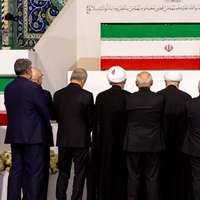
Iranian President Ebrahim Raisi among the commanders of Revolutionary Guards during the second death anniversary of IRGC Quds force commander Qasem Soleimani at Tehran’s Mosalla on January 3, 2022
Iranian academic Mohammad Fazeli and reformist political commentator Abbas Abdi have explored the best and worst-case scenarios for Iran as it entered a new year on March 21.
He offered an optimistic and a pessimistic scenario. He ruled out that the government’s poor performance can improve, because a change in the combination of players is out of the question.
President Ebrahim Raisi came to office with the motto of hardliners uniting to run the government and his choice of officials is limited to leftovers of former controversial president Mahmoud Ahmadinejad’s aides.
In the light of public dissatisfaction with the Raisi administration, Fazeli argued that any improvement in the government’s standing should come with a change in its foreign policy to open doors for economic improvement. But so far there is no sign of a shift.
Although the paradoxical formula leaves little room for optimism, Fazeli said that there might be a tentative breakthrough if Iran reaches a nuclear agreement with the West, which would lend a new lease of life to the economy and help the government, similar to what happened after the nuclear deal in 2015.
Fazeli insisted that the benefits of an agreement would not last long as Donald Trump or someone like him could always win the presidency in the United States. During the short breakthrough, however, the government can put up a show of its competence by controlling inflation and prices, and boost the battered Iranian currency.
Nonetheless, Fazeli said that Iran is a country at the brink. The government needs political courage and honesty to confront interest groups who are used to getting unfair economic advantages.
Fazeli went on to say that the worst-case scenario will occur when government officials adopt policies or make statements that would erode its legitimacy further. The situation will become even worse if negotiations with the West are not fruitful and radicals take the upper hand in the government. This, he said, will lead to protests with unpredictable consequences.
Iran needs ‘a détente’
Meanwhile, Abdi, who regularly writes for Iran's reformist newspapers, said that Iran needs a process of detente in its international relations to reach a long-term solution for its nuclear crisis. However, he expressed doubt that such a change would occur in the new year.
Abdi added that Iran's economic problems need political rather than economic solutions. "We are talking about those political variables that will totally change the government's approach." He added that the key elements affecting Iran's situation include, foreign policy, domestic politics and managerial approaches which are interlinked.
A good solution to the nuclear question can give the economy a boost although its effect may not be as big as it was in 2015. However, a deal on the nuclear issue will not encourage foreign investment because the companies know that the situation may change in two years. Without a fundamental solution to the nuclear program, the economic crises will worsen, Abdi said.
On the domestic front, the hardliners' rise to power is irreversible. But the problem is that coalitions among hardliners are loose and unstable, so there is a chance that political instability and social tensions will rise. The year that just started will be a continued purgatory, he argued.
The managerial approach, which is based on reliance on managers less educated than average Iranians, cannot create any sustainable growth or boost employment. All they can do is wasting resources. This is the Iranian economy's main problem Abdi said, adding that even if nuclear talks lead to an agreement, not much can be done in the absence of good plans, management, and coordination.
Women who were denied entry gathered outside the Emam Reza Stadium in the city of Mashhad.
Iran's government and football federation officials are blaming each other for an incident in Mashhad during which women who wanted to watch a soccer game were pepper sprayed.
In a statement Wednesday, the football federation of the Islamic Republic blamed time constraints for failing to properly organize ticket sales and organizing women's presence at the Emam Reza Stadium in the religious city of Mashhad and argued that federation officials had not "invited" women to purchase tickets to watch the game.
Without offering any apologies, the federation also said that there had been no plans to allow spectators to watch the game at until 72 hours before the game and claimed that the tickets held by women had been sold by "ticket forgers" or the women who purchase tickets online had lied about their gender. "Only nine women had purchased tickets for men's section of the stadium who will be reimbursed with 48 hours," the statement said.
"Doubtlessly the bitter episodes during this game were the result of mischief and profiteering of individuals who jeopardized the order and security of the stadium by printing and selling fake tickets," the federation alleged.
Many Iranians on social media have slammed the federation for suggesting that women should have been "invited" to watch the game by the federation authorities, but men could do so without being granted a special permission. "This statement is clear evidence of gender discrimination," a tweet by an Iran journalist who also called for a FIFA ban on Iran's football federation said.
President Ebrahim Raisi on Wednesday ordered an investigation into the incident which occurred in his hometown of Mashhad. The incident may mar Raisi's scheduled provincial tour to Mashhad where he headed with some cabinet ministers on Wednesday.
Iran's state media which are controlled by hardliners completely ignored the news about the incident in Mashhad. The state broadcaster (IRIB) did not report the violence against women and even censored a remark by Alireza Jahanbakhsh, one of the players for Iran's national team, who after the game said in an interview that he hoped women could watch the team's games at stadiums in the future.
The official news agency IRNA also censored the violence against female soccer fans in its reports. IRNA said Wednesday that Raisi has ordered the interior minister to investigate the "ticket sales process, failure to abide by the Covid protocols … regarding the maximum number of those allowed to attend the game," as well as "the violation of the rights of some citizens who had purchased tickets".
FIFA has been insisting for years that the Islamic Republic should relax the ban on women's presence at soccer stadiums and allow female spectators to its stadiums.
"FIFA should be held accountable for participating in Iran's human rights violation because it has not enforced its clear regulations and disciplinary rules on Iran codes all these years," Mehdi Rostampour, journalist and former presenter of sports program for the state-run broadcaster (IRIB), told Iran International TV on Wednesday.
The hands of the bride are decorated with henna or hina (Lawsonia inermis) in some wedding ceremonies in Iran, especially in southern regions
As many as 131,365 girls under the age of 15 have been married in Iran over the last five years, according to official data quoted by local media.
Tejarat News on Tuesday cited data from the Statistical Center of Iran (SCI) as showing that more than 7,500 of the marriages took place during the summer of 2021.
The numbers do not include unregistered marriages, which are common in the country’s rural areas.
Under the Islamic law, or Sharia, the minimum age at marriage for girls is 13 and 15 for boys.
Since the Iranian year of 1396, which started in March 2017, an average of about 30,000 girls under the age of 15 have been married every year.
During the same period, an average of 123 boys under that age have been married in the country.
ISNA earlier reported that 791 children were born to mothers aged between 10 and 14 in the first six months of the previous Iranian year beginning in March 2021. The semi-official news agency said that most of these births took place in the southeastern province of Sistan-Baluchestan.
Earlier in March, a married teenage girl who had experienced "domestic violence" set herself on fire in Sistan-Baluchestan, according local media reports.
It was the second reported case of self-immolation by a married Baluch girl in the past few months.
Iranian President Ebrahim Raisi in a cabinet meeting
Political analysts in Iran say President Ebrahim Raisi has not carried out any economic reforms and has simply surrendered to vested interests of regime insiders.
Alimohammad Namazi, a political analyst said in an interview with the conservative news website Nameh News that people's purchasing power has shrunk because of no change in the country's economic structure.
Iran has an economy dominated by the state, the Revolutionary Guard and religious entities.
Namazi said that the Raisi administration is facing numerous challenges including a major economic crisis, protests by labor groups across the country and a long-standing nuclear problem with the West that has remained unresolved.
The analyst stopped short of attributing the economic crisis to the nuclear issue and Iran's anti-West foreign policy, however, he stressed that Raisi's government is under pressure by the economic and foreign policy impasses more than its predecessors ever were.
He said Raisi was expected to meet the promises he made to those who voted for him, but none of his pledges have come true. The people understand the existing difficulties but expect to see Raisi delivering at least on some of his promises.
"Raisi had promised a non-partisan government which would not favor only one faction. But everyone in the government comes from the same 'principlist' camp," Namazi complained.
Prices continue to rise and there is no change in the country's problematic economic structure. Namazi did not mention the negative impact of insiders controlling large chunks of the economy, as most Iranian pundits exercise self-censorship when speaking to the media.
Namazi also blamed Raisi for the delay last year in resuming nuclear negotiations with the West, although he mentioned recent obstructions by Russia which complicated an agreement at the last minute. Meanwhile, he pointed out that even if there is a nuclear agreement, Iran may still not be able to conduct foreign trade as it has not yet accepted financial reforms to ban financing of terrorism.
In another development, a Reformist pundit and a critic of the administration, Ali Soufi, charged that Raisi has surrendered to the pressures of those who wanted a share of political power in Iran. He also accused the administration of being overwhelmed by its daily business rather than planning to deal with problems.
He added that Raisi has never presented a plan to the nation, let alone changing the make-up of his cabinet to carry it out.
Soufi said that he and other Iranian analysts agree that Raisi's honeymoon has ended as he has started his 8th month in office. "It is now time for him to be accountable," Soufi added. He further said, "So far, he has simply occupied the presidential seat and has not done anything in particular."
The reformist activist said that talks about impeaching some of Raisi's cabinet ministers have been continuing during the first days of the new Iranian year which started on March 21.
During the past months many Iranian lawmakers and political commentators have pointed out the weak performance of some of Raisi's economic team members, including his Labor Minister Hojjat Abdolmalei, Economy Minister Ehsan Khandouzi and Industry Minister Reza Fatemi Amin and called for their impeachment by the parliament.
Soufi said that Raisi, contrary to promises, surrendered to demands of different factions and gave a big share of posts to Majles Speaker Mohammad Bagher Ghalibaf and the Paydari Party.
Meanwhile Soufi warned that Raisi's claims about his success in boosting revenues and economic growth are not true because even if there is more money, it is simply the outcome of a sudden rise in oil prices which cannot last long.
A map from Kuwait's oil ministry showing the Dorra gas field near the tip of the Persian Gulf.
Kuwait says the disputed Arash/Durra gas field in the Persian Gulf is “exclusively owned” by the Persian Gulf nation and its neighbor Saudi Arabia.
Iran “is not part of the gas field” and is not a party to development projects related to it, Kuwait’s official news agency Kuna quoted Foreign Minister Sheikh Ahmad Nasser al-Mohammad al-Sabah as saying in a tweet on Tuesday.
The comments came hours after the minister said that the gas field, located on maritime borders of Iran, Kuwait and Saudi Arabia, was a tripartite issue between these countries.
He later explained that these remarks meant Iran could be involved in talks on the demarcation of the continental shelf where the gas field is located.
Iran has branded "illegal" an agreement reached between Kuwait and Saudi Arabia on March 21 to develop the gas field, insisting on its right to also exploit it.
The Kuwaiti-Saudi move came amid soaring energy prices on world markets following Russia's invasion of Ukraine.
Iranian Oil Minister Javad Owji said Monday that Tehran would soon begin drilling in the area after having completed “comprehensive studies…by drilling exploration wells and conducting seismic surveys”.
The Arash/Durra field, discovered in 1967 where maritime borders are unclear, has reserves of around 20 trillion cubic feet (ft3) of gas, enabling a potential daily output of 1 billion ft3 and 84,000 barrels of condensates.
“Even if the border is not demarcated, the field can be developed jointly using internationally tested models,” Iran’s Deputy Oil Minister for International Affairs Ahmad Asadzadeh said Sunday.
Iran had delayed its development pending a decision on maritime borders, he added.