Iran Nuclear Talks Resume In Vienna Following New Year Recess
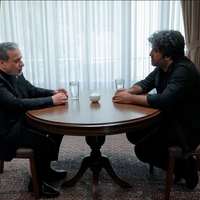
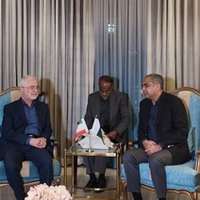
Iranian negotiators meeting with the three European envoys in nuclear talks on Monday.
Iran's Chief negotiator Ali Bagheri-Kani has met with the European Union’s representative at the Vienna talks, Enrique Mora, and envoys of the three European participants in the 2015 nuclear deal, Iran’s official news agency IRNA reported.
The second leg of the eighth round of the negotiations started Monday as the participating parties have returned to the Austrian capital after the New Year holidays and consultations with their respective capitals.
According to the negotiating teams, the sides were also engaged in unofficial talks and exchanging messages during the three-day recess, IRNA said.
During the Monday meetings, the participating teams continued discussions on the possible roadmap for revival of the July 2015 nuclear deal, also known as the JCPOA.
Earlier in the day, Iran's foreign ministry spokesman Saeed Khatibzadeh said that Western negotiators have backed off from their "maximalist demands”.
The emphasis on the Western side's "retreat" is apparently a reaction to the Iranian media's criticism of the negotiating team after the Russian envoy to the talks, Mikhail Ulyanov, said that Russia and China had convinced Iran to back off from some of its "maximalist demands" in the last round of talks.
Nour News which is affiliated with the secretary of Iran's Supreme National Security Council (SNSC), Ali Shamkhani, Sunday admitted that Iran had dropped some of its previous demands but accused the media of misinterpreting the facts.
Spokesman of Iran's foreign minister, Saeed Kharibzadeh speaking to reporters on December 27.
Iran's foreign ministry spokesman said Monday that Western nuclear negotiators in the Vienna talks have backed off from their "maximalist demands".
"If we have a shared text, it is because the Western side realized it had to back off from its maximalist demands. Today we witness the retreat, or I'd better say realism, of the Western sides in the negotiations," Saeed Khatibzadeh said in his press conference Monday morning.
Khatibzadeh reiterated that the West cannot have any demands other than those directly related to the nuclear issue and the 2015 nuclear deal, Joint Comprehensive Plan of Action (JCPOA) or lift the sanctions in a more limited way than they committed to in the deal. He reiterated that the window of opportunity to make a deal will not remain open forever.
Although it was clear from the beginning that the Vienna talks were focused on finding ways to restore the Joint Comprehensive Plan of act (JCPOA), the United States and its three European allies in the talks are also concerned about Tehran’s ballistic missiles and its interventions in the Middle East. There have been references in the past few months of the West asking Iran to agree to discuss these issues after the JCPAO talks, but Tehran has adamantly refused.
The stress on the Western side's "retreat" is apparently a reaction to the Iranian media's criticism of the negotiating team after the Russian envoy to the talks, Mikhail Ulyanov, said Russia and China had convinced Iran to back off from some of its "maximalist demands" in the last round of talks.
Nour News which is affiliated with the secretary of Iran's Supreme National Security Council (SNSC), Ali Shamkhani, Sunday admitted that Iran had dropped some of its previous demands but accused the media of misinterpreting the facts.
Russia's proactive role in the talks reflected by Ulyanov's quite frequent tweets and interviews, and photos of his meetings with the US Special Representative for Iran, Robert Malley, have become quite controversial in Iranian media and social media in recent weeks.
Many have criticized the Iranian negotiating team for conversing with the US side through the Russian envoy when they could directly negotiate with the US. Khatibzadeh responded to such criticisms by stressing that Iran and the US communicate through the European Union envoy Enrique Mora, the talks' coordinator, and exchange ‘non-papers’. "There have been no verbal messages."
The Russian envoy said on December 29 that the US and Russian delegations had "close consultations and coordination in the course of the Vienna talks" and called such coordination a prerequisite for progress towards restoration of the JCPOA. He also tweeted a photo of a meeting of all JCPOA participants, minus Iran, and the US.
"We have nothing to do with how 4+1 (France, Britain, Russia, China and Germany) communicate with the US, or whether they follow a shared mechanism or individual. We never ask them," Khatibzadeh said when asked about the Ulyanov-Malley meeting.
Khatibzadeh added that bilateral and multilateral talks among the participants in the talks are not unprecedented and not exclusive to the Russian team and attributed the attention drawn to Ulyanov and Russia's role in the talks to the extensive tweeting of Ulyanov whose posts are picked up by the press.
"The Russian envoy is very active in social media and has sometimes made statements that he [had to] correct two hours later," Khatibzadeh said.
Ali Bagheri and Mikhail Ulaynov meeting in Vienna in late December.
A state-affilliated website in Iran has admitted that Russia and China have "convinced Iran to drop some of its maximalist demands" in the Vienna nuclear talks.
Nour News which is affiliated with the secretary of Iran's Supreme National Security Council (SNSC), Ali Shamkhani, made the admission in an editorial Sunday headlined "Why Russia and China's Assistance To Iran Is Misrepresented by Media".
Mikhail Ulyanov, the Russian envoy to the talks, said this week that Russia and China convinced Iran to drop some of its "maximalist demands" and that Iran has accepted to negotiate on the basis of the text drawn up during earlier rounds of talks conducted by the Rouhani administration in the spring.
"[The media] present [Ulyanov's] statement, which is true, in a manner that causes a wrong interpretation by its audience," Nour News wrote referring to Ulyanov's revelations. Nour News also admitted that the text being negotiated is the same text previously agreed on -- which Tehran's new negotiating team at first insisted had been dropped – but said the new proposals have been incorporated into it.
"One of the cases that erroneously forms part of these controversies is the claim that the Iranian [negotiation] team is being led by the Eastern bloc, particularly Russia, in the talks", the editorial said while claiming that it is in fact Iran that has managed to encourage Russia to work alongside Iran and "pave the way to a good deal".
Tehran presented two new documents with new demands on November 29 when the Vienna talks to revive the 2015 nuclear deal, Joint Comprehensive Plan of Action (JCPOA) reconvened. European sides to the JCPOA – France, Germany, and Britain – rejected the move saying that Iran had gone back on all the progress made during April-June negotiations. US officials claimed that even Russia and China had been disappointed with Iran's action.
The Nour News editorial accused political rivals of fueling controversies over the role of Russia and China to overshadow upcoming visits to Moscow and Beijing by President Ebrahim Raisi and Foreign Minister Hossein Amir Abdollahian. They want to weaken the Raisi administration's " grand strategy of Looking to the East" to prove that Iran must align itself with the West, the website said.
The policy of relying on Asia or the East, particularly China and Russia, was promulgated by Supreme Leader Ali Khamenei in 2018, with the catchphrase, “Looking East”. Since then, his hardliner followers have made it one of the centerpieces of a ‘revolutionary economy’.
Meanwhile, in an editorial Sunday entitled "Excessive Demands of the US in Vienna", the official news agency (IRNA) said the United States is hampering the talks despite "recent progress and acceptance of Iran's demands of verifying the lifting of sanctions and assurance that the US will not renege from the nuclear deal again". US officials are reintroducing demands not related to the JCPOA and causing slowness in the talks, the website claimed, but did not mention any specific announcements by Washington.
"Bringing up issues such as the Islamic Republic's missiles and regional activities, particularly during [nuclear] talks, shows that Washington is trying to achieve its non-JCPOA aims through the nuclear talks," IRNA wrote and alleged that Western powers are using the media to exert pressure on Iran.
Robert Malley, US chief negotiator in Iran nuclear talks.
In a sharply critical article in the Spectator, Jake Wallis Simons has called the Iran nuclear talks one of “the West’s great foreign policy failures of 2021”.
Simons, who is the Editor of the Jewish Chronicle, has based some of his criticism on information from unnamed diplomatic sources, but also on arguments such as candidate Joe Biden’s move in September 2020 to telegraph his eagerness to rejoin the Obama-era 2015 nuclear agreement known as the JCPOA.
Simons said in the Staurday op-ed that “there has been a dramatic failure to extract any concessions from Tehran,” not even a freeze on Iran’s uranium enrichment that is bringing the country close to the threshold of stockpiling enough fissile material for a bomb.
He quoted diplomatic sourcesas having described the chief American negotiator Robert Malley as “the most dovish official we’ve ever seen.”
Simons wrote that Malley “has bent over backwards so far that, as one official put it, he now speaks to Tehran from between his legs.”
The Op-ed also described tensions among Western countries involved in the talks and the European often trying to hold back the Biden Administration from making unnecessary concession to Iran.
Simmons concludes. “It is hard to avoid the conclusion that 2022 will be Iran’s year.”
Russia's envoy to Iran nuclear talks, Mikhail Ulyanov. November 29, 2021
Russia’s role in the Vienna nuclear talks splits Iranians. Some accuse Moscow of pressuring Tehran, while others see Russia negotiating on Iran’s behalf.
With Iranians traditionally suspicious of both Russia and Great Britain, which held influence in the country from the mid-19th to the mid-20th century, frequent tweets from
Mikhail Ulyanov, Russia’s lead negotiator in Vienna, have offered fuel for controversy.
Ulyanov, who has also spoken to journalists starved of news about the talks, said this week that Russia and China had persuaded Iran to moderate some of its demands, including an insistence that talks focus on sanctions rather than the nuclear issue.
Ulyanov also said Iran had agreed to negotiate on a draft under discussion when talks were suspended in June at the tail end of the government of President Hassan Rouhani. Officials in the new administration of President Ebrahim Raisi (Raeesi) have instead emphasized written proposals submitted by Iran at the beginning of December.
In comments to the media on December 30, Ulyanov suggested that the first half of February was a realistic target for achieving agreement on how to revive the 2015 nuclear deal, the Joint Comprehensive Plan of Action (JCPOA).
This remark was seized on by a commentary by the Iranian Labour News Agency (ILNA) Saturday as consistent with warnings from both the United States and the three European JCPOA signatories – France, Germany and the United Kingdom – that it would soon be too late to revive the 2015 agreement. "These remarks were made by the Russian envoy despite the Iranian side's insistence that there would be no deadline,” INLA noted.
Moscow’s consistent position sincethe US left the JCPOA in 2018 and Iran began in 2019 to expand its nuclear program beyond JCPOA limits is that both should respect their commitments under the agreement.
Photos tweeted by Ulyanov of his meetings with Rob Malley, the United States official leading the US delegation in Vienna, and his December 29 reference to“close consultations and coordination”with Malleyhave spurred more controversy. Many on social media took the photo as a sign that Russia is negotiating on Iran’s behalf face to face with the United States, while Tehran refuses to have direct talks with Washington. “Isn’t this a sign of how weak the regime is?”, a post said.
Farmer in remote village
In its commentary, ILNA noted that talks between Malley and Ulyanov had “worried” Iranians who had “become sensitive in recent days about Russian moves … that Moscow is playing the Iran card against Washington.” Such Iranians, INLA continued, saw these meeting as “their country's dignity being peddled at the negotiation table.”
In an editorial Saturday headlined "Honesty, Pillar of Good Governance,” Masih Mohajeri, editor of the conservative Jomhouri Eslami (Islamic Republic) newspaper, wrote that Iranians “should not hear the news, decisions, and plans of their country from foreigners.” While Jomhouri Eslami has a small circulation, many Iranian news websites on Saturday reprinted the editorial in full.
Mohajeri recounted a conversation with a "farmer in a remote village" who had asked him why Iran’s leaders were not admitting that they had decided to agree to revive the 2015 nuclear agreement soon. "His expectation from the authorities is to be honest with the people," Mohajeri wrote.
Another commentary in Jomhouri Eslami Saturday, written by Hossein Alaei, former commander of the Revolutionary Guards (IRGC) navy, offered advice over the 20-year Iran-Russia pact due to be signed during Raisi's upcoming visit to Moscow."We should be vigilant so that new pacts increase the two countries' trade and be mutually beneficial rather than solving Russia's long-term problems," Alaei wrote.
Foreign Minister Yair Lapid has claimed Israel has superior military capabilities, amid talks between world powers and Iran on restoring the 2015 nuclear deal.
In an interview with Channel 12 on Friday, Lapid answering a question about Israel’s military ability to attack and destroy Iran’s nuclear infrastructure, said, “Israel has capabilities, some of which the world, and even some experts in the field, cannot even imagine. And Israel will protect itself against the Iranian threat.”
As world powers try to restore the Joint Comprehensive Plan of Action (JCPOA), abandoned by former US president Donald Trump, Israel is concerned of a new agreement that would not permanently restrict Iran’s nuclear program, while lifting sanctions giving Tehran a financial lifeline.
The foreign minister also repeated an earlier position that if Israel feels threatened by Iran’s nuclear advances, it could attack without necessarily informing the Biden administration, which is pursuing a new accord with Iran.
“Israel will do whatever it needs to do to protect its security. And we don’t need anybody’s permission for that. That’s been the case since the first day we established this state,” he said. He also added that “Israel is not against a good deal, it is only against the wrong deal.”