Iranian state TV broadcasts mock hanging of Trump live
An actor wearing a Donald Trump mask and an orange prison uniform stands inside a mock prison cell alongside a man dressed in a Revolutionary Guards uniform during a staged execution performance in Tehran.
Iranian state television broadcast live a mock hanging of US President Donald Trump as part of a pro-establishment campaign featuring public displays calling for his killing, following Republican losses in Tuesday's US midterm elections.
Footage circulated by Iranian media showed an actor wearing a Trump mask and dressed as a prisoner being subjected to a mock execution by a man in a Revolutionary Guards uniform in Tehran's Tajrish Square, as spectators watched and cheered.
The performance was part of a series of anti-American displays organized by Iranian authorities across the capital.
Banner depicting US and Israeli leaders set ablaze
Videos circulating on social media also showed a large banner depicting Trump, US Vice President JD Vance, Israeli Prime Minister Benjamin Netanyahu and US special envoy Steve Witkoff being set on fire in Tehran's Enghelab Square on Wednesday evening, November 4.
Pro-establishment demonstrators set fire to a large banner depicting US President Donald Trump, Vice President JD Vance, Israeli Prime Minister Benjamin Netanyahu and US special envoy Steve Witkoff in Tehran's Enghelab Square on November 4, 2026.
People gathered in front of the banner chanted "We will kill Trump" as it burned. Several Iranian media outlets also published the footage.
Another large billboard installed in Enghelab Square depicted Trump behind prison bars, his head bowed beneath the English-language message "We will kill Trump."
Pro-establishment demonstrators gather in Tehran's Enghelab Square on November 4, 2026, beneath a giant billboard depicting US President Donald Trump behind bars with the message "We Will Kill Trump."
State-backed campaign targets Trump
Tehran's municipal authorities organized the prison-themed exhibition in Tajrish Square, which included a life-size cell and an actor impersonating the American president.
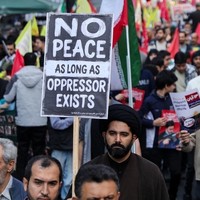
The displays coincided with events marking the anniversary of the 1979 seizure of the US Embassy in Tehran, during which demonstrators carried placards calling for Trump's death.
Iranian diplomatic accounts also joined the campaign following the US midterms.
The Islamic Republic's embassy account in India shared an AI-generated video depicting Trump being carried out of the White House and thrown into a dumpster marked "Hazardous waste."
Another AI-generated image portrayed a defeated Trump outside the White House, accompanied by the words "Mission Failed" and a message mocking his election losses.
Iran targets Trump after Republican election losses
The displays followed major Republican setbacks in the November 3 elections, which handed control of Congress to the Democrats.
Trump attributed much of the Republican defeat to the US-Israeli war with Iran and the resulting increases in gasoline prices and inflation, although he maintained that the war had been worthwhile.
A man walks past a display of Iran's Kheibar Shekan ballistic missile in Tehran.
Russia agreed to supply Iran with 90 helicopter-mounted launchers for precision-guided missiles widely used by Russian forces in Ukraine, the Financial Times reported on Thursday, revealing another dimension of Moscow's military cooperation with Tehran.
The previously unreported order adds to evidence of Russian assistance to Iran's military, including a secret program to help Tehran develop supersonic cruise missiles that could potentially threaten US Navy vessels in the Persian Gulf.
A Russian defense industry production schedule covering 2024 and 2025, obtained by the FT, identified an export order for 90 APU-L launchers from a buyer designated "K-10," a code used by Russia's state arms exporter to refer to Iran.
The documents did not establish whether the launchers were ultimately delivered.
Precision-guided weapons used in Ukraine
The launchers are designed to carry Russia's light multipurpose guided missile, known as LMUR or Izdeliye 305, a precision weapon capable of striking moving targets.
The missile entered Russian military service in 2022 and has since been widely used in Ukraine. An operator can guide it during flight, allowing adjustments to its target.
According to the US Army's Worldwide Equipment Guide, APU-L launchers are designed for Russia's Mi-28 attack helicopters and can carry two missiles each.
Iran has already acquired Russian Mi-28 helicopters. In November 2023, Iranian officials announced that arrangements for their delivery had been finalized. Images appearing online in January 2026 subsequently showed an Mi-28 at an aviation facility in Tehran, according to the FT.
The production documents were provided to the newspaper by Dallas Analytics, a Ukrainian private intelligence organization.
A May 2024 letter from Russian missile manufacturer Vympel warned another defense bureau that delays in supplying launcher components could jeopardize several contracts.
Russia also helped Iran develop supersonic cruise missiles
The latest report follows a September FT investigation revealing that Russia had secretly assisted Iran in developing supersonic cruise missile technology through a program codenamed C430L.
According to leaked Russian correspondence, travel records and military patents reviewed by the newspaper, the program began in 2023 and continued during this year's war involving Iran, the United States and Israel.
The project focused on developing a ramjet propulsion system capable of sustaining missile flight at several times the speed of sound, potentially reducing the time available for US and allied air defenses to respond.
"For the Iranians, this would give them a qualitatively new strategic weapon system that could threaten US Navy vessels," Jim Lamson, a former CIA military analyst specializing in Iran, told the FT.
Iran had built and flight-tested the propulsion system, but the newspaper found no evidence that a Russian-assisted supersonic cruise missile had entered operational service.
Russian engineers reportedly traveled repeatedly to Iran and later analyzed Iranian flight-test data, advising on fuel systems, combustion stability, air intake and engine design.
"This is the transfer of a highly strategically sensitive military technology from Russia that the Iranians have wanted to acquire for decades," Fabian Hinz, a senior analyst at Conflict Armament Research, told the FT in September.
Military cooperation deepens during Iran war
The launcher agreement and missile development program illustrate different aspects of Russian assistance to Tehran, ranging from supplying military equipment to transferring specialized technical knowledge.
The FT has also reported that Russia agreed to supply Iran with Verba shoulder-fired air defense systems.
The relationship has developed in both directions. Iran previously supplied Russia with Shahed attack drones used in Ukraine and helped Moscow establish domestic production.
Western intelligence officials told the FT that Moscow and Tehran had strengthened their military partnership further during this year's conflict in the Middle East, despite US President Donald Trump's assertion that Russia was doing "very little, if anything" to assist Iran.
"It is indicative of Russia's willingness to continue supplying Iran despite its own wartime demands and with far less concern about western objections than in the past," Nicole Grajewski, a scholar at the Carnegie Endowment for International Peace, told the newspaper.
Limits to Moscow's involvement
Despite growing cooperation, analysts cautioned against overstating Russia's role in the ongoing conflict.
Hanna Notte, Eurasia program director at the James Martin Center for Nonproliferation Studies, said Moscow was balancing its support for Iran against its relationships with Washington and other countries in the Middle East.
"Russia still has certain red lines when it comes to its involvement in this war," Notte told the FT.
"Which is why the support it has provided to Iran is operationally helpful but is not the game changer in this war."
US President Donald Trump and Vice President JD Vance take part in ceremonies in commemoration of the Memorial Day holiday, at Arlington National Cemetery in Arlington, Virginia, US.
US Vice President JD Vance blamed the war with Iran for Republicans' sweeping midterm election defeats, including the loss of both chambers of Congress, as President Donald Trump weighed renewed military strikes against Tehran or a negotiated settlement to end the conflict.
"The reason we lost is the war," Vance wrote on X.
"If you'd like to argue it was worth it, that losing the Senate for the next 6 years was worth it, then do so," Vance wrote on Wednesday. "But everyone knows why we lost. And any honest conversation about where we go from here must start there."
Trump acknowledged that the war had contributed to the election setbacks but defended his decision to attack Iran, saying he would make the same choice again.
Trump defends Iran war
Speaking to reporters on Wednesday, Trump said Vance's assessment was "largely true," pointing to the rise in gasoline prices following the conflict.
"We had no choice. You can't let Iran have a nuclear weapon," Trump said.
Asked when he would end the war, Trump replied: "Whenever I wanted to. But it's got to be done right, because they can't have a nuclear weapon."
In comments to The Wall Street Journal, Trump said "Iran was a piece of it," referring to the Republican losses, but reiterated that the military campaign was necessary.
Vance, who has been involved in negotiations with Tehran, also praised advice to seek a diplomatic resolution to the conflict.
The Wall Street Journal reported that Vance had opposed the war from the outset, despite publicly defending the administration's military actions.
US officials debate renewed strikes on Iran
Senior US officials are debating whether to escalate military operations against Iran or continue applying economic pressure while pursuing negotiations, according to reports by The Wall Street Journal and Axios.
The Journal reported on Wednesday that some officials were advocating an escalation of strikes, while the administration had spent weeks discussing the war's impact on the elections and whether to publicly acknowledge continuing military operations against Iran.
Axios reported that the US military was completing preparations for a possible resumption of major combat operations, including deploying additional military assets to the region.
Other senior officials favor maintaining the naval blockade of Iranian ports and economic sanctions while assessing whether Tehran is prepared to reach an agreement.
CIA Director John Ratcliffe and Treasury Secretary Scott Bessent are among those advocating continued economic and military pressure rather than an immediate return to large-scale strikes, according to Axios.
Trump has not announced a decision on whether to expand the military campaign.
Qatar seeks agreement to avert renewed fighting
The discussions in Washington come as Qatar continues efforts to secure US and Iranian approval for a proposal aimed at preventing another major escalation and potentially restarting direct negotiations.
According to Axios, Qatari mediators are working to obtain support from both sides for a draft agreement, with the possibility of direct talks in the coming days.
Vance has been among the senior officials advising Trump to pursue an agreement with Iran, warning privately about the consequences of prolonging the war, the report said.
The mediation effort has yet to produce a breakthrough. Iranian and US officials remain divided over key issues, including Tehran's nuclear program, sanctions and arrangements involving the Strait of Hormuz.
Trump's administration is also considering maintaining its current approach of a naval blockade and economic pressure without immediately resuming large-scale military operations.
Trump backs defense secretary amid scrutiny of Iran campaign
Trump also defended Defense Secretary Pete Hegseth on Wednesday as questions emerged over whether the administration might change its military leadership following the election.
Asked whether he was considering replacing Hegseth, Trump said: "No, I think he's doing a very good job."
Reuters reported that some Trump advisers had discussed the possibility of replacing Hegseth, who has been a prominent supporter of the war against Iran.
Democratic lawmakers, who won control of both chambers of Congress, have indicated that they intend to investigate the Pentagon's handling of the Iran conflict.
The Defense Department said Hegseth remained committed to serving through the end of Trump's term and defended the legality of its operations.
With no agreement yet reached between Washington and Tehran, the administration continues to weigh renewed strikes, sustained economic pressure and diplomatic efforts to end the conflict.
US House Democratic Leader Hakeem Jeffries speaks at a Democratic Congressional Campaign Committee (DCCC) midterm election night watch party as election results point toward Democrats regaining control of the US House of Representatives, in Washington, DC.
Democratic leaders vowed Wednesday to push for an end to the Iran war and tackle rising living costs after sweeping US midterm election victories handed their party control of both chambers of Congress.
"It's important for the president, before we even cross over into the new Congress, to end this war in Iran," House Democratic leader Hakeem Jeffries told MS Now's Morning Joe programme.
Jeffries blamed what he called Trump's "reckless and costly war of choice in Iran" for driving up fuel and fertiliser costs, contributing to higher prices for groceries and other goods.
The Democrats' victories in Tuesday's elections gave them control of both the House of Representatives and Senate, reversing Republican majorities and potentially allowing them to constrain President Donald Trump's agenda during the final two years of his presidency.
Democrats flipped at least seven Republican-held Senate seats, winning in Texas, Kansas, Iowa, Ohio, Maine, North Carolina and South Carolina. They also captured more than two dozen Republican-held House districts, including areas Trump had won comfortably in the 2024 presidential election.
Among the most notable results, James Talarico became the first Democrat elected to the Senate from Texas since 1988, defeating Republican Ken Paxton. Democrats also retained competitive Senate seats in Georgia and Michigan.
The scale of the victories reflected voter dissatisfaction over high living costs, the war with Iran and concerns about government corruption, according to Associated Press voter polling.
Democratic leaders demand an end to Iran war
Senate Democratic leader Chuck Schumer said the incoming majority could use congressional control over government spending to push for an end to military operations against Iran.
"This war must end. It must end," Schumer told reporters Wednesday.
He said Congress's "power of the purse" was one way to restrain a president conducting a war without the consent of the American people.
Jeffries, who is set to become House speaker when the new Congress convenes in January, said the party's priority would be reducing the cost of groceries, gasoline, housing and healthcare.
"We ran on affordability. We won on affordability," he said.
Trump and Vance acknowledge war's impact
Vice President JD Vance blamed the Iran war for Republicans' losses, writing on X that "the reason we lost is the war."
Trump acknowledged Wednesday that the conflict had likely contributed to the electoral defeat by pushing up gasoline prices, but defended his decision to launch military action against Tehran.
"I think it's largely true because it drove the gasoline up a little bit short term," Trump said when asked about Vance's assessment.
He insisted the war had been necessary to prevent Iran from acquiring nuclear weapons and said he would make the same decision again.
"I can tell you that as far as that war is concerned, I would have done nothing different," he said.
Trump also argued that Republicans would have won if he had been on the ballot, saying the enthusiasm he attracted at campaign rallies had not transferred to other Republican candidates.
The Democratic takeover of Congress will give the party greater power to investigate the Trump administration, challenge its legislative agenda and potentially restrict military funding.
However, Trump will retain the presidency and veto power, meaning congressional control alone will not give Democrats the authority to end the war.
Tehran hails results, warn against further strikes
Iranian officials portrayed the Democratic victories as a rejection of Trump's military campaign, although Tehran remained wary of renewed US attacks.
"Conscience or the cost of living, Americans said NO TO WAR, and we endorse this message," Parliament Speaker Mohammad Bagher Ghalibaf wrote on X Wednesday.
Ghalibaf, who has led Iran's negotiations with Washington, warned the US government against disregarding voters' message by launching further strikes.
Supreme Leader Mojtaba Khamenei, however, dismissed expectations that a change in the balance of power in Washington would alter US hostility toward Tehran.
A written statement attributed to Khamenei warned against "even the slightest inclination towards submission" to the United States, saying Washington's approach would persist regardless of which party was in power.
"The US sees the end of its hegemony as distant; we see it as near," Khamenei added.
Two senior Iranian sources cited by Reuters said that while Tehran welcomed the Democratic victories, Iranian leaders feared Trump could attempt to compensate for his electoral setback with renewed military action.
A Revolutionary Court in Tehran has sentenced social media activist Amirhossein Mousavi to death on charges of "corruption on earth" over his activity on X, his lawyer said Wednesday.
In a post on X, Mousavi's lawyer, Reza Shafakhah, said his client had been sentenced over his online activity under the account name "James Bidin."
The sentence was issued by Branch 15 of Tehran's Revolutionary Court, presided over by Judge Abolghasem Salavati, who is under US, British and European Union sanctions over his role in human rights abuses.
Mousavi, 42, who has been detained since December 2024, was also sentenced to five years in prison for "insulting religious sanctities," his sister said on X.
His sister, Saeideh Mousavi, condemned the ruling and called for it to be overturned.
"We condemn this unjust sentence and demand its reversal and that Amirhossein's life be saved," she wrote.
She said her brother had used his online presence to amplify the voices of political prisoners and families of people killed during protests in Iran.
"His only crime was writing about and highlighting the suffering of people whose voices were rarely heard," she wrote, adding: "Writing about people's suffering is not a crime!"
The death sentence also prompted messages of support from other X users, some of whom echoed his sister's appeal.
"He was our voice for years. Now it's our turn to be his," one user wrote.
Another warned that the ruling could have wider implications for Iranians expressing their views online.
"Today, Amirhossein Mousavi was sentenced. Tomorrow, it could be you or me," the user wrote. "We must speak up for him before it's too late."
Mousavi had also received support from families of slain protesters before Wednesday's verdict.
Shabnam Eskandari, whose brother Mohammadreza Eskandari was killed during the 2022 Woman, Life, Freedom protests in Pakdasht, near Tehran, praised Mousavi for helping bereaved families keep the memories of their loved ones alive.
In an October 10 post on X, Eskandari recalled how Mousavi had repeatedly shared posts about her brother and other slain protesters.
"It was James Bidin who constantly shared posts from our families' accounts and repeatedly wrote the names of our loved ones," she wrote.
Solitary confinement, televised confession
Mousavi was arrested on December 18, 2024, at Tehran's Mehrabad Airport while preparing to travel to the southern Iranian island of Kish, according to HRANA.
His lawyer previously said security agencies had monitored Mousavi's X account for nearly six months before identifying him through his activity on the platform.
His prosecution has drawn attention over allegations of prolonged solitary confinement, physical abuse and a televised confession that Mousavi subsequently said had been obtained through threats and coercion.
On October 6, 2025, Iranian state television aired footage of Mousavi during its 20:30 news programme, presenting statements linking him to alleged intelligence activities involving Israel.
Mousavi later rejected the allegations in a letter from Evin Prison, saying interrogators had forced him to participate in the televised interview after months of physical and psychological pressure.
He said he had spent 148 days in solitary confinement, been subjected to beatings and faced threats involving his wife, who had also been arrested.
According to Mousavi, interrogators threatened to detain her again unless he agreed to the interview.
He said his statements had been made under pressure and at the prompting of interrogators, and that state television had selectively edited and distorted his remarks before broadcasting them.
Mousavi also denied supplying Israel with information about sensitive military facilities or maintaining contact with agents of Mossad, Israel's intelligence agency, saying he had never had access to classified information.
Iranian state television has a long history of broadcasting confessions by detainees accused of espionage, national security offences and involvement in anti-government protests.
Human rights organisations have repeatedly criticised the practice, warning that confessions obtained under duress have been used in criminal proceedings, including cases resulting in death sentences.
Hundreds under death sentence
Mousavi's sentence comes amid growing concern over Iran's use of capital punishment against political prisoners and people detained during nationwide anti-government protests in January 2026.
Although Mousavi was arrested before those demonstrations, his case comes as Iranian courts continue to issue death sentences against protesters and other defendants accused of political and national security offences.
An Iran International review of cases involving political charges indicates that approximately 220 prisoners are currently under sentence of death, up from around 194 recorded in early October.
Iran Human Rights, a Norway-based rights organisation, reported Tuesday that at least 691 people had been executed in Iran during the first 10 months of 2026.
Of those, 81 were executed on security-related charges, a category that includes political prisoners, protesters, people accused of espionage and other defendants.
The organisation said 36 protesters were among those executed during the period, including 34 arrested in connection with the January uprising and two associated with the 2022 Woman, Life, Freedom protests.
A plastic skeleton appears from the sunroof of a vehicle parked in front of the Capitol Hill in Washington, DC, US, October 31, 2026.
The Democrats' victory in the US midterm elections has drawn mixed reactions from Iran International's audience, with some criticizing Donald Trump's prolonged indecision over Iran and others maintaining that Democratic control of Congress will not prevent military action.
Democrats regained control of both the House of Representatives and the Senate from Republicans in the November 3 elections, ending two years of Republican control.
The outcome does not change Trump's presidential powers during his remaining two years in the White House, but could influence his administration's decisions, including its approach toward the Islamic Republic.
"Don't celebrate too soon. An angry Trump is far more lethal to you than a happy Trump," one wrote, addressing Islamic Republic officials.
Islamic Republic warned against early celebrations
Officials and supporters of the Islamic Republic have sought to portray the election results as a victory for themselves and a defeat for Trump's policies.
However, comments shared with Iran International reflected different perspectives, including concerns about the consequences of the vote and warnings against premature celebrations by Iranian authorities.
Several people suggested that such celebrations reflected a misunderstanding of the US political system and the powers Trump retains as president.
"Islamic Republic officials are talking as if they don't realize Trump still has two years in office. Even that amount of time is enough to finish the job," one user wrote.
Another commenter pointed out that congressional elections would not necessarily prevent military action against the Islamic Republic, suggesting Trump could use his veto powers to counter congressional opposition.
The new Congress will take office on January 3, 2027.
Trump previously said that a Democratic victory could force him to use his presidential veto so frequently that he might become known as "Mr. Veto."
Democratic majorities could increase congressional oversight of the administration and impose budgetary restrictions on military operations. However, overriding a presidential veto requires a two-thirds majority of members present and voting in both chambers.
Trump's delays over Iran draw criticism
A substantial portion of the comments criticized Trump's handling of the confrontation with the Islamic Republic, particularly his shifting positions on negotiations, economic pressure and military action.
Some expressed frustration over the prolonged uncertainty, saying Trump's approach had prevented him from fulfilling his promises and cost him an opportunity to end the war and bring about political change in Iran.
"Trump prolonged this uncertainty for so long, talking about war one day and negotiations the next, that he missed the opportunity to overthrow the Islamic Republic and turned what could have been a victory into a defeat," one commenter wrote.
Another accused Trump of excessive accommodation, saying his approach had given the Islamic Republic time to delay negotiations, use diplomacy to avoid further confrontation and escape additional Israeli strikes.
Others described the administration's approach as a "cat-and-mouse game" or a strategy of pursuing contradictory policies.
Trump said on November 2, a day before the elections, that he was in no hurry to resume the war and preferred to continue economic pressure to persuade Iran to accept an agreement.
The US president also said military action would remain an option if negotiations failed.
S House Minority Leader Hakeem Jeffries (D-NY) walks down the House steps on Capitol Hill in Washington, DC, US, September 30, 2026.
One citizen questioned Trump's apparent expectation that economic hardship would drive Iranians into the streets, pointing to the armed repression protesters face alongside their worsening living conditions.
Another blamed Trump for missing an opportunity to continue military strikes following the killing of Ali Khamenei. A separate commenter accused the US president of halting the momentum toward overthrowing the Islamic Republic by preventing further Israeli operations.
Other comments cited continued executions, economic hardship and threats to Iran's critical infrastructure as evidence that Trump's approach had failed to produce meaningful results.
Can a Democratic Congress constrain Trump?
Other Iran International audience questioned whether Democratic control of Congress would significantly restrict Trump's ability to pursue military operations or increase pressure on the Islamic Republic.
Some cited historical examples of US military campaigns that continued or expanded despite opposition-party control of Congress.
One pointed to the continuation of the Vietnam War and its expansion into Cambodia under President Richard Nixon, the 1991 war under President George H.W. Bush, and military operations against ISIS and in Libya under President Barack Obama.
The wars in Afghanistan and Iraq under President George W. Bush were also cited.
Democrats controlled both chambers of Congress from 2007 until Bush left office in January 2009, but the two wars continued.
These examples were raised to challenge the assumption that a Democratic majority would automatically prevent Trump from pursuing military action against the Islamic Republic.
The reactions highlighted two competing concerns among Iran International's audience: frustration over Trump's reluctance to pursue further military action against the Islamic Republic and uncertainty over how far the Democratic victory could restrict his options during his remaining two years in office.