A large portrait of Iran’s Supreme Leader Mojtaba Khamenei hangs above a street in Iran.
Iran’s Supreme Leader Mojtaba Khamenei has portrayed the country as stronger after successive wars and pressures and among the world’s foremost powers, a vision that key economic and military indicators and recent regional events put to the test.
Khamenei described Iran as enjoying “progress, dignity and independence” and its highest standing in the Muslim world and beyond in a written message marking the anniversary of the Iran-Iraq War on Monday.
“Today, some consider us the world’s fourth superpower,” Khamenei wrote. He went further, saying that according to “divine calculations,” Iran is the “world’s top power.”
The depiction comes more than six months after Khamenei became supreme leader without making a public appearance.
No new photograph, video or audio recording of Khamenei has been released since his elevation to the post. Islamic Republic officials have said he remains in charge and has stayed out of public view for security reasons.
His absence extended to the days-long funeral and burial ceremonies for his father and predecessor, Ali Khamenei.
That absence creates a contrast at the heart of a message centered on national strength and retreating adversaries. Khamenei invokes “millions” of Iranians taking to the streets and a country growing in power while remaining unseen by the public himself.
The ‘fourth superpower’ by what measure?
Khamenei does not identify those who regard Iran as the world’s fourth superpower or explain what measure produces that ranking.
Military spending offers one measurable comparison.
Iran spent an estimated $7.4 billion on its military in 2025, according to the Stockholm International Peace Research Institute. The United States spent about $954 billion, China $336 billion and Russia $190 billion.
SIPRI says Iran also finances some military activities outside its regular budget, meaning actual expenditure could be higher. Even allowing for that, the available figures leave a wide gap between Iran and the world’s largest military spenders.
Economic measures offer another comparison. The International Monetary Fund estimates Iran will account for around 0.8% of the global economy on a purchasing-power-parity basis in 2026.
A large portrait of Mojtaba Khamenei is displayed alongside Iranian flags at a public venue.
Khamenei moves his larger assertion outside such measurable criteria by invoking “divine calculations” to describe Iran as the world’s top power.
Military expenditure, economic output, trade, industrial capacity and the outcome of military operations can be measured. “Divine calculations” provide no equivalent benchmark for determining what outcome would confirm or contradict the assertion.
‘Progress’ meets inflation and contraction
Khamenei portrays pre-revolutionary Iran as an era of “backwardness, humiliation and disgrace,” contrasting it with a present filled with “progress, dignity and independence.”
Measured through economic conditions and everyday living standards, however, progress presents a more complicated picture.
The IMF projects average inflation of 68.9% in Iran in 2026 and a 5.4% contraction in the economy.
The World Bank has also pointed to pressure from war and sanctions, water and energy shortages, weak investment and rising poverty.
Those indicators raise a basic question about Khamenei’s broad description of progress: what is being measured, and for which part of Iranian society?
The enemy that supposedly stops at the Arabian Sea
One of the most readily testable parts of Khamenei’s message concerns foreign military activity in waters around Iran.
Waters south of the country were once a domain for enemy forces, Khamenei wrote, but “painful blows” by Iranian forces and the “defenders of the Strait of Hormuz” mean those adversaries now advance no further than the Arabian Sea.
Military activity in recent months presents a more complicated geographical picture.
US officials told Axios in August that the American military had established a shipping route through the Strait of Hormuz, with around 15 to 20 tankers entering or leaving each night. The operation allowed roughly 10 million barrels of oil to move through the waterway each day, according to the officials.
The US military presence in waters around Iran continued in September.
The Revolutionary Guards fired ballistic missiles toward a US aircraft carrier and destroyer in early September, according to US military accounts. American forces also struck Iranian oil tankers near Kharg Island and in the Gulf of Oman.
US Central Command said on September 8 that an American warship continued patrolling regional waters after being targeted twice by Iranian missiles over two days. US forces struck five Iranian tankers during the same operation in the Gulf of Oman and near Kharg Island.
The maritime pressure has also become part of negotiations between the two countries. Iran would be prepared to reopen the Strait of Hormuz if Washington reduced military pressure and lifted its blockade of Iranian ports, a senior Iranian official told Reuters on September 22.
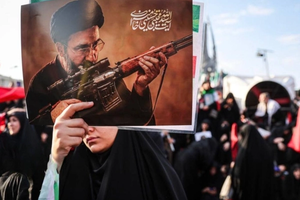
A woman holds a portrait of Mojtaba Khamenei, with his father Ali Khamenei pictured in the background.
US operations in the Strait of Hormuz, Gulf of Oman and waters close to Iran therefore do not fit an absolute geographical reading of Khamenei’s assertion that adversaries no longer advance beyond the Arabian Sea.
‘Millions of supporters’ and the Iranians left out
Khamenei also presents pro-establishment mobilization over the past seven months as evidence of domestic strength and cohesion.
“More than 30 million Iranians have declared themselves ready for self-sacrifice,” he wrote, adding that more than 500,000 people filled the available capacity of one registration drive in just 100 minutes.
Even if those figures are accepted, mobilizing millions of people does not by itself measure support across Iranian society.
Iran during the same period witnessed nationwide protests that began over economic grievances in late December 2025, spread rapidly across the country and developed into direct protests against the political establishment. The demonstrations subsided after a sweeping crackdown.
The government put the death toll at 3,117. Iran International’s Editorial Board estimated that more than 36,500 people were killed, based on classified security documents, field reports and information from medical workers, with most deaths occurring on January 8 and 9.
In Khamenei’s account, government supporters filling streets provide evidence of national unity and strength. Opponents occupying those same public spaces are not given comparable weight in assessing the state of Iranian society.
Khamenei’s own absence again becomes relevant. He invokes millions of Iranians gathering in streets and squares, but more than six months after becoming supreme leader has yet to appear among them or release a public video or audio message.
‘Victory’ and Hezbollah’s losses
Khamenei applies a similar conception of power to Iran’s regional allies.
He describes “victory and triumph” as the constant companions of late Hezbollah leader Hassan Nasrallah and presents his successor, Naim Qassem, as continuing the same path.
Hezbollah’s present position complicates a narrative of uninterrupted victory.
Nasrallah was killed and Hezbollah lost a significant number of senior commanders. Israel’s operation against the group’s communications network also exposed the extent of Israeli intelligence penetration into its structures.
Inside Lebanon, Hezbollah’s weapons have become central to one of the country’s major political disputes. The Lebanese government has pursued a process aimed at bringing the group’s weapons under state control, which Hezbollah opposes.
The death of a leader and senior commanders, combined with political pressure to transfer control of a group’s weapons to the state, sits uneasily alongside a historical description centered on permanent “victory and triumph.”
A definition of power with little room for defeat
The central issue in Khamenei’s message may be less any single assertion than the way power itself is defined.
In his account, the Islamic Republic emerged stronger from the eight-year Iran-Iraq War. Subsequent pressure, he said, made it stronger. More recent wars have made the Islamic Republic’s “phoenix” larger, while its future will be “far more glorious.”
Such a framework can absorb sharply different outcomes without altering its conclusion.
If an adversary retreats, that demonstrates strength. If fighting continues, that demonstrates resistance. Economic pressure becomes the cost of independence. If a regional ally loses leaders and commanders, the continuation of its cause takes precedence. Government supporters in the streets demonstrate popular backing, while opponents filling those streets are given no equivalent role in measuring political strength.
Within such a definition, defeat becomes increasingly difficult to identify.
National power can also be examined through observable outcomes: a country’s capacity to protect its territory and infrastructure, influence an adversary’s behavior, maintain economic stability, achieve foreign policy objectives, preserve regional influence and retain domestic support.
Measured against such indicators, Iran’s ability to impose costs on its adversaries does not by itself establish the status invoked by Khamenei when he describes the country as the “fourth superpower” or, according to “divine calculations,” the world’s top power.
That leaves the central question running through his message: if decades of war, pressure and confrontation have elevated Iran to such a position, which military, economic, social or regional measures demonstrate it?
The question takes on additional weight when this portrait of national power comes not from a leader addressing the public, but through a written message from a supreme leader who, more than six months after taking Iran’s highest office, has yet to be seen or heard by Iranians in a public appearance.
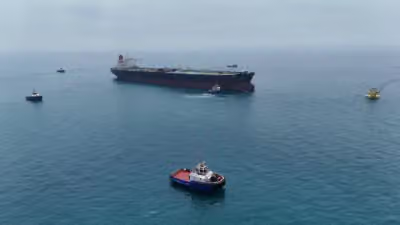
Drone view of oil tanker HELGA berthed at one of Iraq's southern offshore oil terminals near Basra as it prepares to load crude oil, becoming the second vessel to arrive since the closure of the Strait of Hormuz, April 24, 2026.
The UAE has found ways to blunt Iran’s ability to disrupt oil traffic through the Strait of Hormuz by exploiting its maritime tactics, Iranian state television commentators said in a recent broadcast.
Four people appeared on IRIB’s Be Vaght-e-Iran (Iran Time) program, with three speaking during an exchange on how Abu Dhabi has adapted its oil shipments to Iran’s approach to the strategic waterway.
One participant suggested Iran could target the smaller shuttle vessels moving through the strait or strike their point of origin. Another rejected that approach as insufficient.
“It makes no sense to just hit these vessels. That is not an adequate response to this change in logic,” he said.
A third participant laid out the central argument: Abu Dhabi has sought to change the economics behind Iran’s maritime leverage rather than directly challenge its military capabilities.
“The UAE has attacked the logic of closing the Strait of Hormuz,” he said.
Cheap ships change the calculation
Iran’s strategy, according to the panel, had relied partly on the vulnerability of very large crude carriers, or VLCCs, whose high value meant the prospect of an Iranian strike could make voyages commercially prohibitive as insurers withdrew coverage.
The UAE has sought to remove that pressure by creating a state-backed logistics chain and using smaller, cheaper vessels that can be readily replaced.
“It is defining a battlefield that has been designed to its advantage,” the commentator said. “It says: fight me here. You hit these small ones, and I keep replacing them.”
Abu Dhabi is also using ageing VLCCs that would otherwise be destined for scrapping because they no longer meet environmental or safety standards required at many ports, according to the discussion.
The ships can be worth considerably less than the oil they carry, reducing the economic loss if Iran damages them.
The broadcast also described a pattern in Iranian operations that the UAE could anticipate. Iranian forces radio vessels, fire warning shots if they continue and then target the bridge rather than immediately sinking the ship, giving crews around 30 to 40 minutes to evacuate.
Abu Dhabi has responded by positioning tugboats to recover damaged vessels and tow them to Sohar in Oman, where their cargo can still be unloaded, the main contributor said.
“The tugboat comes and attaches itself right there to the ship that has been hit,” he said. “They tow it to Sohar and unload it there on the Omani coast.”
The result, he argued, is that Iran can damage a vessel without preventing its oil from reaching port.
Iran’s military logic questioned
Simply striking greater numbers of replaceable vessels would not restore Iran’s leverage, the discussion suggested.
“They have attacked our military logic,” the main contributor said. “You have to hit this logic.”
The participant who opened the exchange said Iran’s problem was not a lack of political will, but its continued reliance on an approach that was no longer producing the intended outcome.
“There really is the political will to confront them. But because we are confronting them within the previous framework, we are not getting the result we want,” he said.
The main contributor described the problem as a “cognitive error.”
Another researcher and Middle East commentator Mustafa Najafi separately accused the UAE on X of spending weeks trying to reduce Iran’s leverage over the Strait of Hormuz and seeking to move oil belonging to other countries through the waterway.
Najafi also accused Abu Dhabi of obstructing an Iran-Oman agreement on managing the strait and lobbying in the United States and Israel for attacks on Iran.
“After Israel, no actor dreams of weakening and disintegrating Iran as much as the UAE does,” Najafi wrote, arguing that Tehran should move beyond a solely political and diplomatic response.
The remarks reflect concern among Iranian pro-system experts that the UAE is seeking not to overcome Iran’s military power in the Strait of Hormuz, but to diminish the strategic leverage that power is intended to provide.
US President Donald Trump’s rejection of Iran’s proposal for a swift reopening of the Strait of Hormuz may say less about Washington’s opposition to a deal than about its changing assessment of Tehran’s most important bargaining chip.
Trump publicly rejected the proposal on Saturday. The plan would have reopened the strait within seven days and resumed nuclear negotiations in return for measures including lifting the US naval blockade of Iranian ports.
The president plainly wants normal shipping restored, but he appears unwilling to pay the price Tehran is asking for it.
Iranian officials have repeatedly described Hormuz as a strategic asset and a source of leverage. Disruption of the narrow waterway affects energy markets, shipping costs and inflation far beyond the region.
That importance has not disappeared. What may be changing is Iran’s ability to convert that disruption into immediate political concessions from Washington.
The US military has spent months trying to reduce Iran’s ability to attack shipping while expanding escorts for commercial vessels. CENTCOM commander Adm. Brad Cooper said last week that US forces had facilitated the transit of more than 2,000 commercial vessels and more than one billion barrels of crude oil through the strait.
The operation has not restored normal shipping, but it has allowed substantial volumes of oil to move without an agreement with Tehran, helping Washington turn Hormuz from an Iranian energy veto into what it increasingly appears to regard as a manageable risk.
Why Trump can wait
If Washington believes it can keep significant quantities of oil moving without Tehran’s cooperation, there is less incentive to lift the naval blockade and ease economic pressure simply to secure the full reopening of the strait.
Trump’s rejection also comes as his administration is increasing rather than reducing that pressure. At the UN General Assembly this week, he called for Iran’s “complete economic isolation” and said he expected an agreement after the November midterm elections
The administration has expanded restrictions on Iranian banking and aviation. Iranian airlines have lost access to several international destinations, while companies servicing sanctioned Iranian carriers face the threat of secondary US sanctions.
Trump’s rejection therefore suggests Washington believes time is, for now, working more in its favor than Tehran’s.
Hormuz still matters
None of this means Iran’s Hormuz strategy has failed.
Keeping commercial traffic moving requires a major US military operation, while shipping and insurance costs remain elevated and the threat of attacks has not disappeared. Washington is paying a price for managing the disruption.
But the balance may have shifted. Tehran still views reopening Hormuz as something it can exchange for relief from economic and military pressure. Washington appears to believe it has reduced the costs of disruption enough that it does not yet need to meet Iran’s asking price.
Seen that way, Trump’s “no” becomes more significant. He has not necessarily rejected diplomacy: contacts through mediators continue, and Iran says it is still awaiting Washington’s formal response to its proposal. US officials have also described indirect discussions as continuing.
What Trump has rejected, for now, is Tehran’s price for ending the Hormuz crisis.
Iran still holds the Hormuz card. Washington’s calculation appears to be that it no longer has to pay as much to take it off the table.
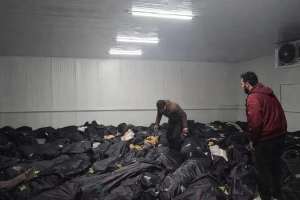
The bodies of slain protesters at an unnamed morgue in Iran (January 2026)
Relatives of protesters killed during Iran’s January crackdown challenged President Masoud Pezeshkian’s portrayal of the unrest as foreign-driven, saying their family members were unarmed and had no links to foreign governments, after his UN General Assembly address on Wednesday.
Pezeshkian accused protesters of being incited by the United States and Israel and receiving weapons to disrupt Iran’s security. He also defended system supporters who took to the streets during the unrest.
The sisters of Sina Kazemi, Emad Mavedatipour and Babak Sadeghi Mohseni responded on X, saying their brothers were unarmed when they were killed on January 8 or 9 and were not acting on behalf of any foreign government.
“I testify that my brother was unarmed when he was killed by the Islamic Republic of Iran’s forces on January 8, 2026,” Kazemi’s sister wrote. “He was not acting on behalf of any foreign government. I seek truth, justice, and accountability.”
Mavedatipour’s sister posted the same account of her brother, saying he was unarmed when he was killed on January 9 and denying that he acted for a foreign government.
Sadeghi Mohseni’s sister said her brother was unarmed when he was killed on January 8 and also called for “truth, justice, and accountability.”
The sister of Ahmad Khosravani, a 21-year-old professional basketball player, said her brother was completely unarmed when Iranian forces killed him on January 9.
“He was not acting on behalf of any foreign government,” she wrote. “They shot him directly in the heart.”
Fathers challenge Pezeshkian
Two other bereaved fathers challenged the government's account in separate video messages sent to Iran International.
The father of Erfan Abdipour, an architecture student who also worked at his brother’s restaurant, called on Pezeshkian to publish evidence if authorities had any showing that his son had received military training or carried a weapon.
“My request is that if you have evidence showing that he received military training, was instructed or had a weapon, or anything else that night, publish it,” Abdipour’s father said.
Abdipour had gone to protest on the night he was killed, his father said, questioning what his son could have been trying to seize in an area he described as having no military barracks or security facility.
The father of Pouria Bagheri separately rejected the government's explanation for the scale of the killings.
“I categorically reject the overall argument that such widespread killing was foreign actors work.”
Bagheri’s father questioned why authorities shut down the internet and electricity and said that security agents removed surveillance cameras from shops. He also asked why officials brought government supporters onto the streets two days later if foreign-backed armed groups posed the extensive threat described by authorities.
“Why did you bring your own supporters into the streets two days later? With what guarantee?” he said. “Was it not because you were in control?”
January crackdown
The protests began on December 28, 2025, following a sharp fall in the rial and rising prices before spreading across all 31 provinces and developing into a broader challenge to the Islamic Republic.
The deadliest violence came on January 8 and 9. Amnesty International said verified videos and eyewitness testimony showed security forces using rifles and shotguns against protesters, frequently firing at heads and torsos.
Iran International’s Editorial Board concluded in January that more than 36,500 people were killed by security forces on January 8 and 9 after reviewing classified government documents, field reports and accounts from medical workers, witnesses and victims’ families.
The UN Fact-Finding Mission on Iran later said security forces used lethal force against protesters and bystanders, including children, who posed no imminent threat of death or serious injury.
Iranian authorities initially put the death toll at 3,117. The government subsequently published 3,038 names, according to the UN mission, which said it believes the actual number may be significantly higher.
US President Donald Trump cited increasingly higher death tolls from Iran’s January protest crackdown in successive remarks, putting the number at 32,000 on February 20, 42,000 in later comments and subsequently 45,000.
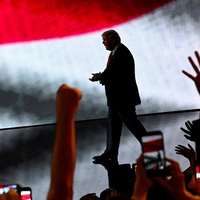
President Trump at the Republican National Midterm Convention in Dallas, September 10, 2026.
Tehran is making a “total miscalculation” if it believes the US midterm elections will constrain President Donald Trump’s actions against Iran, former senior US official Morgan Ortagus told Iran International.
Ortagus pointed to Trump’s first term, when Democrats took control of the House in the 2018 midterms but his administration continued its “maximum pressure” campaign against Tehran and ordered the 2020 killing of Qasem Soleimani.
“Any fallacy that they have that President Trump is going to limit his decision-making authority… based off a change in the Congress is a miscalculation by a regime who still fundamentally does not understand this president.”
Congressional debate over war powers was “healthy for our democracy,” Ortagus said, but did not change the president’s authority “to take any action against Iran that he deems necessary for the safety and the security of the American people.”
Ortagus, who held senior roles in both Trump administrations, said the United States has been in a conflict with the Islamic Republic “not for seven months, but for 47 years,” and argued that economic pressure alone would not have prevented the current military confrontation.
She described Trump’s first-term maximum pressure campaign as “incredibly effective,” but said it was interrupted during Joe Biden’s presidency and has amounted to less than four years in total.
“Sanctions are not a silver bullet,” she said. “Sanctions are a tactic. They’re a way in which you pursue a larger strategy.”
That strategy, she said, should prevent Iran from obtaining a nuclear weapon, cut funding to its proxy groups and stop Tehran from becoming “the next North Korea,” with missiles capable of threatening US bases, regional states and the American homeland.
Ortagus said Trump ordered military action beginning in June last year because Iran was “intransigent” in negotiations and “weeks away from getting a nuclear weapon.” The president had given Tehran a deadline, she said, and Iranian leaders may have believed he was bluffing.
“They learned pretty quickly that he wasn’t.”
Asked whether the campaign would have happened without a closely aligned Israeli government, Ortagus said it would have. Israeli operations had “complemented” US action, she said, but “these have been American decisions and American decisions alone.”
She cited Trump’s decision to order the killing of Soleimani in 2020 as an example of an action he took “by himself.”
On diplomacy, Ortagus said Trump had “always… extended the hand of diplomacy” during both administrations.
“It’s the regime that keeps rejecting that hand.”
She was skeptical that an agreement signed with Iranian officials in New York would hold if the real decision-makers remained in Tehran, echoing Secretary of State Marco Rubio’s doubts about the authority of Iran’s UN delegation.
Former senior US official Morgan Ortagus in an interview with Iran International's Kambiz Tavana in Washington DC on September 24, 2026.
“What you have to do is to make the thugs in the IRGC understand that everything, their livelihoods, everything that they possess, is going to be put at risk,” Ortagus said.
Trust was not the issue, she added. The question was what mechanisms Washington would establish “so they know… if you backtrack on this, there actually will be a consequence.”
She said she did not see how any future arrangement could work “without some sort of American verification process.”
Hezbollah and Lebanon
Ortagus rejected the argument that Hezbollah should be accepted as part of Lebanon’s social and political fabric.
“Bullshit,” she said.
She said the group was led by the Islamic Revolutionary Guard Corps, had been “indoctrinated, trained, equipped and brainwashed” by Tehran and had dragged Lebanon into “perpetual war,” with Shia communities among the main victims.
President Joseph Aoun and Prime Minister Nawaf Salam had been “very clear,” she said, that Hezbollah must be disarmed and that Lebanon cannot have “a parallel state within a state.”
Dismantling that structure would take time, Ortagus added.
“It wasn’t created overnight, and it won’t be expunged overnight.”
Ortagus said the Abraham Accords had endured the turmoil since October 7, pointing to a meeting of Accords countries on the sidelines of the UN General Assembly this week.
By contrast, she said a Mecca-centered regional alignment “looks pretty weak right now,” after Houthi attacks on Saudi Arabia, including toward holy sites, drew no meaningful response from its signatories.
“Anybody who does that and says they speak in the name of Islam are the worst hypocrites imaginable,” she said.
She declined to discuss current private exchanges between Riyadh and Washington but warned against seeking security through accommodation with Tehran.
“Pacifying this regime is not going to protect you in the long run,” she said. “It will buy you time. It might be a temporary salve, but it won’t heal the wound.”
Ortagus also described the current blockade of Iran as a harder form of enforcement than previous sanctions.
“Nothing’s coming in, and nothing’s going out.”
Asked about the broader US endgame, she listed four goals: preventing Iran from obtaining a nuclear weapon; curbing its ballistic missiles, drones and conventional arms; cutting funding to proxy groups; and supporting the Iranian people.
A final conversation about Iran
Ortagus closed the interview by recounting an unpublished story about the late Senator Lindsey Graham.
In January, she said, she had “Make Iran Great Again” hats overnighted to Graham at Mar-a-Lago so he could give one to Trump on the golf course.
She said she spoke to Graham an hour or two before his death, and that their last conversation was about Iran.
“He never stopped believing in the people of Iran,” she said.
Participants ride motorcycles during a Janfada mobilisation rally in Tehran, beneath a billboard depicting a warrior emerging from the sea and confronting a burning ship, September 25, 2026
Talks between Iranian and US diplomats have continued in New York despite increasingly harsh rhetoric from both capitals, but the emerging dispute is less over whether to negotiate than over who must move first.
The discussions have increasingly focused on sequencing: Iran wants the United States to lift its economic blockade before Tehran reopens the Strait of Hormuz, while Washington is seeking movement on the strait before surrendering its principal source of leverage.
Neither side appears willing to go first despite the mounting economic and political costs of the deadlock.
On the sidelines of the UN General Assembly, Iranian President Masoud Pezeshkian said in an interview with Fox News that Tehran was willing to relinquish its stockpile of uranium enriched to 60% within the framework of international law and its obligations under the Nuclear Non-Proliferation Treaty.
The choice of Fox News may also have reflected an effort to reach President Donald Trump and his political audience more directly, given the network’s close relationship with the president.
Pezeshkian also said Tehran hoped to revive its June ceasefire understanding with Washington before the US midterm elections in November.
“We don't want it to get to the midterm elections,” he told reporters.
Trump has suggested the opposite timetable, saying in his UN General Assembly address that an agreement with Iran would likely be reached after the elections.
Who moves first?
Although both sides insist they seek peace, they remain divided over how an agreement would be implemented and in what order each should make concessions.
Tehran insists that no agreement can be reached before the United States lifts its economic blockade, while Washington and its European allies favour the opposite approach.
The disagreement is compounded by the collapse of the Islamabad Memorandum of Understanding.
From Tehran’s perspective, returning to an agreement that Washington previously failed to honour requires guarantees upfront. From Washington’s perspective, reviving the June arrangement risks appearing to reward Iran for using the Strait of Hormuz as leverage.
Supporters of diplomacy on both sides, along with mediators including Pakistan and Qatar, continue to urge the replacement of military rhetoric with political dialogue.
The problem is that each side is making a different calculation about timing and sequencing, while political considerations discourage either from moving first.
Iran’s demand that “all fronts” be addressed further complicates the equation, linking any agreement to Israel’s actions in Lebanon and elsewhere, while the widening confrontation in the Red Sea and around Bab el-Mandeb has added another layer of uncertainty to negotiations.
The midterms
The competing timetables reveal another dimension of the deadlock: both capitals have now openly linked a potential agreement to the November elections, but appear to be drawing opposite conclusions about who benefits from waiting.
It remains unclear whether Pezeshkian’s remarks will materially alter the course of negotiations. For now, each side appears to calculate that time is placing greater pressure on the other.
Trump’s threat to “annihilate Iran” raises the domestic political cost for Tehran of making concessions and increases the risk that any flexibility will be portrayed by Pezeshkian’s hardline opponents as capitulation.
Washington has political constraints of its own, with congressional hawks and influential regional lobbying groups likely to raise the political cost of concessions to Tehran ahead of the midterm elections.
The view from Tehran
The reformist daily Sharq argued on Thursday that the resumption of contacts offered an opportunity to prevent further escalation, but that significant differences between the two governments and political opposition at home made an immediate breakthrough unlikely.
“The mere continuation of mediation, or even a direct meeting between the presidents of Iran and the United States, lacks the capacity to overcome the current deadlock,” it said. “Changing this situation requires practical and reciprocal decisions from both Tehran and Washington that go beyond diplomatic messaging.”
That assessment points to the constraints facing Pezeshkian, including opposition from hardline parliamentary factions and Iran’s powerful security establishment.
For Iran’s leadership, the principal risk of an agreement is surrendering strategic leverage without guaranteed sanctions relief. For the Trump administration, moving first could expose it to accusations of appeasement ahead of the midterm elections.
The contacts in New York therefore suggest that diplomacy itself is not the missing ingredient. The harder question is whether either side is prepared to move first — and accept the political cost of doing so.