Since Mojtaba Khamenei was named the Islamic Republic's third supreme leader, no one has seen him or heard his voice. That looks like weakness. It is worth asking whether it might instead be postponing the system's political death.
For nearly half a century the Islamic Republic has reproduced the image of its leaders everywhere: on the walls of schools and government offices, in theatres, cinemas and concert halls, behind officials at podiums, on television screens. Visibility was not vanity. In a system built on the authority of one man, the leader had to be seen for the state to demonstrate that it existed.
Before the war with the United States and Israel, that was the rule. Now the same system publishes messages from its new leader without being able, or perhaps without wanting, to show him.
In the first weeks after his appointment by the Assembly of Experts, the clerical body that selects Iran's supreme leader, intelligence services and media inside and outside the country waited for one thing: his Nowruz address. The Persian new year, which falls around March 20, brings the leader's most closely watched speech of the year, and a video would have answered the essential questions at once. He would have been demonstrably alive, apparently well, and visibly in charge.
No video came. The absence stopped looking like a security precaution and started looking like a condition.
The record since has only deepened the ambiguity. There is no photograph, no audio, no film.
Written statements have appeared, attributed to his office rather than demonstrably from his hand. The absence of anything verifiable, no image, no voice, no signature, has weakened the official account of his health and strengthened the theory that he was gravely wounded.
The effect on the state has been visible. Officials who held together in the first days of the war have since split over what comes next, and the fault line runs through the war-or-negotiation question: the state broadcaster has censored the government's own negotiators, while hardline outlets have claimed the leader opposed the process that produced the Islamabad agreement. Both camps invoke him. Neither can produce him.
So the question is whether any of this can work in the system's favor.
Absence as possibility
Consider what visibility would cost. If Mojtaba Khamenei appears and the marks of injury or incapacity are apparent, the Islamic Republic must concede that its leader is diminished. If his death is confirmed, the succession fight begins. If he turns out to be healthy and active, he must accept responsibility for the decisions of the past six months, including a war.
Absence suspends all three. He can be alive, wounded, incapacitated or dead, and the machinery of the state can go on issuing orders in his name.
Uncertainty, which ought to be the government's problem, becomes its instrument.
While the leader's status remains unresolved, no faction can settle the succession, and no official has the standing either to accept defeat or to wind the system up. Commanders and institutions can continue to say they take their orders from the center, a center that may exist but cannot be seen.
That has a second edge, and it cuts the other way. The same fog that prevents anyone from declaring the system finished also prevents anyone from commanding it. An absent leader cannot arbitrate between the men arguing over war and diplomacy, which is very likely why they began arguing in the first place. Ambiguity buys the system time by denying it direction.
Still, on this reading, even the collapse of the state's outer structure would not necessarily be the end. A network of the Revolutionary Guards, the Basij, the intelligence services, financial channels and allied forces across the region could carry on in the name of an absent leader. What would survive, in that case, would no longer be a government. It would be an underground organization.
From state to network
The comparison that follows is about mechanics, not equivalence. The question is narrow: how does a network continue after it loses its territory or its leader disappears? On that specific question, two cases are instructive, and neither is offered as a moral parallel to a state that has governed 90 million people for nearly five decades.
Abu Bakr al-Baghdadi declared the Islamic State's caliphate from a mosque in Mosul in July 2014 and did not appear on camera again for almost five years, though audio messages attributed to him continued to circulate. In that period the group lost nearly all its territory and became a network of clandestine cells. After he was killed in 2019, a US Defense Department inspector general assessment found his death had produced no immediate decisive effect on the group's operations.
Osama bin Laden spent almost a decade in hiding while releasing video and audio messages. His evasion of capture became, for his followers, evidence of invulnerability. Killing him destroyed that impression but did not destroy a network that had already devolved into regional branches.
The Islamic Republic is far better equipped for that kind of afterlife than either. It has governed for close to half a century. It has trained personnel, security intelligence, economic resources, religious institutions and cross-border networks. Driven underground, it would not be starting from nothing.
A familiar pattern of absence
Absence also carries a particular charge in Shia religious culture, and this is where the Islamic Republic has a vocabulary ready to hand.
Twelver Shia Muslims believe the twelfth imam, who vanished in the ninth century, is alive but hidden and will one day return. During the period known as the Lesser Occultation, roughly 874 to 941, his instructions are said to have reached his followers through four successive deputies who spoke on his behalf. The Greater Occultation, in which he remains hidden and has no named deputy, has continued ever since.
This is not a claim about religious rank. Mojtaba Khamenei holds no such standing for Shia believers, and the comparison is not about status. It is about the function of absence: a person who cannot be seen can still be treated as present. Intermediaries speak in his name, and waiting takes the place of proof.
The Islamic Republic itself was built on a theology of absence. Its constitution justifies the rule of a jurist explicitly as an arrangement for the era of the hidden imam, which means the state has spent 47 years governing on behalf of a leader nobody can see. Its propaganda apparatus therefore has both the language and the precedent to convert the absence of Mojtaba Khamenei into a kind of hidden presence.
That possibility is not indefinite. The longer the absence lasts, the harder it becomes to distinguish a genuine order from a manufactured one, the sharper the competition among those claiming to speak for the leader, and the more insistent the question: who is actually giving the orders in Tehran?
Mojtaba Khamenei's absence will probably not save the Islamic Republic from military defeat, economic collapse or social unrest. It may, however, allow it to go on existing after such a collapse.
As long as the fate of the absent leader remains unclear, the system's followers can treat the fall as temporary, the defeat as unfinished and the return as possible. Because sometimes governments continue not because they are still standing, but because their death has not yet been proven.
Iran's drawdown of strategic fuel reserves has reached a “red alert” level and could exhaust remaining stocks within weeks, fueling disagreement between President Masoud Pezeshkian and the Revolutionary Guards, informed sources told Iran International on Wednesday.
The reserves, intended to cushion severe shortages and emergencies, have been tapped at a pace in recent weeks that has prompted warnings from experts within the state about the consequences of continuing, the sources said.
Remaining fuel stocks could be depleted within several weeks if withdrawals continue at the current rate, limiting the government's ability to offset disruptions to domestic production or imports and prevent widespread supply stoppages, according to the sources.
The growing reliance on strategic stocks has also opened a dispute between the government and the Revolutionary Guards over how long withdrawals should continue, they said.
Revolutionary Guards officials oppose unrestricted use of the reserves, while government officials want to keep drawing on them to keep filling stations operating and contain public concern over shortages and higher prices, the sources added.
Daily shortfall strains supplies
Iran produces about 120 million liters of gasoline a day but consumes around 135 million liters, leaving a daily deficit of about 15 million liters.
Ali-Akbar Saghab Esfahani, head of Iran's Energy Optimization and Strategic Management Organization, put the daily gasoline shortfall at 14 million to 15 million liters on August 15.
Before the shortage intensified, imports covered about half the gap, much of it through fuel supplies from Russia, the sources said.
A US maritime blockade, Ukrainian strikes on Russian refining infrastructure and the closure of the Caspian Sea supply route have sharply restricted Iran's ability to maintain those imports, according to the sources.
Iranian diplomatic efforts to secure alternative fuel supplies from allies and neighboring countries have yet to produce an agreement.
Britain and Qatar have meanwhile backed a new US economic campaign against the Islamic Republic, as Washington seeks to restrict its financial, shipping and energy trade routes.
Fuel moved to reopen Tehran stations
Gasoline shortages have reached Tehran, forcing some filling stations to close, according to information obtained by Iran International.
Authorities have ordered fuel transferred from neighboring provinces to reopen some stations in the capital, but dozens of others remain at risk of closure, the sources said.
Videos and messages sent by citizens have also documented long lines, station closures and difficulties obtaining gasoline in Tehran, Alborz, South Khorasan and Razavi Khorasan provinces.
The Tehran regional manager of the National Iranian Oil Products Distribution Company attributed temporary closures at some stations to a sudden rise in demand and congestion along fuel transportation routes.
Reports from citizens suggest the disruption is also affecting transportation costs. Several people told Iran International that fares charged by ride-hailing services Snapp and Tapsi had risen sharply as fewer drivers accepted trips.
“Gas stations are crowded, GPS doesn't work and you can't work for Snapp. Fares have gone up, but there are no drivers to accept the trip. We're left without money and without gasoline,” a Tehran resident told Iran International.
Another citizen said the cost of a regular Snapp journey had risen from 1,000,000 rials last month to 3,200,000 rials, while a resident of Shiraz described steep increases in ride-hailing fares despite no gasoline shortage there.
A Snapp driver said fuel consumption from running air conditioning for passengers required him to refill about every two days, but his quota had been exhausted and purchases outside the quota were limited to 25 liters.
Other messages sent to Iran International accused authorities of deliberately restricting supplies before a possible price increase.
“When they want to raise the price of cooking oil, they say there isn't any. When they want to raise the price of rice, they say there isn't any. But after the price goes up, everything is available,” a resident of Mashhad said. “Now it's gasoline's turn.”
The Mashhad resident said filling stations were not receiving enough gasoline but predicted supplies would become readily available if authorities raised prices.
Another citizen questioned why a gasoline deficit of 10% to 20% was causing such widespread disruption and accused authorities of deliberately making fuel scarce to make consumers more willing to accept higher prices.
File photo shows a man filling his car with gasoline at a gas station in Tehran.
“Many gas stations are either closed or have no gasoline to distribute,” a Tehran resident said, also accusing the government of diverting fuel for foreign currency earnings.
Another message accused authorities of using the shortage as justification for a gasoline price increase and manipulating distribution to create congestion at filling stations and reduce resistance to higher prices.
“Half of Pakdasht's gas stations have no gasoline and the rest are extremely crowded,” a resident said. “They are trying to force people to accept higher gasoline prices.”
Government weighs three options
The government is considering three responses to the shortage: limiting gasoline supply to domestic production levels, reducing subsidized quotas and selling additional consumption at the unrestricted price, or shifting fuel quotas from vehicles to individuals.
Concern that higher gasoline prices could trigger protests has encouraged the government to use strategic reserves to buy time, the sources said.
Fuel price increases have been politically sensitive in Iran. A sudden rise in gasoline prices in November 2019 triggered nationwide protests followed by a deadly state crackdown.
The attempt to delay harder choices by drawing on emergency stocks is now creating another problem, according to Iran International's sources: the buffer intended to protect Iran during severe supply disruptions may itself be only weeks away from exhaustion.
File Photo: An offshore rig on Iran's South Pars gas field in the Persian Gulf
Iran has announced another major gas discovery, but with the world’s second-largest reserves already beneath its soil, Tehran’s problem is not finding gas but finding the money and technology to extract it.
Oil Minister Mohsen Paknejad said the newly discovered field in southern Fars Province contains more than 7.5 trillion cubic feet (Tcf) of gas in place, of which about 5.7 Tcf could be recoverable.
He compared the recoverable volume with roughly 15 years of production from one phase of South Pars.
The gas is also described as “sweet,” meaning its relatively low sulphur content could reduce processing and operating costs.
Yet the discovery adds to an already enormous resource base. Iran held about 1,200 Tcf of proved natural gas reserves at the end of 2023, second only to Russia, and produced about 9.4 Tcf that year.
Most of that gas is consumed domestically, while exports remain largely confined to regional pipeline trade.
Lack of investment
The headline figure also comes with an important caveat: gas in place is not the same as commercially recoverable reserves. Whether the estimated 5.7 Tcf can ultimately be produced economically will depend on reservoir performance, infrastructure, costs and access to investment.
That last constraint may prove particularly difficult.
Sanctions have restricted Iran’s access to international financing, foreign investment and Western energy companies and equipment suppliers, while Tehran is already confronting the costly task of sustaining production from its existing fields.
The scale of the challenge is visible at South Pars, Iran’s largest gas field. In March 2025, the National Iranian Oil Company signed contracts worth about $17 billion for pressure-boosting facilities needed to counter declining reservoir pressure.
Paknejad has also said Iran would require about $19 billion in annual investment to meet its broader gas-production targets over the following four years.
The new Fars field will therefore be competing for capital with the increasingly expensive task of maintaining production from fields Iran already depends on.
Technology gap
Iranian companies have developed considerable capabilities after years of sanctions forced domestic contractors to take over work previously carried out by international firms. But self-reliance has not eliminated dependence on foreign technology.
The South Pars pressure-boosting program, for example, requires 56 high-capacity turbo-compressors across seven hubs.
S&P Global reported that while most equipment was expected to be sourced domestically, foreign assistance and technology transfer would still be required for parts of the project.
South Pars Phase 11 demonstrated that vulnerability. TotalEnergies withdrew after Washington reimposed sanctions, and China National Petroleum Corporation subsequently left the project, forcing Iran to proceed through domestic companies without the advanced foreign technology originally envisaged.
Iranian firms can therefore develop significant parts of new gas projects, but financing constraints and gaps in specialized technology can increase costs and extend timelines, particularly when the same companies are expected to maintain mature fields, repair infrastructure and expand production simultaneously.
Can China fill the gap?
China is the most obvious candidate to provide some of what Iran lacks, but its role has limits.
Chinese independent refiners remain major buyers of sanctioned Iranian crude. Yet buying discounted oil through sanctions-resistant trading networks involves far less long-term exposure than committing billions of dollars to a multi-year gas development.
CNPC’s withdrawal from South Pars Phase 11 showed that major Chinese companies are also sensitive to sanctions, financing difficulties and access to international technology.
Recent US measures targeting Chinese independent refiners, vessels and financial channels involved in Iranian oil trade have increased those risks.
Smaller Chinese companies may continue supplying equipment and services, but they are unlikely by themselves to replace the financing, technology and project-management capabilities once provided by major international energy companies.
The Fars discovery therefore adds another potentially valuable asset to Iran’s extraordinary resource base. Its sweet gas and condensate content may improve the economics, and Iranian companies are more capable of developing such fields than they were a decade ago.
But Iran’s energy paradox remains: it can keep finding enormous quantities of hydrocarbons faster than it can find the investment and technology needed to turn them into reliable supply and export revenue.
Former IRGC commanders Mohammad Bagher Ghalibaf (left) and Mohsen Rezaei, currently Parliament Speaker and security chief. Undated file photo
Mohsen Rezaei’s threats to halt Iranian oil exports, target countries cooperating with the United States and comments suggesting a possible nuclear shift have triggered a debate in Tehran over his authority to outline such policies as tensions escalate.
Rezaei, secretary of Iran’s Supreme National Security Council (SNSC) and the Supreme Leader’s representative on the body, said Sunday that Tehran would consider any country participating in or supporting the US economic campaign against Iran to have committed an act of war.
“If the economic war continues, not a single drop of oil will be exported, neither through the Strait of Hormuz nor from anywhere in the Persian Gulf,” he wrote on X.
But the sweeping statements have raised a more fundamental question: Is Rezaei articulating Iran’s security policy, the Supreme Leader’s position or his own?
The question has become particularly significant because Rezaei’s increasingly confrontational rhetoric comes as President Masoud Pezeshkian and Parliament Speaker Mohammad-Bagher Ghalibaf have struck a markedly different tone.
Pezeshkian said Friday it would be better to end the war while Iran remains in a position of “power and dignity,” while Ghalibaf warned that “no matter how much military power we have, we won't survive if people are hungry.”
‘Secretary or president’?
Hardliners have seized on the contrast.
The hardline Hamshahri newspaper praised Rezaei on Monday for offering an alternative to what it called the language of “weakness and surrender” from other officials.
His approach, it said, was “neither a denial of economic pressure nor merely an attempt to neutralize sanctions, but to make the siege costly for its designers and supporters.”
“From this perspective, with Rezaei’s remarks, Iran’s economic doctrine has become militarized,” Hamshahri said.
Reformists, however, have questioned whether the SNSC secretary has the authority to articulate such policies without a formal council decision.
They argue that the secretary administers and communicates the council’s decisions rather than independently determining them, while Pezeshkian serves as president of the SNSC.
Former reformist lawmaker Mahmoud Sadeghi addressed Rezaei directly on X: “The seat you are sitting on is the secretaryship of the Supreme National Security Council, not the presidency.”
The nuclear question
The disagreement is particularly consequential because Rezaei has gone beyond the immediate economic confrontation to raise the possibility of reconsidering Iran’s longstanding rejection of nuclear weapons.
In an interview broadcast on state television, he argued that US attacks had demonstrated that neither membership in the Non-Proliferation Treaty nor cooperation with international nuclear inspectors could protect a country from military attack.
“When America is waging such a war, people naturally ask: Why shouldn’t we pursue nuclear weapons ourselves?” Rezaei said.
He went further, arguing that a nuclear weapon could be “cheaper and more effective than having hundreds of F-35s and spending enormous amounts of money on other military capabilities.”
Rezaei stopped short of saying Iran had decided to pursue a bomb. But some hardliners interpreted his remarks as an invitation to reconsider Iran’s nuclear doctrine.
“I hope this accurate and correct analysis by General Rezaei will be a prelude to Iran’s withdrawal from the NPT and a change in Iran’s nuclear doctrine,” hardline journalist Nezameddin Mousavi wrote.
Hamshahri similarly said Rezaei had raised the question of an atomic bomb without explicitly presenting it as Iran’s official position.
‘Solution out of reach’
Abdollah Ramezanzadeh, spokesman for former reformist President Mohammad Khatami, countered that the responsibilities of the SNSC chairman, secretary, members and Supreme Leader’s representatives are separately defined.
The secretary’s job, he argued, is to prepare meetings and communicate decisions under the chairman’s supervision.
Hardliners reject that interpretation, pointing to Rezaei’s second position as the Supreme Leader’s representative on the council.
Rezaei served as the Leader’s military adviser during the war before being appointed his representative on the SNSC, alongside his appointment as secretary by Pezeshkian.
His supporters argue that the dual role gives his statements greater political weight than those of an ordinary council secretary. Some have gone further, portraying criticism of Rezaei as an attack on the Supreme Leader himself.
Conservative journalist Ehsan Salehi, meanwhile, portrayed Rezaei’s statements as part of a deliberate escalation strategy in which each new stage of US pressure produces a tougher Iranian response.
“Each new stage of pressure and tension makes Iran’s behavior more complicated and tougher and puts a solution further out of reach,” Salehi wrote.
The dispute comes as Iran confronts increasingly severe economic pressure and an unresolved military standoff with the United States—and is no longer simply over tactics.
With Rezaei threatening oil exports across the Persian Gulf and openly questioning the logic of remaining non-nuclear, it has become an argument over who has the authority to signal how far Iran is prepared to go.
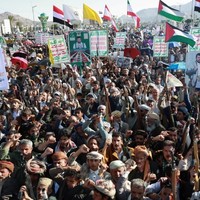
Supporters of Iran’s Supreme Leader attend a state-backed event in Tehran, with a billboard depicting the Statue of Liberty toppled amid Iranian and religious flags, August 22, 2026
Iranian officials have dismissed Washington’s “Economic D-Day” as another failed attempt to cripple the country, but analysts inside Iran warn that an economy weakened by war may be far less capable of absorbing the latest US pressure campaign.
US Treasury Secretary Scott Bessent has described the campaign as the “endgame,” while Iran’s Central Bank Governor Abdolnasser Hemmati insisted it would have “no impact on Iran.”
Other senior officials have warned regional and European states against helping Washington enforce its measures.
But Abdolrahman Fathollahi, an analyst writing in Shargh, cautioned against assuming that decades of experience circumventing sanctions mean Tehran can simply weather the latest campaign.
Iran, he said, is now more economically fragile after the recent conflicts known as the 12-day and 40-day wars. The new measures are designed not simply to add restrictions but to close Iran’s remaining economic lifelines—and test how far China is prepared to go to keep them open.
That could prove crucial.
Hamed Vafaei, an associate professor of Chinese studies at the University of Tehran, argues that Beijing is likely to maintain enough oil purchases and trade to prevent Iran’s complete economic isolation, but will not sacrifice its own interests to rescue Tehran.
China’s economic relationships with the United States, Western markets and Persian Gulf Arab states dwarf its trade with Iran. Vafaei said Tehran should therefore view Beijing as a pragmatic strategic partner rather than an unconditional ally.
International affairs analyst Esmail Beshari similarly told Shargh that tougher US sanctions would create additional obstacles but were unlikely to sever Iran-China trade altogether.
Some Iranian analysts have urged Tehran to move beyond what they describe as a “North Korea model” of relying on China for basic economic survival toward a “Pakistan model” based on deeper, mutually beneficial trade and investment.
The warnings come as pressure on Iran’s domestic economy is already mounting. Annual inflation reached 66 percent in July and food prices were 128 percent higher than a year earlier, according to official data, while gasoline supplies have also come under strain.
Iranian economic newspapers have cautioned against complacency. Donya-ye Eghtesad warned that relying on methods used to circumvent previous sanctions could prove a mistake, arguing that Tehran must also address its domestic vulnerabilities.
Concern about those vulnerabilities is increasingly visible within the security establishment.
Police chief Ahmadreza Radan said foreign powers were preparing to exploit economic hardship to foment unrest. President Masoud Pezeshkian has said it would be better to end the war while Iran remains in a position of “power and dignity.”
Parliament Speaker Mohammad Bagher Ghalibaf was blunter.
“No matter how much military power we have, we won't survive if people are hungry and we don't have financial turnover, economic growth and national production,” he said.
Such warnings sit uneasily alongside Tehran’s public insistence that Washington’s latest campaign will fail.
Iran has survived decades of sanctions and analysts do not expect the new measures to completely sever its economic links with China. But keeping some trade and oil exports flowing is not the same as insulating an economy already weakened by war from further pressure.
The question for Tehran may therefore be not whether “Economic D-Day” can completely isolate Iran, but how much additional pressure the country can absorb.
A deserted gas station in Tehran, Iran, in this undated file photo
Reports of gasoline shortages spread across Tehran on Monday, with filling stations closing after running out of fuel and motorists describing long searches and queues for increasingly scarce supplies.
Images, videos and accounts posted widely on Persian-language social media showed closed stations and lines of cars at others still operating, with shortages reported in several parts of the capital, including central and northern Tehran.
The disruption was also acknowledged by state-affiliated media.
“Some gas stations have closed without a clear explanation, creating considerable concern and questions for people,” SSN wrote, calling on the government to explain whether the closures were part of an attempt to curb fuel consumption and how long they would last.
The shortages bring into the open a problem Iranian officials have been warning about for months: the country is consuming more gasoline than it can produce.
Reza Sepahvand, spokesperson for parliament’s Energy Committee, said this month that Iran was producing about 130 million liters of gasoline a day while consuming around 137 million liters, leaving a daily shortfall of about seven million liters.
Sepahvand also said gasoline imports had stopped under the US naval blockade, removing one of the ways Tehran had previously made up the difference between domestic production and demand.
Other official estimates have put the deficit even higher. Mohammad Jafar Ghaempanah, President Masoud Pezeshkian’s executive deputy, said this month that Iran faced a gasoline imbalance of around 14 million liters a day.
The government is therefore confronting an increasingly difficult choice: finding ways to reduce consumption without sharply raising the price motorists pay at the pump.
Iran has for years sold heavily subsidized gasoline, contributing to high consumption and imposing a growing burden on state finances. Pezeshkian himself has questioned the logic of buying fuel at international prices while selling it domestically at a fraction of the cost.
But attempts to raise gasoline prices carry considerable political risk.
A sudden increase in November 2019 triggered nationwide protests that quickly expanded into broader demonstrations against the Islamic Republic. Security forces responded with a deadly crackdown and a near-total internet shutdown.
The memory of those protests has made gasoline prices one of the most politically sensitive economic issues facing successive Iranian governments.
Officials have instead discussed alternatives including changes to fuel quotas, limiting subsidized gasoline and charging higher prices for consumption above allocated amounts.
But uncertainty over those plans has itself contributed to anxiety among motorists, with long queues reported at filling stations in recent days.
The supply squeeze comes as Iran faces a broader deterioration in economic conditions following months of war and sanctions.
Washington on Monday expanded its campaign of secondary sanctions against Tehran as part of what US Treasury Secretary Scott Bessent has called an “economic D-Day” intended to sever Iran’s remaining economic lifelines.
For motorists in Tehran, however, the consequences are increasingly immediate.
Social media reports on Monday described people visiting several stations before finding gasoline, waiting for hours in the summer heat and arriving at pumps only to find supplies exhausted.
The closures have also fueled speculation that restricting supply may itself be emerging as a way of forcing down consumption without announcing a politically dangerous price increase.
There has been no official announcement that the government has adopted such a policy.