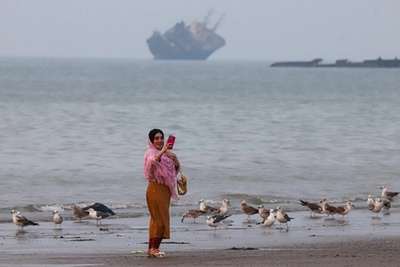
Iranian hardliners are intensifying pressure on authorities to enforce compulsory hijab, as recent cafe closures and online campaigns raise fears of a renewed crackdown despite widespread defiance of the dress code.
Last week, hardline lawmaker Mohammad Naghd-Ali told parliament that another member had told him he cries after every parliamentary session because of the current state of women's dress.
Naghd-Ali fiercely criticized President Masoud Pezeshkian's administration for refusing to implement the controversial hijab law approved in 2024, saying the government was allowing what he described as "nudity” and “immorality" to spread.
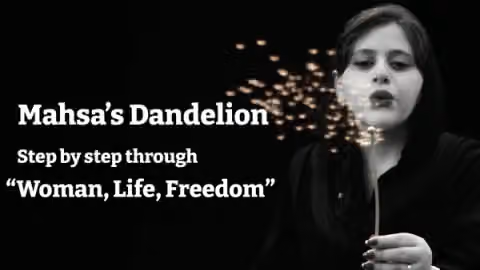
Although the new legislation was finalized in 2024, its implementation has been suspended following a decision by the Supreme National Security Council, reportedly out of concern that enforcing it could trigger unrest similar to the nationwide protests that erupted after Mahsa Amini's death in 2022.
Existing compulsory-hijab rules, however, remain legally in force.
Hardline activists have likewise blamed Pezeshkian for what they portray as the country's cultural decline.
"If Pezeshkian's incompetent and secular government continues for another two years, even today's level of dress will become something people long for," conservative commentator Hassan Abbasi wrote on social media. "Pezeshkian is standing against God's command on hijab and wants to return Iran's cultural climate to the Pahlavi era."
Social media campaign seeks broader crackdown
Hardline activists have also intensified an online campaign demanding tougher enforcement.
In recent days they have circulated videos showing unveiled women in tight-fitting sleeveless tops serving customers at a well-known restaurant in Tehran—scenes that would have been almost unimaginable in the capital and other cities until only a few years ago. Such activists frequently describe these styles as "nudity" or "body display."
One hardline X user, allegedly tied to a state institution, wrote: "The first step in confronting unveiled women is confronting cafes and establishments that violate social norms." According to the post, enforcement is currently focused mainly outside Tehran but will gradually expand across the capital.
Hardline journalist Fereshteh Sadeghi similarly shared a photograph of an unveiled woman shopping outside Tehran and criticized those arguing that hijab should not be discussed while the country faces broader security challenges.
"They tell us not to talk about hijab in the middle of a war and not even to take pictures. Then when are we allowed to speak?" she wrote.
Yet Sadeghi also acknowledged the state's failure to restore widespread headscarf compliance.
"The battle to force the hijab back onto women is over; you can't force the hijab on their heads," she wrote in another post, while arguing that authorities should at least establish dress regulations to prevent what she called "body display."
Hijab as a political symbol
For many hardliners, compulsory hijab is not only a religious obligation but also a defining political symbol of the Islamic Republic.
"Hijab is the flag of Islam. Muslim society is recognized through hijab," conservative social media activist Alireza Akbari wrote.
Supporters of compulsory veiling frequently cite a ruling by Supreme Leader Ali Khamenei, who described unveiling as forbidden both religiously and politically.
Journalist Mehrdad Khadir argued in an article published by Asr-e Iran that women's dress is no longer among the public's primary concerns.
"The way women and girls dress is not a concern for the majority of people," he wrote. "The face of the city has changed, and it will not return to what it once was."
According to Khadir, the country's real concerns are the threat of war and the collapse in living standards.
"In the current circumstances," he wrote, "it is unlikely—indeed impossible—that the authorities would surrender their judgment to those tears and turn an issue that has effectively been settled back into a national crisis. If there is anything worth crying over, it is the collapse of people's purchasing power."
Resistance through everyday life
Although enforcement has eased in many areas over recent years, critics argue that this should not be mistaken for legal liberalization because compulsory hijab laws remain fully in force even if they are not consistently applied.
The social landscape has nevertheless changed dramatically. Many women who continue to wear the hijab have also moved away from the traditional all-black chador and highly conservative appearance. Styles often described online as “hijab style” combine headscarves with colorful clothing, modern designs and fashion accessories.
Hardliners reject these styles as well, arguing that they contradict hijab's original purpose of discouraging attention and preserving modesty.
Opponents of compulsory veiling, meanwhile, say the increasingly visible presence of unveiled women reflects persistence rather than freedom.
"The type of clothing women wear in public still depends on the neighborhood, how they travel, even the day and time," one X user wrote. "The fact that we now see bolder styles is the result of the relentless struggle of brave women who accept the risks of dressing that way. Nothing has actually been liberated."
AI-generated illustration depicting Mohammad-Bagher Kharrazi (foreground) and Iran's Supreme Leader Mojtaba Khamenei (background) against a map of Iran and Tehran's skyline.
A cleric tied by marriage to Iran's ruling family has declared the Islamic Republic obsolete, telling followers that a shadow government already exists and urging them to build a 250,000-strong network to replace the system with an "Islamic government."
The roughly five-minute video of Mohammad-Bagher Kharrazi, released Wednesday, shows the head of the Hezbollah of Iran organization addressing a religious gathering, the kind of mosque pulpit from which much of Iran's clerical politics is conducted. What he delivered from it was not a sermon but an organizational plan.
"Before Mr. Saeed Jalili ever said 'I make the shadow government,' we had formed the shadow government, and we still have it... We have 60 thick volumes of plans covering the smallest details of every organ and institution," Kharrazi said, brushing aside the hardline politician who popularized the term.
"We have prepared plans for implementing the guardianship system, even for how to convert the Islamic Republic into an Islamic government. We have the organization and the planning. But because this transition has not happened, they are taking the Islamic Republic from us”
The Islamic Republic, he told the crowd, "has reached a stage where, in this form, it simply doesn't work anymore."
The arithmetic of a takeover
What separates the video from ordinary hardline grievance is that Kharrazi laid out numbers, methods and targets.
Each follower, he said, should recruit 17 people, and each of those another 17. "If we do this and organize at least 250 people in every city, with a thousand cities that makes 250,000 people," he said.
He offered to bankroll the first gathering himself, "at Hezbollah's own expense," promised a meeting of one hundred thousand, and told the audience the network would "surround all the ministries." The crowd answered with a salavat, the blessing on the Prophet that in such gatherings signals assent.
At another point he set the threshold at 530 organizers per city, a figure drawn not from arithmetic but from devotion: in the abjad letter-numerology cherished in his circles, he ties the number to the name of Fatemeh, the Prophet's daughter. The two figures do not reconcile, and may not be meant to.
He then described the endgame: "With one announcement, everyone comes to Tehran, and that single announcement will finish the work. Mr. Khamenei and the government must understand that a 250,000-strong organization stands ready to move."
The government of President Masoud Pezeshkian, he assured his listeners, "will not reach its end. Have no doubt."
Contempt for the republic, president by president
Kharrazi's case against the republic half of the Islamic Republic was delivered as a roll call. "Why should Mr. Hashemi win a vote in this country? Why should Mr. Ahmadinejad win a vote in this country? Why should Mr. Rouhani win a vote? Why should Mr. Pezeshkian win a vote?" The list, spanning nearly every president of the past four decades, implied that the office itself, not its occupants, is the error.
For the current occupant he reserved open abuse, calling Pezeshkian "this buffoon" who "understands nothing," and cursing the physician he blamed for promoting him: "God damn the accursed Marandi, Khamenei's doctor, who foisted Pezeshkian on the nation."
He damned the Guardian Council for approving such candidates, a complaint carrying its own footnote: the same council disqualified Kharrazi himself when he tried to run for president in 2013.
The faithful, he complained, have been reduced to carrying other men's loads. "Hezbollahi forces in this country have become pack mules," he said.
"What business do we have being pack mules for Ghalibaf, who understands nothing of the religion of Islam?"
‘Mojtaba is more radical than his father’
The video's most consequential claims concern the man Kharrazi presents as his patron. Describing "forty years of friendship, not mere acquaintance, and numerous private meetings," he told the crowd that the new supreme leader wants what he wants: "Mojtaba's thinking is far more radical than his father's."
He offered what he framed as an insider's history: that Mojtaba Khamenei was cast out of his father's office for three years by its deputy chief of staff, confined to his home and reduced to ferrying intelligence letters, with even some of his circle pushed away.
Kharrazi claimed credit for protecting the movement through that period: "They wanted to tear out Hezbollah by the roots. I did not let them."
None of these accounts can be independently verified, and they describe a man who has not been seen or heard in public since his selection five months ago.
The claims also come with a fresh credibility problem attached. Only days earlier, the leader's office publicly branded Kharrazi's previous quotations of Mojtaba Khamenei, that Pezeshkian's next resignation after 28 attempts would be accepted, as unauthenticated and false, warning that such material "serves the objectives of the ill-wishers and sworn enemies of the Iranian nation." Pezeshkian denied the resignation as well.
Kharrazi's response to that rebuke may be the most revealing sentence he has produced.
In a statement styled like a senior cleric's communique, he said he accepts the denial "out of respect" for the late and current leaders, "but we hope that after the important coming changes in those offices, this denial will still stand."
The changes he has in mind are not abstract. In the same week, Kharrazi announced that the new leader intends to remove Mohammad-Bagher Zolghadr as secretary of the Supreme National Security Council and hand the post to Mohsen Rezaei, his military aide.
"They are going to replace Mr. Zolghadr, and Mr. Mohsen Rezaei will take his place," he said, adding that Foreign Minister Abbas Araghchi has been told he has no right to intervene in the negotiations. A man rebuked for speaking in the leader's name answered by announcing the leader's next appointments.
The family and the record
Kharrazi, 65, is as embedded in the Islamic Republic's aristocracy as a cleric can be. His father, Ayatollah Mohsen Kharrazi, sits in the Assembly of Experts; his uncle, Kamal Kharrazi, ran Iran's diplomacy for years and headed its Strategic Council on Foreign Relations until died from injuries sustained in recent Israeli airstrikes in April; his brother Sadegh is a veteran diplomat; his sister is married to Masoud Khamenei, another of Ali Khamenei's sons.
Reuters has reported that the Nobitex cryptocurrency exchange, sanctioned by Washington for helping the Revolutionary Guards evade sanctions, belongs to the Kharrazi family.
His own record is a catalogue of the spectacular. In his 2013 presidential bid he promised to lift sanctions within months, to recover "the territories separated from Iran," from Tajikistan to Azerbaijan, without a drop of blood, and to triple the value of Iran's crashed currency, vowing to bring the dollar from above 3,000 tomans back down to 1,000.
The Guardian Council struck him from the ballot, and even before it did, the Hezbollah coordination council of East Azarbaijan province publicly disowned his group, accusing him of misusing the movement's name and the leader's, and reminding him that by the leader's own explicit guidance, any private quotation attributed to him is to be considered untrue. Thirteen years later, the leader's office is issuing him the same reminder about a different Khamenei.
In clips that went viral this year, he proposed building a nuclear bomb and detonating it in the Atlantic to send a tsunami toward the American coast, and mused about igniting a race war inside the United States.
He studied under Mohammad-Taghi Mesbah-Yazdi, the late theorist whose school long argued that the republic's elections were a concession to be outgrown, which is to say the manifesto is not his invention, only its loudest current recital.
Three readings of one video
The puzzle is not what Kharrazi said but what it means that he can keep saying it. In a state that imprisons filmmakers and poets for far less, a man has now twice in one week put words in the supreme leader's mouth, insulted the president on camera and announced a plan to encircle the ministries, without a knock on his door.
However it is read, the collision at the heart of the video is documented on both sides. The government's own leaked polling shows a society that has drifted decisively from clerical rule, with barely nine percent wanting things to stay as they are. The loudest organizing energy inside the system, on this week's evidence, wants to move the opposite way.
One reading is that the leader's office will now be forced to do more than issue denials, and that Kharrazi's next video will be his last.
A second is bleaker for the system: that there is no functioning leader capable of silencing anyone, and the in-law is filling a vacuum with his own voice.
A third, voiced in exile commentary, is that Kharrazi is not speaking for the present leadership at all but building a following for the day the question of who leads is reopened, including a future in which his own brother-in-law's household sits closer to the throne.
Under any of the three, the fact stands: five months into the new reign, the most detailed public plan for ending the Islamic Republic has come not from its opponents but from inside its founding family's circle, and it points toward more theocracy, not less.
A shopper looks over dairy products in an Iranian supermarket. Retail workers say thefts of basic food items have become more common as economic pressures intensify.
Petty thefts of basic food items are becoming a symbol of Iran's economic hardship, according to a newspaper investigation published on Wednesday that linked supermarket shoplifting to inflation and shrinking purchasing power.
Unlike the corruption scandals that have long dominated headlines in Iran, the report by Jahan-e Sanat focuses on thefts measured not in billions of rials but in loaves of bread, packages of cheese and cuts of meat.
It argues that cases involving everyday groceries are increasingly reflecting economic distress rather than simple criminality.
"There are no billions of tomans, no gold, no luxury villas," the newspaper wrote. "Sometimes it is only a can of cheese, a loaf of bread or a few simple food items."
Days before Jahan-e Sanat published its report, CCTV footage from outside a minimarket at night in the northern city of Babolsar spread widely across Persian-language social media.
The footage appears to show a woman wearing a black chador approaching a display of boxed goods outside the shop. After pausing beside the display and glancing around, she appears to pick up one of the boxes before walking away.
Exactly what prompted the woman's actions remains unknown. But for many Iranians, the clip became less about one apparent shoplifting than about the growing struggle to afford everyday necessities.
"May God never let anyone feel ashamed in front of their family," one user wrote.
"This is what happens when prices keep rising. We live in a country rich in oil and gold, yet the government cannot provide for 87 million people," another commented.
"People simply cannot afford to buy things anymore because prices have become so expensive," another wrote.
Others pleaded with whoever shared the footage not to expose the woman's identity.
"Who would steal a few groceries unless driven by poverty and hunger? God help them," one commenter wrote.
AI-generated image shows a security camera monitoring supermarket shelves in Iran, where reports of petty thefts involving everyday groceries have sparked debate over poverty and the country's worsening cost-of-living crisis.
"Maybe she had no money to buy food for her children. The shopkeeper should have protected her dignity instead of exposing her," another said.
Some comments contrasted the apparent theft with what they described as large-scale corruption, arguing authorities should focus on powerful figures accused of enriching themselves rather than people taking everyday necessities.
The sympathy expressed online echoed account gathered by Jahan-e Sanat from a supermarket employee who described an apparent increase in customers taking inexpensive food items.
Behind the supermarket shelves
Amirhossein, an employee at a large supermarket chain, told the newspaper he had witnessed several such incidents during the past 10 months.
He recalled seeing a woman place two tubs of cheese into her handbag during a busy period before leaving without paying. In another case, he said, security camera footage later showed a man leaving with butter, cakes and pastries concealed beneath his coat.
Staff also stopped a customer who had eaten packaged cakes inside the store and hidden the empty wrappers before trying to leave, according to the employee.
Perhaps most surprising, Amirhossein said, was a regular customer who was caught taking a package of meat.
"I think poverty is the main reason," he told Jahan-e Sanat. "You cannot judge everyone the same way, but when someone steals a simple item, they are probably under enormous pressure. Sometimes, if what was taken has little financial value, we don't pursue it because we think the person's circumstances may have brought them to this point."
'A crisis of livelihoods'
Sociologist Mostafa Abroshan said reports of thefts involving bread, dairy products and other essentials should be viewed in the context of Iran's prolonged economic difficulties.
"Thefts of basic goods, especially food and other necessities, reflect disruptions in economic structures and the declining ability of households to meet their basic needs," he told the newspaper.
"This does not justify theft, but it shows that people's behavior must be understood within its social context."
Abroshan said inflation, declining purchasing power and job insecurity had left many households struggling to afford essential goods.
"A society in which stealing bread, milk or rice becomes more common is facing a crisis of livelihoods and social justice more than a security crisis," he said.
A shopper carries groceries in Iran. Rising prices and declining purchasing power have pushed basic food items to the center of the country's widening cost-of-living crisis.
Prolonged economic hardship, he warned, could also erode social trust, leaving retailers more suspicious of customers, increasing security costs and weakening confidence in public institutions.
While enforcing the law remains necessary, Abroshan said that reducing poverty, controlling inflation, creating jobs and strengthening social support would do more to curb petty theft than harsher punishment alone.
Without addressing the economic pressures facing low-income households, he said, the theft of everyday groceries risks becoming an increasingly visible measure of Iran's widening cost-of-living crisis.
A woman eats by flashlight during a power outage at a restaurant in Ahvaz, southwestern Iran
In Iran, the authorities call it a scheduled outage. The electricity will be disconnected for two hours. The water may return later in the evening. Families are instructed to adjust their lives to temporary emergencies. But there is no pause button for daily life.
A baby does not stop needing clean water because the pumps have shut down. A patient cannot postpone the use of refrigerated medicine or medical equipment. An elderly person living on the 14th floor cannot simply take the stairs when the elevator stops working. Parents cannot suspend cooking, washing or caring for their children until the state restores the water.
During the brutal Iranian summer, when temperatures in parts of the country exceed 40 degrees Celsius and climb above 50 in the south, air conditioning is not merely a comfort. For children, older people and those with medical conditions, it can become a matter of survival.
The authorities can announce a two-hour power cut. A child's fever, a patient's oxygen machine and a family's need for clean water do not follow that schedule.
Iran's water and electricity emergencies are not separate crises. Water distribution depends on electricity to operate pumping stations and move water through municipal networks, especially into apartment buildings and elevated neighbourhoods. When electricity fails, pumps stop working and water pressure falls. One failing system pulls another down with it.
‘No one to turn to’
Reports from across Iran describe daily electricity cuts lasting for hours alongside recurring water shortages. In Boumehen, east of Tehran, residents reportedly received running water on only two days during one week, and even then for only a few hours.
"We have a sick person at home. We no longer know who to turn to," one resident said.
In Pardis, another city east of Tehran, a resident of a 14-storey building said a four-hour power cut left the elevators out of service. "How are we supposed to climb all these stairs?" he asked.
In Ilam, power cuts reportedly lasted as long as four hours while temperatures reached around 46 degrees Celsius. In Khuzestan, one of Iran's principal oil- and electricity-producing provinces, residents complained that outages had resumed as temperatures crossed 50 degrees.
This is one of modern Iran's deepest contradictions. A country with some of the world's largest oil and natural gas reserves cannot guarantee electricity to its own population. Provinces that generate much of Iran's energy cannot rely on power in their own homes.
Factories lose production hours, small businesses lose income, food and medicine spoil, and families organise their days around outage schedules that are not always accurate.
During the summer they lose electricity; during the winter they face gas shortages. The crisis changes with the season, but it never disappears.
‘Energy imbalance’
Officials describe this as an "energy imbalance," a phrase that makes the problem sound technical rather than political. But Iran's energy crisis was not created overnight.
For years, electricity generation failed to keep pace with demand. Transmission networks deteriorated, renewable energy remained marginal and water systems continued to lose enormous quantities through leakage and decay.
In June 2026, Iran's Parliamentary Research Center reportedly projected a peak summer electricity deficit of roughly 13,600 megawatts.
The government's answer was to ask every Iranian to reduce electricity consumption by ten percent. Once again, citizens were instructed to compensate for failures they did not create.
A family can switch off a lamp. It cannot modernize a power station. A parent can shorten a child's shower. She cannot repair a leaking municipal water network. A shopkeeper can turn off an air conditioner, but he cannot recover decades of lost investment or build the electricity capacity the country requires.
Iran does face genuine environmental pressures. Drought, extreme heat and irregular rainfall have reduced water availability across the country. Climate change is making an already dry region hotter and more vulnerable.
But climate alone cannot explain why so much available water is wasted, why groundwater has been extracted beyond natural recovery or why inefficient agricultural practices remained dominant for decades.
Low efficiency
Even experts quoted by Iran's official news agency acknowledge as much.
Hashem Oraee, head of the Iran Energy Associations Union, estimated that nearly 90 percent of Iran's annual water consumption goes to agriculture, where efficiency remains extremely low.
He also said roughly one-third of the water entering urban distribution networks is lost before reaching consumers.
Iran is not simply running out of water. It is losing the water it still has. The current war did not create this crisis. It struck a system that was already fragile, underfunded and unable to meet national demand.
Iranian electricity officials have said more than 2,000 points across the national grid were damaged during the conflict, reducing available generating capacity by around 4,200 megawatts.
Those figures have not been independently verified, but they indicate the scale of the damage the authorities themselves claim to be facing.
Extended hours
In Bandar Abbas, residents described explosions followed by prolonged electricity cuts. One woman who depends on the internet for her income said she had already been struggling with government-imposed internet shutdowns before longer power cuts placed her work at further risk.
"We always had power cuts, but the hours have now extended," she said.
That distinction matters. The war made the outages longer and more dangerous, but it did not introduce Iranians to blackouts. Years of neglect had already done that.
Inside the home, the consequences are immediate. Refrigerators stop cooling food and medicine. Medical devices fail unless families can afford backup power. Elevators become unusable. Water no longer reaches upper floors when electric pumps stop working. Parents struggle to prepare food, wash clothes, sterilize baby bottles or care for elderly relatives and young children.
The word "outage" suggests a temporary interruption after which normal life resumes. But when electricity disappears every day, when water and power fail together, and when no one knows whether the published schedule can be trusted, the interruption becomes normal life.
Water and electricity are not luxuries. They are the foundations on which healthcare, sanitation, education, industry and family life depend.
Iran did not run out of intelligence, resources or human ability. Its people were deprived of functioning systems because those in power failed to build and maintain them.
Now the lights are going out, the taps are running dry, and ordinary Iranians are once again being asked to bear the cost.
Lawmakers raise their hands to express opinion in a parliamentary debate, in Tehran, Iran, undated file photo
Iran's parliament has become all but irrelevant since the war, as power has shifted further toward the Revolutionary Guards and decision-making has moved ever deeper behind closed doors amid the unresolved leadership transition.
The shift has left lawmakers arguing over soaring inflation, corruption and economic policy while increasingly questioning what authority the Majles still retains.
Two interviews published Tuesday by moderate Khabar Online and pro-reform Rouydad24 offered sharply different diagnoses of Iran's economic crisis, but together painted a picture of a legislature struggling to remain relevant.
The interviews came after months of complaints from MPs that parliament has been sidelined, with Speaker Mohammad Bagher Ghalibaf limiting its work to sporadic online sessions while assuming an increasingly prominent role in high-level diplomacy.
"If you ask lawmakers at the parliament door how much a kilo of chicken, meat or bread costs, I swear to God most of them cannot tell you," outspoken former MP Gholamali Jafarzadeh Imenabadi told Khabar Online.
"This is because a massive gap has formed between our officials and the people."
Citing Parliamentary Research Center data, Imanabadi said less than seven percent of the Majles' resolutions over the past two years had addressed economic issues despite soaring inflation and the rising cost of basic goods.
‘Don’t weep, resign!’
Responding to a current MP who publicly wept over women's non-compliance with compulsory hijab laws, Jafarzadeh said officials should instead feel shame—or resign—over inflation, unemployment and empty stomachs.
"For the empty stomachs of the people, officials should ask for death, not just weep. For the state of inflation, they should resign," he said.
He also criticized what he described as parliament's misplaced priorities, questioning why Ghalibaf had become one of Iran's chief negotiators while lawmakers neglected their core duty of overseeing the government and tackling corruption and inflation.
Former conservative MP Hamidreza Taraghi offered a sharply different assessment in an interview with Rouydad24, blaming President Masoud Pezeshkian's administration rather than parliament for the country's economic turmoil.
"Regarding inflation and rising prices, the government follows methods that lack the necessary efficiency to control inflation," he said, arguing that weak oversight by the administration and the Central Bank lay behind many of the country's economic problems.
Taraghi also rejected suggestions that hardline MPs represented parliament as a whole: "The positions of 10 to 15 MPs should not be generalized to the entire parliament.”
He further defended the Majles against accusations of economic inaction, arguing that under Iran's constitution parliament could not introduce spending measures without identifying funding sources, leaving many economic decisions in the government's hands.
Elected bodies sidelined
The competing accounts reflect a broader debate over who bears responsibility for Iran's economic crisis. Moderates portray parliament as increasingly detached from both public concerns and the country's most pressing challenges, while hardliners argue its powers are constrained and responsibility rests primarily with the executive.
Yet the interviews also point to a deeper shift in Iran's political system.
Under former Supreme Leader Ali Khamenei, institutions including parliament, the Expediency Discernment Council, the Assembly of Experts and even the presidency steadily lost influence as authority became concentrated in the leader's office.
Since the five-month war with Israel and the United States, critics say that trend has accelerated, with the Revolutionary Guards and the power center surrounding Mojtaba Khamenei increasingly eclipsing the Islamic Republic's formal institutions.
Whether lawmakers blame the government, Ghalibaf or one another, the interviews suggest they are debating problems in a parliament many believe no longer has a role in decision-making..
Students walk on a school campus in Iran. Officials say easy access to nas, a smokeless tobacco product sold legally in many shops, is contributing to rising nicotine use among schoolchildren.
Schoolchildren in Iran are getting hooked on nas, a cheap smokeless tobacco sold openly within steps of their classrooms, an official warned on Tuesday, as social media users asked why a product this addictive is hawked to children in plain sight.
The use of nas has become increasingly common among students, particularly in middle school, said Mostafa Mohammadpour, head of the state Welfare Organization office in the northeastern city of Kashmar. In some cases, he added, children in the upper years of primary school have begun using it.
"What has now become common among students and paves the way for drug dependence starts with the use of nas," Mohammadpour said. "Unfortunately, children have very easy access to it because selling it is not considered a crime and it is not recognized as a narcotic."
Nas, known across the region as naswar, is a moist green tobacco mixture held under the lip or tongue. It is a centuries-old habit in eastern Iran, Afghanistan and Central Asia, and because it produces no smoke, a child can use it in a classroom without anyone noticing.
'Why don't they stop it?'
The warning drew a wave of responses from users reacting to Iran International's coverage, many asking why the product remains on open sale despite years of warnings about its risks.
"Why don't they stop it from being distributed?" one commenter asked.
Packets of nas, a smokeless tobacco product, are prepared for sale at a market.
Another argued the answer lies in giving children somewhere else to go. "Municipalities should build at least three sports complexes for students in every district and make them free. School facilities should also be improved so students stay occupied and don't turn to it," the commenter wrote.
Others aimed their frustration at official indifference. "Do they even care what happens to young people?" one wrote.
Some tied the issue to wider political grievances. One X user alleged that the authorities allow addiction to spread among the young to blunt political activism, and wrote that nas "causes addiction quickly," "causes cancer in the mouth" and "damages teeth," adding a claim, which could not be independently verified, that products sold in Iran contain arsenic.
Because nas is not classified as an illegal narcotic, it sits on the shelves of small shops, and students obtain it with little difficulty, according to Mohammadpour.
The habit is most entrenched in the northeastern province of Razavi Khorasan, he said, but is no longer confined to one region, with nas now readily available across much of the country.
Tehran is no exception. Iranian media have reported vendors openly selling nas in and around the capital's Molavi market, the green tobacco displayed in packages large and small under a variety of brands.
The market draws buyers with lower prices and a wider selection, though the product is also sold through herbal shops across the city.
For children, the attraction is obvious: it is cheap, easy to hide and everywhere.
Nas, a smokeless tobacco product, is shown in a plastic bag. Iranian officials say its widespread availability has made it increasingly accessible to children and teenagers.
More than a tobacco habit
Doctors warn the risks run well beyond nicotine.
Research has linked nas to cancers of the mouth, esophagus and pancreas, as well as cardiovascular disease. Health experts also reject the belief that smokeless tobacco is a safe alternative to cigarettes, warning that no tobacco product is without risk.
The spread among students carries a further danger: early exposure to nicotine can leave children more vulnerable to addiction of every kind later in life, the concern at the heart of Mohammadpour's "gateway" warning.
A small packet of nas, a smokeless tobacco product, is exchanged between two people.
A country's changing addictions
The warning lands against a wider shift in substance use in Iran.
More than 4.4 million people in Iran use narcotics regularly or occasionally, according to a report last year in the daily Shargh, which estimated that, counting their families, some 15 million people live with the consequences of drug use.
Officials and health experts have also pointed to rising use of synthetic drugs, a falling age of first use, and growing numbers of women and young people among users, signs that addiction in Iran is getting younger.
The children with green packs in their pockets, on this reading, are not an anomaly but the leading edge.