• العربية
  • فارسی
Brand
  • Iran Insight
  • Politics
  • Economy
  • Analysis
  • Special Report
  • Opinion
  • Podcast
  • Iran Insight
  • Politics
  • Economy
  • Analysis
  • Special Report
  • Opinion
  • Podcast
  • Theme
  • Language
    • العربية
    • فارسی
  • Iran Insight
  • Politics
  • Economy
  • Analysis
  • Special Report
  • Opinion
  • Podcast
All rights reserved for Volant Media UK Limited
volant media logo

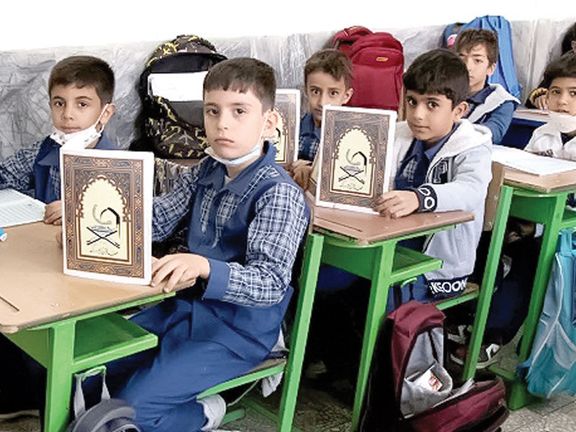
Iran says Quran 'memorization' schools to expand
May 16, 2026, 03:43 GMT+1
Young school children in Iran with abridged copies of the Qur'an, undated file photo

Iran’s Education Ministry said Quran-related activities and prayer programs are continuing online as schools remain virtual, with 200 school for memorising Qur'an set to open this year.

Mikail Bagheri, director general for Quran, Etrat and Prayer Affairs at the ministry, told ILNA news agency that Quran instruction is continuing through online platforms alongside other school subjects.

He said Quran classes in primary schools are taught by general teachers, while specialized Quran instructors handle the subject in secondary education.

Bagheri also said Iran launched around 200 official Quran memorization schools across the country last year and plans to expand the program further.


Most Viewed

Iran parliament working on bill that proposes €50m reward for killing Trump
1

Iran parliament working on bill that proposes €50m reward for killing Trump

2

Iran and UAE clash at BRICS foreign ministers meeting

3
INSIGHT

Earthquakes and storm revive Tehran’s fears of 'the big one'

4
ANALYSIS

Xi may help Trump on Iran, but at a price

5
INSIGHT

'Class internet' fuels anger in blackout-hit Iran

Banner
Banner

Spotlight

  • Iran’s café culture buckles as everyday life contracts
    INSIGHT

    Iran’s café culture buckles as everyday life contracts

  • China’s Iran balancing act grows more costly
    ANALYSIS

    China’s Iran balancing act grows more costly

  • Tehran media sees rising risk of war as US talks stall
    INSIGHT

    Tehran media sees rising risk of war as US talks stall

  • Xi may help Trump on Iran, but at a price
    ANALYSIS

    Xi may help Trump on Iran, but at a price

  • How one Tehran hospital became a window into Iran’s January massacre
    SPECIAL REPORT

    How one Tehran hospital became a window into Iran’s January massacre

•
•
•

More Stories

Fuel shortages and rationing push Iranians into gasoline black market

May 15, 2026, 09:04 GMT+1
•
Saba Heidarkhani

Fuel shortages and tighter rationing are pushing drivers across Iran into a growing gasoline black market, with citizens describing long lines at gas stations and sharply inflated prices in messages sent to Iran International.

The accounts describe growing frustration over restricted access to subsidized gasoline and arbitrary limits imposed by operators, leaving many motorists dependent on costly unofficial sales.

“One day there’s quota left on your card, the next day it says your quota is finished,” one citizen said. “They even steal the few drops of gasoline they give people.”

Iran uses a subsidized fuel quota system controlled through electronic fuel cards. Every private vehicle receives a monthly gasoline allocation at discounted prices, while extra consumption is charged at higher rates.

Under Iran’s latest pricing system introduced in late 2025, the first 60 liters of gasoline each month cost 15,000 rials per liter (about $0.008), the next 100 liters cost 30,000 rials ($0.017), and any amount above 160 liters costs 50,000 rials ($0.028).

Despite heavy fuel subsidies, Iran’s minimum monthly wage is now worth less than $90 because of inflation and the sharp decline of the rial.

  • Iran begins pilot sales of imported gasoline at market price

    Iran begins pilot sales of imported gasoline at market price

Another driver said he could not use his personal fuel card on Wednesday because his monthly allocation had already run out. The station operator, he said, agreed to provide a fuel card only if payment was handed directly to him, and even then limited sales to 15 liters at 70,000 rials ($0.038) per liter.

President Masoud Pezeshkian said in late April that the country faced “some shortages” in sectors including energy and fuel.

On May 9, Esmail Saghab Esfahani, vice president and head of Iran’s Strategic Energy Policy and Management Organization, said damage during the war had affected parts of the country’s gas and fuel infrastructure and disrupted some gasoline production capacity.

He said Iran had “no choice but to conserve” fuel consumption for at least the next 18 to 24 months.

But Oil Minister Mohsen Paknejad said on April 29 there were no concerns over fuel supply or distribution.

File Photo: A worker adjusts fuel pumps at a gas station in Iran
100%
File Photo: A worker adjusts fuel pumps at a gas station in Iran

Black market prices rise

A resident of Bandar Abbas in southern Iran said drivers often wait more than an hour at gas stations, even with personal fuel cards, while gasoline is “widely available” on the black market at 150,000 rials, about $0.08, per liter.

In Zahedan, in southeastern Iran, one resident said gasoline shortages and tighter controls had accelerated illegal fuel sales.

“Everything has been left without oversight,” the resident said. “Sometimes 20 liters of gasoline is sold on the street for 10 million rials ($5.5).”

One driver from Isfahan said operators demanded between 1 million rials ($0.55) and 4 million rials ($2.22) to provide access to only 15 liters.

  • Iran officially rolls out higher gas price under new three-tier system

    Iran officially rolls out higher gas price under new three-tier system

Citizens also described growing congestion at gas stations nationwide, with drivers saying some stations on major routes had limited purchases to 15 liters.

A resident of Sistan and Baluchestan said 70 liters of gasoline now costs around 50 million rials, about $28, while many villagers must drive hundreds of kilometers to reach hospitals or provincial centers.

For many Iranians, the shortages have become less a matter of conservation than another daily pressure in an increasingly strained economy.

'Class internet' fuels anger in blackout-hit Iran

May 15, 2026, 04:37 GMT+1
•
Maryam Sinaiee

President Masoud Pezeshkian has ordered the creation of a special committee to end Iran’s internet blackout, but many Iranians doubt it can overcome resistance from powerful state institutions.

President Masoud Pezeshkian has ordered the creation of a special committee to end Iran’s internet blackout, but many Iranians doubt the government can override the powerful institutions controlling cyberspace policy.

Earlier this week, Pezeshkian tasked First Vice President Mohammad-Reza Aref with forming a body aimed at restoring access to the global internet after more than two and a half months of severe restrictions.

Reformist newspaper Shargh reported that the committee is expected to restore broader access within a month.

Pezeshkian announced the move on X, saying he had instructed Aref to carry out the task while considering “governance sensitivities, the Supreme Leader’s views, and the promise I made to the people.”

During his presidential campaign, Pezeshkian repeatedly promised to ease internet filtering and restrictions. But ordinary Iranians have effectively been cut off from the global internet since US-Israeli strikes began on February 28.

Before the war, some individuals had access to so-called “white SIM cards,” exempt from ordinary filtering restrictions. After the ceasefire, authorities expanded selective access to businesses and approved individuals through services branded as “Internet Pro.”

Many users responding to Pezeshkian’s X post expressed frustration and skepticism.

“Mr. President, don’t make us regret voting for you,” one voter wrote. “End this discrimination, these white SIM cards, these Pro subscriptions, and this class-based treatment of a natural right. We want free internet.”

Another user reminded Pezeshkian that during the election campaign he had said he would resign if he failed to fulfill major promises, including lifting internet restrictions.

It remains unclear whether recent decisions were made by the Supreme Council of Cyberspace (SCC) or the Supreme National Security Council (SNSC). Both are formally chaired by Pezeshkian, but other figures and institutions — including the Revolutionary Guards — wield significant influence within them.

The appointment of Aref to lead the new “Special Taskforce for Organizing and Guiding Cyberspace” also drew criticism from conservative figures.

Former Cultural Heritage Minister Ezzatollah Zarghami, himself a member of the SCC appointed by Khamenei, described the initiative as parallel decision-making overlapping with the council’s responsibilities.

“Transformation and restructuring in the decision-making system must be fundamental and involve changing the governance model in cyberspace,” he wrote on X.

One social media user responded sarcastically: “The president realized he can’t stand up to the Supreme Council of Cyberspace, so he created another council that can do absolutely nothing.”

‘Class-based internet’

The prolonged disruption of international internet access has created serious technical and economic problems inside Iran.

Domestic websites and online platforms have struggled because technical teams lost access to international tools and services. Software licenses expired, search engines failed to properly index Iranian sites, and server disruptions affected service delivery.

The impact on employment has also been severe. Millions of jobs linked to online businesses, social media and international digital services have been disrupted, including work done by programmers, online sellers and content creators.

Selective access programs such as “Pro Internet” and white SIM cards have meanwhile become symbols of inequality for many Iranians.

Some groups offered privileged access — including nurses and certain lawyers — refused to accept it, branding it institutionalized discrimination.

Restrictions on ordinary users have also fueled a growing black market.

According to Iranian media reports, while the official price for a 50-gigabyte Pro Internet package is around 20 million rials, the same service is being resold for as much as 120 million rials. White SIM cards are reportedly advertised on Telegram starting at 440 million rials, depending on the level of access provided.

Even before the current near-total shutdown, millions of Iranians already relied on paid VPN services to access blocked platforms such as Instagram and YouTube.

The high cost has effectively turned internet access into a luxury product many cannot afford in a country where some public sector workers, including teachers, earn roughly 150 million rials per month.

Journalist Sadegh Zangeneh wrote in Khabar Online: “The level of anger and dissatisfaction among the people over the internet shutdown and its divisive consequences should not be sought in reports written by those who have monopolized the internet themselves.”

He added: “Either those who deprive people of the internet in the name of security are betraying the country, or those who auction off national security under the label of ‘Pro Internet’ and other forms of class-based internet are doing so.”

Sociologist Mohammad Fazeli also warned about the social consequences of unequal access, arguing that “discriminatory internet” would become yet another reason for people to confront the state.

Earthquakes and storm revive Tehran’s fears of 'the big one'

May 15, 2026, 00:40 GMT+1
•
Maryam Sinaiee

A series of overnight earthquakes and a powerful dust storm rattled Tehran and nearby cities on Tuesday night, reviving fears of a catastrophic earthquake in a capital still psychologically scarred by recent war.

The seismic activity began with a mild 3.4-magnitude tremor before intensifying into a 4.6-magnitude earthquake later in the night. Several aftershocks continued into early Wednesday morning.

At the same time, a storm swept through Tehran, bringing severe dust, power outages and fallen trees. At least seven people were reportedly injured in the storm, though authorities said the earthquakes themselves caused no casualties or major damage.

Still, the tremors revived a long-standing fear in Tehran: the possibility of a devastating earthquake along the active fault lines beneath eastern Tehran and surrounding towns.

The big one may be overdue

ILNA quoted earthquake expert Fariborz Nateghi Elahi criticizing the lack of serious crisis planning for the major quake scientists have long warned about.

“We know an earthquake will happen,” he said. “Not on this scale, but something much, much larger.”

Eastern Tehran and nearby towns sit atop an active fault stretching at least 200 kilometers and capable of generating earthquakes above magnitude 7. Geologists say the fault typically produces a major earthquake roughly once every century.

Nearly 200 years have passed since the last truly destructive event. In 1830, a massive earthquake estimated at magnitude 7.1 devastated Tehran, then a relatively young capital.

Scientists now warn that pressure accumulated underground since then has left the fault in a critical state, primed for a major release of energy.

In December 2017, a 3.5-magnitude tremor caused widespread panic, sending residents into the streets and forcing many families to sleep in their cars overnight. This time, despite the stronger quake, the public reaction appeared noticeably more subdued.

Crisis fatigue

Some residents still spent the night in parks, streets or inside their vehicles, but many on social media said the trauma of recent air and missile attacks during two wars had numbed their reactions.

One psychologist writing on X suggested the muted response could be explained by “crisis fatigue.”

A social media user wrote: “The 2017 earthquake made Tehran residents sleep in their cars until morning. Streets were completely gridlocked, and gas stations were packed. Its magnitude? 3.5. Now our reaction is: ‘Oh, it’s just an earthquake,’ and we pull the blanket over our heads and go back to sleep. I think only a nuclear bomb could still move people in this country.”

Another user described how the storm initially triggered fears of renewed military attacks: “The storm started, windows were shaking, and I thought: ‘Is it fighter jets?’”

She said she then checked the news and realized it was just a storm, which briefly calmed her. “Then the earthquake came, and I thought: well, that’s nothing. Compared to war, everything feels like a joke.”

Skyrocketing rents push Iranians back to parents’ homes, shared housing

May 14, 2026, 13:28 GMT+1

More Iranians are moving back in with family or taking on roommates after losing jobs and struggling to keep up with rising rents in major cities, according to messages sent to Iran International.

“I worked at a petrochemical company and got fired. Since we can no longer afford rent, my wife, two children and I have moved back into my parents’ house,” one citizen told Iran International.

Another, a woman supporting her household alone, said she was forced to share her home after losing her job at a restaurant.

“I am the head of my household and after losing my job at a restaurant, I had no choice but to get a roommate to reduce rent and living costs while raising my teenage child,” she told Iran International.

Shargh newspaper reported on Thursday that more tenants in Tehran and other large cities are turning to shared housing, returning to parents’ homes or leaving the capital altogether as rent and living costs climb.

The newspaper cited residents who said they were searching for roommates for the first time after years of living independently, while others described plans to move back with family members or relocate to smaller cities after losing income.

  • Iran's Housing Crisis Deepens As Inflation Soars

    Iran's Housing Crisis Deepens As Inflation Soars

A 45-year-old woman who had lived alone in central Tehran for two decades told Shargh she was considering taking in roommates because she could no longer afford rent on her own.

“More than two decades passed living alone and now I have to change my standards,” she told the newspaper. “Paying 400 million rials ($220) in rent in Tehran’s Bahar neighborhood is impossible for me.”

Another resident said he and his brother were looking for a third housemate after his workplace suspended operations and stopped paying salaries.

File photo: Iranians move household belongings as soaring rents and economic pressure force many families to move back in with parents or relatives.
100%
File photo: Iranians move household belongings as soaring rents and economic pressure force many families to move back in with parents or relatives.

Reverse migration from Tehran

Shargh said some residents were preparing to leave Tehran entirely after years in the capital, describing what it called a wave of reverse migration driven by economic hardship and shrinking work opportunities.

One editor told the newspaper she was returning to her hometown Kashan in her mid-40s after more than two decades in Tehran because rising costs and declining work in publishing left her unable to continue living independently.

“I thought I would return to Kashan after retirement, not in middle age because I can no longer survive economically in Tehran,” she told Shargh.

  • War-hit homeowners feel abandoned as Iran’s reconstruction aid fades

    War-hit homeowners feel abandoned as Iran’s reconstruction aid fades

The report also pointed to signs of tighter housing supply, citing online property listings and real estate agents who said available rental units had declined while demand increased, particularly after displacement linked to the conflict with Israel.

Erosion of independence

Sociologist Abdolvahab Shahlibar told Shargh that shared housing in Iran is increasingly a financial necessity rather than a lifestyle choice.

“Efforts to improve quality of life have in many cases been replaced by efforts to preserve basic survival,” Shahlibar told the newspaper, warning that being forced to return to parents’ homes or abandon independent living could reshape social relationships and personal identity.

Tehran quake stirs dark humor, hopes for renewed strikes

May 13, 2026, 21:10 GMT+1

A series of tremors in and around Tehran late Tuesday stirred shock, dark humor and political despair among residents, with some initially mistaking them for renewed US-Israeli strikes.

On Tuesday night, Iran’s Seismological Center said a 4.6-magnitude quake struck near Pardis, east of Tehran, at a depth of 10 kilometers, with no immediate reports of casualties or major damage. A series of nine smaller earthquakes also struck the area overnight.

“This is what life is like for us inside Iran: an earthquake happens and my mother says, ‘I wish it were bombing instead.’ The result of 47 years of Islamic rule,” one message sent to Iran International said.

The reactions came against the backdrop of a fragile ceasefire after more than two months of war that began on February 28 with a US-Israeli bombing campaign on Iran.

Donald Trump said Monday that the ceasefire with Iran was “on life support” after rejecting Tehran’s response to a US proposal aimed at ending the war.

The ceasefire has been in place since April 7, but Trump has repeatedly threatened to end it if Iran failed to reach an agreement with Washington.

One message captured the bitter humor with which some residents viewed the quake amid fears of renewed conflict, suggesting divine intervention had stepped in where Trump had not.

“Trump dragged this out so much that God stepped in,” the message said.

Several residents said they initially mistook the shaking for renewed strikes.

“The earthquake at 11:40 p.m. on Tuesday in Tehran was really terrifying. For a few seconds, we thought the attacks had started again,” one Tehran resident said.

Another resident in eastern Tehran’s Tehranpars district said the tremor felt like a nearby missile strike.

“We are in eastern Tehran, in Tehranpars. Tuesday night’s earthquake shook and rattled our house so badly that we thought a missile had hit next to our home,” the resident said.

Several messages described the tremors as reviving memories of the recent war, when residents had become used to distinguishing between air defense fire, missiles, drones and explosions.

“Around 9 p.m. on Tuesday, an earthquake was felt in Tehran, but the one that came at 11:45 p.m. was felt very strongly. The whole house shook and the chandeliers rattled. It felt like the experience we had during those 40 days of war,” one message said.

Another resident said the earthquake and the sound of a storm afterward produced conflicting emotions.

“When the earthquake happened and then the sound of the storm afterward, we thought we were under attack again. We felt fear and relief at the same time,” the resident said.

In Pardis, east of Tehran, residents reported repeated tremors through the night.

“In Pardis, from 8 p.m. until 1 a.m., there were three relatively strong earthquakes. People rushed into the streets in fear and gas stations became crowded,” one message said.

One resident said a sudden dust storm added to the confusion.

“We were sitting at home, the weather was nice, and suddenly the air became extremely dusty and the sky filled with dirt and dust. Even though the war experience has taught us to distinguish between air defense fire, missiles and drones — or judge from the sound and shaking how close an explosion is — when the earthquake happened, for a few seconds we could not tell whether it was an attack or something else,” the resident said.

Other messages reflected mistrust and speculation about whether the tremors were linked to underground missile activity or even a possible nuclear test near Parchin.

“Could the earthquake have been caused by the criminals’ underground missile activities? Especially considering Tehran naturally sits on a fault line and their underground activities were exposed during the war,” one person said.

Another message said there was speculation online that the quake’s epicenter near Parchin meant Iran may have carried out a nuclear test rather than experienced a natural earthquake.

One message accused state television of failing to quickly cover the earthquake because authorities feared people would pour into the streets.

“State TV was not covering the earthquake because they were afraid people would pour into the streets. Human lives are so worthless to them as long as they can stay in power a little longer,” the message said.