India and Pakistan condemn Iran’s attacks on UAE
India and Pakistan condemned on Tuesday Iran’s attacks on the United Arab Emirates, calling for restraint and a return to diplomacy.
India and Pakistan condemned on Tuesday Iran’s attacks on the United Arab Emirates, calling for restraint and a return to diplomacy.
Indian Prime Minister Narendra Modi said attacks that injured three Indian nationals were unacceptable, adding that targeting civilians and infrastructure must stop.
“India stands in firm solidarity with the UAE and reiterates its support for the peaceful resolution of all issues through dialogue and diplomacy,” he wrote on X.
Prime Minister Shehbaz Sharif also strongly condemned the attacks and expressed full solidarity with UAE President Mohammed bin Zayed in a post on X.
“Pakistan stands firmly with our Emirati brothers and sisters as well as with the Government of the United Arab Emirates at this difficult time,” he wrote.
He said it was essential that the ceasefire be upheld to allow space for diplomacy and called for dialogue to achieve lasting peace and stability in the region.
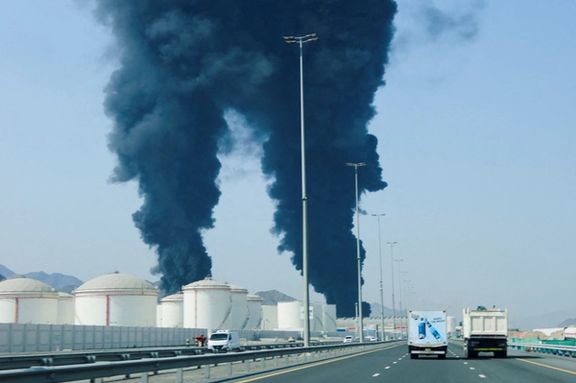
The United Arab Emirates came under attacks from Iran’s drones and missiles on Monday, causing a fire at the Fujairah Oil Industry Zone.
Abu Dhabi “condemned in the strongest terms the renewed terrorist, unprovoked Iranian attacks targeting civilian sites and facilities.”





One consequence of the shutdown has been the emergence of short-term, urgent migration to countries such as Armenia and Turkey. Individuals whose businesses depend on global markets have been forced to temporarily leave the country to preserve their livelihoods.
A technology specialist currently in Yerevan told Iran International: “I spent all my savings from the past year to stay in Armenia for two months. This migration is not voluntary; if I cannot connect, all my foreign contracts will be canceled. Some of my friends even sold their wives’ gold or household items just to reach the internet and not lose their jobs.”
These forced migrations not only drive human capital out of the country but also impose heavy costs on families already under economic strain, especially as such options are only available to a limited number of people.
Three Iranian citizens working in internet-dependent businesses told Iran International they had traveled to Istanbul and rented a small home in a remote area to make use of the 90-day visa-free stay for work.
One of them, a programmer and father of two, said: “The only solution was to leave my wife and children behind so I could finish a project in these three months. That’s just to pay off debts from the past four or five months and cover part of the travel costs. Then we’ll see what happens next.”
He added that his wife had lost her job due to the internet disruption, saying thre temporary migration and separation from family was the only option available. “Despite all difficulties, my friends and I know that even being able to come to Turkey is not possible for everyone, and that adds to our sense of guilt.”
Security as justification; internet under control
Since February 28, coinciding with the start of military conflict, authorities have used “national security” as justification to restrict access for millions of people, without providing clear answers about the duration of the disruption, instead linking restoration to a return to “normal conditions.”
At the same time, inequality has extended into the digital sphere. While the majority are confined to the domestic network, a black market for “free internet” has emerged, with prices ranging from 5000,000 to 20 million rials per gigabyte ($2.5 to over $10). Average Iranian incomes have contracted to roughly $100–$150 per month due to severe inflation and currency devaluation.
“White SIM cards”: privileged access
Alongside widespread restrictions, authorities have distributed tools known as “white SIM cards,” a term first used during the 2022 protests to describe unfiltered and unmonitored internet access for insiders.
Holders of these SIM cards, often linked to security institutions or state-affiliated media, are able to access global platforms and publish narratives aligned with official messaging.
In addition, services marketed as “Pro internet” have been offered to selected companies and individuals, effectively turning internet access into a state-controlled privilege.
Government spokeswoman Fatemeh Mohajerani confirmed the system on April 28, saying the service had been approved to maintain business connectivity during crisis conditions.
Economic and human toll
The consequences of the shutdown extend beyond statistics. Preliminary estimates from Iran’s Chamber of Commerce put daily losses at around $80 million, both directly and indirectly.
But the deeper impact is human. Disrupted communication, lost educational opportunities, and pressure on healthcare systems reliant on global data have all contributed to rising psychological strain.
Teenagers deprived of digital interaction and elderly individuals cut off from relatives abroad are living in what many describe as enforced isolation.
By formalizing unequal access to the internet, authorities have effectively restricted a basic right. As planes and buses carry workers and professionals across borders in search of connectivity, many inside Iran remain in digital darkness, facing the gradual erosion of their livelihoods and aspirations.
Born in 1997 in Urmia, he had been arrested on October 22, 2022 during the “Woman, Life, Freedom” protests.
The judiciary said Abdollahzadeh had been sentenced to death on charges of “corruption on earth” in connection with the killing of Abbas Fatemiyeh, described as a “volunteer force” member in Urmia.
Mizan, the judiciary’s media outlet, said the conviction was based on confessions, witness testimony, images and security reports, adding that the Supreme Court upheld the sentence.
He was executed after previously saying in a message from prison, “From the very first day of my arrest, they extracted confessions from me through torture and threats, all of which were false.”
Rights groups cite coercion concerns
Rights organizations also said the case relied on forced confessions obtained under pressure and lacked fair trial guarantees.
The Kurdistan Human Rights Network said Abdollahzadeh was interrogated for 38 days without access to a lawyer or family contact and faced physical and psychological pressure.
The group added he denied the charges and requested mobile location data to challenge his presence at the scene.
Timeline and broader executions
Abdollahzadeh was arrested at his workplace during nationwide protests and later sentenced to death by a revolutionary court in Urmia in September 2024.
Rights groups reported he was moved to solitary confinement days before the execution following a dispute with a prison official.
The execution came after two other men were hanged in the same prison a day earlier on charges of spying for Israel, with rights groups raising concerns over fast-track proceedings and lack of due process.
UN human rights chief Volker Turk said this week that at least 21 people have been executed and more than 4,000 arrested on national security charges since the latest conflict in February, warning that rights in Iran continue to face severe restrictions.
"I am appalled that – on top of the already severe impacts of the conflict – the rights of the Iranian people continue to be stripped from them by the authorities, in harsh and brutal ways," Turk said.